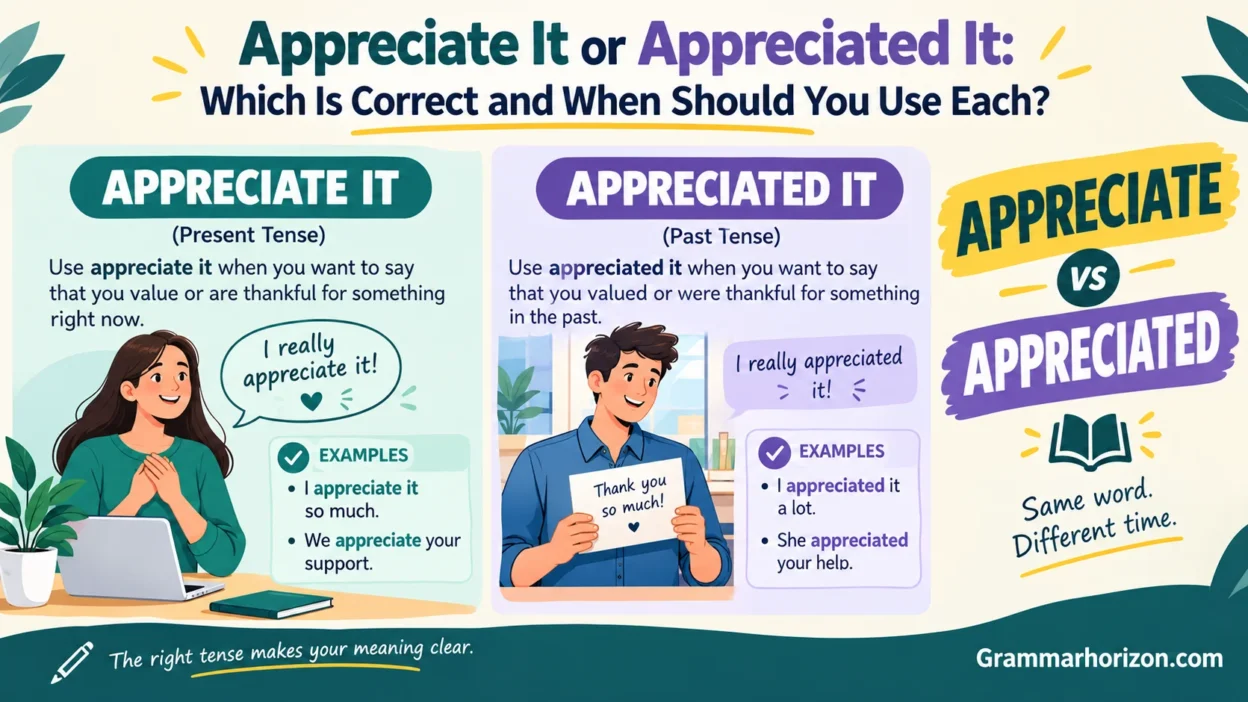
Appreciate It or Appreciated It can be confusing for English learners because both forms express gratitude, but they refer to different times and contexts. I appreciate it is the common phrase when you feel thankful now or want to respond to something immediately. For example, if someone helps you, sends useful information, or does you a favour, you can say, “I appreciate it.” This sounds natural, polite, and courteous in everyday conversation. I appreciated it, by contrast, describing gratitude for something that happened in the past. The difference may be tiny, but noticing the verb tense makes the decision easier.
The main verb gives you a simple clue when choosing between these phrases. Appreciate normally connects your gratitude with the present, while appreciated connects it with a past situation. I’d appreciate it is another useful expression and often appears when you politely ask for something. For example, “I’d appreciate it if you could send the report today” is a courteous request, rather than a thank-you for an action already completed. This distinction is important because the forms can look almost identical, yet their meanings shift according to time and context. Once you understand this point, you can use the right phrase without making your English sound awkward.
In my experience, the simplest way to learn these forms is to connect each one with the time of the action. When you use “I appreciate it,” you show that your gratitude is current; when you use “I appreciated it,” you refer to a completed experience in the past. Many learners struggle with how to choose because both expressions can sound similar in speech. However, this guide can help you ensure that your grammar stays clear. Most examples become easier when you look at the surrounding words and ask whether the action is happening now or belongs out in the past. These tips can help you place them correctly in a message, conversation, or other place where you want to express thanks.
Quick Answer: Appreciate It or Appreciated It?
“Appreciate it” and “appreciated it” are both grammatically correct. The right choice depends on when the gratitude applies.
- Appreciate it = you feel thankful now.
- Appreciated it = you felt thankful at a specific point in the past.
- I’d appreciate it = you’re politely asking for something.
- Much appreciated = a concise expression of thanks, often used in informal communication.
For example:
“Thanks for helping me with the report. I appreciate it.”
Here, the speaker is expressing gratitude in the present.
Now compare it with:
“You helped me finish the report last week. I really appreciated it.”
The second sentence looks back at a completed event and describes the speaker’s past gratitude.
The simplest rule
If you’re thanking someone right now, use “I appreciate it.”
If you’re talking about something you were thankful for in the past, use “I appreciated it.”
If you’re asking someone to do something, consider “I’d appreciate it if…”
That small distinction covers most everyday situations.
Comparison Overview
| Phrase | Verb tense | Main meaning | Common use | Example |
| I appreciate it | Present | I am thankful now | Immediate thanks | “Thanks for your help. I appreciate it.” |
| I appreciated it | Past | I was thankful then | Past situations | “I appreciated it when you helped me.” |
| I’d appreciate it | Conditional | I would be thankful | Polite requests | “I’d appreciate it if you could reply today.” |
| Much appreciated | Past participle/adjectival expression | Thank you | Short informal thanks | “Much appreciated!” |
The important point is that the completed action and the speaker’s gratitude don’t have to occur at exactly the same grammatical time.
Someone may have finished helping you five seconds ago, yet you can still say, “I appreciate it.” The action happened in the past, but your gratitude exists right now.
That distinction explains why “I appreciate it” sounds so natural after someone has just helped you.
Main Differences Between Appreciate It and Appreciated It
The main difference is that “appreciate it” expresses present gratitude, while “appreciated it” refers to gratitude felt in the past.
Present Gratitude vs. Past Gratitude
The biggest difference is verb tense.
Appreciate is the present-tense form of the verb. When you say, “I appreciate it,” you’re presenting your gratitude as something you feel now.
Appreciated is the simple past form. When you say, “I appreciated it,” you’re placing that feeling in a completely past situation.
Consider these two examples:
- “Thanks for covering my shift. I appreciate it.”
- “You covered my shift last Friday, and I appreciated it.”
The first sentence responds to the favor. The second sentence recalls it.
Neither sentence is inherently better. They simply tell the reader something different about time.
Immediate Thanks vs. Reflection
Another useful distinction involves the speaker’s perspective.
“I appreciate it” feels immediate. It works naturally when someone has just done something helpful.
“I appreciated it” feels reflective. It often appears when you look back at an event and describe how you felt about it.
For example:
“Thanks for waiting for me. I appreciate it.”
This sounds like a natural response at the moment.
Now imagine discussing that event several days later:
“You waited for me even though you were busy. I really appreciated it.”
The speaker isn’t thanking the person for the first time in the same immediate context. Instead, the speaker is describing a previous experience.
The Difference in One Timeline
You can picture the distinction like this:
Past event → “I appreciated it.” → Current situation → “I appreciate it.” → Possible future favor → “I’d appreciate it.”
Once you connect each phrase to its time frame, the grammar becomes much less confusing.
What Does “Appreciate It” Mean?
“Appreciate it” means you’re expressing gratitude for someone’s help, kindness, effort, or support in the present moment.
Grammar of “I Appreciate It”
The complete expression is:
I + appreciate + it
Each part has a job:
- I = subject
- appreciate = present-tense verb
- it = object referring to something already understood
The word “it” might refer to help, kindness, advice, support, patience, information, effort, or a favor.
For example:
“Thanks for explaining the problem. I appreciate it.”
Here, “it” refers to the person’s explanation or assistance.
You don’t need to repeat the entire idea because the context already makes the meaning clear.
Why People Say “Appreciate It” Without “I”
In casual English, speakers often drop the subject:
“Thanks for the ride. Appreciate it!”
The complete grammatical version is:
“Thanks for the ride. I appreciate it!”
The shorter version is common in everyday speech, texts, workplace chats, and informal messages. English frequently allows subjects to disappear in conversational expressions when the meaning remains obvious.
That doesn’t mean “Appreciate it” is appropriate in every setting. In a formal letter or carefully written business document, “I appreciate it” or “I appreciate your assistance” usually sounds more polished.
When to Use “Appreciate It”
Use “I appreciate it” when your gratitude is current or directly connected to the situation.
Common situations include:
- Someone helps you with a task.
- Someone gives you useful information.
- Someone offers practical assistance.
- Someone takes time to explain something.
- Someone accommodates your schedule.
- Someone completes a favor.
- Someone shows patience or kindness.
For example:
“Thanks for sending the file. I appreciate it.”
“I appreciate it. That explanation cleared things up.”
“Thanks for staying late. I really appreciate it.”
The phrase works because your appreciation remains relevant at the moment you speak.
What Does “Appreciated It” Mean?
“Appreciated it” means you’re expressing gratitude for something helpful, kind, or meaningful that happened in the past.
Grammar of “I Appreciated It”
“I appreciated it” uses the simple past form of appreciate.
It describes a feeling or reaction connected to an earlier situation.
For example:
“I appreciated it when you checked on me after the meeting.”
The checking happened in the past. The speaker is now describing the gratitude they felt because of that action.
Another example:
“I appreciated your advice during my first week at the company.”
This sentence looks back at a previous period.
When to Use “Appreciated It”
Use “I appreciated it” when you’re talking about a completed past situation.
It fits naturally when:
- You’re telling a story.
- You’re describing an earlier favor.
- You’re reflecting on someone’s kindness.
- You’re discussing a previous professional experience.
- You’re explaining how you felt during a past event.
For instance:
“When I was new to the team, you always answered my questions. I appreciated it.”
The phrase makes sense because the speaker is looking back at an earlier experience.
Is “Appreciate It” Correct When the Action Has Just Happened?
Absolutely.
This is one of the most important details in the appreciate it or appreciated it distinction.
A favor can be completed while your gratitude remains present.
Suppose a coworker sends you a document at 10:00 a.m. You receive it and respond immediately:
“Thanks for sending that. I appreciate it.”
The document was already sent. In that narrow sense, the action happened in the past. However, your appreciation is happening now.
Using “appreciated” would change the perspective:
“Thanks for sending that. I appreciated it.”
That sentence isn’t impossible, but without additional context it can sound unusual as an immediate response.
Why? The simple past makes the gratitude sound like something associated with a completed earlier situation.
This distinction is similar to saying:
- “I like what you did.” = my positive reaction exists now.
- “I liked what you did.” = I had that reaction in the past.
The same principle applies to appreciate.
Can You Say “Appreciate It” Before Someone Helps You?
Usually, you shouldn’t use “I appreciate it” for an action that hasn’t happened yet if you’re specifically trying to express present gratitude for that future action.
Instead, “I’d appreciate it” is often the better construction.
Compare:
“I appreciate it if you send me the report.”
This sounds unnatural in standard English when you’re making a future request.
A more natural version is:
“I’d appreciate it if you could send me the report.”
Here, “I’d appreciate it” means that you would be grateful if the person completed the requested action.
“I Appreciate It” or. “I’d Appreciate It”
These phrases have different jobs.
I appreciate it:
“Thanks for sending the report. I appreciate it.”
You’re expressing gratitude for something that has happened.
I’d appreciate it if…:
“I’d appreciate it if you could send the report by Friday.”
You’re politely asking for something.
That difference matters in professional communication because the wrong construction can make a request sound awkward or change its intended meaning.
“Appreciate It” or. “I’d Appreciate It”
“Appreciate it” expresses current gratitude, while “I’d appreciate it” usually introduces a polite request for something you’d like someone to do.
“I Appreciate It”
This phrase communicates current gratitude.
“Thanks for your patience. I appreciate it.”
The speaker is thankful now.
“I’d Appreciate It”
This phrase commonly introduces a polite request.
“I’d appreciate it if you could review this document.”
The speaker hasn’t necessarily received the favor yet. Instead, they’re explaining that they would be grateful if the person did it.
Why the Difference Matters
The two expressions differ by only one small word, yet the conversational purpose changes.
| Expression | Purpose | Example |
| I appreciate it | Thank someone | “Thanks for your help. I appreciate it.” |
| I’d appreciate it | Make a polite request | “I’d appreciate it if you could help.” |
Think of “I appreciate it” as looking backward toward something already received, while “I’d appreciate it” often points toward something you hope to receive.
Appreciate It or Appreciated It in Professional Communication
Professional settings make this distinction especially useful because tone matters.
Workplace Conversations
Suppose your coworker fixes a spreadsheet problem for you. A natural response is:
“Thanks for fixing that. I appreciate it.”
Now imagine you’re discussing the same event during a later conversation:
“You fixed that spreadsheet issue when I was under pressure. I really appreciated it.”
Both sentences work. The first responds to the help. The second reflects on it.
Professional Emails
In an email, “I appreciate it” can sound friendly and professional when the context is straightforward.
For example:
“Thanks for sending the updated figures. I appreciate it.”
For more formal communication, you can be more specific:
“I appreciate your assistance with the updated figures.”
The second version names exactly what you’re grateful for. That added precision can make professional writing feel more deliberate.
Customer Service and Business Messages
The same distinction applies when communicating with customers, vendors, clients, and service providers.
For immediate gratitude:
“Thank you for resolving the issue so quickly. I appreciate it.”
When referring to an earlier interaction:
“Your team handled the issue efficiently, and I appreciated the quick response.”
The tense should follow the time frame of the idea, not simply the time when the action itself occurred.
Common Mistakes With Appreciate It and Appreciated It
Common mistakes with “appreciate it” and “appreciated it” usually happen when writers confuse present gratitude with past gratitude or use the wrong tense for the situation.
Using “Appreciated It” for Immediate Thanks
One common mistake is using “appreciated it” simply because the other person’s action has finished.
For example:
“Thanks for helping me. Appreciated it.”
This may be understood, especially in casual speech, but “I appreciate it” is usually more natural as an immediate expression of thanks.
Better:
“Thanks for helping me. I appreciate it.”
The key is that the speaker is expressing gratitude now.
Using “Appreciate It” for a Clearly Past Situation
The opposite mistake happens when you’re describing an earlier experience.
Consider:
“When I started my first job, my manager gave me useful advice. I appreciate it.”
The final phrase can sound mismatched because the sentence has established a past context.
A more natural version is:
“When I started my first job, my manager gave me useful advice. I appreciated it.”
The past tense matches the historical context.
Confusing “Appreciate It” With “I’d Appreciate It”
This mistake can create an awkward request.
Instead of:
“I appreciate it if you could send the invoice.”
Use:
“I’d appreciate it if you could send the invoice.”
The conditional form makes the request sound natural and courteous.
Assuming One Form Is Always More Polite
Grammar and politeness aren’t the same thing.
“I appreciate it” isn’t automatically more polite than “I appreciated it.” Each expression has a different time reference.
Likewise, “I’d appreciate it” isn’t merely a fancier version of “I appreciate it.” It often serves a different communicative purpose.
Context does the heavy lifting.
Appreciate It or Appreciated It: Real-Life Examples
Real-life examples show how “appreciate it” fits immediate gratitude, while “appreciated it” works when you’re referring to something you were thankful for in the past.
Casual Conversation
Situation: A friend gives you a ride.
“Thanks for picking me up. I appreciate it.”
Situation: You’re talking about the same favor several days later.
“You picked me up when my car broke down. I really appreciated it.”
Text Messages
Short messages often favor the concise present form:
“Thanks! Appreciate it!”
“Got the files. Appreciate it.”
When discussing an earlier event:
“I really appreciated it when you checked on me yesterday.”
Workplace Communication
Immediate response:
“Thanks for handling that client call. I appreciate it.”
Past reflection:
“I appreciated your support during the project.”
Polite request:
“I’d appreciate it if you could review the proposal before noon.”
Formal Communication
In formal writing, the complete phrase often sounds more polished:
“I appreciate your assistance with this matter.”
For a past situation:
“I appreciated your assistance during the transition.”
This approach also removes ambiguity because “your assistance” tells the reader exactly what the speaker values.
Case Study: Choosing the Right Phrase in Context
Imagine three coworkers discussing a project.
Scenario One: Immediate Help
Maria sends David the spreadsheet he needs.
David replies:
“Thanks for sending this. I appreciate it.”
The gratitude is current. Appreciate is the natural choice.
Scenario Two: Looking Back
A month later, David discusses the project with another coworker.
“Maria sent me the spreadsheet when I was working against a deadline. I really appreciated it.”
Now he’s describing a past experience. Appreciated fits naturally.
Scenario Three: Making a Request
David needs another update from Maria.
“I’d appreciate it if you could send the revised figures by Thursday.”
The figures haven’t arrived yet. David is making a polite request, so “I’d appreciate it” works best.
These three situations demonstrate why context matters more than memorizing one supposedly “correct” phrase.
Quick Decision Guide: Which One Should You Use?
When you’re unsure, ask yourself one question:
What exactly am I trying to say about time?
Use “I Appreciate It” When:
- You’re thanking someone now.
- You just received help.
- You value someone’s current effort.
- You’re responding directly to a favor.
- You’re expressing present gratitude.
Example:
“Thanks for staying late. I appreciate it.”
Use “I Appreciated It” When:
- You’re describing past gratitude.
- You’re recalling a completed event.
- You’re reflecting on previous support.
- The surrounding story is clearly in the past.
Example:
“I appreciated your support during my first month.”
Use “I’d Appreciate It” When:
- You’re making a polite request.
- The action hasn’t happened yet.
- You’re describing what would make you grateful.
Example:
“I’d appreciate it if you could send the details tomorrow.”
Appreciate It or. Appreciated It: Alternatives and Similar Expressions
English gives you several ways to express gratitude. However, each option carries its own tone.
Alternatives to “I Appreciate It”
- Thanks.
- Thanks a lot.
- I really appreciate it.
- I’m grateful.
- Thank you for your help.
- Much appreciated.
Alternatives to “I Appreciated It”
- I was grateful for it.
- I was thankful for your help.
- I valued your support.
- Your help meant a lot to me.
- I was glad you helped.
These aren’t perfect substitutes in every situation.
For example, “Thanks” works as an immediate response, while “I valued your support” often sounds more reflective. Likewise, “Much appreciated” is concise and informal, whereas “I sincerely appreciate your assistance” carries a more formal tone.
Is “Much Appreciated” the Same as “I Appreciate It”?
Not exactly.
“Much appreciated” is a common shortened expression of thanks. You might see it in emails, messages, workplace chats, or casual requests.
For example:
“Please send the revised schedule when you have a chance. Much appreciated.”
It essentially means:
“Your help with this would be greatly appreciated.”
The phrase is widely understood, but it doesn’t function exactly like a complete sentence such as “I appreciate it.”
In very formal writing, a complete sentence may be clearer:
“Thank you. I greatly appreciate your assistance.”
Read Also:Here Is or Here Are: Which Is Correct? A Simple Grammar Guide
Conclusion
Choosing the correct English word or phrase becomes much easier when you understand its meaning, grammar, spelling, and context. Similar-looking or similar-sounding words can have different functions, so paying attention to how a word works in a sentence helps you avoid common mistakes. With regular practice and attention to context, you can use the correct form confidently in both formal writing and everyday conversation.
FAQs
Q1. Is it important to understand the difference between similar English words?
Yes. Understanding the difference helps you write clearly, speak accurately, and avoid common grammar or spelling mistakes.
Q2. Can similar words have different meanings?
Yes. Two words may look or sound similar but have completely different meanings and grammatical uses.
Q3. How can I remember the correct word?
Focus on the meaning and context rather than spelling alone. Creating a few example sentences can also make the difference easier to remember.
Q4. Are these mistakes common among English learners?
Yes. English has many words with similar spellings, sounds, or meanings, so confusion is common, especially for learners.
Q5. Should I use the same word in formal and informal English?
Not always. Some words or phrases work well in casual conversation but may sound less appropriate in formal or professional writing.
Q6. How can I improve my English word choice?
Read regularly, notice how words are used in real sentences, and practice writing your own examples. A good dictionary can also help you check meaning, pronunciation, and usage.
Q7. What is the best way to avoid grammar mistakes?
Learn the basic grammar rule, understand why it applies, and practice using it in different contexts. Regular reading and writing practice will make correct usage more natural over time.