Headed vs Heading can confuse writers because both forms come from the same verb, head, and relate to movement or direction. Heading usually describes an action that is happening or continuing, such as “I am heading home.” The word can also refer to a title at the top of an article or document, so its meaning depends on the context. Understanding this difference makes your writing clearer and more natural.
The grammatical usage of heading becomes easier when you consider tense and the intended meaning of the sentence. When someone says, “I am heading to work,” the sentence focuses on movement toward a particular place. Headed can also describe direction, as in “I am headed home,” but it often places more focus on the destination or direction. Although these forms may sometimes seem interchangeable, they can create slightly different meanings depending on the situation.
For writers, choosing between headed and heading requires attention to context, sentence structure, and natural English usage. Both forms can be correct, but understanding how each one works helps you avoid confusion and make your sentences clearer. In everyday communication and professional writing, this distinction allows English learners and native speakers to express movement and direction more confidently while keeping their writing natural and grammatically accurate.
Quick Answer: Headed vs Heading
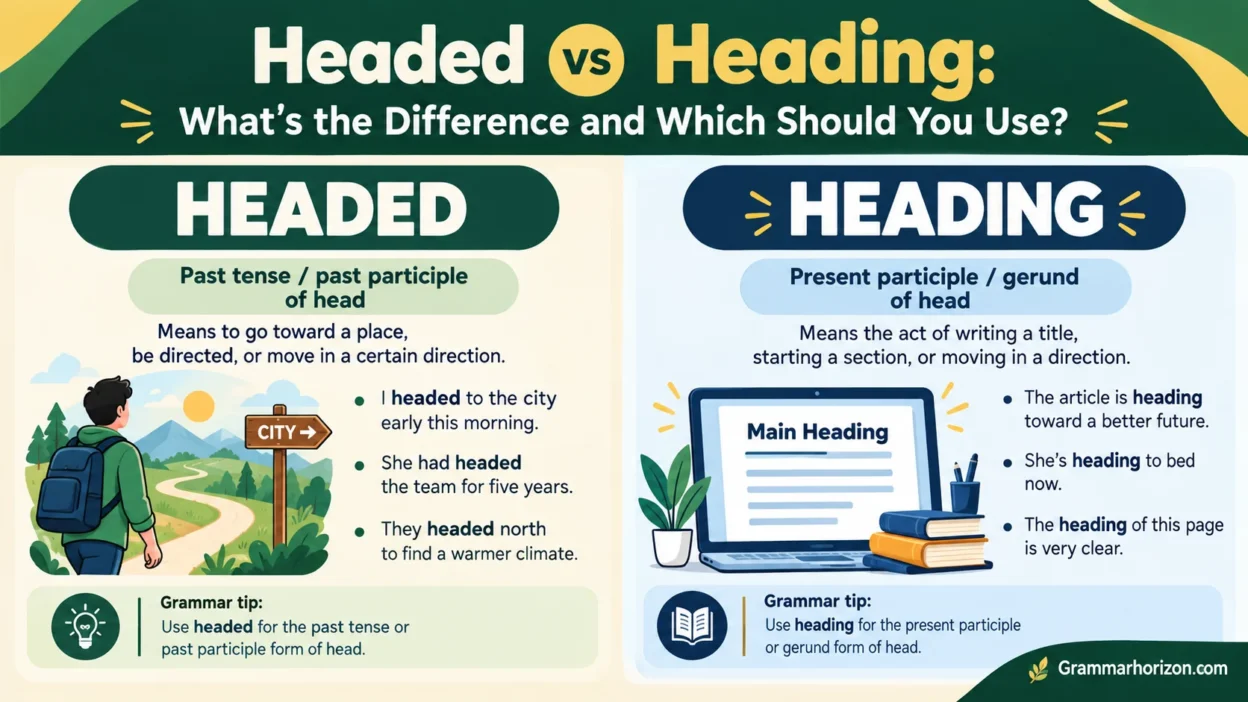
Headed is the past tense and past participle of head. It commonly describes movement toward a destination, being directed somewhere, or being led by someone.
Heading is the present participle of head and can describe an action in progress. It also works as a noun meaning a title or label that introduces a section of writing.
| Word | Main Function | Common Meaning | Example |
| Headed | Past tense/past participle | Went toward or was directed | “We headed home.” |
| Heading | Present participle | Going toward or directing | “We’re heading home.” |
| Heading | Noun | Title or section label | “Read the heading first.” |
The simplest distinction is this: headed usually describes something that happened or a resulting state, while heading often describes an action in progress. Heading also has a separate noun meaning related to written titles.
Comparison Overview: Headed vs Heading
The two words share the same root but perform different grammatical jobs.
Consider these examples:
- “They headed north.” → They went north.
- “They are heading north.” → They are currently going north.
- “The article has three headings.” → The article has three section titles.
- “The department is headed by Maria.” → Maria leads the department.
Notice how the meaning changes with the form and context.
In the first sentence, headed describes a completed movement. In the second, heading highlights the movement that is happening now. In the third, heading isn’t about movement at all. It means a title.
What Does “Headed” Mean?
Headed is the past tense and past participle of head, meaning to move toward a destination, go in a particular direction, or lead something or someone.
Headed as the Past Tense of “Head”
The most basic use of headed is as the simple past form of head.
When head means “move toward” or “go in a particular direction,” headed tells you that the action occurred in the past.
For example:
- “We headed home after dinner.”
- “She headed toward the station.”
- “The hikers headed south before sunrise.”
- “They headed back to the hotel.”
Here, headed tells you that the movement took place.
The word doesn’t necessarily mean the person reached the destination. “She headed toward the station” only tells you about her direction.
Headed as a Past Participle
Headed also functions as a past participle. You can see it after helping verbs or in constructions that describe a condition.
For example:
- “The company is headed by an experienced manager.”
- “The team has headed back to the hotel.”
- “The project is headed in the right direction.”
In “headed by,” the word means led by.
So if someone says, “The committee is headed by Dr. Smith,” Dr. Smith leads the committee.
Common Meanings of Headed
Depending on context, headed can express several related ideas:
- Movement: “We headed downtown.”
- Direction: “The plane was headed east.”
- Leadership: “She headed the department.”
- Likely outcome: “The company is headed for trouble.”
- Management: “The project is headed by a senior engineer.”
That last use shows why context matters. “Headed for success” doesn’t describe physical movement. It describes an expected result.
What Does “Heading” Mean?
Heading is the present participle of head and can mean moving toward a destination, directing something, or a title that introduces a section in a piece of writing.
Heading as the Present Participle of “Head”
Heading is formed by adding -ing to the verb head.
When it acts as a verb, it usually describes something happening now or around the present time.
Examples include:
- “I’m heading home.”
- “She’s heading to work.”
- “We’re heading downtown.”
- “The storm is heading toward the coast.”
The construction am/is/are + heading commonly expresses an action in progress.
Heading as a Noun in Writing
Here’s where heading takes on a completely different role.
In writing, a heading is a title or label placed above a section. It helps readers understand what information follows.
For example, an article might contain headings such as:
- Introduction
- Main Differences
- Common Mistakes
- Examples
- Frequently Asked Questions
A heading acts like a signpost. It tells readers what to expect before they read the paragraph underneath.
That’s why headings matter in articles, reports, essays, manuals, and other structured documents.
Heading in Documents and Web Content
A heading can organize information into logical sections. In digital writing, headings also make long pages easier to scan.
A well-structured article might move from a main title into major sections and then smaller subsections.
For example:
Main Topic
→ Major Section
→ Subsection
→ Specific Point
This structure helps readers find information without reading every sentence.
Main Differences Between Headed and Heading
The main difference between headed and heading is that “headed” usually refers to a past or established direction, while “heading” describes an ongoing action or a title in written content.
Difference in Verb Form
The biggest grammatical difference is simple:
Headed is the past tense and past participle of head.
Heading is the present participle and gerund form of head.
Compare:
- “Yesterday, we headed home.”
- “Today, we are heading home.”
The verb form changes because the grammatical context changes.
Difference in Time
Headed often points to an action that occurred in the past.
Heading often emphasizes an action currently happening.
However, don’t treat this as an absolute rule. English uses these forms in several constructions, and context can shift the exact meaning.
Difference in Grammatical Function
Headed mainly works as a verb form or participial adjective.
Heading can work as a verb, gerund, or noun.
For example:
- Verb: “They are heading west.”
- Gerund: “Heading home early saved us time.”
- Noun: “The heading explains the section.”
That flexibility makes heading more versatile than headed.
Difference in Meaning
The biggest semantic difference appears when heading means a written title.
“Heading” can mean a section title, while “headed” doesn’t carry that meaning.
So “Add a heading to the paragraph” means to add a title. It doesn’t mean to direct the paragraph somewhere.
Headed vs Heading When Talking About Direction
When talking about direction, “headed” usually describes a destination or direction already established, while “heading” emphasizes the action of moving toward that destination.
“Headed to” vs “Heading to”
Both expressions are common and grammatically correct.
“I am headed to the office” describes your direction or destination. It can sound like a statement about your current state or immediate plan.
“I am heading to the office” emphasizes the action of going there.
For example:
“I’m headed to the airport.”
This sounds like you’re on your way or have set your destination.
“I’m heading to the airport.”
This puts slightly more focus on the movement itself.
In everyday American English, both sound natural.
“Headed Home” vs “Heading Home”
These expressions also overlap.
“I’m headed home” commonly describes your current destination or direction.
“I’m heading home” emphasizes the act of leaving and going home.
Neither is automatically more correct.
“Headed Toward” vs “Heading Toward”
Both can describe direction.
- “The car headed toward the bridge.”
- “The car is heading toward the bridge.”
The first places the action in the past. The second presents it as ongoing.
Headed vs Heading in Different Contexts
Headed and heading can express movement, direction, leadership, or progress depending on the context, while “heading” can also mean a title or section label in writing.
Travel and Movement
Travel provides one of the clearest examples.
“The passengers headed toward the gate” describes a past movement.
“The passengers are heading toward the gate” describes movement currently underway.
Careers and Life Direction
English also uses these words figuratively.
You might hear:
- “She is headed for a promotion.”
- “He is heading toward a new career.”
- “The business is headed in the right direction.”
These expressions describe progress or an expected outcome rather than physical movement.
Weather and Natural Events
Weather reports frequently use heading to describe movement.
For example:
“The storm is heading toward the coast.”
This means meteorologists expect the storm to move in that direction.
After the movement occurred, you could say:
“The storm headed east overnight.”
Leadership and Management
Headed also has a strong connection with leadership.
Consider:
“The research team is headed by Dr. Lee.”
Here, headed by means led by.
You can also use head directly:
“Dr. Lee heads the research team.”
These constructions describe responsibility or leadership rather than physical direction.
Is “Headed” or “Heading” Correct?
Neither word is universally better. The correct choice depends on what you want to express.
When to Use “Headed”
Choose headed when you’re describing:
- A past movement
- A direction already established
- Something led by a person
- An expected destination or outcome
- A completed action involving head
Example:
“The students headed back to class.”
When to Use “Heading”
Choose heading when you’re describing:
- An action in progress
- Current movement
- Movement toward a goal
- Direction
- A title or section label
Example:
“The students are heading back to class.”
If you’re talking about writing, heading is the correct word for a section title.
Common Mistakes With Headed and Heading
Common mistakes with heading and heading often happen when writers confuse verb tense, ongoing actions, direction, or the noun “heading” used for a title.
Using “Heading” for a Completed Action
If you’re clearly describing a past action, headed may be the appropriate form.
Incorrect in a simple past context:
“Yesterday, we heading home early.”
Correct:
“Yesterday, we headed home early.”
Using “Headed” for an Ongoing Action
When the sentence uses a continuous structure, heading normally follows the helping verb.
Correct:
“We are heading home.”
The combination are + heading creates the present progressive form.
Confusing “Heading” With “Headed” in Documents
A heading is a title.
For example:
“Use a clear heading before each major section.”
You wouldn’t replace heading with headed because the two words don’t share the same grammatical function here.
Confusing “Headed to” With “Heading to”
These expressions sound similar because they describe similar situations.
Compare:
- “I’m headed to school.”
- “I’m heading to school.”
Both are standard English. The first focuses more on destination or state. The second focuses more on the action of going.
Headed vs Heading Example Sentences
| Context | Headed | Heading |
| Home | “We headed home.” | “We’re heading home.” |
| Work | “She headed to work early.” | “She’s heading to work.” |
| Direction | “The car headed north.” | “The car is heading north.” |
| Weather | “The storm headed east.” | “The storm is heading east.” |
| Leadership | “He headed the department.” | “He is heading the department.” |
| Writing | — | “Add a heading here.” |
Headed vs Heading in American English
In American English, both headed and heading are standard and widely used.
Americans commonly say:
- headed home
- heading home
- headed to work
- heading to work
- headed for trouble
- heading toward success
The important distinction isn’t usually American versus British English. It’s grammar and context.
If you’re unsure, identify what the sentence describes. Is it a past action, an ongoing action, leadership, direction, or a written title? That usually reveals the correct form immediately.
Headed vs Heading: Easy Ways to Remember the Difference
A simple memory trick can make the distinction stick.
Think of -ed as looking backward and -ing as showing movement in progress.
- Headed → past or established direction
- Heading → action in progress
- Heading → written title
For example:
Yesterday: “We headed home.”
Right now: “We are heading home.”
In an article: “The heading introduces the topic.”
One small spelling change can shift the grammar and sometimes the meaning.
Related Words: Head, Heads, Headed, and Heading
These forms all come from the head, but they serve different purposes.
| Form | Typical Function | Example |
| Head | Base verb/noun | “We will head home.” |
| Heads | Present-tense verb/plural noun | “She heads the team.” |
| Headed | Past tense/past participle | “They headed north.” |
| Heading | Present participle/gerund/noun | “We’re heading north.” |
Learning the entire word family makes headed vs heading meaning much easier to understand.
Conclusion
Understanding Headed vs Heading becomes easier when you focus on the context, meaning, and grammatical usage. Heading commonly describes ongoing movement or direction, while headed can describe a destination or direction. Choosing the correct form helps make your writing clearer, more natural, and grammatically accurate.
Read Also:It Worth It or It Is Worth It: Which One Is Correct?
FAQs
Q1. Is “headed” or “heading” correct?
Both headed and heading can be correct. The right choice depends on the context and the intended meaning.
Q2. What does “heading” mean?
Heading commonly means moving toward a particular place or direction, as in “I am heading home.”
Q3. What does “headed” mean?
Headed can describe someone or something moving toward a particular destination, such as “She is headed to work.”
Q4. Are “headed” and “heading” interchangeable?
They can sometimes be used in similar sentences, but they aren’t always completely interchangeable because they can emphasise different aspects of movement and direction.
Q5. Is “I am heading home” correct?
Yes. “I am heading home” is a natural and grammatically correct sentence that describes movement toward home.
Q6. Is “I am headed home” correct?
Yes. “I am headed home” is also correct and commonly used to indicate that someone is going toward home.
Q7. How can I remember the difference between headed and heading?
Remember that heading often emphasises an action or ongoing movement, while headed often emphasises the destination or direction.