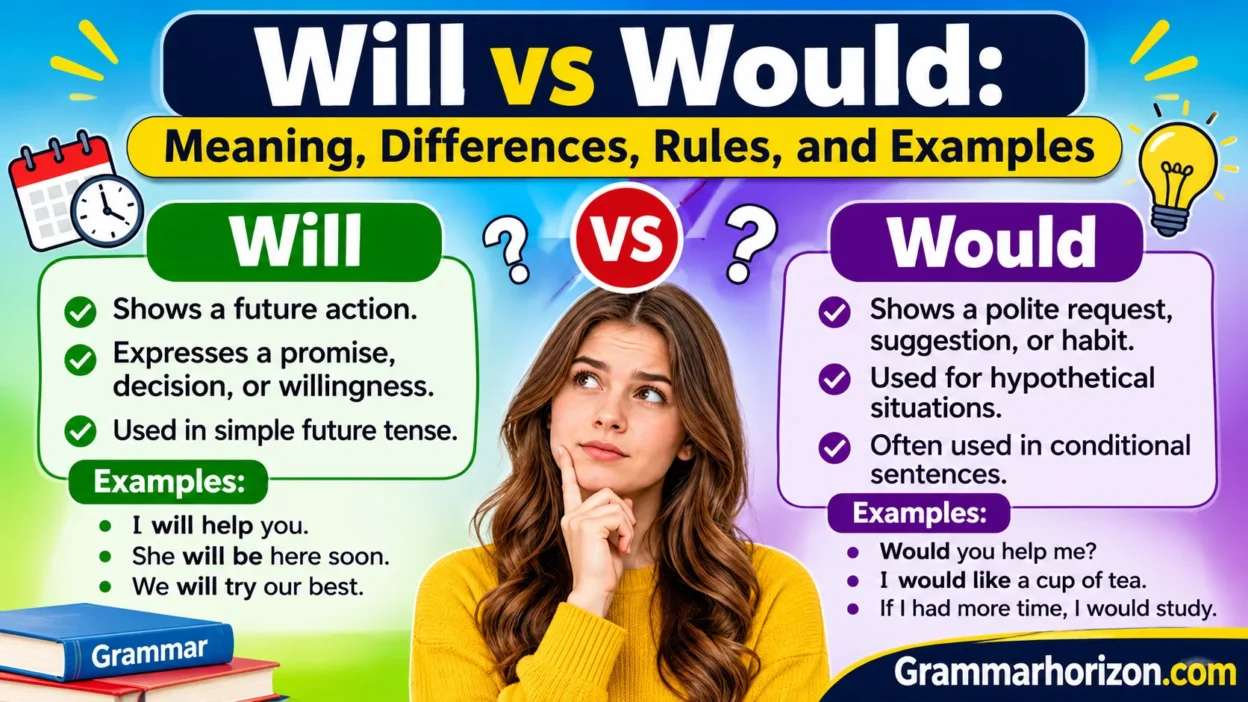
Will vs Would can be confusing, but understanding their differences helps you improve your English speaking and writing. Both are modal auxiliary verbs, also known as auxiliary verbs or modal verbs, but their meanings and uses depend on the situation. Will generally expresses future actions, intentions, promises, requests, decisions, predictions, and willingness. In contrast, would is commonly used for hypothetical situations, polite requests, preferences, and past habits. It can also describe future actions viewed from a past perspective, which makes the correct context important.
In everyday English grammar, both words follow specific grammar rules, and their definitions become easier to understand through practical examples. For instance, “I will help you with your project” expresses an action and shows making a promise. However, “I would help you if I had more time” describes a condition and a conditional action. The first sentence involves describing an action that someone intends to perform, while the second depends on something else. Even a small change in a sentence can affect its sentence meaning. Although these are closely related words, using one instead of the other can cause a change in meaning and affect correct usage.
Choosing the right verb forms improves communication and makes your English more natural. Will expresses future intention and future predictions, whereas would is useful for a hypothetical condition, polite language, and expressing preference. You can also use these words for expressing willingness, expressing possibility, and discussing past actions. In practical English, promises and commitments, requests and offers, and everyday expressions depend on context and word choice. Comparing real-life examples helps learners understand grammatical differences without simply memorizing rules. This approach makes modal auxiliary usage easier and supports more natural English and accurate communication.
Quick Answer: Will vs Would
Will is used to talk about future actions, predictions, promises, decisions, and willingness. Would is used for hypothetical situations, polite requests, preferences, repeated past actions, and future events viewed from a past perspective.
Here is a quick comparison:
| Will | Would |
| Expresses future intentions | Expresses hypothetical intentions |
| Makes promises | Describes conditional actions |
| Gives predictions | Discusses imagined outcomes |
| Shows willingness | Makes polite requests |
| Expresses spontaneous decisions | Describes repeated past actions |
| Example: I will call you tomorrow. | Example: I would call you if I had your number. |
Remember: Use will when talking about what you intend or expect to happen. Use would when discussing what could happen under certain conditions, making polite requests, or describing certain past situations.
What Does Will Mean?
Will is a modal auxiliary verb used to express future actions, decisions, promises, predictions, and willingness. It helps communicate what someone expects, intends, or agrees to do.
Unlike regular verbs, will does not change according to the subject. You use the same form with I, you, he, she, it, we, and they.
For example:
- I will finish my assignment tonight.
- She will visit her parents tomorrow.
- They will arrive before lunchtime.
- We will support your decision.
In each sentence, will connect the subject with an action that is expected or intended to happen.
Common Uses of Will
There are several situations in which you should use will. Understanding these uses makes it easier to choose the correct word.
To Talk About Future Actions
Use will when describing an action or event expected to happen in the future.
Examples:
- I will attend the meeting tomorrow.
- She will start her new job next Monday.
- They will travel to New York next summer.
- The store will open at 9 a.m.
These sentences describe future events rather than actions happening right now.
To Make Promises
Use will when promising to do something or assuring another person that you will take responsibility for an action.
Examples:
- I will never forget your kindness.
- We will help you complete the project.
- I will call you as soon as I arrive.
- She will keep your information private.
A promise often shows commitment and willingness. It tells someone that you intend to follow through with an action.
To Make Predictions
Use will when expressing what you think or expect will happen in the future. These predictions can be based on available information, personal judgment, or general knowledge.
Examples:
- I think it will rain this evening.
- The new business will become successful.
- Technology will continue to change our lives.
- He will probably pass the examination.
Notice that these statements express expectations. They don’t necessarily guarantee that the events will happen.
To Express Spontaneous Decisions
Will is commonly used when you make a decision while speaking rather than following a previously arranged plan.
Examples:
- The phone is ringing. I will answer it.
- I am tired. I will take a short break.
- We don’t have enough food. I will visit the supermarket.
- You look confused. I will explain the instructions again.
In these situations, the speaker decides what to do at that moment.
To Show Willingness or Offer Help
Use will to express readiness to help someone or perform an action.
Examples:
- I will carry your bags.
- She will help you with your homework.
- We will arrange transportation for the guests.
- I will show you how this machine works.
Will can also appear in negative sentences to express unwillingness or refusal.
For example:
- He won’t listen to my advice.
- The child won’t eat vegetables.
- My brother won’t share his computer.
Here, won’t communicate refusal or unwillingness rather than simply describing a future event.
What Does Would Mean?
Would is a modal auxiliary verb commonly used to express hypothetical situations, polite requests, preferences, conditional actions, and repeated activities in the past.
It is also frequently used as the past form of will in reported speech. However, would has several meanings that do not simply refer to past time.
For example:
- I would travel more if I had enough money.
- Would you please open the window?
- She said she would contact me later.
- My grandfather would tell us stories every evening.
Each sentence uses would for a different purpose. The first describes an imaginary situation, the second makes a polite request, the third reports a past statement, and the fourth describes a repeated past action.
Common Uses of Would
To Describe Hypothetical Situations
Use would when discussing an imagined situation or an action that depends on a condition.
Examples:
- I would buy that house if I had enough money.
- She would move abroad if she found a good job.
- We would visit you if we had more time.
- He would accept the offer if the salary were higher.
These sentences describe possibilities rather than definite plans. The action depends on something that may not be true or available.
To Make Polite Requests
Would make requests sound more polite, indirect, and considerate.
Examples:
- Would you help me with this assignment?
- Would you please close the door?
- Would you mind waiting for a few minutes?
- Would you explain this lesson again?
Compare these two sentences:
- Will you help me?
- Would you help me?
Both ask someone for help, but the second usually sounds more polite and less direct.
To Express Preferences
Would is commonly used in expressions such as would like, would prefer, and would rather.
Examples:
- I would like a cup of coffee.
- She would prefer to work from home.
- We would rather stay indoors today.
- Would you like to join us for dinner?
These expressions help communicate choices, wishes, and preferences.
To Describe Repeated Past Actions
Would can describe actions that happened regularly or repeatedly in the past.
Examples:
- My mother would read stories to me every night.
- We would visit our grandparents during summer vacations.
- My friends and I would play football after school.
- Every Sunday, my father would take us to the park.
These sentences describe repeated activities rather than one-time events.
However, would is not normally used for past states in this way.
For example:
- Correct: I used to live in a small village.
- Incorrect: I would live in a small village.
When describing a past state, such as living somewhere or knowing someone, used to is generally more suitable.
To Talk About the Future From a Past Perspective
Would can describe something that was expected to happen in the future from a point in the past. This use is called future in the past.
Examples:
- I knew she would become a successful teacher.
- He believed the company would grow quickly.
- They thought we would arrive early.
- She promised she would return soon.
The speaker is looking back at an earlier time and describing what someone expected to happen afterward.
To Express Willingness in the Past
Would can also describe whether someone was willing to do something in the past. Its negative form, wouldn’t, often communicates refusal.
Examples:
- My brother wouldn’t share his toys.
- The manager wouldn’t approve the request.
- The driver wouldn’t stop the vehicle.
- She wouldn’t accept any help.
In these examples, I wouldn’t describe someone’s unwillingness or refusal in a past situation.
Key Differences Between Will and Would
Although will and would are related, their meanings change depending on the situation. Understanding their differences will help you select the correct word when writing sentences.
Future Actions vs Hypothetical Situations
The most noticeable difference is that will commonly describes future actions, while would often describes imagined or conditional actions.
Examples:
- I will buy a new laptop next month.
- I would buy a new laptop if I had enough money.
The first sentence expresses an intention or expectation. The second describes something that depends on having enough money.
Certainty vs Conditional Possibility
Will often expresses a strong expectation about the future. Would commonly describes an outcome that depends on a particular situation.
Examples:
- She will become a great doctor.
- She would become a great doctor if she continued studying.
The first sentence communicates the speaker’s prediction. The second connects the expected result to a condition.
Remember that will does not always mean complete certainty. It can also express predictions that might not come true.
Direct vs Polite Requests
Both words can appear in requests, but would usually sound more polite and indirect.
Examples:
- Will you send me the document?
- Would you send me the document?
The first is a straightforward request. The second sounds more considerate, especially in professional conversations.
Present Decisions vs Past Viewpoints
Will can express a decision made in the present, while would can describe what someone expected or intended from a past viewpoint.
Examples:
- I will meet you after work.
- I thought I would meet you after work.
The first expresses a current intention. The second reports an earlier expectation.
General Willingness vs Conditional Willingness
Will expresses a person’s readiness to do something, while would can communicate willingness under particular circumstances.
Examples:
- I will help you with your work.
- I would help you if I had more time.
The first sentence offers direct help. The second makes the offer dependent on available time.
When to Use Will Instead of Would
Choose will when you want to communicate an intention, promise, prediction, or future action without presenting it as an imagined result.
Here are the main situations:
| Situation | Example |
| Future action | I will visit you tomorrow. |
| Promise | I will keep your secret. |
| Prediction | It will rain tonight. |
| Immediate decision | I will order some food. |
| Offer | I will help you carry the boxes. |
| Willingness | She will explain the problem. |
| Request | Will you open the window? |
Important: Will is also used in the main clause of first conditional sentences when discussing realistic future possibilities.
For example:
“If you study regularly, you will improve your English.”
The condition is presented as a possible future event, and will introduce its expected result.
When to Use Would Instead of Will
Choose would when discussing imaginary situations, polite requests, preferences, past habits, or future expectations viewed from an earlier time.
| Situation | Example |
| Hypothetical action | I would travel if I had enough money. |
| Polite request | Would you help me, please? |
| Preference | I would rather stay home. |
| Past habit | We would play outside every evening. |
| Reported speech | He said he would call me. |
| Future in the past | She knew they would arrive late. |
| Conditional result | I would accept the offer if it were suitable. |
Would is particularly useful when you want to sound polite or describe an outcome that depends on circumstances.
Will vs Would in Conditional Sentences
Conditional sentences explain what happens, might happen, or would happen when a particular condition is met.
Will and would have important roles in these sentences. The correct choice depends on whether the speaker describes a realistic possibility, an imaginary situation, or an unreal past event.
First Conditional: Will
The first conditional describes a possible future situation and its expected result.
Structure: If + present simple, will + base verb.
Examples:
- If it rains, we will stay indoors.
- If you work hard, you will achieve your goals.
- If she calls me, I will answer.
- If they arrive early, we will start the meeting.
These situations are possible in the future.
Second Conditional: Would
The second conditional describes an imaginary or unlikely present or future situation.
Structure: If + past simple, would + base verb.
Examples:
- If I had more money, I would buy a bigger house.
- If she knew the answer, she would tell us.
- If we lived near the beach, we would swim every day.
- If he studied harder, he would get better grades.
The speaker is imagining a situation rather than presenting it as a straightforward future plan.
Third Conditional: Would Have
The third conditional discusses an unreal past situation. It explains what could have happened if something had been different.
Structure: If + past perfect, would have + past participle.
Examples:
- If I had studied harder, I would have passed the examination.
- If she had left earlier, she would have caught the train.
- If they had invited me, I would have attended the party.
- If we had known about the problem, we would have helped.
These sentences describe past situations that cannot now be changed.
Comparison of Conditional Structures
| Conditional | Structure | Example |
| First | If + present, will + verb | If I study, I will pass. |
| Second | If + past, would + verb | If I studied, I would pass. |
| Third | If + past perfect, would have + past participle | If I had studied, I would have passed. |
A common mistake is placing would in the if-clause of a standard second conditional sentence.
- Incorrect: If I would have money, I would travel.
- Correct: If I had money, I would travel.
In standard conditional sentences, would normally appears in the result clause, not the ordinary if-clause.
Will vs Would in Reported Speech
Reported speech is used when you explain what someone said without repeating their exact words. In many situations, will changes to would when the reporting verb is in the past tense.
This happens because would can represent the past form of will in reported statements.
Changing Will to Would
Consider these examples:
Direct speech: Sarah said, “I will finish the assignment.”
Reported speech: Sarah said that she would finish the assignment.
Here are more examples:
| Direct Speech | Reported Speech |
| He said, “I will call you.” | He said he would call me. |
| She said, “I will help you.” | She said she would help me. |
| They said, “We will arrive early.” | They said they would arrive early. |
| John said, “I will buy a car.” | John said he would buy a car. |
The change from will to would is common when the reporting verb refers to the past.
However, it is not necessary in every situation. If the statement is still true or the speaker is reporting something without shifting the time perspective, the original tense may sometimes remain.
Future in the Past vs Ordinary Future
These two forms can look similar but communicate different time perspectives.
- Future: I will meet you tomorrow.
- Future in the past: I knew I would meet you the next day.
The first sentence expresses a current future intention. The second describes an expectation that existed in the past.
Will vs Would in Questions and Negative Sentences
Will and would follow similar grammatical patterns when forming questions and negative sentences. However, their meanings and levels of politeness can differ.
Questions With Will
Use will before the subject to ask about future actions, willingness, or decisions.
Structure: Will + subject + base verb + …?
Examples:
- Will you attend the meeting tomorrow?
- Will she visit us next weekend?
- Will they finish the project on time?
- Will you help me with this work?
- Will he bring the documents?
These questions can ask about future events or someone’s willingness to perform an action.
Questions With Would
Would is often used to make polite requests, ask about preferences, or discuss imaginary situations.
Structure: Would + subject + base verb + …?
Examples:
- Would you help me with this problem?
- Would she accept the invitation?
- Would you like a cup of tea?
- Would they travel abroad if they had enough money?
- Would you mind closing the door?
Would you mind is a particularly common expression in polite English.
Notice that it takes a verb ending in -ing:
- Correct: Would you mind helping me?
- Incorrect: Would you mind helping me?
Negative Forms: Will Not and Would Not
The negative form of will is will not, commonly shortened to won’t.
The negative form of would is would not, commonly shortened to wouldn’t.
Examples with will not:
- I will not forget your birthday.
- She won’t attend the meeting.
- They will not accept the proposal.
- The car won’t start.
Examples with would not:
- I wouldn’t make that decision.
- He wouldn’t help me with the assignment.
- She would not accept the offer.
- They wouldn’t travel without proper arrangements.
The difference depends on the context. Won’t can express a future refusal, while wouldn’t can describe hypothetical refusal or unwillingness in the past.
Will vs Would: Sentence Structure and Grammar Rules
Both will and would are modal auxiliary verbs. They follow similar grammatical rules and do not change according to the subject.
Learning their sentence structures will help you avoid common mistakes.
Affirmative Sentence Structure
Use this structure to make positive statements:
Subject + will/would + base form of the verb.
Examples:
- I will complete the task.
- She will attend the conference.
- They would enjoy the trip.
- He would accept the invitation.
Always use the base form of the main verb after will and would.
For example:
- Correct: She will work tomorrow.
- Incorrect: She will work tomorrow.
- Correct: He would visit us.
- Incorrect: He would visit us.
Negative Sentence Structure
To make a negative statement, place not after will or would.
Subject + will/would + not + base verb.
Examples:
- I will not leave early.
- She will not attend the event.
- He would not accept the offer.
- They would not agree with the decision.
You can use won’t and wouldn’t in everyday conversations and informal writing.
Question Sentence Structure
To form a question, place will or would before the subject.
Will/Would + subject + base verb + …?
Examples:
- Will you join us?
- Will she complete the assignment?
- Would you help me?
- Would they accept the invitation?
You don’t need do, does, or did to form questions with these modal verbs.
Why Does the Base Form Follow Will and Would?
Modal auxiliary verbs are followed by the base form of the main verb, not its past or third-person singular form.
For example:
- Correct: I will go.
- Incorrect: I will go.
- Correct: She would study.
- Incorrect: She would study.
- Correct: They would leave.
- Incorrect: They would leave.
Also, will and would remain unchanged with third-person singular subjects.
You say “He will work” rather than “He wills work.” Similarly, you say “She would agree” rather than “She woulds agree.”
These rules apply regardless of whether the subject is singular or plural.
Common Mistakes to Avoid When Using Will vs Would
English learners sometimes use will and would interchangeably because both words can refer to future actions. However, choosing the wrong modal verb can change the meaning of a sentence.
Here are some common mistakes and their corrections.
| Incorrect Sentence | Correct Sentence | Explanation |
| I will go tomorrow. (when expressing a definite intention) | I will go tomorrow. | Use will for a straightforward future intention. |
| If I had money, I would travel. | If I had money, I would travel. | Use the past simple in a standard second conditional. |
| She would go to school. | She would go to school. | Would take the base form. |
| He will help me. | He will help me. | Will takes the base form. |
| Would you mind helping me? | Would you mind helping me? | Would you mind is followed by an -ing form. |
| He said he will call me. (with ordinary past-tense backshift) | He said he would call me. | Would commonly replace will in reported speech. |
| I will buy it if I have enough money. | I would buy it if I had enough money. | Would express the hypothetical result. |
| She would live here when she was young. | She used to live here when she was young. | Used to is better for a past state. |
Confusing Would With Would Have
Another common mistake is using would have incorrectly.
Would have is used to describe an unreal or imagined past result.
For example:
- Correct: I would have helped you if I had known.
- Incorrect: I would have helped you if I had known.
The correct structure is:
Would have + past participle.
Examples:
- She would have passed the test.
- They would have arrived earlier.
- We would have accepted the invitation.
Confusing Would With Would Of
Some people write “would of” because it sounds similar to the contraction “would’ve.”
However, would have is the correct grammatical form.
Examples:
- Correct: I would have visited you.
- Incorrect: I would of visited you.
The same rule applies to could have and should have.
Conclusion
Understanding the difference between will vs would helps you communicate more clearly and use English grammar correctly. Will is mainly used for future actions, decisions, promises, predictions, and willingness, while would is useful for hypothetical situations, polite requests, preferences, and past habits. Although these modal verbs are closely related, they cannot always replace each other. Pay attention to the sentence’s meaning, context, and intended message when choosing between them. With regular practice and real-life examples, you can use both words naturally and confidently.
Frequently Asked Questions
Q1. What is the main difference between will and would?
Will generally expresses future actions, decisions, promises, and predictions. Would is commonly used for hypothetical situations, polite requests, preferences, and past habits.
Q2. Is would the past tense of will?
Yes. Would is traditionally considered the past form of will in reported speech and certain grammatical structures. However, it also has other uses, such as expressing politeness and hypothetical situations.
Q3. When should I use will in a sentence?
Use will when talking about future plans, decisions, promises, predictions, or willingness.
Example: I will call you tomorrow.
Q4. When should I use would instead of will?
Use would for hypothetical situations, polite requests, preferences, and actions that depend on certain conditions.
Example: I would travel more if I had enough money.
Q5. Can I use will and would interchangeably?
No. Although both are modal auxiliary verbs, they express different meanings. Using the wrong word can change the meaning, tone, or intention of your sentence.