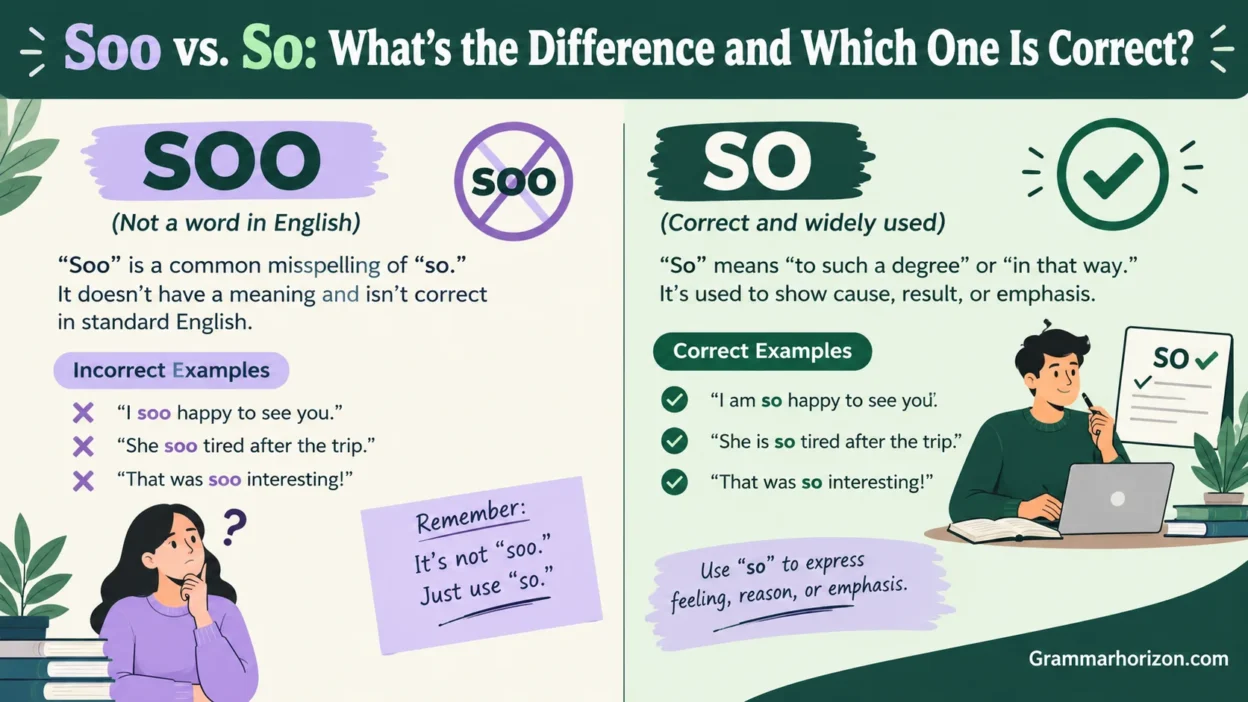
In English, Soo vs. So shows how a small spelling change can create a different tone, even when the basic meaning stays the same. So is the standard and correct form used in everyday communication, formal writing, and academic contexts. It can work as an adverb, conjunction, or part of common expressions. For example, you can write, I’m so excited, She was so tired, or It was so interesting. Soo, however, isn’t considered a standard English spelling when it is used as an extended version of so. English learners may notice soo in informal messages and wonder whether it is a spelling mistake or a different word. In most casual situations, it is simply a playful variation created to represent the way someone might stretch a sound while speaking.
The use of soo, sooo, and other extended spellings has grown alongside the digital world, social media, texting, memes, tweets, DMs, and online conversations. People often use these forms to communicate more than the literal meaning of a word. For example, I’m sooo happy can suggest stronger emotion, excitement, humor, or emphasis than the ordinary spelling. The extra o visually represents a longer sound, almost as if the writer is stretching the word while speaking. This makes the message feel more expressive, playful, or emotional. In casual communication, such spelling choices can also help people create a particular vibe and connect naturally with friends or online audiences. Because digital communication often lacks facial expressions and vocal tone, writers sometimes change spelling to make their intended feeling easier to understand.
Even though soo can work naturally in casual settings, you should normally use so in formal writing. Emails, reports, essays, academic writing, applications, and other professional or educational documents require standard spelling and established grammar conventions. Writing I am so pleased with the results is appropriate in a formal context, while I’m sooo pleased! can sound much more casual and emotional. Soo may also appear as a typo, proper noun, or specialized term in certain contexts, so its meaning depends on the specific occurrence. Still, when you want the ordinary English word that expresses degree, emphasis, or result, so is the reliable choice. Knowing this distinction allows you to communicate clearly while still understanding how modern language, internet culture, and informal writing continue to evolve.
Quick Answer: Soo vs. So
So is the standard English spelling. It can function as an adverb, conjunction, discourse marker, and part of several common expressions.
Soo is usually an informal spelling used to exaggerate emotion or emphasis. For example, “I’m soo happy!” visually stretches the word to suggest that the speaker feels very happy.
Here’s the simplest rule:
Use “so” in standard English. Use “soo” only when you intentionally want an informal, exaggerated tone.
For example:
- Standard: “That movie was so good.”
- Informal: “That movie was soo good!”
- More exaggerated: “That movie was sooo good!”
The extra o doesn’t create a new grammatical form. Instead, it changes the tone.
Soo vs. So: Comparison Overview
| Feature | So | Soo |
| Standard English spelling | Yes | No, when intended as so |
| Common in formal writing | Yes | No |
| Used in texting | Yes | Yes |
| Expresses exaggeration | Sometimes | Usually |
| Has standard grammatical functions | Yes | No, when used as an elongated so |
| Suitable for academic writing | Yes | No |
| Suitable for playful social media writing | Yes | Yes |
| Can have other legitimate meanings | Yes | Yes, in specialized uses |
The important distinction is function. “So” is an established English word with grammatical jobs to perform. Informal “soo” normally doesn’t replace those grammatical functions. It simply gives the reader a visual cue that the writer is stretching the sound.
What Does “So” Mean?
The word so is remarkably versatile. Although it looks simple, it can perform several different grammatical roles depending on the sentence.
“So” as an Adverb
One of the most common uses of so is to modify an adjective or adverb and show degree.
Consider these examples:
- “The coffee is so hot.”
- “She runs so quickly.”
- “That restaurant is so popular.”
- “The baby was so sleepy.”
Here, so intensifies another word. It tells you that something reaches a high degree.
For instance, “The coffee is hot” gives you a basic fact. “The coffee is so hot” adds stronger emphasis.
“So” as a Conjunction
So can also connect an action or situation with its result.
For example:
- “It was raining, so we stayed home.”
- “He studied hard, so he passed the exam.”
- “The store was closed, so we came back later.”
In these sentences, so means something close to therefore or as a result.
This is a completely grammatical function. Replacing it with “soo” would look like an informal spelling error rather than a normal grammatical choice.
“So” as a Discourse Marker
In conversation, so often helps introduce a new point or move a discussion forward.
You might hear:
- “So, what happened?”
- “So, where should we start?”
- “So, that’s the problem.”
- “So, what do you think?”
Here, so doesn’t simply describe degree or connect cause and result. It helps organize spoken conversation.
“So” for Emphasis
You can also use so to add emotional force.
For example:
“I’m so glad you came.”
The word emphasizes the speaker’s emotional reaction. However, standard spelling still uses one o.
What Does “Soo” Mean?
When people write soo instead of so, they usually aren’t introducing a new grammatical word. They’re changing the spelling to create a particular effect.
For example:
“I’m soo tired.”
The writer probably means:
“I’m so tired.”
The extra o suggests that the writer would pronounce the word with greater length or emphasis.
This practice is especially common online because written communication lacks the facial expressions, vocal tone, and gestures found in face-to-face conversation.
Why Do People Write “Soo”?
Imagine someone saying:
“I’m sooooo excited!”
When spoken aloud, the vowel may last noticeably longer than usual. Writing “sooooo” recreates that stretched sound visually.
Digital communication has made this technique extremely common. People use repeated letters to communicate emotions that would otherwise disappear in plain text.
Examples include:
- “Nooooo!”
- “Yessss!”
- “Sooo cute!”
- “Pleeeease!”
- “I’m sooo tired!”
These spellings aren’t normally mistakes in a casual conversation. They’re deliberate stylistic devices.
“Soo” vs. “Sooo”: Does the Number of O’s Matter?
Not grammatically.
You might see:
- soo
- sooo
- soooo
- sooooo
The number of extra letters generally signals the level of exaggeration.
Compare:
“That’s soo cute!”
with:
“That’s sooooo cute!”
The second version feels more dramatic. The underlying word hasn’t changed, though.
This is similar to stretching a sound in speech. The spelling simply gives the reader a rough impression of the speaker’s tone.
Main Differences Between Soo and So
Understanding soo vs. so becomes much easier when you separate spelling, grammar, meaning, and tone.
Grammar
So has established grammatical functions. It can modify words, connect clauses, introduce ideas, and appear in many fixed expressions.
Informal soo doesn’t normally have those independent grammatical functions when it simply means an exaggerated so.
Meaning
The standard word can express degree, consequence, manner, or conversational transition.
Informal soo usually keeps the same basic meaning as so. The difference lies primarily in emphasis and tone.
For example:
- “She is so beautiful.” — standard emphasis
- “She is soo beautiful!” — exaggerated, informal emphasis
The factual meaning remains similar.
Tone
This is where the difference becomes most noticeable.
So is neutral and flexible. You can use it in a casual conversation, a professional email, or an academic paper.
Soo feels more emotional, playful, dramatic, or conversational.
That’s why “I’m soo excited!” sounds like a text message, while “I’m so excited” works almost anywhere.
Spelling
There is only one standard spelling for the ordinary English word:
so
Adding letters changes the visual presentation rather than creating a standard grammatical alternative.
When Should You Use “So”?
The answer is simple: use “so” whenever you’re writing standard English.
That includes most situations where correctness, clarity, or professionalism matters.
Use “So” in Formal Writing
Choose so in:
- Academic essays
- Research papers
- Business emails
- Cover letters
- Resumes
- Reports
- Applications
- Professional websites
- Official documents
For example:
Correct: “The results were so significant that researchers conducted another analysis.”
Writing “soo significant” would make the sentence look informal and potentially careless.
Use “So” in Everyday Conversation
You don’t need “soo” to sound expressive. Standard so already works naturally in ordinary conversation.
For example:
“That was so funny.”
“I’m so hungry.”
“You’re so kind.”
The surrounding sentence, punctuation, and context can communicate plenty of emotion.
Use “So” When You Need Standard Grammar
Whenever you’re unsure, choose so.
It’s the safer option because it works in both formal and informal contexts. Soo, on the other hand, is limited by tone and context.
When Is “Soo” Acceptable?
Although soo isn’t the standard spelling of the ordinary word so, it can be acceptable in specific informal situations.
Text Messages
Friends may write:
“I’m soo ready for the weekend!”
The goal isn’t formal correctness. The writer wants the message to sound enthusiastic.
Social Media
Social platforms encourage expressive language. A caption such as:
“This puppy is sooo adorable!”
fits a casual, playful environment.
The same wording would look out of place in a formal report.
Playful or Creative Writing
Writers sometimes manipulate spelling to represent a character’s voice.
For example:
“Pleeease let me come with you!”
The unusual spelling communicates emotion. It can make dialogue feel more like natural speech.
When “Soo” Should Be Avoided
Avoid informal soo when you’re expected to follow standard written English.
That includes:
- College assignments
- Job applications
- Business proposals
- Professional emails
- Research papers
- Formal reports
- Government or legal documents
In these settings, expressive spelling can distract readers from your actual message.
Soo vs. So in Example Sentences
Examples make the distinction much clearer.
Correct Standard Examples With “So”
- “I’m so happy to see you.”
- “The test was so difficult.”
- “She was tired, so she went home.”
- “He speaks so clearly.”
- “So, what are we doing tomorrow?”
Each sentence uses the established English word so.
Informal Examples With “Soo”
- “I’m soo happy right now!”
- “That cake looks soo good.”
- “You’re soo funny!”
- “I missed you soo much!”
- “This is sooo exciting!”
These examples deliberately stretch the word for emotional effect.
Formal vs. Informal Comparison
| Informal version | Standard version |
| “I’m soo tired.” | “I’m so tired.” |
| “That’s soo funny.” | “That’s so funny.” |
| “Thank you soo much.” | “Thank you so much.” |
| “She’s sooo excited.” | “She’s so excited.” |
| “This is soo important.” | “This is so important.” |
The standard versions aren’t less expressive. They’re simply conventional.
Is “Soo” a Real English Word?
This question needs a more careful answer than a simple yes or no.
When soo appears as an elongated spelling of so, it isn’t the standard English form. However, Soo can appear as a legitimate name or specialized term in other contexts.
For example, Soo is associated with Sault Ste. Marie, a place name commonly shortened to “Soo.” The term therefore can have a meaning unrelated to the informal spelling used in texting.
That distinction matters.
If someone writes:
“I’m soo excited!”
the word is almost certainly an informal spelling of so.
If someone writes:
“She lives in the Soo.”
The capitalized Soo may refer to a place rather than exaggerated emotion.
Context determines the meaning.
Is “Soo” Correct in Texting?
Yes, it can be acceptable in texting when you’re intentionally using an informal style.
Text messages don’t always follow formal writing conventions. People routinely use abbreviations, emojis, repeated letters, lowercase spellings, and expressive punctuation.
For example:
“I’m sooo happy you came!!!”
The extra letters and punctuation create an enthusiastic voice.
However, acceptable in texting doesn’t mean standard in formal English. Those are two different ideas.
A useful comparison is the difference between spoken slang and formal writing. Something can sound perfectly natural between friends while remaining inappropriate in a business report.
Common Mistakes With Soo and So
The most common mistake is using “soo” instead of “so” in formal writing, where “so” is the correct standard spelling.
Writing “Soo” in Formal Documents
The most common mistake occurs when someone carries texting habits into professional writing.
Instead of:
“The results were soo impressive.”
write:
“The results were so impressive.”
The second version follows standard spelling.
Confusing Emphasis With Standard Spelling
Another mistake is assuming that because people commonly write soo, it must be an alternative dictionary spelling of so.
Usually, it isn’t.
The additional letter signals style, not a different grammatical form.
Assuming “Soo” Always Means “So”
Context matters. Soo can appear in proper names and specialized contexts.
Therefore, don’t automatically “correct” every instance of Soo without considering what the writer means.
Using “Sooo” When Standard English Is Expected
Repeated letters are useful for creative expression, but they can weaken a formal sentence.
For example:
“We are sooo pleased with the results.”
works as a playful social media caption.
In a business report, use:
“We are so pleased with the results.”
Soo vs. So in Professional and Academic Writing
Professional writing depends heavily on consistency and conventional spelling. Readers shouldn’t have to interpret whether an unusual spelling was intentional.
Consider this example:
“The company was so successful that it expanded internationally.”
The sentence sounds conversational and enthusiastic. It might work in marketing copy aimed at a youthful audience.
Now compare:
“The company was so successful that it expanded internationally.”
This version is neutral and professional.
Neither sentence changes the underlying fact. The difference lies in register, meaning the level of formality appropriate for a particular situation.
Case Study: A College Essay
Imagine a student writing:
“The experiment was soo important because it changed how scientists understood the problem.”
The argument may be perfectly reasonable. The spelling, however, makes the sentence look casual.
Changing it to:
“The experiment was so important because it changed how scientists understood the problem.”
immediately gives the sentence a more polished academic tone.
The lesson is straightforward: formal writing needs standard spelling even when the meaning remains unchanged.
How to Remember the Difference Between Soo and So
You don’t need a complicated grammar trick.
Remember these three rules:
- So = standard English.
- Soo = usually an informal, stretched version of “so.”
- Sooo = even more exaggerated and informal.
Conclusion
So is the standard and correct English spelling, while soo is mainly an informal, playful variation used in texting, social media, and casual online communication. The extra o can express emotion, excitement, emphasis, or a stretched pronunciation, but it doesn’t make soo appropriate for formal writing. For emails, essays, reports, applications, and academic writing, stick with so. Understanding the difference helps you choose the right form based on your context, audience, and writing style.
Read More:Is It Anual or Annual? Which Is Correct? Complete Guide to the Correct Spelling
FAQs
Q1. Is so or soo correct?
So is the standard and grammatically accepted spelling. Soo is generally an informal or playful variation rather than standard English.
Q2. Is soo a real English word?
Soo can appear as a proper noun or specialized term, but when people use it as an extended form of so, it isn’t standard English spelling.
Q3. Why do people write soo instead of so?
People often write soo to show extra emphasis, excitement, emotion, or a stretched pronunciation, especially in texting and social media.
Q4. Is sooo grammatically correct?
Sooo isn’t standard spelling. It’s an intentional informal variation used to create emphasis or express stronger emotion.
Q5. Can I use soo in formal writing?
It’s best to avoid soo in formal emails, academic writing, essays, reports, and applications. Use the standard form instead.
Q6. Does soo have a different meaning from so?
Usually, soo doesn’t have a separate meaning when used online as an extended spelling. It generally adds tone or emphasis to the ordinary word.