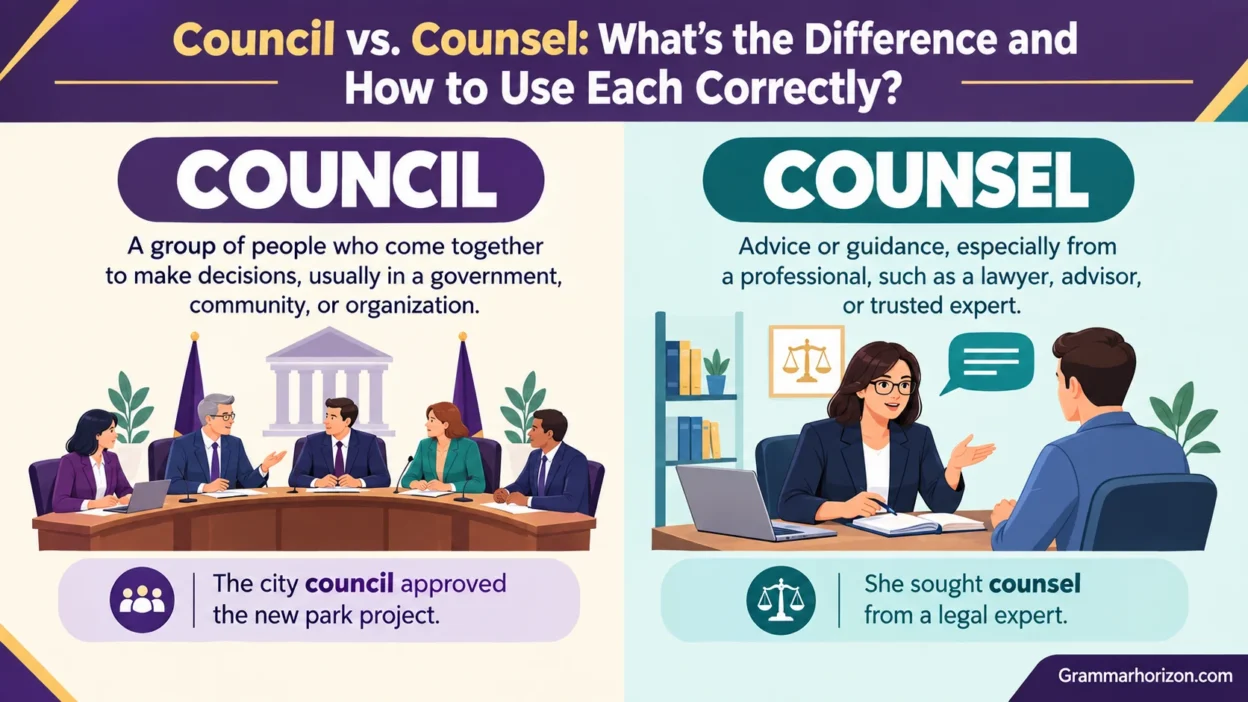
Council vs. Counsel can be easier to understand when you focus on their roles rather than their similar sound. Council refers to a group of people who meet, discuss issues, govern, and make decisions, while counsel refers to advice, guidance, or a lawyer who advises someone. This small spelling difference can cause common mistakes, especially for English learners and writers who hear these homophones in speech before seeing them on a page.
A city council, for example, may pass a local ordinance for a city, while legal counsel may advise whether that ordinance is legal. This example helps connect the words with their different meanings, uses, and grammatical purposes. Although their pronunciation is almost identical, their spelling and meaning are different. Council has a decision-making or government role, whereas counsel involves advice, guidance, or the act of advising. Keeping this distinction in mind makes the words easier to separate and helps you avoid mixing them up.
This distinction is especially useful in professional writing, academic work, legal documents, and everyday communication. When you hear either word, look at the surrounding context and ask what the word is doing in the same sentence. If it describes people who meet to discuss matters and make decisions, choose council. If it describes advice, guidance, or a lawyer, choose counsel. Understanding this simple distinction improves clear communication, strengthens writing, and helps you use these classic English words correctly.
Quick Answer: Council vs. Counsel
The simplest way to remember the difference is this:
- Council = a group, committee, or governing body.
- Counsel = advice, guidance, a lawyer, or the act of advising.
- Counsel can work as both a noun and a verb.
- Council normally functions as a noun.
Here are a few quick examples:
The city council approved the proposal.
Here, council means a governing group.
She sought counsel from her attorney.
Here, counsel means advice or guidance.
The attorney counseled his client before the hearing.
Here, counseled is a verb meaning advised.
A useful shortcut is: Council is a group. Counsel is guidance.
Council vs. Counsel: Comparison Overview
| Word | Part of Speech | Main Meaning | Example |
| Council | Noun | An organized group or governing body | The city council met Tuesday. |
| Counsel | Noun | Advice, guidance, or a lawyer | She sought legal counsel. |
| Counsel | Verb | To advise or guide | The therapist counseled the student. |
Both council and counsel are pronounced alike in standard American English. This makes them homophones: words that sound the same but have different spellings and meanings.
That pronunciation explains why people frequently confuse them. When you hear someone say “counsel,” you can’t tell from sound alone whether the speaker means counsel or council. Writing requires you to choose the spelling based on context.
Main Differences Between Council and Counsel
The main differences between council and counsel are based on their meanings: council refers to a group of people who make decisions, while counsel refers to advice, guidance, a lawyer, or the act of advising someone.
Council Refers to a Group
Council describes an organized group of people who come together for a specific purpose. That purpose might involve governing, advising, discussing policies, or making decisions.
You’ll often see council in government and organizational settings.
Common examples include:
- city council
- town council
- student council
- school council
- advisory council
- executive council
- security council
- council meeting
- council member
Consider this sentence:
The city council voted to approve the new zoning plan.
The word council refers to the group of officials who participated in the decision. It doesn’t refer to the advice they gave or to an individual lawyer.
Counsel Refers to Advice or Guidance
Counsel has a broader range of meanings. As a noun, it can refer to advice, guidance, or a recommendation, particularly advice given by someone with knowledge or experience.
For example:
She asked her parents for counsel before accepting the job.
Here, counsel means advice.
You may encounter this use in formal, professional, literary, or serious contexts. In casual conversation, people often use advice instead.
For example:
- He sought counsel from his mentor.
- Her counsel helped him make a better decision.
- The manager valued the consultant’s counsel.
- They ignored the expert’s counsel.
The word often carries a sense of thoughtful or considered guidance rather than a quick suggestion.
Counsel Can Mean a Lawyer
In legal English, counsel has another important meaning: a lawyer or legal adviser.
You may see phrases such as:
- legal counsel
- defense counsel
- counsel for the plaintiff
- counsel for the defense
- general counsel
- outside counsel
For example:
The company consulted its legal counsel before signing the agreement.
Here, counsel refers to the lawyer or legal advisers.
This meaning creates one of the most common mistakes involving these words: legal counsel versus legal council.
The standard phrase is legal counsel when you’re talking about legal advice or a lawyer.
Counsel Works as a Verb
Unlike council, counsel can function as a verb.
To counsel someone means to advise, guide, or give professional advice.
For example:
- The lawyer counseled his client.
- The teacher counsels students about career choices.
- The doctor counseled the patient about lifestyle changes.
- The manager counseled the employee about workplace expectations.
The grammatical difference provides an easy clue. If the word needs to mean advise, use counsel.
You wouldn’t write:
The therapist councils her clients.
The correct form is:
The therapist counsels her clients.
Council Examples in Sentences
Because council refers to a group, it usually appears in contexts involving meetings, membership, decisions, or government.
Government and Public Bodies
The city council approved the new transportation plan.
The council is the governing body responsible for making the decision.
Several council members opposed the proposal.
Here, council members are individuals who belong to the council.
The council meeting begins at seven tonight.
The word identifies a meeting involving that organized body.
Schools and Organizations
Maria was elected to the student council.
A student council is an organized group of students.
The advisory council meets every quarter.
An advisory council provides organized input or recommendations.
The same principle applies in each example: council refers to the group itself.
Counsel Examples in Sentences
Counsel can mean advice, guidance, or a lawyer, and it can also function as a verb meaning to advise or guide someone.
Counsel Meaning Advice
When counsel means advice, it usually describes guidance received from another person.
He followed his father’s counsel and waited before making a decision.
The company sought expert counsel before entering the foreign market.
Her counsel helped the team avoid an expensive mistake.
In these sentences, replacing counsel with advice generally preserves the basic meaning.
Counsel Meaning Lawyer
Legal writing frequently uses counsel as a noun for a lawyer or legal representative.
The defendant spoke with counsel before entering a plea.
Defense counsel presented evidence during the trial.
The company hired outside counsel to review the contract.
Here, counsel doesn’t mean a governing group. It refers to legal representation or a lawyer.
Counsel as a Verb
As a verb, counsel means to advise or guide.
The attorney counseled the client to review the agreement carefully.
The school counselor counseled students about their career options.
Notice the relationship between counsel and counselor. Both involve advising or guidance.
Legal Counsel or Legal Council?
This is one of the most important distinctions to remember.
Legal counsel is correct when you’re referring to a lawyer, lawyers, or legal advice.
For example:
The business contacted its legal counsel before responding to the lawsuit.
By contrast, legal council would suggest a council that happens to be legal or connected with law. That’s a completely different idea and isn’t the normal expression for a lawyer.
Compare these sentences:
| Expression | Meaning |
| Legal counsel | A lawyer, legal advisers, or legal advice |
| City council | A local governing body |
| Council member | A person who belongs to a council |
| Defense counsel | Lawyer or lawyers representing the defense |
| Counsel for the plaintiff | Lawyer representing the plaintiff |
A simple context test works well here. If you’re talking about a lawyer or legal advice, choose counsel. If you’re talking about a governing group, choose council.
Council Member vs. Counsel
The difference becomes especially clear when you compare council members with counsel.
A council member belongs to a council.
The council member introduced the proposal.
A counsel may provide advice or legal representation.
The counsel reviewed the contract.
Although both expressions can appear in government or legal discussions, they describe completely different roles.
Think of it this way:
Council = the group.
Council member = someone in the group.
Counsel = advice or a legal adviser.
That three-part distinction eliminates most confusion.
Counselor vs. Councilor: Another Common Confusion
Two related words create another spelling trap: counselor and councilor.
A counselor is someone who provides advice, guidance, or counseling.
A councilor is a member of a council.
For example:
The school counselor helped students choose suitable courses.
The city councilor voted on the proposed ordinance.
The spelling reflects the root word:
- counsel → counselor
- council → councilor
This distinction matters because both words can describe people. However, their roles differ sharply.
A counselor advises.
A councilor serves on a council.
Council vs Counsel in the Same Sentence
Sometimes both words appear together. In fact, these sentences provide an excellent way to understand their difference.
The city council consulted legal counsel about the proposed ordinance.
The council is the government body. The counsel is the legal adviser.
Another example:
The advisory council sought expert counsel before changing its policy.
Again, the council is the group. The counsel is the advice.
This isn’t just a grammar exercise. Real-world writing often places these words close together, especially in government, business, education, and law.
Common Mistakes With Council vs Counsel
Common mistakes with council and counsel usually happen because they sound alike, even though they have different meanings and grammatical uses.
Using Council When You Mean Advice
Incorrect: She asked her mentor for council.
Correct: She asked her mentor for counsel.
The sentence refers to guidance, not a group.
Using Counsel When You Mean a Governing Group
Incorrect: The city counsel approved the budget.
Correct: The city council approved the budget.
The sentence describes a governing body.
Using Council as a Verb
Incorrect: The therapist councils her clients.
Correct: The therapist counsels her clients.
Only counsel functions as the verb meaning “to advise.”
Confusing Legal Counsel With Legal Council
Incorrect: The company hired a legal council.
Correct: The company hired legal counsel.
A lawyer is counsel, not council.
How to Remember Council vs. Counsel
You don’t need a complicated mnemonic. Two simple questions usually solve the problem.
Ask: Is It a Group?
If you’re talking about a group of people who govern, advise, deliberate, or make decisions, choose council.
The school council meets tomorrow.
Ask: Is It Advice or Advising?
If you’re talking about advice, guidance, a lawyer, or the act of advising, choose counsel.
She sought counsel before making the decision.
The attorney counseled his client.
A useful memory line is:
Council gathers. Counsel guides.
It isn’t a complete definition, but it gives you a quick mental checkpoint when you’re writing.
Council vs. Counsel: Etymology and Word History
The similarity between these words isn’t accidental. Council and counsel developed from related historical roots associated with ideas of consultation, deliberation, and advice.
Over time, English gave the two forms different spellings and specialized meanings. That historical relationship helps explain why their pronunciation remains so similar.
Their shared background also explains why the distinction can feel slippery. The words aren’t random look-alikes. Their meanings have a genuine historical connection.
Modern English, however, keeps their functions separate.
Council developed into the word for an organized deliberative body, while counsel retained meanings connected with advice and advising and also developed its important legal sense.
Council vs. Counsel in American English
American English uses both words as standard forms.
The distinction isn’t a British-versus-American spelling issue. Instead, it depends on meaning and grammatical function.
Common American expressions include:
- city council
- student council
- council member
- legal counsel
- general counsel
- defense counsel
- counselor
- councilor
The same core distinction applies across these expressions.
Quick Decision Guide: Which Word Should You Use?
| If you mean… | Use |
| A governing body | Council |
| An advisory group | Council |
| A committee or organized body | Council |
| Advice or guidance | Counsel |
| A lawyer | Counsel |
| Legal representation | Counsel |
| The act of advising | Counsel |
| To advise someone | Counsel |
When you’re unsure, don’t focus on pronunciation. Instead, identify what the word actually means in the sentence.
Read More:Gluing vs Glueing: Which Spelling Is Correct? Examples and Rules
Conclusion
Understanding Council vs. Counsel becomes much easier when you focus on meaning, use, and context. Council refers to a group of people who meet to discuss and make decisions, while counsel means advice, guidance, or a lawyer. Remembering this simple distinction can help you avoid common mistakes in writing, speech, and everyday communication.
FAQs
Q1. What is the difference between council and counsel?
Council is a group that meets to discuss or make decisions. Counsel means advice or guidance, and it can also refer to a lawyer.
Q2. Is council a person or a group?
A council is generally a group of people chosen or appointed to discuss issues, govern, or make decisions.
Q3. What does counsel mean?
Counsel can mean advice or guidance. It can also mean a lawyer, especially in a legal context.
Q4. Are council and counsel homophones?
Yes. Council and counsel have the same or nearly the same pronunciation, but they have different spellings and meanings.
Q5. Is it city council or city counsel?
The correct phrase is city council because it refers to a group responsible for local government and decision-making.
Q6. Is legal counsel correct?
Yes. Legal counsel is correct when referring to a lawyer or legal advice and guidance.
Q7. How can I remember council vs. counsel?
Think of council as a group that makes decisions and counsel as advice or a lawyer who provides guidance.