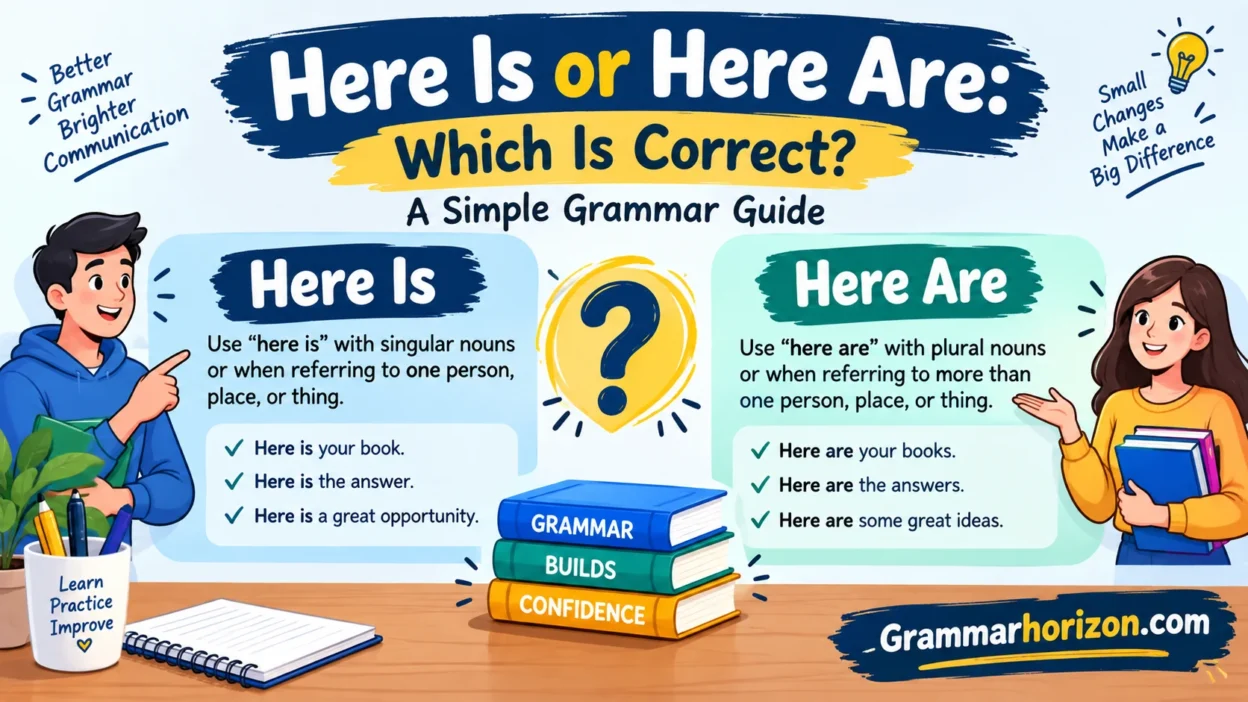
Here Is or Here Are becomes easier when you look at the noun that comes after the verb rather than focusing on here first. Use here is with a singular noun or uncountable nouns, and use here are with plural nouns. For example, Here is the book uses book as a singular noun, while Here are the books uses a plural noun. These phrases help you introduce something, present information, point out an item, or highlight something in English speech and writing.
The choice may seem less obvious because here comes first, so writers may naturally look at the first word and choose the wrong verb. However, here isn’t the subject. The noun that follows the verb determines the correct form. This small grammar point can trip up writers because the sentence has a different normal sentence structure. When you point to something, use here is with a singular noun and here are with a plural noun. The same rule applies to uncountable nouns, which are generally treated as singular.
To identify the right form, look right after it and keep looking ahead to the noun. The answer becomes clear when you mind the noun instead of the word here. Both forms are correct in different situations, and the choice depends entirely on the noun. From my experience, this simple approach makes the choice more automatic and helps with lists, contractions, common mistakes, formal writing, practical examples, and a quick reference table. The good news is that the rule is simpler than it looks, so you can return to it anytime for a quick grammar check.
Quick Answer: Is It “Here Is” or “Here Are”?
Use “here is” with a singular noun or an uncountable noun. Use “here are” with a plural noun.
Here are the basic patterns:
- Here is + singular noun: Here is the answer.
- Here is + uncountable noun: Here is some information.
- Here are + plural nouns: Here are the answers.
- Here are + plural noun phrases: Here are the documents you requested.
The easiest test is to mentally move “here” to the end.
Here is the book. → The book is here.
Here are the books. → The books are here.
That simple transformation reveals which noun controls the verb.
Comparison Overview: Here Is vs. Here Are
| Expression | Used With | Example |
| Here is | Singular noun | Here is your ticket. |
| Here is | Uncountable noun | Here is some advice. |
| Here are | Plural noun | Here are your tickets. |
| Here are | Several people or things | Here are the students. |
| Here’s | Contraction of “here is” | Here’s your phone. |
The important point is subject-verb agreement. The verb must match the grammatical number of the subject.
So, “Here is the report” is correct because “report is singular. “Here are the reports” is correct because reports is plural.
Main Differences Between Here Is and Here Are
The main difference between “here is” and “here are” depends on the number of the subject, with “here is” used for singular or uncountable nouns and “here are” used for plural nouns.
Singular Subjects Take “Here Is”
Use here is when the subject is singular.
Consider these examples:
- Here is the book.
- Here is your order.
- Here is the problem.
- Here is my suggestion.
- Here is the information you requested.
- Here is a better solution.
In each sentence, the main subject is singular. The verb therefore agrees with it.
A useful trick is to reverse the sentence:
Here is the answer.
→ The answer is here.
Here is your package.
→ Your package is here.
The structure becomes easier to see when you place the subject before the verb.
Plural Subjects Take “Here Are”
Use here when the subject is plural.
For example:
- Here are the books.
- Here are your keys.
- Here are three options.
- Here are the results.
- Here are my reasons.
- Here are the files from yesterday.
The plural nouns books, keys, options, results, reasons, and files required are.
This rule remains the same even when additional words appear between the subject and other parts of the sentence.
Here are the documents from the meeting.
The subject is documents, not meeting. Since documents is plural, are is correct.
Uncountable Nouns Usually Take “Here Is”
Uncountable nouns don’t normally have separate plural forms. Common examples include information, advice, furniture, equipment, luggage, money, evidence, and research.
Therefore, you would say:
- Here is some information.
- Here is useful advice.
- Here is the equipment.
- Here is the evidence.
- Here is some research on the subject.
You wouldn’t normally say “Here is some information.”
If you want to make an uncountable noun countable, you can use a suitable counting expression.
Here is some information.
Here are three pieces of information.
In the second sentence, pieces is the plural noun controlling the verb.
Why Does “Here” Not Control the Verb?
One of the biggest reasons people make mistakes with here is or here is is sentence inversion.
In an ordinary sentence, you might write:
The keys are here.
When you move here to the beginning to emphasize location or presentation, the structure changes:
Here are the keys.
The subject hasn’t changed. Keys remain the subject. The sentence has simply changed its word order.
Think of here as a signpost. It tells you where something is or introduces something. It doesn’t decide whether the verb should be is or are.
Compare these:
- Here is the car.
- Here are the cars.
- Here is your answer.
- Here are your answers.
The noun determines the verb every time.
How to Identify the Subject in “Here Is” and “Here Are” Sentences
To identify the subject in “here is” and “here are” sentences, look for the main noun being introduced because that noun determines whether you should use is or are.
Look at the Noun After “Is” or “Are”
In many sentences, the quickest method is simply to identify the noun following the verb.
Here is the report.
The subject is report, which is singular.
Here are the reports.
The subject is reports, which is plural.
However, don’t rely on the nearest word alone when the sentence becomes longer.
Don’t Get Distracted by Extra Words
Consider this sentence:
Here is the list of names.
The noun name is plural, but it doesn’t control the verb. The main noun is list, which is singular.
Therefore, here is is correct.
Now compare:
Here are the lists of names.
This time, lists is plural, so here are is correct.
This distinction matters in professional and academic writing because longer noun phrases can easily hide the true subject.
Watch the Head Noun
The head noun is the central noun in a noun phrase.
For example:
Here is a box of old photographs.
The head noun is box. The phrase of old photographs only provides additional information.
Similarly:
Here are two boxes of old photographs.
The head noun is boxes, which is plural.
A quick rule helps: Don’t let a nearby noun trick you into choosing the wrong verb.
“Here’s” vs. “Here Are”
“Here’s” is a contraction of “here is.”
You can use it with singular nouns and uncountable nouns:
- Here’s your coffee.
- Here’s the report.
- Here’s some information.
- Here’s what I mean.
- Here’s the answer.
Because here means here is, it normally doesn’t agree with a plural noun in careful standard English.
For formal writing, choose:
Here are the documents.
rather than:
Here’s the documents.
You may hear the second form in casual speech. Spoken English often bends grammatical patterns because people prioritize speed and rhythm. However, standard written English should maintain clear subject-verb agreement.
How to Use “Here Is” With Uncountable Nouns
Uncountable nouns deserve special attention because they don’t behave like ordinary plural nouns.
Common examples include:
- Information
- Advice
- Furniture
- Equipment
- Luggage
- Evidence
- Research
- Money
For example:
Here is some advice for your presentation.
Not:
Here are some advice for your presentation.
If you need to count the idea, use a countable expression:
Here are three pieces of advice for your presentation.
The difference is important. Advice remains uncountable, while pieces provide the plural form that can be counted.
Here Is or Here Are With Lists
Lists create another common problem.
Consider:
Here are the items you need: a notebook, a pen, and a folder.
This is straightforward because items are plural.
However, introductory phrases can sometimes sound awkward when the items don’t have the same grammatical number. In those cases, rewriting the sentence can make your meaning much clearer.
Instead of forcing an awkward construction, you might write:
You can find everything you need here: a notebook, a pen, and a folder.
Good writing isn’t only about following a rule. It’s also about making the sentence easy to understand.
Here Is or Here Are With Numbers and Quantities
Numbers often make the choice obvious because they usually signal whether the noun is singular or plural.
- Here is one reason.
- Here are two reasons.
- Here are five examples.
- Here is one example.
- Here are three cups of coffee.
Pay attention to the noun phrase rather than the number alone.
For instance:
Here is a box of six pencils.
The phrase contains six pencils, but the main noun is box, which is singular.
Therefore, here it remains correct.
Here Is or Here Are in Everyday Conversation
Both expressions appear constantly in everyday English.
You might say:
Here is your phone.
Here are your shoes.
Here’s your coffee.
Here are the keys you were looking for.
These phrases are especially common when handing something to another person or introducing information.
The conversational form here is extremely common with singular nouns. In careful writing, however, always expand it mentally to here is before deciding whether the sentence agrees correctly.
Here Is or Here Are in Formal and Professional Writing
In professional communication, grammatical agreement matters because small errors can make otherwise strong writing look careless.
For example:
Here are the documents you requested.
sounds polished and precise.
By contrast:
Here are the documents you requested.
contains a basic agreement error.
You should pay particular attention to these expressions in:
- Business emails
- Reports
- Academic assignments
- Presentations
- Instructions
- Proposals
- Professional notices
When in doubt, identify the head noun first. That approach works better than relying on how the sentence sounds.
Common Mistakes With Here Is and Here Are
Common mistakes with “here is” and “here are” usually happen when writers confuse singular and plural subjects, misidentify the main noun, or use “here’s” incorrectly with plural nouns.
Using “Here Is” Before a Plural Noun
Incorrect:
Here are the documents.
Correct:
Here are the documents.
Documents is plural, so it requires are.
Using “Here Are” With an Uncountable Noun
Incorrect:
Here is some information.
Correct:
Here is some information.
Information is uncountable in standard English.
Letting “Here” Control the Verb
A common misconception is that here somehow determines whether you need is or are. It doesn’t.
Here functions as an adverb in these constructions. The noun that follows controls agreement.
Letting a Nearby Noun Confuse You
Incorrect reasoning:
Here is the box of papers.
The writer sees papers and chooses them. But the main noun is box.
Correct:
Here is the box of papers.
If the subject becomes plural, the verb changes:
Here are the boxes of papers.
Here Is or Here Are: Correct and Incorrect Examples
| Incorrect | Correct | Reason |
| Here is the books. | Here are the books. | Books are plural. |
| Here are some information. | Here is some information. | Information is uncountable. |
| Here is your keys. | Here are your keys. | Keys is plural. |
| Here are the report. | Here is the report. | The report is singular. |
| Here are the box of files. | Here is the box of files. | Box is the head noun. |
| Here is three examples. | Here are three examples. | Examples is plural. |
| Here are one reason. | Here is one reason. | Reason is singular. |
A Simple Trick to Choose Between “Here Is” and “Here Are”
When you’re unsure, use this three-step method.
First, find the main noun.
Ask yourself, “What exactly am I introducing or pointing out?”
Second, decide whether that noun is singular, plural, or uncountable.
A singular or uncountable noun normally takes is. A plural noun takes are.
Third, reverse the sentence.
For example:
Here are the new employees.
Becomes:
The new employees are here.
The correct choice becomes obvious.
Try another:
Here is a collection of photographs.
Becomes:
A collection of photographs is here.
The head noun collection controls the verb.
Case Study: Why Head Nouns Matter
Imagine someone writes:
Here are the list of available courses.
At first glance, courses might tempt you to choose are. Yet the sentence isn’t talking about multiple lists. It’s talking about one list.
The correct version is:
Here is the list of available courses.
Now change the meaning:
Here are the lists of available courses.
Now multiple lists exist, so are is correct.
This small change demonstrates why the grammatical number depends on the actual subject rather than the noun that happens to appear closest to the verb.
Conclusion
Choosing between Here Is or Here Are becomes simple when you focus on the noun that follows the verb. Use here is with a singular noun or uncountable noun, and use here are with plural nouns. Once you understand this basic grammar rule, you can avoid common mistakes and make your writing and speech clearer.
Read More:Simpler or More Simple: Which One Is Correct?
FAQs
Q1. Is “Here Is” grammatically correct?
Yes, here is is grammatically correct when it introduces a singular noun or an uncountable noun.
Q2. Is “Here Are” grammatically correct?
Yes, here are is correct when the noun that follows is plural.
Q3. Which is correct: “Here Is” or “Here Are”?
Both are correct. The choice depends on the noun that follows the verb. Use here is for singular nouns and here are for plural nouns.
Q4. Can I use “Here Is” with uncountable nouns?
Yes. Uncountable nouns are normally treated as singular, so here is is generally the correct form.
Q5. Why do people confuse “Here Is” and “Here Are”?
The confusion happens because here comes first, which can make writers focus on the wrong word. The noun determines whether you need is or are.
Q6. Can “Here Is” and “Here Are” introduce a list?
Yes. Here is can introduce a list treated as one item or idea, while here are is commonly used when introducing multiple separate items.
Q7. What is the easiest way to remember the rule?
Look at the noun after the verb. If it’s singular, use here is. If it’s plural, use here are.