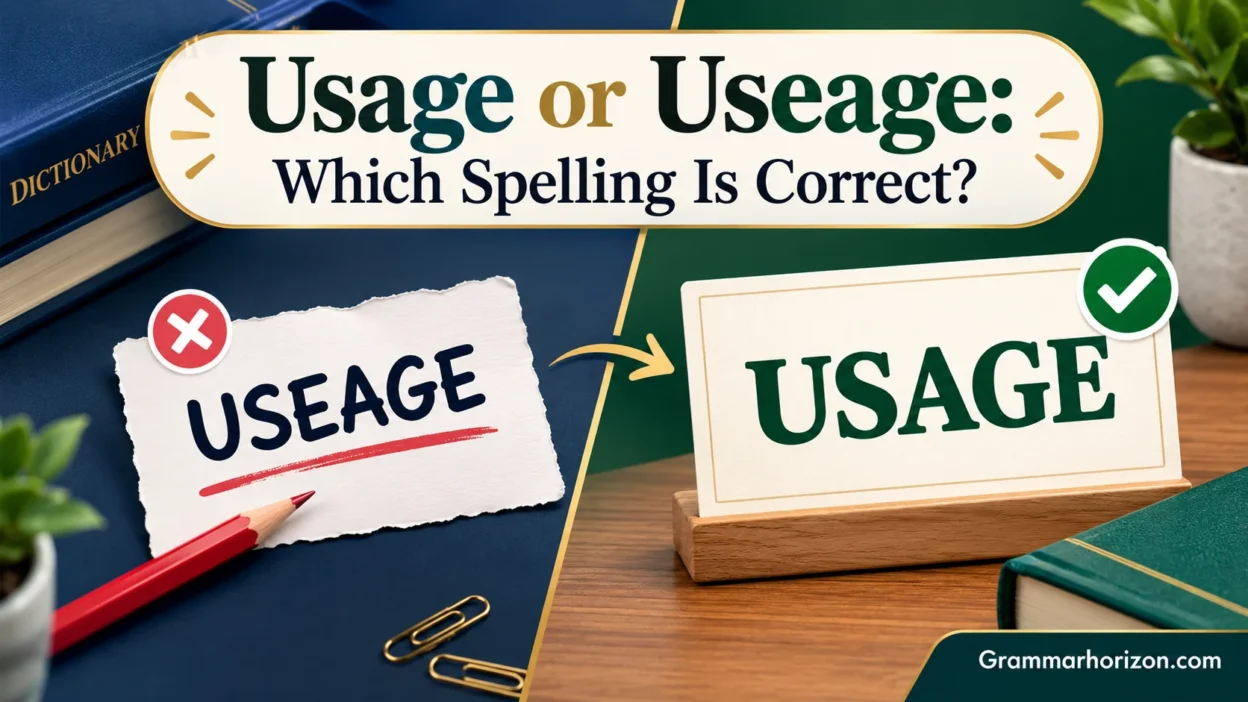
The Usage or Usage choice is straightforward: usage is the correct spelling in standard English, while usage is a spelling error. Although the two forms can look identical, the extra e makes usage incorrect. This common confusion happens because use is a familiar word, but the correct noun is usage. A simple way to remember the difference is to write usage without the extra e.
In English usage, usage can describe how people use language, words, and phrases. It can also describe how much of something people consume, such as data usage or water usage. These usage patterns can show how often a resource or expression is used. Understanding these meanings makes the difference between usage and usage more useful when using the word in everyday writing.
The accepted way to spell the term is usage, and this form is widely recognized in standard English and dictionaries. When checking different spellings, choose usage whether you are describing language, data usage, or water usage. This understanding can prevent a common mistake and help keep your writing accurate.
Quick Answer: Is It Usage or Useage?
The word usage is a standard English noun. It can refer to the way something is used, the amount or frequency of use, or established practices in language. Useage doesn’t serve as a standard alternative spelling in American English or British English.
| Word | Correct? | Part of Speech | Example |
| Usage | ✅ Yes | Noun | “Internet usage has increased.” |
| Useage | ❌ No | — | “Internet useage has increased.” |
So if you’re writing an essay, business report, email, website, or academic paper, choose usage.
Comparison Overview
The simplest way to understand usage vs. useage is to look at what each spelling represents.
| Feature | Usage | Useage |
| Standard English spelling | Yes | No |
| Standard noun | Yes | No |
| Used in American English | Yes | No |
| Used in British English | Yes | No |
| Refers to a way of using something | Yes | No |
| Refers to consumption or frequency | Yes | No |
| Common in grammar discussions | Yes | No |
| Appropriate for formal writing | Yes | No |
One important point stands out: useage isn’t a separate word with a different meaning. In ordinary modern English, it’s simply a misspelling of usage.
What Does “Usage” Mean?
Usage has several related meanings. The exact meaning depends on the context, but each sense connects to the general idea of using something.
Usage Means the Way Something Is Used
First, usage can describe the manner or method in which someone uses an object, service, system, or resource.
For example:
- “The manual explains proper equipment usage.”
- “Heavy usage may cause the battery to drain faster.”
- “The software tracks employee usage.”
Here, the word describes how something gets used.
Imagine a public library. Two people might borrow books, but they may use the library differently. One visits every day while another visits once a month. Their patterns of library usage aren’t the same.
Usage in Language and Grammar
The word takes on a more specialized meaning when people discuss language.
English usage refers to the way words, phrases, grammar structures, and expressions are actually used by speakers and writers.
For example:
- “The book is a guide to English usage.”
- “This expression is common in informal usage.”
- “The dictionary includes notes about modern usage.”
This meaning is important because usage and grammar aren’t exactly the same thing.
Grammar describes the structural rules and patterns of a language. Usage focuses more broadly on how people actually use that language in real communication.
A phrase can therefore be common in everyday usage even when a particular style guide recommends another form in formal writing.
Usage Can Mean Amount or Frequency
Usage can also describe how much or how often something gets used.
You’ll see this meaning frequently in technology, utilities, business, and statistics.
Consider these examples:
- Data usage shows how much mobile data you consume.
- Electricity usage describes how much electrical power a household uses.
- Water usage measures water consumption.
- Internet usage can describe how frequently or extensively someone goes online.
In these examples, usage focuses on measurable activity or consumption.
What Does “Useage” Mean?
Useage is generally not the correct English spelling.
People often create this spelling by looking at the word use and then adding an ending. Visually, useage seems logical because it appears to combine use with -age.
English spelling doesn’t always work that mechanically, though.
The established noun is usage, not useage. Therefore, these sentences need correction:
- ❌ “The website monitors customer useage.”
- ✅ “The website monitors customer usage.”
- ❌ “High data useage can affect your plan.”
- ✅ “High data usage can affect your plan.”
- ❌ “This guide explains proper English useage.”
- ✅ “This guide explains proper English usage.”
If you see useage in an online article, document, or message, don’t assume it represents an alternative spelling. Most likely, the writer simply added an unnecessary e.
Why Do People Spell Usage as Useage?
The error makes sense once you look at the word visually.
The Influence of the Word “Use”
The word use is spelled with an e at the end. When people form the noun mentally, they may think:
use + age = useage
That reasoning looks tidy. Unfortunately, standard spelling gives us usage instead.
This is a useful reminder that English words don’t always form through simple letter-by-letter combinations.
English Spelling Isn’t Always Predictable
English contains many words whose spelling doesn’t perfectly match what you might expect from their related words.
That can create traps for even careful writers.
When you already know how to use, your brain naturally wants to preserve every letter. However, the correct noun has its own established spelling: usage.
The best approach isn’t to invent the spelling from scratch. Learn usage as a complete word.
Visual Confusion
The difference between the two spellings is tiny.
Usage
Useage
Only one extra e separates them. That’s precisely why the mistake can slip through proofreading.
A quick spell-check can catch it in many applications, but understanding the correct form is more reliable than depending entirely on software.
Main Differences Between Usage and Useage
The main difference is straightforward: usage is standard English, while useage is not.
Spelling Difference
The correct spelling is:
U-S-A-G-E
The incorrect form adds an unnecessary e:
U-S-E-A-G-E
That extra letter has no place in the standard spelling.
Dictionary Status
Usage has established dictionary meanings and grammatical uses. It functions as a noun and appears across everyday, technical, academic, and professional English.
Useage, by contrast, isn’t the standard noun used for these meanings.
Meaning and Grammatical Function
Usage can describe a practice, manner, frequency, amount, or pattern of use.
For example:
“The company analyzed customer usage.”
Here, usage functions as a noun.
Useage doesn’t provide a separate meaning that you can substitute into the sentence.
Formal and Professional Writing
The distinction matters even more in professional communication.
A spelling error in a casual text may cause little trouble. In a resume, report, academic assignment, or published article, however, repeated use of useage can make the writing look careless.
Using usage keeps your writing accurate and professional.
Usage vs. Use: What’s the Difference?
There’s another distinction worth learning: usage vs. use.
Both are correct words, but they don’t always fit the same sentence.
Use can work as both a verb and a noun:
- “Please use the new software.”
- “I made good use of the available resources.”
Usage is a noun:
- “Software usage increased this month.”
- “The company tracks customer usage.”
A helpful rule is this: use often refers to the act of using something, while usage often emphasizes a pattern, manner, amount, or established practice.
For example, “Please use less water” sounds natural when giving an instruction. “Household water usage increased” sounds natural when discussing measured consumption.
How to Use “Usage” Correctly
You can use “usage” correctly when describing how, how often, or how much something is used in a particular context.
Usage in Everyday English
You can use usage when discussing regular patterns of use.
- “The phone records daily app usage.”
- “Frequent usage can wear down the equipment.”
- “The product is designed for regular usage.”
Usage in Academic Writing
Academic writing frequently uses usage when discussing language or measurable behavior.
For example:
- “The study examined social media usage among students.”
- “The research focuses on regional language usage.”
- “The paper discusses changes in vocabulary usage.”
Usage in Business and Technology
Businesses often track usage patterns to understand customer behavior.
Common phrases include:
- Customer usage
- Data usage
- Software usage
- Usage patterns
- Usage statistics
- Usage rates
- Usage limits
These expressions are standard and widely understood.
Usage in Grammar Discussions
In language discussions, you’ll often encounter phrases such as:
- Standard usage
- Common usage
- Modern usage
- Formal usage
- Informal usage
- English usage
Here, the word refers to accepted or observed ways of using language.
Usage or Useage in Sentences
Seeing the word in context makes the distinction easier.
Correct Examples With “Usage”
- “The report examines household energy usage.”
- “This dictionary explains modern English usage.”
- “The application tracks daily usage.”
- “Heavy equipment usage requires regular maintenance.”
- “The company noticed unusual customer usage patterns.”
Incorrect Examples With “Useage”
These examples contain the common spelling mistake:
- ❌ “The app tracks mobile data useage.”
- ❌ “English useage changes over time.”
- ❌ “High electricity useage can increase costs.”
The corrections are simple:
- ✅ “The app tracks mobile data usage.”
- ✅ “English usage changes over time.”
- ✅ “High electricity usage can increase costs.”
Pronunciation of Usage
The spelling can cause confusion because the pronunciation doesn’t clearly reveal every letter.
In standard American English, usage is commonly pronounced with the first syllable receiving the main stress. The word has three syllables.
The key lesson is simple: don’t use pronunciation as a guide for adding an extra e. English spelling often preserves historical forms that aren’t obvious from sound alone.
Is Usage Different in American and British English?
No. Usage is standard in both American and British English.
This isn’t like spelling differences such as color and colour. You don’t need to switch between usage and useage depending on which variety of English you’re writing.
For example, both American and British writers can correctly write:
“Modern English usage changes over time.”
The spelling remains usage.
Common Mistakes With Usage and Useage
Common mistakes include spelling “usage” as “useage,” confusing “usage” with “use,” and using “usage” where another word fits better.
Adding an Extra E
The biggest mistake is writing useage instead of usage.
Remember the correct form:
usage
Not:
useage
Treating Useage as a Variant
Seeing useage repeatedly can make it look legitimate. Frequency doesn’t automatically establish a spelling as standard.
If a word appears incorrectly across websites or documents, the error can spread. That doesn’t turn it into a preferred spelling.
Confusing Usage With Use
Another mistake involves choosing usage when use would sound more natural.
For example:
- “Use this button to continue.” ✅
- “Usage this button to continue.” ❌
The first sentence needs the verb use. The second doesn’t work because usage is a noun.
Assuming Every Derived Word Keeps the Base Spelling
It’s tempting to preserve the final e from use. However, established English spelling doesn’t require that.
Rather than thinking use + age, memorize usage as the standard noun.
How to Remember the Correct Spelling
A simple memory trick works well:
Usage has no extra E.
Think of the correct word as one unit:
USAGE
Don’t mentally build it as USE + AGE.
Another useful reminder is:
Use it, then remember its usage.
The verb use has its own spelling. The noun usage has its own established form.
Usage or. Useage: Quick Decision Guide
When you’re unsure, follow this quick checklist:
- Need the standard noun? Choose usage.
- Talking about language practices? Choose usage.
- Discussing consumption or frequency? Choose usage.
- Writing useage? Remove the extra e.
- Giving an instruction to perform an action? You may need to use it instead.
Real-World Examples of Usage
The word appears naturally across many fields.
| Context | Example |
| Language | “The expression is common in modern usage.” |
| Technology | “The app monitors daily usage.” |
| Mobile data | “Data usage exceeded the monthly limit.” |
| Utilities | “Water usage rose during summer.” |
| Business | “Customer usage patterns changed.” |
| Education | “The course covers English usage.” |
| Equipment | “Frequent usage requires maintenance.” |
These examples show why learning the correct spelling matters. Usage isn’t limited to grammar discussions. It’s a useful noun across everyday and professional English.
Quick Practice: Usage or Useage?
Choose the correct form:
- “The software tracks customer usage/useage.”
- “Please use/usage the correct password.”
- “English usage/useage varies by context.”
- “High data usage/useage can affect your monthly allowance.”
Answers
- Usage
- Use
- Usage
- Usage
The pattern becomes clear once you separate use as a verb from usage as a noun.
Read More:Council vs. Counsel: What’s the Difference and How to Use Each Correctly?
Conclusion
Usage is the correct spelling in standard English, while usage is a common spelling error caused by adding an extra e. Remembering this simple difference can help you avoid confusion and keep your writing accurate.
FAQs
Q1. Is “usage” or “useage” correct?
Usage is correct. Usage is not the standard spelling.
Q2. Is “useage” a word?
Usage is generally considered a spelling error. Use usage instead.
Q3. Why is “usage” incorrect?
It incorrectly adds an extra e to use. The accepted noun is usage.
Q4. What does “usage” mean?
Usage can mean the way something is used or the amount of something that people consume, such as water usage or data usage.
Q5. What is English usage?
English usage refers to how people commonly use words, phrases, and language.