Understanding Shown vs. Showed helps you learn why these verb forms differ and how to choose the correct word in English sentences clearly. Both words come from the verb show, but they have different roles in grammar. Many learners find these forms tricky because they are often seen in books, conversations, and school assignments. Although they may seem interchangeable, they follow different grammar patterns. Showed is the simple past form used for finished actions, while shown is the past participle form that works with helping verbs such as has, have, and had.
The form used in a sentence can change whether the meaning sounds natural and grammatically correct. For example, She showed me her notebook describes a completed past action, while She has shown me her notebook uses shown because has acts as the helping verb. The grammar rule is straightforward when you break it down step-by-step. Remembering this small difference makes it easier to choose the right one in every situation and avoid writing mistakes.
This guide clears up the confusion that causes many learners to hesitate, rewrite sentences, or second-guess phrases like I’ve shown you this before. A simple memory trick is to connect showed with past actions and shown with helper verbs. Understanding these key differences improves your writing in academic, professional, and formal settings while helping you use English more confidently.
Quick Answer
Here’s the short answer.
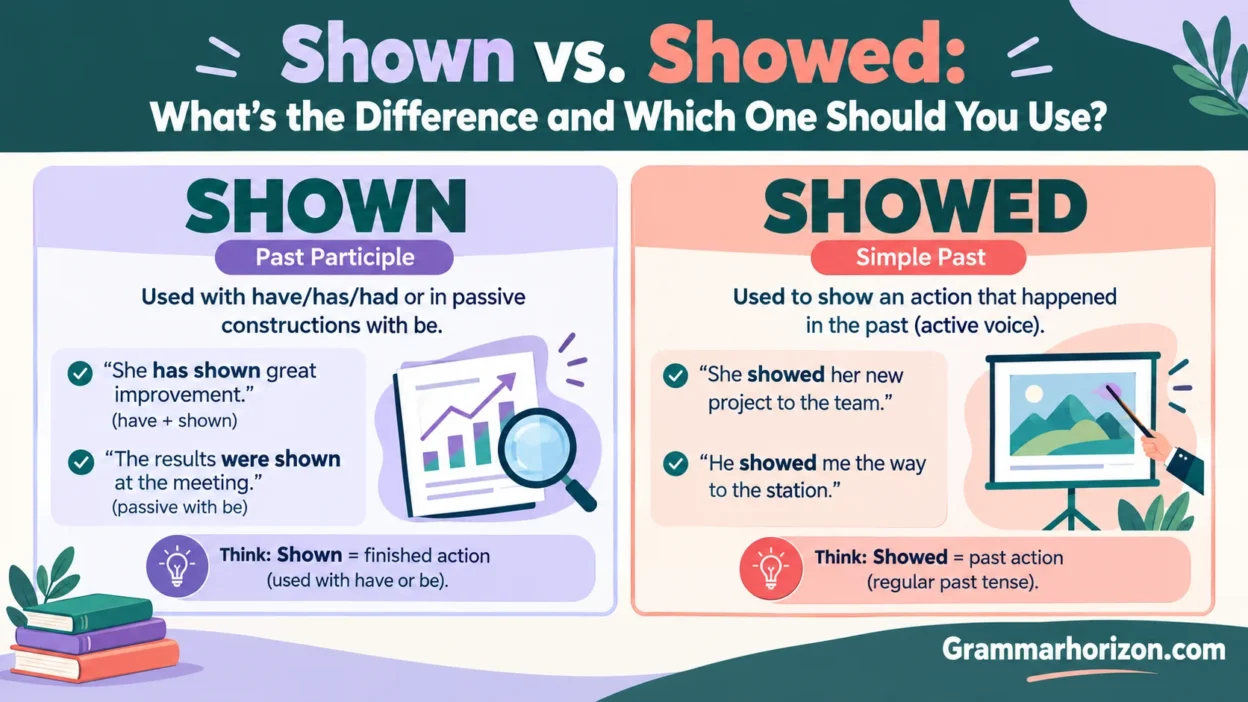
- Use showed as the simple past tense of show.
- Use shown as the past participle, usually with a helping verb such as has, have, had, is, was, were, be, or been.
Examples
| Correct Usage | Example |
| Simple past | She showed me her new laptop yesterday. |
| Present perfect | She has shown me her new laptop already. |
| Past perfect | They had shown the proposal before the meeting. |
| Passive voice | The presentation was shown on the main screen. |
If you’re unsure which one to use, look for a helping verb. If one is present, shown is almost always the correct choice.
Comparison Overview
The easiest way to understand shown vs. showed is to compare them side by side.
| Feature | Showed | Shown |
| Verb form | Simple past | Past participle |
| Can stand alone as the main verb | Yes | Usually no |
| Requires a helping verb | No | Yes |
| Used in perfect tenses | No | Yes |
| Used in passive voice | No | Yes |
| Example | He showed me the report. | He has shown me the report. |
Although both words describe the same action, they perform different grammatical functions. That distinction determines which one belongs in your sentence.
Main Differences Between Shown vs. Showed
The biggest difference between shown and showed is their role in English grammar.
Showed is the simple past tense. It describes an action that happened and finished in the past.
Shown is the past participle. It appears with helping verbs to form perfect tenses or passive voice.
Here’s a simple comparison.
| Showed | Shown |
| Describes a completed past action | Works with helping verbs |
| Functions as the simple past tense | Functions as the past participle |
| Can stand alone | Usually cannot stand alone |
| Common in stories and conversations | Common in formal writing and passive constructions |
Understanding this difference makes it much easier to choose the correct form.
Showed Expresses a Completed Past Action
Use showed when describing something that happened at a specific time in the past.
Examples:
- The teacher showed the students a science experiment.
- I showed my passport at the airport.
- She showed everyone her vacation photos.
Each sentence refers to an action that has already finished.
Shown Works with Helping Verbs
Use shown after helping verbs.
Examples:
- I have shown you this document before.
- She had shown remarkable progress.
- The results were shown during the presentation.
Without the helping verb, these sentences would be incorrect.
What Does “Showed” Mean?
Showed is the past tense of the verb show. It tells readers that someone displayed, demonstrated, explained, or revealed something in the past.
It answers questions like:
- What happened yesterday?
- What did someone do?
- What occurred during a particular event?
When to Use Showed
Use showed when:
- describing completed past events
- telling stories
- discussing historical events
- explaining what someone did earlier
Examples
- The guide showed us around the museum.
- My friend showed me how to fix the problem.
- The coach showed the team a new strategy.
- The report showed higher profits last quarter.
Notice that none of these examples require another verb before showed.
Common Sentence Patterns
You’ll often find showed with time expressions like:
- yesterday
- last week
- last year
- earlier today
- two days ago
- in 2024
Examples:
- She showed me the contract yesterday.
- They showed the apartment last weekend.
These time markers reinforce that the action happened in the past.
What Does “Shown” Mean?
Shown is the past participle of show.
Unlike showed, it usually cannot function as the main verb by itself. Instead, it joins a helping verb to create perfect tenses or passive voice.
When to Use Shown
Use shown in these situations:
- present perfect tense
- past perfect tense
- future perfect tense
- passive voice
Examples
Present perfect:
- She has shown great leadership.
Past perfect:
- They had shown the proposal before lunch.
Future perfect:
- By tomorrow, we will have shown every customer the new design.
Passive voice:
- The winning entries were shown during the ceremony.
Each sentence contains a helping verb before shown.
Why Shown Needs a Helping Verb
Think of shown as part of a team.
The helping verb carries the tense.
The word shown completes the meaning.
For example:
- has shown
- have shown
- had shown
- was shown
- were shown
- has been shown
That partnership is what makes the sentence grammatically complete.
Incorrect vs. Correct Usage
| Incorrect | Correct |
| She shown me the report. | She showed me the report. |
| She has showed me the report. | She has shown me the report. |
| They had showed the results. | They had shown the results. |
| The results was showed. | The results were shown. |
Looking for the helping verb is often enough to spot the correct answer immediately.
Conclusion
Learning the difference between shown and showed becomes much easier once you understand how the verb show works. Showed is used for simple past actions, while shown is used as a past participle with helping verbs like has, have, or had. These small grammar details can make a big difference in how natural and correct your writing sounds. By remembering that showed works alone and shown needs a helper, you can confidently choose the right form in everyday conversations, academic writing, and professional communication.
FAQs
Q1.What is the difference between shown and showed?
Showed is the simple past form of the verb show, while shown is the past participle form. Showed can be used alone, but shown needs a helping verb.
Q2. Is shown a past tense word?
No, shown is not the simple past tense. It is a past participle and is used with helping verbs such as has, have, or had.
Q3. When should I use showed?
Use showed when you are talking about an action that happened and finished in the past. For example: She showed me her new book yesterday.
Q4. When should I use shown?
Use shown when you need a past participle with a helping verb. For example: He has shown great improvement this year.
Q5.Can I say “I shown you this before”?
No, this sentence is incorrect. You should say “I have shown you this before” because shown requires a helping verb.
Q5.Why do people confuse shown and showed?
People often confuse them because both words come from the same verb and have similar meanings. The difference is based on grammar structure, not meaning.
Q7.How can I remember the difference between shown and showed?
A simple memory trick is to remember that showed = simple past action and shown = helper verb needed. If you see has, have, or had, shown is usually the correct choice.