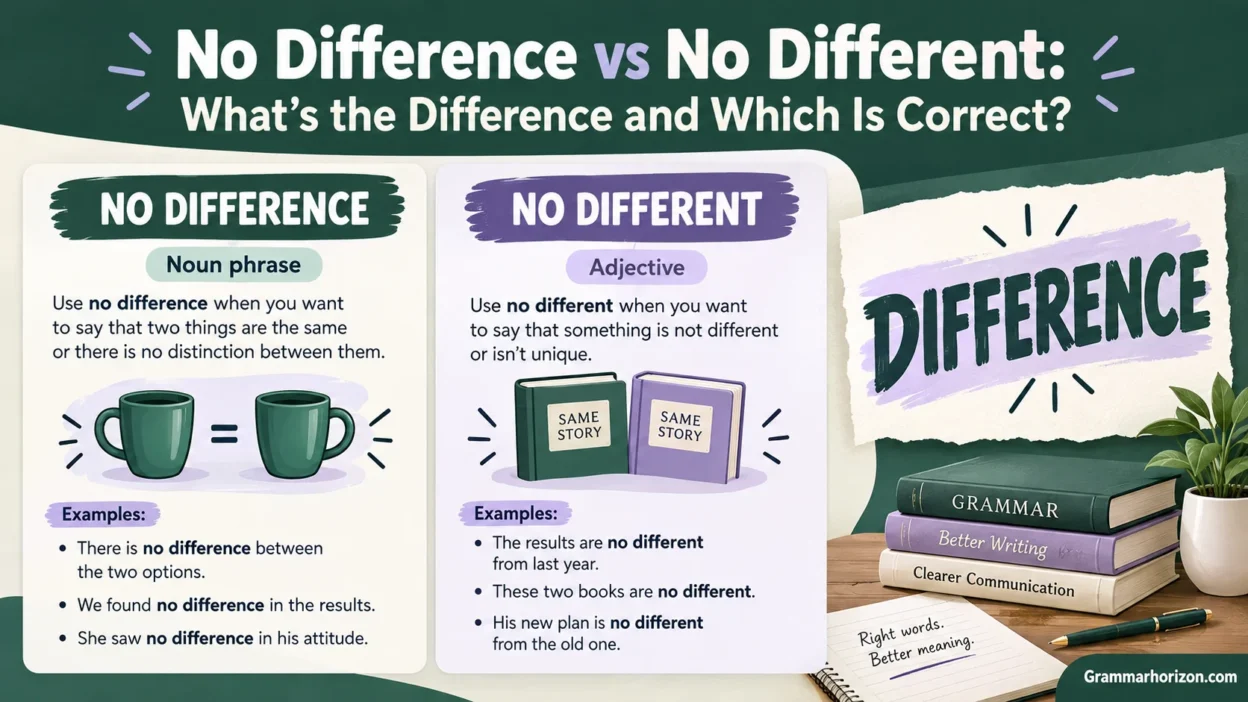
No Difference vs No Different becomes easier when you know whether you need a noun phrase or an adjective phrase in a sentence. English learners may look similar at these phrases and feel confusion because they sound similar and both express similarity, but they serve different grammatical roles. No difference is a noun phrase that refers to a lack or absence of distinction between two things, while no different is an adjective phrase used to describe something as not different from something else. The structure determines the correct usage: difference is a noun, while different is an adjective. In my experience, checking the grammar role makes the distinction easier to understand, because the role of each word helps decide the correctness of a sentence.
The same distinction is useful when both expressions appear in everyday conversation, professional writing, emails, or academic work. No difference can describe two products, ideas, or choices as identical, with no meaningful change between each other, while no different describes one thing in relation to another. Common mistakes often occur when writers swap the expressions because of their similarity in meaning. I’ve hesitated over this kind of choice when a phrase stands alone, but a small change in wording can matter. The good news is that the rule is easy to understand: choose no difference when the sentence needs a noun, and use no different when it needs an adjective.
In daily writing, clear communication and professional communication depend on choosing the expression that fits better with the surrounding words and context. A writer may compare two things and state that there is no difference, or describe one thing as no different from another. These are not interchangeable words, even though their similarity can create doubt. This grammar difference influences tone, clarity, and correctness, helping build confidence and professionalism in English writing. Understanding these subtle distinctions in usage, word choice, and meaning helps you avoid awkward sentences, recognize which option fits better, and understand why two phrases that seem almost the same can have a different grammatical purpose.
Quick Answer: No Difference or No Different?
“No difference” and “no different” are both grammatically possible, but you use them in different sentence structures.
- No difference uses difference as a noun.
- There is no difference between the two answers.
- It makes no difference to me.
- No different uses are different as an adjective.
- This answer is no different from the other one.
- Her situation is no different from mine.
A simple rule makes the choice much easier:
Use “no difference” when you need a noun. Use “no different” when you need an adjective.
So, “It makes no difference” is correct, while “It makes no different” is incorrect.
Likewise, “This is no different from that” is correct, while “This is no difference from that” is incorrect.
Comparison Overview
| Expression | Grammar | Meaning | Example |
| No difference | Noun phrase | No distinction exists | There is no difference between them. |
| No different | Adjective phrase | Not different from something else | This one is no different from that one. |
| Make no difference | Fixed expression | Doesn’t matter | It makes no difference to me. |
| Be no different from | Adjective construction | Be essentially the same | The new version is no different from the old one. |
| Different from | Adjective phrase | Not the same as something else | This method is different from the old method. |
The key distinction is grammatical rather than merely stylistic. Difference names a distinction. Different describes something that isn’t the same.
Main Differences Between No Difference and No Different
The main difference is that “no difference” uses a noun to show no distinction exists, while “no different” uses an adjective to describe something as essentially the same.
“No Difference” Is a Noun Phrase
The word difference is a noun. It names the distinction between two or more things.
Consider this sentence:
There is no difference between the two plans.
Here, difference represents the thing being discussed. The sentence isn’t describing the plans directly. Instead, it says that no distinction exists between them.
You can use no difference in several common structures:
- There is no difference between…
- There was no difference in…
- It makes no difference…
- I can see no difference…
- We found no difference between…
For example:
- There is no difference between these two fabrics.
- The test showed no difference in performance.
- It makes no difference which seat you choose.
- I can see no difference between the original and the copy.
In each example, difference functions as a noun.
“No Different” Is an Adjective Phrase
The word different is an adjective. It describes a person, object, condition, result, or idea.
Look at this example:
The new version is no different from the old version.
Here, different descriptions of the new version. The phrase tells you that the new version doesn’t differ from the old one in the relevant way.
This construction commonly appears after linking verbs such as:
- is
- are
- was
- were
- seems
- looks
- appears
- feels
Examples include:
- The new policy is no different from the previous one.
- Their results were no different from ours.
- The second design looks no different from the first.
- His explanation seems no different from hers.
Notice the pattern. The adjective different describes the subject.
When to Use “No Difference”
Use “no difference” when you’re referring to an absence of distinction, especially in phrases like “there is no difference” or “it makes no difference.”
Use “No Difference” After “There Is” or “There Was”
One of the most common structures is that there is no difference.
For example:
There is no difference between the two measurements.
The noun difference fits naturally after no because the sentence identifies whether a distinction exists.
You can also use the plural form when necessary:
- There are no differences between the two versions.
- There were no significant differences in the results.
However, no difference often works as an uncountable concept when you’re talking about an absence of distinction generally.
Use “No Difference” With “Make”
The expression make no difference is extremely common in English.
It means that something doesn’t matter or doesn’t affect the outcome.
For example:
- It makes no difference which restaurant we choose.
- The extra five minutes made no difference.
- Your decision makes no difference to the final result.
You cannot replace difference with different here.
Incorrect:
It makes no difference to me.
Correct:
It makes no difference to me.
The reason is simple: make takes the noun difference in this established expression.
Use “No Difference” When Discussing Distinctions
When your sentence focuses on whether two things have a measurable or meaningful distinction, no difference is usually the right choice.
For example:
- Researchers found no difference in the two groups’ average scores.
- There was no difference in price.
- The two materials showed no difference in durability.
- I noticed no difference in sound quality.
This structure works particularly well in reports, comparisons, and factual writing.
When to Use “No Different”
Use “no different” when describing something as essentially the same as another thing, usually in structures like “is no different from” or “looks no different from.”
Use “No Different” With “Be”
The most common pattern is:
subject + be + no different from + comparison
Examples:
- This model is no different from the previous one.
- Her approach is no different from mine.
- The new rules are no different from the old rules.
- His experience was no different from theirs.
The adjective different describes the subject.
That’s why there are no different works while no difference doesn’t work in the same structure.
Compare these two sentences:
There is no difference between the products.
The products are no different from each other.
Both communicate a similar idea, but their grammar differs.
Use “No Different” With Other Linking Verbs
You aren’t limited to is or are.
Because different functions as an adjective, other linking verbs can introduce it naturally.
Examples:
- The second option seems no different from the first.
- The updated website looks no different from the original.
- The experience feels no different from last year.
- The final result appears no different from the earlier result.
These sentences describe the subject rather than naming a distinction.
“No Different From” Means Essentially the Same
The phrase no different from usually means that two things are alike in the characteristic being discussed.
For example:
The new phone is no different from the previous model in battery life.
This doesn’t necessarily mean every feature is identical. It means that, regarding battery life, the two models aren’t different.
That detail matters. Natural English often uses no different form to make a focused comparison.
No Difference vs. No Different in Common Sentence Patterns
“No difference” describes the absence of a distinction, while “no different” describes something as essentially the same, depending on the sentence structure.
“There Is No Difference”
This construction directly states that no distinction exists.
Examples:
- There is no difference between these two answers.
- There is no difference in their final scores.
- There was no difference in quality.
The structure is:
There + be + no difference + comparison
“It Makes No Difference”
This expression means it doesn’t matter.
For example:
“It makes no difference which option you choose.”
The speaker is saying that either choice produces the same practical result.
Other examples include:
- It makes no difference whether you arrive early.
- It makes no difference to us.
- It makes no difference what time you call.
This is one of the most useful phrases to remember because it’s extremely common in natural English.
“It Is No Different From”
This construction describes one thing as essentially the same as another.
For example:
The new procedure is no different from the old one.
The structure is:
Subject + be + no different from + comparison
You’ll often see it in discussions about products, policies, experiences, people, and situations.
No Difference vs. No Different Examples
Examples of “no difference” and “no different” show how each expression works naturally in sentences while highlighting their distinct grammatical roles.
Examples With “No Difference”
Here are several natural examples:
- There is no difference between the two colors.
- It makes no difference which route we take.
- The study found no difference in the results.
- I can see no difference between these photographs.
- There was no difference in their final scores.
- The price makes no difference to the customer.
In every sentence, difference acts as a noun.
Examples With “No Different”
Now compare these examples:
- This version is no different from the original.
- Her experience is no different from mine.
- The second option looks no different from the first.
- His reaction was no different from everyone else’s.
- The updated policy seems no different from the previous policy.
- Their situation is no different from ours.
Here, different descriptions of the subject.
Common Mistakes With No Difference and No Different
Common mistakes happen when “no difference” and “no different” are used interchangeably, even though difference is a noun and different is an adjective.
Mistake: “It Makes No Different”
This is one of the most common errors.
Incorrect: It makes no difference.
Correct: It makes no difference.
The phrase make no difference requires the noun difference.
Mistake: “There Is No Different”
Incorrect: There is no difference between the two products.
Correct: There is no difference between the two products.
After there is, the sentence needs the noun difference when you’re talking about the existence or absence of a distinction.
Mistake: “It Is No Difference”
Incorrect: This product is no different from that one.
Correct: This product is no different from that one.
After that, you need the adjective different when describing the product.
Mistake: Using “No Different” Alone
A response such as “No different” usually sounds incomplete in ordinary conversation.
If someone asks:
“Which one should I choose?”
Natural responses include:
- It makes no difference.
- Either one is fine.
- They’re basically the same.
- There’s no difference.
The expression no different generally needs a subject and a suitable verb.
No Difference vs. No Different vs. Different From
These three expressions are related, but they aren’t interchangeable.
| Expression | What It Does | Example |
| No difference | Says no distinction exists | There is no difference between them. |
| No different from | Describes something as essentially the same | This is no different from the original. |
| Different from | Says something isn’t the same | This is different from the original. |
The difference between no different and different is especially important.
Compare:
The new system is different from the old system.
This means the systems aren’t the same.
The new system is no different from the old system.
This means the new system isn’t different from the old system. In other words, they are essentially the same in the relevant respect.
Adding no reverses the basic meaning of different.
A Simple Memory Trick for No Difference vs. No Different
When you’re unsure, ask yourself one question:
Am I naming a distinction or describing something?
If you’re naming a distinction, choose a difference.
There is no difference.
If you’re describing something, choose something different.
It is no different from the original.
Think of it this way:
Difference = a thing
Different = a description
That small grammatical distinction solves most cases.
No Difference vs. No Different in Formal Writing
Both expressions can appear in formal writing, but context determines which one fits.
For analytical writing, no difference works well when discussing results or comparisons:
- The analysis found no difference between the two groups.
- The experiment showed no significant difference in performance.
Meanwhile, no different from works when describing similarity:
- The revised procedure is no different from the previous procedure.
- The outcome was no different from the predicted result.
In formal writing, precision matters more than choosing one expression over the other. Don’t replace difference with different simply because the words look related.
Case Study: Comparing Two Products
Imagine you’re comparing two laptops.
You might write:
There is no difference in battery life between the two laptops.
Here, you’re discussing the difference as a measurable characteristic.
You could also write:
The second laptop is no different from the first in battery life.
Now you’re describing the second laptop.
Both sentences communicate nearly the same practical conclusion. However, the grammar and sentence structure are different.
This is why learning the underlying word classes is more useful than memorizing isolated phrases.
Practice: Choose the Correct Expression
Fill in each blank with no difference or no different.
- There is ______ between the two answers.
- This model is ______ from the previous one.
- It makes ______ which option you select.
- Her experience was ______ from mine.
- The researchers found ______ in the results.
- The new policy seems ______ from the old policy.
Answer Key
- no difference
- no different
- no difference
- no different
- no difference
- no different
The pattern becomes clear once you identify the grammatical job of each word.
Read More:Here Is or Here Are: Which Is Correct? A Simple Grammar Guide
Conclusion
Understanding No Difference vs No Different becomes much easier when you focus on their grammatical roles. No difference works as a noun phrase when you’re talking about the absence of a distinction, while no different works with different as an adjective when describing something as not different from something else. Although the expressions may seem similar, choosing the correct one improves clarity, correctness, and confidence in everyday and professional English writing.
FAQs
Q1. Is “no difference” grammatically correct?
Yes, “no difference” is grammatically correct. It means that there is no distinction or change between two or more things.
Q2. Is “no different” grammatically correct?
Yes, but it normally needs a comparison. For example, “This option is no different from the other one.”
Q3. What is the main difference between “no difference” and “no different”?
“No difference” is a noun phrase, while “no different” uses different as an adjective. Their grammatical roles are different.
Q4. Can I use “no difference” and “no different” interchangeably?
No. They may express a similar idea, but their sentence structures are different. You should choose the phrase that fits the grammar of your sentence.
Q5. Which is correct: “There is no difference” or “There is no different”?
“There is no difference” is correct. Difference is a noun and can follow no in this structure, while different is an adjective.
Q6. Which is correct: “It is no difference” or “It is no different”?
“It is no different” is correct when making a comparison, such as “It is no different from the original.” “It is no difference” is not standard English.
Q7. How can I remember the difference easily?
Remember this simple rule: difference = noun and different = adjective. Use no difference to name the absence of a distinction and no different to describe something that isn’t different from another thing.