Simpler or More Simple can seem confusing, but simpler is usually the more natural choice in everyday English. When choosing between the two forms, remember that simpler is the standard comparative form of the adjective simple. Native speakers commonly use the -er form, especially when comparing two things. For example, you might say that one idea is simpler because it is less complicated. Although simple has a two-syllable structure, simpler remains the safer option in most situations. This common grammar rule makes the comparison easier and helps you avoid a tricky usage problem.
More simple isn’t necessarily incorrect, but it’s less common and may sound awkward in ordinary communication. Either pattern can appear depending on context, style, rhythm, or emphasis, yet simpler is generally the better choice for clear English. You’ll often find it in everyday writing, an email, essay, article, or report. The more construction can sometimes provide a different version or deliberate effect, but the -er form is normally the first choice. If you’re unsure, choosing simpler can make your writing more direct and keep your ideas easy to understand.
Learners often become confused because both forms express the same idea, and natural language patterns can seem inconsistent. The key is to recognize that simpler normally functions as the comparative form, while more simple can sound more deliberate or stylistically marked. Correct usage still depends on the context, so consider how your sentence sounds to an experienced reader. Avoid common mistakes by remembering that simple usually takes the -er form. In everyday speaking and professional communication, this small choice can reduce confusion and unnecessary complication.
Quick Answer: Is It Simpler or More Simple?
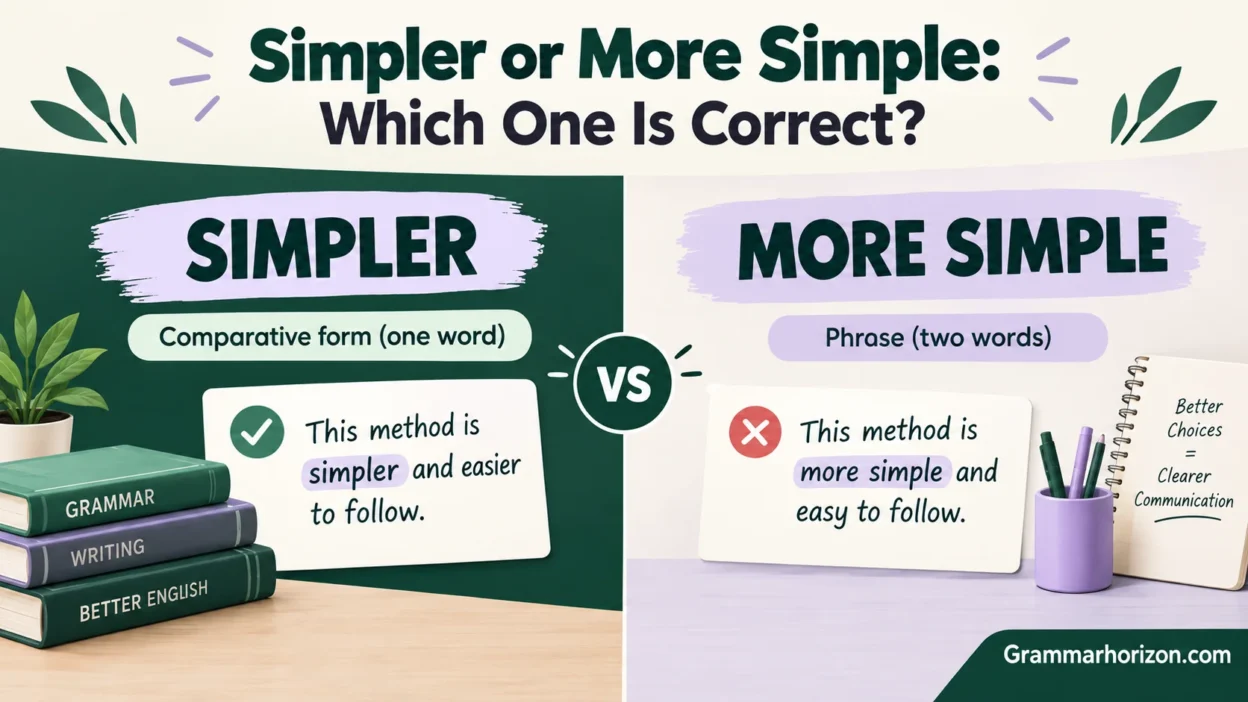
Simpler is generally the preferred and more natural comparative form of simple.
For example:
- This explanation is simpler than the first one.
- The new system is simpler to use.
- We need a simpler solution.
The more simple form isn’t automatically grammatically incorrect. English speakers do use it, although it’s considerably less common in ordinary modern usage.
Compare these sentences:
| Sentence | Evaluation |
| This method is simpler. | ✅ Natural and preferred |
| This method is more simple. | ✅ Possible, but less common |
| This method is more simple. | ❌ Incorrect |
| This is the simplest method. | ✅ Correct |
| She explained it more simply. | ✅ Correct, but different grammar |
The most important rule is straightforward: use simpler as your default comparative form of simple.
You don’t need to avoid every occurrence of more simple, but you generally don’t need it either.
Comparison Overview
The two expressions have essentially the same basic meaning: they compare something with another thing and describe it as less complicated or easier to understand.
| Feature | Simpler | More Simple |
| Base adjective | Simple | Simple |
| Grammatical role | Comparative adjective | Comparative adjective phrase |
| Basic meaning | Less complicated | Less complicated |
| Common in modern English | Very common | Less common |
| Natural in everyday conversation | Yes | Sometimes |
| Natural in professional writing | Yes | Possible |
| Best default choice | Yes | Usually no |
| Superlative | Simplest | Most simple, less usual |
The important distinction isn’t really a difference in meaning. Instead, it concerns frequency, naturalness, and style.
Think of the two forms as two roads leading to the same destination. Both can communicate the comparison, but one road is much more commonly traveled.
Main Differences Between Simpler or More Simple
Although simpler and more simple generally express the same comparison, their usage differs.
Simpler Is the Standard Comparative Form
Simpler follows the common comparative pattern in which an adjective takes -er.
The progression is:
simple → simpler → simplest
For example:
- The instructions are simple.
- The new instructions are simpler.
- This is the simplest version.
This pattern feels natural because English speakers have used simpler extensively for a long time.
More Simple Uses “More” Instead
The alternative construction places more before the adjective:
simple → more simple → most simple
For example:
- The process is more simple than before.
- This explanation is more simple than the previous one.
The construction is understandable and can be grammatically acceptable. However, modern English usually favors simpler when the adjective is simply being compared.
Simpler Is Usually More Concise
There’s another practical reason writers tend to prefer simpler: it’s shorter.
Compare:
The instructions are simpler.
with:
The instructions are more simple.
The first version communicates the same basic idea with fewer words. When the shorter form sounds natural, there’s little reason to add an extra word.
Good writing isn’t about making every sentence as short as possible. It’s about removing unnecessary weight. In this case, simpler usually does the job neatly.
What Does “Simple” Mean?
Before deciding between simpler and more simple, it’s useful to understand what simple actually means.
The adjective simple can describe something that isn’t complicated, difficult, elaborate, or made from many parts.
For example:
- a simple explanation
- a simple machine
- a simple recipe
- a simple design
- a simple question
- a simple solution
However, simple doesn’t always mean “easy.”
A system can have a simple structure but still require skill to operate. Likewise, an explanation can be simple because it avoids unnecessary technical language even when the subject itself is difficult.
That’s why context matters.
Consider these examples:
The diagram has a simple design.
The new diagram has a simpler design.
The second sentence establishes a comparison. The newer design contains less complexity than the other one.
What Is the Comparative Form of Simple?
The standard comparative form is simpler.
A comparative adjective describes a difference between two things or groups. With simple, the normal progression looks like this:
| Degree | Form | Example |
| Positive | Simple | The instructions are simple. |
| Comparative | Simpler | These instructions are simpler. |
| Superlative | Simplest | These are the simplest instructions. |
The comparative form doesn’t always need the word than.
For example:
This version is simpler.
The comparison is understood from context.
However, when you explicitly compare two things, than often appears:
This version is simpler than the original.
That construction is extremely common.
Why Is “Simpler” Usually Preferred?
Simpler” is usually preferred because it’s the standard, concise, and more natural comparative form of “simple.”
Simpler Matches Established English Usage
English has many adjectives that form comparisons with -er, including:
- fast → faster
- small → smaller
- clear → clearer
- narrow → narrower
- simple → simpler
Although simple has two syllables, it behaves naturally with the -er comparative.
That’s an important point because syllable-count rules can be useful, but they aren’t absolute laws.
English has developed through centuries of usage, borrowing, sound changes, and evolving conventions. Real usage sometimes matters more than a neat classroom formula.
Simpler Sounds More Natural
Read these aloud:
We need a simpler way to explain the process.
We need a more simple way to explain the process.
Both are understandable. The first usually sounds smoother.
That difference may seem small, but naturalness matters. When millions of speakers repeatedly choose one construction, that form becomes the expected choice in ordinary communication.
Simpler Works Well in Formal Writing
You don’t need to replace simpler with more simple to make your writing sound formal.
In fact, simpler often makes professional and academic prose cleaner.
For example:
Researchers developed a simpler method for analyzing the data.
This sentence is concise and precise.
Similarly:
The company introduced a simpler reporting process.
The comparative adjective fits naturally without sounding casual.
When Can You Use “More Simple”?
Here’s where grammar discussions often go too far.
It would be inaccurate to claim that more simple is always wrong. It does appear in real English.
The form may be chosen because of rhythm, emphasis, contrast, or sentence structure. Sometimes a writer wants to preserve a particular cadence or contrast involving another adjective.
For example:
The goal isn’t to make the system more complicated. It’s to make it more simple.
The second sentence may sound less conventional than simpler, but the construction can be understood and may be deliberately chosen for contrast.
Still, that doesn’t mean more simple should replace simpler everywhere.
When there is no particular reason to use the longer construction, simpler is normally the stronger choice.
Simpler or More Simple in Real Sentences
Context makes the difference easier to see.
Everyday English
This recipe is simpler than the one we used last week.
The new instructions are simpler to follow.
Can you give me a simpler example?
These sentences sound natural and conversational.
Professional Writing
The company needs a simpler process for handling customer requests.
The updated software provides a simpler interface.
We developed a simpler method for organizing the records.
In business writing, simpler often helps eliminate unnecessary wording.
Academic Writing
The second model offers a simpler explanation of the observed results.
The researchers used a simpler analytical method.
This approach provides a simpler framework for comparing the variables.
Academic writing benefits from precision. Using the familiar comparative form keeps the sentence focused.
More Simple in Context
You may still encounter sentences such as:
The revised explanation is more simple than the original.
The reader will understand the intended meaning. However, in most cases, simpler would sound more natural:
The revised explanation is simpler than the original.
That’s the distinction worth remembering.
Common Mistakes With Simpler
Writers often misuse simpler by adding unnecessary comparative words or confusing it with similar forms such as more simply.
Mistake: Using “More Simpler”
One of the clearest errors is more simple.
For example:
❌ This explanation is more simpler.
The problem is that the sentence combines two comparative markers:
- more
- -er in simpler
You only need one.
Correct:
✅ This explanation is simpler.
You can also say:
✅ This explanation is more simple.
The second form is less common, but it doesn’t create the double-comparative problem.
Mistake: Confusing Simpler With More Simply
Simpler and more simply aren’t interchangeable.
Simpler is an adjective.
The instructions are simpler.
Here, simpler describes the noun instructions.
More simply is an adverbial phrase.
She explained the instructions more simply.
Here, more simply describes how she explained them.
A useful shortcut is to ask what the word describes.
If it describes a noun, you may need something simpler.
If it describes how an action happens, more simply may be appropriate.
Simpler or. More Simply
This distinction becomes clearer through examples.
| Expression | Grammar | Example |
| Simpler | Comparative adjective | This explanation is simpler. |
| More simply | Comparative adverb | She explained it more simply. |
| Simplest | Superlative adjective | This is the simplest explanation. |
| Simply | Adverb | She explained it simply. |
Consider these two sentences:
This explanation is simpler.
She explained the concept more simply.
The first sentence compares the explanation itself. The second compares the way the concept was explained.
That small grammatical difference changes which form you need.
Simpler or. Easier
Another common source of confusion involves simpler and easier.
The words overlap, but they don’t always mean exactly the same thing.
Simpler generally focuses on complexity, structure, or number of components.
Easier generally focuses on difficulty, effort, or the amount of work required.
For example:
The new instructions are simpler.
This suggests that the instructions are less complicated.
The new instructions are easier.
This suggests that people have less difficulty following them.
Sometimes both words work:
The new system is simpler to use.
The new system is easier to use.
But the emphasis shifts slightly. Simpler highlights reduced complexity, while easier highlights reduced difficulty.
Simpler or More Straightforward
More straightforward can sometimes replace simpler, especially when you’re talking about clarity.
Compare:
We need a simpler explanation.
We need a more straightforward explanation.
The first focuses on reduced complexity. The second emphasizes directness and clarity.
That distinction becomes useful in professional and academic writing because “simple” can occasionally be too broad.
For example, a legal explanation might not become truly simple. However, it can become more straightforward by removing unnecessary jargon and organizing the information clearly.
Real-World Examples of Simpler
Real-world examples of “simpler” show how naturally the word works when comparing methods, instructions, ideas, systems, and everyday situations.
Education
The teacher gave the students a simpler explanation of the formula.
Here, simpler indicates that the second explanation had less complexity.
Technology
The latest version has a simpler interface.
The interface may contain fewer menus, clearer labels, or a more intuitive layout.
Business
The company created a simpler process for submitting expenses.
The comparison suggests that employees now face fewer steps or less administrative complexity.
Everyday Conversation
Is there a simpler way to do this?
This is one of the most natural uses of simpler.
Writing
The second paragraph gives a simpler explanation of the issue.
The word works because the paragraph presents the concept with less complexity.
Case Study: Choosing the Better Sentence
Imagine you’re editing an employee handbook.
The original sentence says:
Employees must complete several separate forms before submitting their request.
A revised version reduces the number of forms and combines the instructions.
You could write:
The company introduced a simpler process for submitting requests.
That’s strong because simpler clearly communicates reduced complexity.
You could technically write:
The company introduced a more simple process for submitting requests.
The meaning remains understandable. Yet the first sentence is smoother, shorter, and more idiomatic.
This illustrates an important principle in editing: grammatical possibility and preferred usage aren’t always the same thing.
A sentence can be technically defensible while another version remains clearly better.
A Practical Guide to Choosing Simpler or More Simple
When you’re unsure, use this quick process.
First, identify the base adjective.
The word is simple.
Next, determine whether you’re making a comparison.
If you are comparing two things, you need the comparative form.
Then, choose the conventional form.
In most situations:
simple → simpler
Finally, check for double comparatives.
Never combine more with simpler.
So:
✅ simpler
⚠️ more simple — possible but less common
❌ more simpler
This four-step check solves most usage questions immediately.
Correct and Incorrect Examples
| Sentence | Verdict | Explanation |
| This method is simpler. | ✅ Correct | Standard comparative form |
| This method is simpler than the old one. | ✅ Correct | Natural comparison |
| This method is more simple than the old one. | ✅ Possible | Grammatically possible but less common |
| This method is more simple. | ❌ Incorrect | Double comparative |
| This is the simplest method. | ✅ Correct | Standard superlative |
| She explained it more simply. | ✅ Correct | Comparative adverb |
| We need a simpler solution. | ✅ Correct | Natural adjective use |
| We need a more simple solution. | ❌ Incorrect | Double comparative |
What Is the Superlative Form of Simple?
The standard superlative form is simplest.
The complete pattern is:
simple → simpler → simplest
For example:
This problem is simple.
This problem is simpler than the previous one.
This is the simplest problem in the set.
You may occasionally encounter the most simple, especially in particular stylistic or historical contexts. However, simplest is the normal modern choice.
The same principle applies: when a conventional -est form sounds natural, use it.
Read More:People Do or People Does? Which Is Grammatically Correct?
Conclusion
Choosing between simpler and more simple doesn’t have to create confusion. In most situations, simpler is the more natural and common comparative form. More simple can appear in certain contexts, but it’s less common in everyday English. If you’re unsure which form to use, simpler is usually the safer choice for clear and natural writing.
FAQs
Q1. Is “simpler” grammatically correct?
Yes, simpler is grammatically correct and is the standard comparative form of simple.
Q2. Is “more simple” correct English?
Yes, more simple can be grammatically acceptable, but it’s less common than simpler in everyday English.
Q3. Which is more common, “simpler” or “more simple”?
Simpler is generally more common and sounds more natural to most native speakers.
Q4. Can I use “simpler” in formal writing?
Yes. Simpler works well in formal writing, incomparatives by adding -er to shorter adjectives. Since simple commonly takes this form, simplercluding essays, reports, articles, and professional communication.
Q5. Why do people say “simpler” instead of “more simple”?
English commonly sounds natural.
Q6. Is “simpler” a comparative adjective?
Yes. Simpler is the comparative form of simple, and you can use it when comparing two things, ideas, methods, or situations.
Q6. Should I use “simpler” or “more simple”?
In most cases, choose simpler. It’s the more common and natural option, especially in everyday speaking and writing.