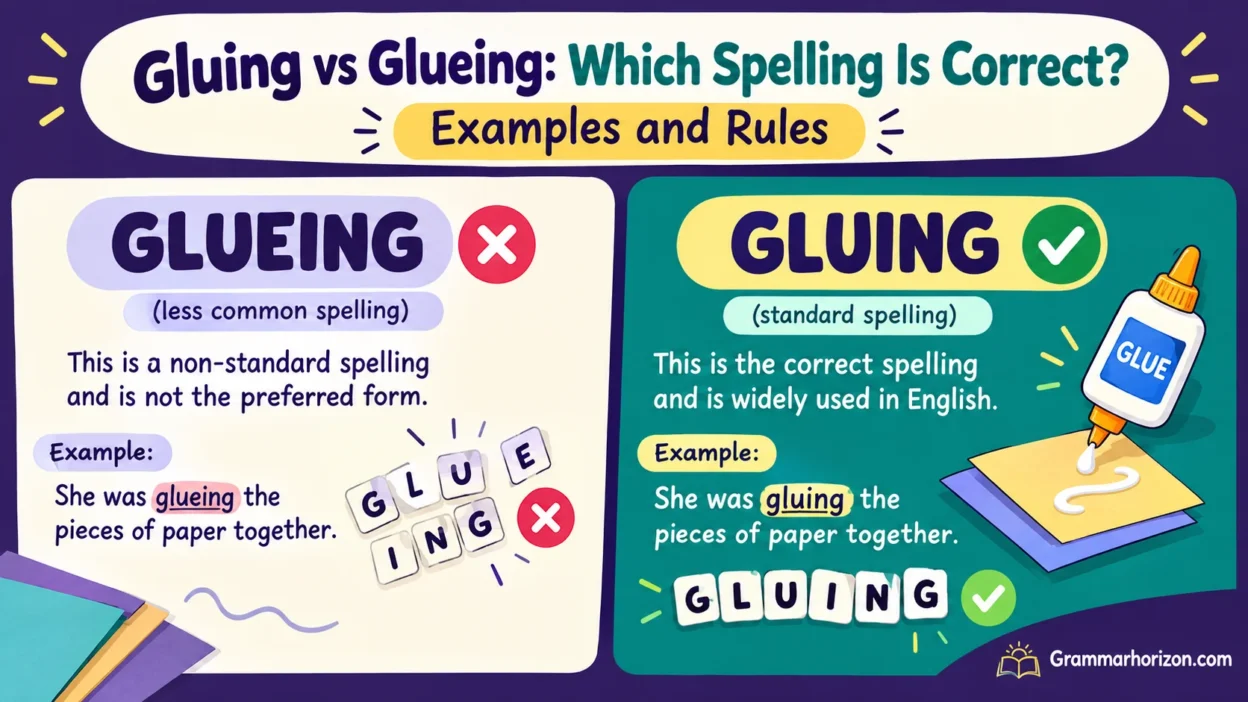
The Gluing vs Glueing question often confuses learners, but the answer is simple: gluing is the correct modern English spelling. The base word is glue, and when you add -ing, the final silent e is dropped. This creates gluing, just as make becomes making and write becomes writing. Although glueing may look logical because it keeps the e, standard English spelling uses gluing. Both American English and British English follow this spelling pattern, making gluing the preferred form in everyday and formal writing.
The difference becomes important when students, writers, or professionals use the word in a school assignment, article, email, report, or instruction manual. Dictionaries generally recognize gluing as the standard verb form, while glueing is an incorrect or less accepted variant in modern usage. The spelling rule is useful because it removes confusion and keeps writing clear for readers. For example, she is gluing the broken cup correctly. The word gluing shows that the final e has been removed before adding ing.
In formal documentation, schools, workshops, forums, and online communities, using the familiar spelling can also improve clarity and credibility. Native speakers may understand both forms because they look alike, but glueing can still appear distracting to an audience that expects standard English spelling. The rule is therefore easy to remember: drop the silent e before adding -ing. Once you recognize this familiar English spelling pattern, choosing gluing instead of glueing becomes straightforward.
Quick Answer: Gluing vs Glueing?
Gluing is the preferred spelling in modern American English.
Glueing does appear in English usage, including some older and less common sources, but it isn’t the spelling most writers should choose today.
Both forms refer to the same action: using glue to attach, join, or bond something to another surface or object. The difference isn’t the meaning. It’s spelling and usage.
| Spelling | Usage | Meaning | Recommended? |
| Gluing | Standard modern usage | Attaching something with glue | Yes |
| Glueing | Less common variant | Attaching something with glue | Usually no |
| Glued | Past tense/past participle | Attached with glue | Yes |
| Glue | Base verb or noun | To attach with adhesive / adhesive substance | Yes |
If you’re writing for a US audience, gluing is the safest and most natural choice.
Comparison Overview
The easiest way to understand gluing vs. glueing is to compare how each form behaves in actual writing.
| Feature | Gluing | Glueing |
| Basic meaning | Attaching with glue | Attaching with glue |
| Spelling pattern | Drops final e | Keeps e |
| Modern frequency | Common | Much less common |
| American English | Preferred | Uncommon |
| Formal writing | Recommended | Usually avoided |
| Everyday writing | Natural | May look unusual |
| Grammatical role | Present participle or gerund | Variant present participle or gerund |
The important point is simple: gluing and glueing don’t describe two different activities. They describe the same action.
Imagine you’re writing instructions for a craft project. You might say, “Start by gluing the paper to the cardboard.” That sentence sounds natural to most modern English readers.
Writing “Start by glueing the paper to the cardboard” won’t necessarily make the meaning unclear. Still, gluing is the more familiar choice.
What Does “Gluing” Mean?
Gluing means attaching one thing to another by applying glue or another adhesive.
The word can describe a simple craft project or a highly technical manufacturing process. A child might be gluing pieces of paper together. A carpenter might be gluing wooden joints. A manufacturer might be gluing components during assembly.
The basic action remains the same: an adhesive creates a bond between surfaces.
Gluing in Everyday Sentences
Here are several natural examples:
- “She is gluing the photographs into her scrapbook.”
- “The children spent the afternoon gluing paper shapes together.”
- “He is gluing the broken handle back onto the cup.”
- “We’re gluing the wooden pieces together.”
- “The instructions recommend gluing the pieces before painting them.”
Notice that gluing works smoothly in each sentence. It follows the verb glue and describes an action happening over time.
Why Is It “Gluing” Instead of “Glueing”?
The main reason is a common English spelling rule involving a final silent e.
When many verbs ending in a silent e take the suffix -ing, the final e disappears.
For example:
| Base Verb | + -ing | Result |
| make | make + ing | making |
| write | write + ing | writing |
| bake | bake + ing | baking |
| drive | drive + ing | driving |
| use | use + ing | using |
| glue | glue + ing | gluing |
So the spelling process is:
glue → remove final e → gluing
That’s why gluing looks different from the base word glue.
The Silent-E Rule
The final e in glue doesn’t normally remain when you add -ing.
You don’t write:
- making
- writing
- baking
- driving
Instead, you write:
- making
- writing
- baking
- driving
The same general pattern gives us gluing.
English spelling has plenty of exceptions, so you shouldn’t treat this as an absolute rule for every word. Still, it provides the correct explanation for glue → gluing.
Is “Glueing” Correct?
Glueing isn’t simply a meaningless collection of letters. It has appeared as a spelling variant in English. That’s why you may occasionally encounter it in older material, dictionaries, publications, or user-generated writing.
However, appearance in English usage doesn’t automatically make spelling the best choice for modern writing.
For most contemporary American English contexts, gluing is the better option.
Why You May Still See “Glueing”
English spelling has developed over centuries rather than through one perfectly consistent system. Different dictionaries, publishers, regions, and historical periods have sometimes preserved alternative forms.
As a result, you may encounter glueing even though gluing is much more familiar today.
This distinction matters because calling every occurrence of glueing an outright error oversimplifies the history of English spelling. The more useful advice is practical: if you’re choosing the spelling yourself, use gluing.
Should You Use “Glueing” in American English?
Generally, no.
If you’re writing for an American audience, gluing is clearer, more familiar, and more consistent with modern standard usage.
Use glueing only when you have a specific reason to preserve a source’s spelling or discuss the variant itself.
Gluing vs Glueing: Main Differences
The biggest difference between gluing and glueing is spelling preference rather than meaning.
Spelling
Gluing removes the final e before adding -ing.
Glueing keeps the final e.
That single letter creates the entire spelling difference.
Meaning
There is no meaningful difference in what the two forms describe.
Both refer to attaching something with glue.
For example:
“She is gluing the pieces together.”
and
“She is glueing the pieces together.”
Both sentences communicate the same basic idea. The first is simply the preferred modern spelling.
Grammar
Gluing functions as the present participle of glue and can also function as a gerund.
For example:
- “He is gluing the pieces.” — present participle
- “Gluing takes patience.” — gerund
Modern Usage
Modern readers are much more likely to recognize gluing immediately.
That familiarity gives it an advantage in practical writing. When two forms communicate the same idea, the form that readers encounter more often is usually the better choice for straightforward communication.
How “Gluing” Works Grammatically
Understanding the grammar behind gluing makes the spelling easier to remember.
Gluing as a Present Participle
A present participle commonly appears with a form of be to describe an action in progress.
Examples include:
- “I am gluing the pieces together.”
- “She is gluing a label onto the box.”
- “They were gluing the wooden panels.”
- “We are gluing the model together.”
Here, gluing helps show that the action is happening at a particular time.
Gluing as a Gerund
The same -ing form can act like a noun.
Consider:
“Gluing requires patience.”
In this sentence, gluing isn’t describing what someone is currently doing. Instead, it names an activity.
Another example is:
“Gluing the pieces correctly takes practice.”
Here, the entire phrase gluing the pieces correctly acts as the subject of the sentence.
Common Phrases With Gluing
You’ll often see gluing used in combinations such as:
- gluing something together
- gluing something to something
- gluing pieces into place
- gluing two surfaces together
- gluing a part onto a larger object
- gluing paper to cardboard
These patterns are useful because they show how the word works naturally in real sentences.
Gluing Examples in Different Contexts
The word gluing appears in far more situations than simple arts and crafts.
Crafts and DIY
Craft instructions frequently use gluing to describe attaching paper, fabric, cardboard, wood, foam, or decorations.
For example:
“After cutting the shapes, start gluing them onto the cardboard.”
The word fits naturally into step-by-step instructions.
Repairs
People also use gluing when describing small household repairs.
For example:
“He repaired the loose trim by gluing it back into place.”
In this context, the word describes the repair method rather than the object itself.
Woodworking and Construction
Woodworkers often talk about gluing joints, panels, veneers, or other wooden components.
For example:
“The carpenter spent several minutes gluing the joint before clamping it.”
The exact adhesive may vary, but the grammatical form remains gluing.
Manufacturing and Technical Writing
Industrial processes can involve adhesives for bonding materials and components.
A technical document might say:
“The operator begins by gluing the two components along the designated seam.”
Here, precise language matters. A consistent spelling such as gluing keeps instructions professional and easy to scan.
Common Mistakes With Gluing and Glueing
The most common mistake is assuming that glueing must be correct simply because the base word is glue.
English spelling doesn’t always work by attaching a suffix without changing anything.
Mistake: Keeping the Final E
A writer may reason:
glue + ing = glueing
That calculation looks logical, but standard spelling gives us:
glue + ing = gluing
The final e is dropped.
Mistake: Treating the Two Forms as Different Words
Another mistake is assuming that gluing and glueing have different meanings.
They don’t.
The difference concerns spelling and usage rather than the underlying action.
Mistake: Switching Forms in One Article
Consistency also matters.
If an instruction manual uses gluing in one section and glueing in another, readers may wonder whether the difference is intentional.
Choose gluing and use it consistently.
When Does English Keep the Final “E” Before “-ing”?
This is where English spelling gets interesting.
The final e often disappears before -ing, but English contains exceptions and special patterns.
Consider these examples:
| Word | Correct -ing Form |
| make | making |
| write | writing |
| hope | hoping |
| bake | baking |
| use | using |
| glue | gluing |
| see | seeing |
| agree | agreeing |
Why do they see and agree to keep their final letters?
Because their spelling and pronunciation patterns differ from verbs such as make and glue. The e in see isn’t simply functioning like the silent final e in make.
This is why it’s better to learn common spelling patterns rather than apply one rule mechanically to every verb.
Gluing vs. Glueing in American English
For American English, gluing is the clear practical choice.
You’ll want to use it in:
- School assignments
- Business writing
- Website content
- Instruction manuals
- Product descriptions
- Emails
- Reports
- Professional documents
- Everyday communication
The reason isn’t complicated. Gluing is the familiar modern form, so readers don’t have to stop and question the spelling.
Good writing should remove unnecessary friction. Choosing the standard form does exactly that.
Gluing vs Glueing in British English
The distinction isn’t as simple as saying that gluing is American while glueing is British.
Gluing is also widely recognized and used in British English. Glueing can appear as a variant, but it isn’t necessary to use it simply because you’re writing for a British audience.
Therefore, regional spelling isn’t the main reason to choose between these forms.
The stronger practical rule is this: use the spelling preferred by your intended style guide, publisher, school, or organization. When no special style requirement exists, gluing is the straightforward choice.
How to Remember the Correct Spelling
Here’s an easy memory trick:
Glue loses its final e before -ing.
Think of the pattern:
glue → gluing
Then connect it with familiar examples:
make → making
write → writing
bake → baking
glue → gluing
Once you recognize the pattern, glueing starts to look unusual.
Gluing vs. Glueing: Quick Examples
| Less Preferred | Preferred |
| She is glueing the paper. | She is gluing the paper. |
| We are glueing the pieces together. | We are gluing the pieces together. |
| He spent an hour glueing the model. | He spent an hour gluing the model. |
| They started glueing the wood. | They started gluing the wood. |
| Glueing requires patience. | Gluing requires patience. |
These examples show the practical difference clearly. The sentence structure and meaning stay the same. The preferred spelling simply drops the final e.
Read Also:Is It Anual or Annual? Which Is Correct? Complete Guide to the Correct Spelling
Conclusion
Gluing is the correct modern English spelling, while glueing is generally considered incorrect. The spelling follows the common rule of dropping the final silent e before adding -ing, just as in making and writing. Whether you’re writing for school, work, or everyday communication, choose gluing for clear and standard English.
FAQs
Q1. Is gluing vs glueing correct?
Gluing is the correct standard spelling. Glueing is generally treated as an incorrect spelling in modern English.
Q2. Why is gluing spelled without the e?
The final silent e in glue is dropped before the -ing ending is added. This gives us gluing.
Q3. Is glueing ever acceptable?
You may see glueing in some older or nonstandard writing, but gluing is the preferred form in modern standard English.
Q4. Is gluing correct in American English?
Yes. Gluing is the standard spelling in American English.
Q5. Is gluing correct in British English?
Yes. Gluing is also the standard spelling in British English.
Q6. What is the rule for gluing?
The rule is simple: drop the final silent e before adding -ing. Therefore, glue + ing = gluing.
Q7. What is an example of gluing?
A simple example is: “She is gluing the broken cup.” Here, gluing is the correct spelling.