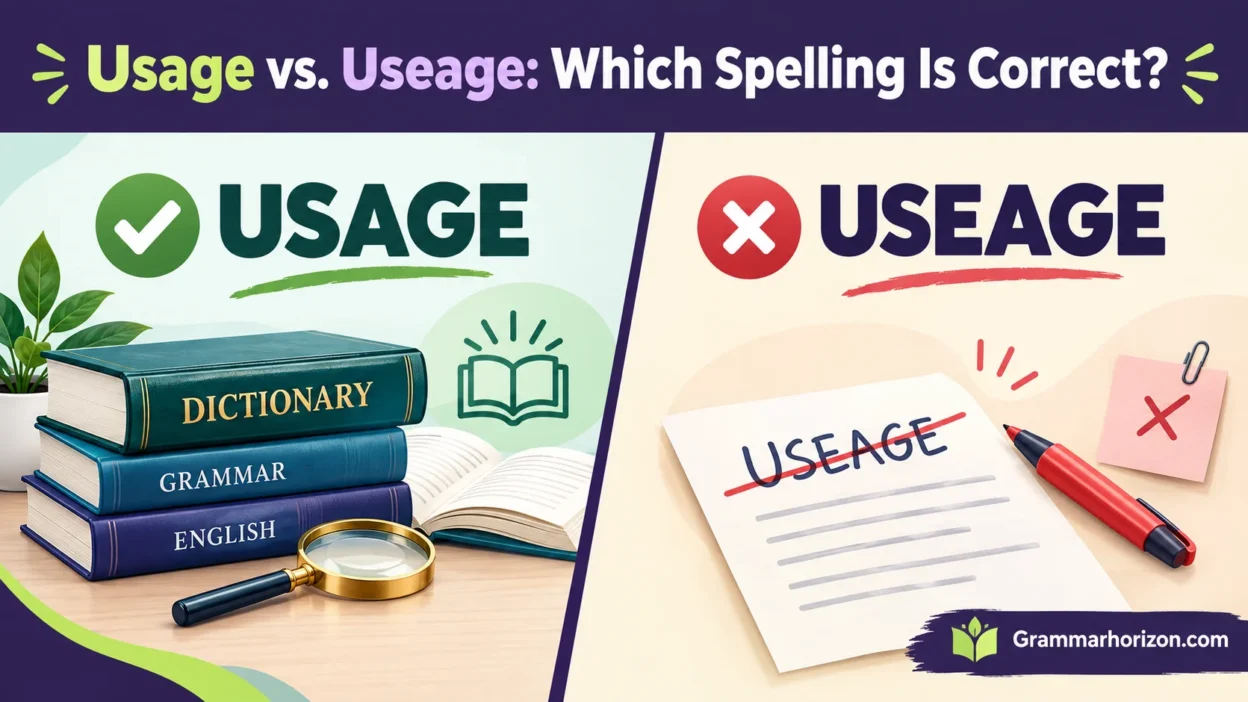
Usage vs. Useage can confuse learners because both words look similar, but only usage is the correct form in standard English writing. The difference is easy to understand: usage refers to the way something is used, especially in language, while useage is a common spelling mistake. Understanding this important distinction can make your writing more clear, professional, and trustworthy. A simple way to remember the correct spelling is to use usage whenever you need the noun related to use.
The correct spelling is usage, not useage. Although useage may seem logical because the word use appears at the beginning, the standard English word drops the silent e before adding the suffix. This spelling rule is fairly predictable once you recognize the pattern. In formal writing, an essay, business report, email, or online content, choosing the correct spelling matters because a spelling mistake can affect readers’ perception and credibility. For example, you can write, “The usage of this word has changed,” or “This guide explains proper usage.”
For language learners, this word comparison becomes easier when you focus on word meaning and word usage rather than memorizing both spellings. Useage is not the correct form, even though it may look natural at first. Using usage helps you avoid common mistakes and improve your English words, clear writing, and professional communication. This guide also makes common spelling questions easier to handle because you can connect usage with accepted language terms, proper sentences, and standard English writing.
Quick Answer
The short answer is simple:
- Usage is the correct spelling.
- Useage is an incorrect spelling and should never be used in standard English.
If you’re referring to the way something is used or accepted language practices, always choose usage.
Here are a few examples:
- ✅ The teacher explained the proper usage of commas.
- ✅ Daily smartphone usage has increased significantly.
- ❌ The teacher explained the proper useage of commas.
No matter whether you’re writing in American English or British English, usage is the only accepted spelling.
Comparison Overview
The table below summarizes the key differences between usage and useage.
| Feature | Usage | Useage |
| Correct spelling | ✅ Yes | ❌ No |
| Recognized in dictionaries | ✅ Yes | ❌ No |
| Standard English | ✅ Yes | ❌ No |
| Suitable for formal writing | ✅ Yes | ❌ No |
| Part of speech | Noun | Misspelling |
| Meaning | The way something is used | No accepted meaning |
| Recommended in academic writing | ✅ Yes | ❌ Never |
Key takeaway: Whenever you’re tempted to write useage, replace it with usage.
Definition of Usage
Usage is a noun that refers to the way a word, phrase, object, or practice is used. It can also describe the accepted or customary way of using language, as well as the amount or frequency with which something is used. In grammar, usage relates to correct language conventions, while in everyday contexts it often refers to consumption or utilization, such as data usage, water usage, or energy usage. Because it describes established or proper use, usage is the only correct spelling recognized in standard English.
What Does “Usage” Mean?
Usage is a noun that refers to the way a word, phrase, object, or practice is used. It can also describe accepted customs, language conventions, or patterns of behavior.
In simple terms, usage explains how something is used.
For example:
- Proper usage of grammar improves clarity.
- Water usage increases during the summer.
- Internet usage continues to grow worldwide.
Although the meaning changes slightly depending on the context, the central idea remains the same: usage describes use in practice.
Common Contexts Where “Usage” Appears
You’ll find the word usage in many areas of everyday life.
Language and Grammar
Teachers and editors often discuss:
- Word usage
- Grammar usage
- Correct usage
- Common usage
Example:
Correct usage makes writing easier to understand.
Technology
Technology companies frequently measure:
- Data usage
- Battery usage
- Memory usage
- Internet usage
- App usage
Example:
The latest update reduced battery usage.
Business
Businesses monitor:
- Product usage
- Customer usage
- Service usage
- Subscription usage
Example:
Monthly product usage increased after the new feature launched.
Education
Students encounter the word in subjects like English, linguistics, and communication.
Example:
The professor explained the proper usage of transition words.
Pronunciation
The word usage is pronounced:
YOO-sij
The pronunciation doesn’t include a noticeable sound for the missing e, which explains why many people accidentally misspell it.
Definition of Useage
Useage is not a real word in standard English. It is a common misspelling of usage and has no accepted definition in modern dictionaries or grammar guides. Many people mistakenly write useage because they assume the silent e in use remains when adding the suffix -age. However, the correct spelling is always usage, vs useage should be avoided in academic, professional, and everyday writing.
Is “Useage” a Real Word?
No.
Useage is not a recognized English word. It is simply a misspelling of usage.
You won’t find useage listed as a standard word in reputable English dictionaries. Instead, dictionaries identify it as an incorrect spelling.
Because of that, you should avoid using useage in:
- School assignments
- Business documents
- Professional emails
- Research papers
- Books
- Blog posts
- Resumes
Why Does “Useage” Appear So Often?
Many people assume that adding -age to the word use creates useage.
That assumption feels logical. Unfortunately, English spelling follows a different rule.
When the suffix -age is added, the silent e is dropped, producing usage.
This spelling has been standard for centuries.
Main Differences Between Usage vs Useage
Although these two spellings differ by only one letter, one is correct and the other isn’t.
| Usage | Useage |
| Correct English spelling | Incorrect spelling |
| Accepted by dictionaries | Not accepted |
| Used in formal writing | Considered an error |
| Appears in academic writing | Should never appear |
| Standard worldwide | Misspelling worldwide |
Only “Usage” Is Correct
Every major English dictionary, grammar guide, university, and publishing style guide recognizes usage as the correct spelling.
This applies to:
- American English
- British English
- Canadian English
- Australian English
There are no regional exceptions.
“Useage” Is Always Incorrect
Unlike words such as color and colour, usage and useage are not alternative spellings.
There isn’t an American version and a British version.
There isn’t a modern version and an older version.
There isn’t a technical meaning for useage.
It is simply a spelling mistake.
Why the Difference Matters
Correct spelling does more than satisfy grammar rules. It builds trust with your readers.
Imagine reading these two sentences:
- The report analyzes customer usage patterns.
- The report analyzes customer useage patterns.
The first sentence looks polished and professional.
The second sentence immediately stands out as incorrect, even though the intended meaning is obvious.
Whether you’re writing for school, work, or your website, using the correct spelling helps your content appear more reliable.
Why Do People Confuse Usage vs Useage?
If useage is incorrect, why do so many people write it?
The answer comes down to spelling patterns and human instinct.
The Base Word Is “Use”
Most people start with the verb use.
Since the word ends with a silent e, it’s natural to think the letter should remain when another ending is added.
That assumption creates the incorrect spelling useage.
English Spelling Isn’t Always Consistent
English contains many words that either keep or remove the final e before adding a suffix.
Because there isn’t one universal rule for every word, writers often rely on guesswork.
Unfortunately, that guess is wrong in this case.
Pronunciation Doesn’t Reveal the Spelling
The pronunciation of usage doesn’t clearly indicate whether an e appears before -age.
Since the spoken word sounds like YOO-sij, many people spell it based on what seems logical instead of memorizing the correct form.
Typing Habits
Fast typing also contributes to the mistake.
Many writers instinctively type:
use + age = useage
They don’t stop to consider whether the spelling follows English conventions.
Similar Words Cause Confusion
English includes many words ending in -age, such as:
- Package
- Message
- Marriage
- Baggage
- Postage
Seeing these familiar patterns makes useage appear believable, even though it has never been the correct spelling.
Autocorrect Isn’t Foolproof
Modern spell checkers usually identify useage as an error, but they aren’t perfect.
Older software, browser settings, or custom dictionaries may overlook the mistake.
That’s why it’s important to understand the rules instead of relying entirely on technology.
Spelling Rule Behind “Usage”
One of the easiest ways to remember the correct spelling is to understand why it is spelled this way.
When the suffix -age is added to use, the silent e is dropped.
The result is:
- Use + -age = Usage
This follows a long-established spelling convention in English and is the form accepted by dictionaries and style guides.
Learning the rule helps you avoid the mistake naturally instead of trying to memorise the word by itself.
Read More:Sweet vs Sweat: What’s the Difference? Meaning, Grammar, Pronunciation
Conclusion
The difference between usage and useage is simple once you remember that usage is the correct spelling, while useage is a common spelling mistake. Whether you’re writing an essay, email, business report, or online content, choosing usage keeps your English clear and professional.
FAQs
Q1. Is “usage” the correct spelling?
Yes. Usage is the correct spelling. Useage is incorrect in standard English.
Q2. Is “useage” a real word?
No. Useage is generally considered a misspelling of usage.
Q3. What does “usage” mean?
Usage means the way something is used. It can also refer to accepted or common language practices.
Q4. Why do people spell usage as useage?
People often write useage because they connect the word directly to use and mistakenly keep the silent e.
Q5. .How can I remember the spelling of usage?
Remember that the correct form is usage, without the extra e between us and age.
Q6. Can I use “usage” in formal writing?
Yes. Usage is appropriate in formal writing, including essays, reports, emails, and professional documents.
Q7. What is the difference between usage and useage?
Usage is the correct English word. Useage is a spelling error and should be avoided.