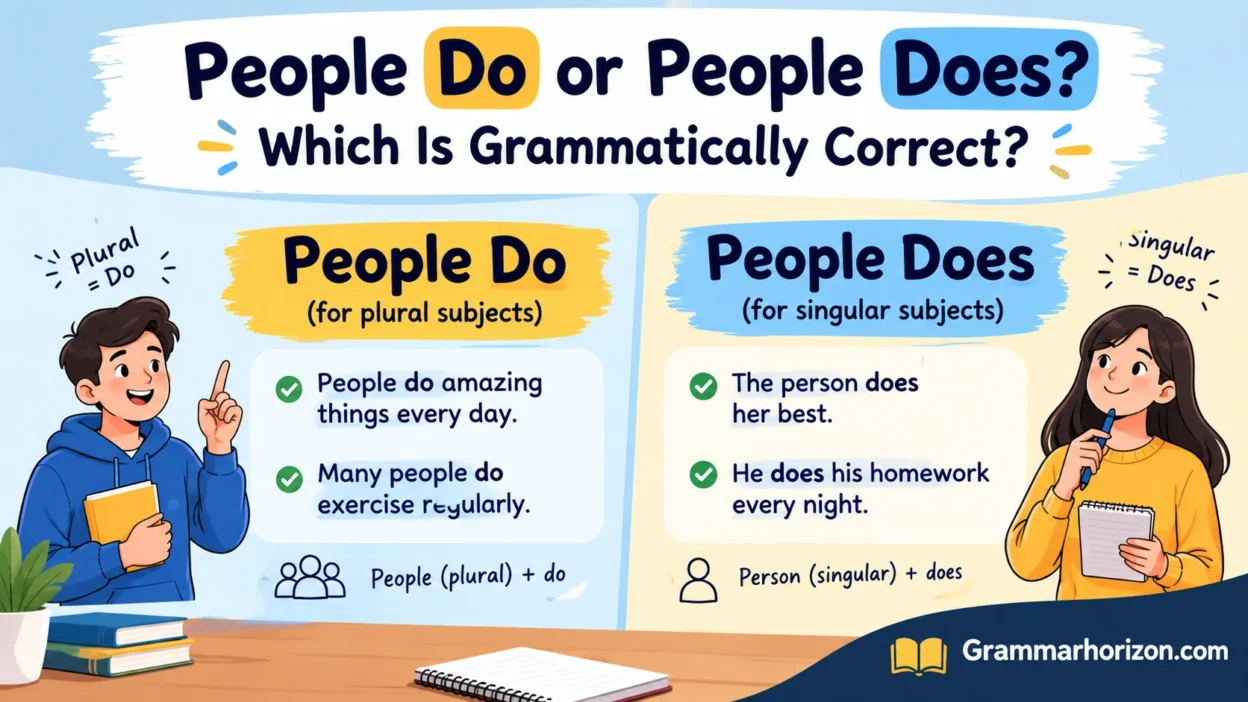
When you’re deciding between people do or people does, the main grammar choice depends on subject-verb agreement. People do is the correct form, while people does is incorrect because people is a plural noun. This simple grammar pattern works naturally in a sentence or question, especially when English learners are writing or speaking. The basic rule is simple: use do with people, not does. In English, does usually follows a singular subject, while do follows a plural subject. This difference is an important part of correct grammar and helps you use the right verb with the right subject.
The word people can refer to students, parents, friends, or writers in classrooms, workplaces, emails, and social media posts. For example, “People do make mistakes” is a correct sentence, while “People does make mistakes” is an incorrect one. A useful memory trick is to remember that people means more than one person, so it needs the plural verb do. This correct grammar rule can help you avoid a common mistake and make your English sound more natural. The guide becomes even easier when you compare people do with “a person does.”
Understanding the usage of people do and people does can prevent common mistakes in everyday English. Learners often confuse these phrases because does appears with singular subjects, but the context makes the difference clear. In real-life examples, you’ll see that people do works when several individuals perform an action, while a person does works for one individual. This rule also explains why agreement matters in writing and speaking. If you remember this basic grammar pattern, you can choose the correct form more confidently and speak and write more naturally.
Quick Answer
If you’re in a hurry, here’s the simple answer.
| Expression | Correct? | When to Use |
| People do | ✅ Yes | Standard English with the plural noun people |
| People does | ❌ No | Grammatically incorrect in standard English except in quoted dialect or intentional nonstandard speech |
Examples:
- People do make mistakes.
- People do enjoy learning new skills.
- People do change over time.
- ❌ People does enjoy music.
- ❌ People does know the answer.
Quick Grammar Rule: A plural subject takes the verb do, while a singular subject takes does.
Comparison Overview
Before diving deeper, compare the two expressions side by side.
| Feature | People Do | People Does |
| Grammar | Correct | Incorrect in standard English |
| Subject Number | Plural | Incorrect verb agreement |
| Used in Formal Writing | Yes | No |
| Used in Academic Writing | Yes | No |
| Used in Business Emails | Yes | No |
| Common in Daily Conversation | Yes | Rare except dialects |
| Recommended for Exams | Yes | Never |
This comparison highlights the biggest difference. The issue isn’t the word people itself. The problem is choosing the correct helping verb to match the subject.
Main Differences Between People Do vs. People Does
Although the two phrases differ by only one word, they follow completely different grammar rules.
People Do
The phrase people do follows standard English grammar because people is normally plural. Plural subjects require the verb do.
Examples:
- People do appreciate honesty.
- People do learn from experience.
- People do support good ideas.
People Does
The phrase people does breaks the basic rule of subject-verb agreement. Since people is plural, pairing it with does creates a grammatical error.
Incorrect examples:
- ❌ People does understand the policy.
- ❌ People does like fresh coffee.
- ❌ People does enjoy vacations.
Side-by-Side Examples
| Correct | Incorrect |
| People do care. | People does care. |
| People do vote. | People does vote. |
| People do improve with practice. | People does improve with practice. |
| People do ask questions. | People does ask questions. |
| People do enjoy good stories. | People does enjoy good stories. |
A simple change from does to do instantly makes these sentences grammatically correct.
Why “People Do” Is Correct
The answer lies in one of the most important grammar rules in English: subject-verb agreement.
Every sentence needs a subject and a verb that agree in number. If the subject is singular, the verb should also be singular. If the subject is plural, the verb should be plural.
Since people almost always refer to more than one person, English treats it as a plural noun.
Think about these examples.
- One person does.
- Two people do.
- One student does.
- Many students do.
- One employee does.
- Several employees do.
Notice the pattern. Whenever the subject becomes plural, the helping verb changes from does to do.
“People” Is a Plural Noun
The word people is the irregular plural form of person.
| Singular | Plural |
| Person | People |
| Child | Children |
| Man | Men |
| Woman | Women |
| Mouse | Mice |
Unlike regular plurals that simply add -s, the word people changes completely. That unusual spelling often causes confusion because many learners expect plural nouns to end with -s.
Subject-Verb Agreement Explained
Subject-verb agreement means your verb must match your subject.
Here’s an easy pattern to remember.
| Subject | Correct Verb |
| Person | Does |
| Student | Does |
| Teacher | Does |
| People | Do |
| Students | Do |
| Teachers | Do |
Once you identify whether the subject is singular or plural, choosing the correct verb becomes much easier.
Why the Verb Changes
English verbs change slightly depending on the subject.
For the present tense:
| Subject | Verb |
| I | Do |
| You | Do |
| We | Do |
| They | Do |
| People | Do |
| He | Does |
| She | Does |
| It | Does |
| Person | Does |
This pattern applies consistently across almost every situation.
Grammar Tip: Ignore how a word looks. Focus on whether it represents one person or more than one.
When Can “People Does” Ever Be Correct?
In standard English, people does is considered incorrect. However, there are a few special situations where you might still see or hear it.
These situations don’t change the grammar rule. They simply reflect how language works in real life.
Quoted Speech
Writers often preserve someone’s exact words, even if those words contain grammar mistakes.
Example:
“People does whatever they want around here,” the character complained.
The quotation reflects how the speaker actually talks. The author intentionally keeps the original wording.
Fiction and Regional Dialects
Some novels use local dialects to create realistic characters.
For example, a storyteller may write dialogue exactly as someone from a particular region speaks.
That doesn’t make the grammar standard. It simply reflects authentic speech.
Humor and Internet Memes
Online jokes sometimes use incorrect grammar on purpose.
Examples include:
- People does funny things.
- Internet does internet things.
- Brain does not cooperate today.
These playful mistakes create humor because readers immediately recognize that the grammar is intentionally wrong.
Outside of comedy, dialogue, or quoted speech, professional writers should always use people do.
Understanding Subject-Verb Agreement
Subject-verb agreement forms the foundation of clear English writing.
Every complete sentence contains a subject that performs an action and a verb that describes that action. Those two parts must agree in number.
Compare these examples.
| Subject | Correct Sentence |
| The child | The child does well in school. |
| The children | The children do well in school. |
| The manager | The manager does a great job. |
| The managers | The managers do a great job. |
| The people | The people do amazing work. |
Although English contains many grammar rules, this one remains consistent. Once you learn it, you’ll avoid hundreds of common mistakes.
Why Learners Get Confused
If the rule is so simple, why do so many people still write people does?
The answer comes down to several common misunderstandings.
“People” Doesn’t End in -S
Many learners associate plural nouns with an -s ending.
Examples include:
- Cars
- Dogs
- Teachers
- Books
Since people don’t follow that pattern, some assume it’s singular. In reality, it’s already a plural noun.
Mixing Up “Person” and “People”
Because person takes does, learners sometimes carry that verb over to people.
Compare these examples.
- The person does agree.
- The people do agree.
Changing the noun also changes the verb.
Confusing Collective Nouns
Words like team, family, committee, and government sometimes behave differently depending on context. That can make learners think people follow the same flexible rule.
It doesn’t.
In standard English, people remains plural when referring to more than one individual, so it always pairs with do.
Influence of Informal Speech
You may occasionally hear incorrect grammar in casual conversations.
Native speakers sometimes speak quickly, shorten sentences, or make mistakes without noticing.
Hearing these errors repeatedly can make incorrect patterns seem acceptable even though grammar guides still consider them wrong.
Translation from Other Languages
Many languages form sentences differently from English.
When learners translate directly from their native language, they may accidentally choose does because their first language follows different agreement rules.
The best solution is simple. Instead of translating word for word, think about whether your English subject is singular or plural. Once you answer that question, choosing between do and does becomes almost automatic.
People vs. Person
One of the easiest ways to master people do vs. people does is to understand the difference between person and people. Although these words are closely related, they require different verbs because one is singular and the other is plural.
| Word | Number | Correct Verb | Example |
| Person | Singular | Does | The person does excellent work. |
| People | Plural | Do | The people do excellent work. |
Notice how only the subject changes. The verb changes with it to maintain proper subject-verb agreement.
Singular and Plural Forms
The word person refers to one individual.
Examples:
- One person does the cleaning.
- One person knows the answer.
- One person makes the decision.
The word people refers to two or more individuals.
Examples:
- People do volunteer work every weekend.
- People do enjoy live music.
- People do appreciate kindness.
Learning this distinction eliminates one of the most common grammar mistakes in English.
Which Verb Goes with Each?
A simple pattern makes the choice easy.
- Person → Does
- People → Do
- He → Does
- She → Does
- They → Do
- We → Do
Whenever you’re unsure, replace people with them. If they do sound correct, then people do.
“People” as a Singular Noun
Although people is usually plural, English has one important exception.
Sometimes people refer to an entire nation, tribe, or ethnic group. In that case, people function as a collective singular noun.
Examples:
- The Japanese people has a rich cultural history.
- The Indigenous people preserve many traditions.
However, modern grammar experts generally recommend treating people as plural even in these contexts.
Preferred examples:
- The Japanese people have a rich cultural history.
- The Indigenous people continue to preserve their traditions.
This special meaning does not make people does correct.
For example:
- ❌ The Japanese people does celebrate…
- ✅ The Japanese people do celebrate…
Even when referring to a nation or ethnic group, do remains the correct choice in modern English.
How to Use “People Do” Correctly
Once you understand the grammar rule, using people does become natural.
Positive Statements
General facts often use people do.
Examples:
- People do value honesty.
- People do need encouragement.
- People do learn from failure.
- People do remember kindness.
- People do benefit from regular exercise.
Negative Sentences
Negative statements use do not or don’t.
Examples:
- People don’t like being ignored.
- People don’t always tell the truth.
- People don’t learn at the same speed.
- People don’t forget meaningful experiences.
- People don’t enjoy unnecessary delays.
Questions
Questions also follow the same rule.
Examples:
- Do people enjoy working remotely?
- Do people trust online reviews?
- Do people prefer simple explanations?
- Do people remember first impressions?
- Do people still read printed books?
Notice that do appears before the subject.
Short Answers
Examples:
- Do people recycle more today?
- Yes, they do.
- Do people understand the policy?
- No, they don’t.
Emphatic Sentences
Sometimes do adds emphasis.
Examples:
- People do care about quality.
- People do notice small details.
- People do appreciate honest feedback.
This structure strengthens the statement without changing its meaning.
Real-Life Examples of “People Do”
Seeing grammar in context makes it much easier to remember.
Everyday Conversations
- People do make mistakes.
- People do enjoy family vacations.
- People do help strangers.
- People do laugh at good jokes.
- People do change their opinions.
Business Communication
- People do respond better to clear instructions.
- People do expect professional service.
- People do appreciate quick replies.
- People do notice excellent customer support.
- People do recommend companies they trust.
Academic Writing
- People do learn more effectively through practice.
- People do develop language skills over time.
- People do respond differently to feedback.
- People do adapt to changing environments.
- People do retain information through repetition.
Workplace Communication
- People do perform better with clear goals.
- People do value teamwork.
- People do welcome constructive criticism.
- People do respect honest leaders.
- People do contribute unique ideas.
Emails
- People do appreciate prompt responses.
- People do notice polite language.
- People do read concise messages.
- People do respond faster to clear requests.
- People do value professional communication.
Social Media
- People do share useful content.
- People do engage with authentic stories.
- People do trust genuine recommendations.
- People do enjoy entertaining videos.
- People do react quickly to trending topics.
Common Grammar Mistakes
Even experienced writers occasionally make subject-verb agreement mistakes.
Here are the most common ones.
Using “Does” with a Plural Subject
Incorrect:
- ❌ People does understand.
- ❌ Students does study.
- ❌ Parents does care.
Correct:
- ✅ People do understand.
- ✅ Students do study.
- ✅ Parents do care.
Matching the Verb with the Wrong Word
Sometimes another noun appears closer to the verb than the actual subject.
Incorrect:
- ❌ The group of people do its best.
Correct:
- ✅ The group of people does its best.
The subject is group, not people.
Forgetting Compound Subjects
When two subjects are joined by and, they usually become plural.
Correct examples:
- Sarah and James do volunteer together.
- Teachers and students do benefit from cooperation.
Confusing Collective Nouns
Collective nouns refer to one unit.
Examples:
- The team does practice daily.
- The committee meets every Friday.
By contrast:
- The people do support the project.
Don’t confuse team with people because they follow different grammar rules.
Errors in Questions
Incorrect:
- ❌ Does people understand?
Correct:
- ✅ Do people understand?
Remember that plural subjects always take do.
People Do vs. Similar Expressions
These similar expressions often appear in writing.
| Expression | Correct Example |
| People do | People do care about honesty. |
| Person does | One person does all the planning. |
| They do | They do enjoy traveling. |
| Humans do | Humans do adapt quickly. |
| Individuals do | Individuals do make different choices. |
| Folks do | Folks do appreciate kindness. |
Although the wording changes, the grammar rule remains the same. Plural subjects require do.
British English vs. American English
Many grammar rules differ between British and American English, but this isn’t one of them.
Both varieties use:
- People do agree.
- People do understand.
- People do work together.
Neither standard accepts people does in formal writing.
The only differences involve vocabulary, spelling, and style rather than subject-verb agreement.
Formal vs. Informal English
Whether you’re writing a research paper or sending a text message, the grammar stays the same.
| Situation | Correct Form |
| Academic writing | People do |
| Business email | People do |
| News article | People do |
| Blog post | People do |
| Everyday conversation | People do |
Informal speech may contain grammar mistakes, but professional writing should always follow standard English rules.
Grammar Rules from Trusted Sources
Leading dictionaries and grammar references agree on one principle:
- People is normally a plural noun.
- Plural subjects take do, not does.
- People does is considered nonstandard English except in quoted speech or intentional dialect.
As a result, you’ll consistently find people do in newspapers, academic journals, business documents, government publications, and professionally edited books.
Decision Guide
Use this quick guide whenever you’re unsure.
| If Your Subject Is… | Use |
| Person | Does |
| He | Does |
| She | Does |
| It | Does |
| People | Do |
| They | Do |
| We | Do |
| Students | Do |
If the subject refers to more than one person, choose do.
Memory Trick
Here’s an easy trick you’ll remember.
Replace people with they.
- They do agree.
- People do agree.
If they do sound correct, then people do it correctly as well.
This simple substitution works almost every time.
Practice Exercise
Choose the correct answer.
- People (do / does) enjoy learning.
- The person (do / does) understand the instructions.
- Do / Does people like surprises?
- People (do / does) make mistakes every day.
- My teacher (do / does) explain grammar clearly.
Answers
- Do
- Does
- Do
- Do
- Does
Quick Quiz
Choose the correct sentence.
- A. People do work hard.
B. People do work hard. - A. The person do agree.
B. The person does agree. - A. Do people understand?
B. Do people understand?
Correct Answers: 1-B, 2-B, 3-A
Read Also:Shown vs. Showed: What’s the Difference and Which One Should You Use?
Cheat Sheet
| Situation | Correct Form |
| One person | Person does |
| More than one person | People do |
| Asking a question | Do people…? |
| Negative sentence | People don’t… |
| Formal writing | People do |
| Business communication | People do |
Conclusion
Choosing people do or people does becomes much easier when you remember the basic subject-verb agreement rule. People do is the correct form because people is a plural noun, while people does is incorrect. Using the right form helps you avoid common grammar mistakes and make your English sound more natural.
FAQs
Q1. Is “people do” grammatically correct?
Yes, people do is grammatically correct because people is a plural noun and takes the plural verb do.
Q2. Is “people does” ever correct?
No, people do is not correct in standard English. Use people do when referring to more than one person.
Q3. Why do we use “do” with people?
We use do because people refer to multiple individuals. Plural subjects generally take do, while singular subjects can take does.
Q4. What is the difference between “people do” and “a person does”?
People do refer to multiple people, while a person does refer to one person. The verb changes because of subject-verb agreement.
Q5. Can I use “people do” in questions?
Yes. For example, you can ask, “Why do people make this mistake?” The auxiliary verb do agrees with the plural subject people.