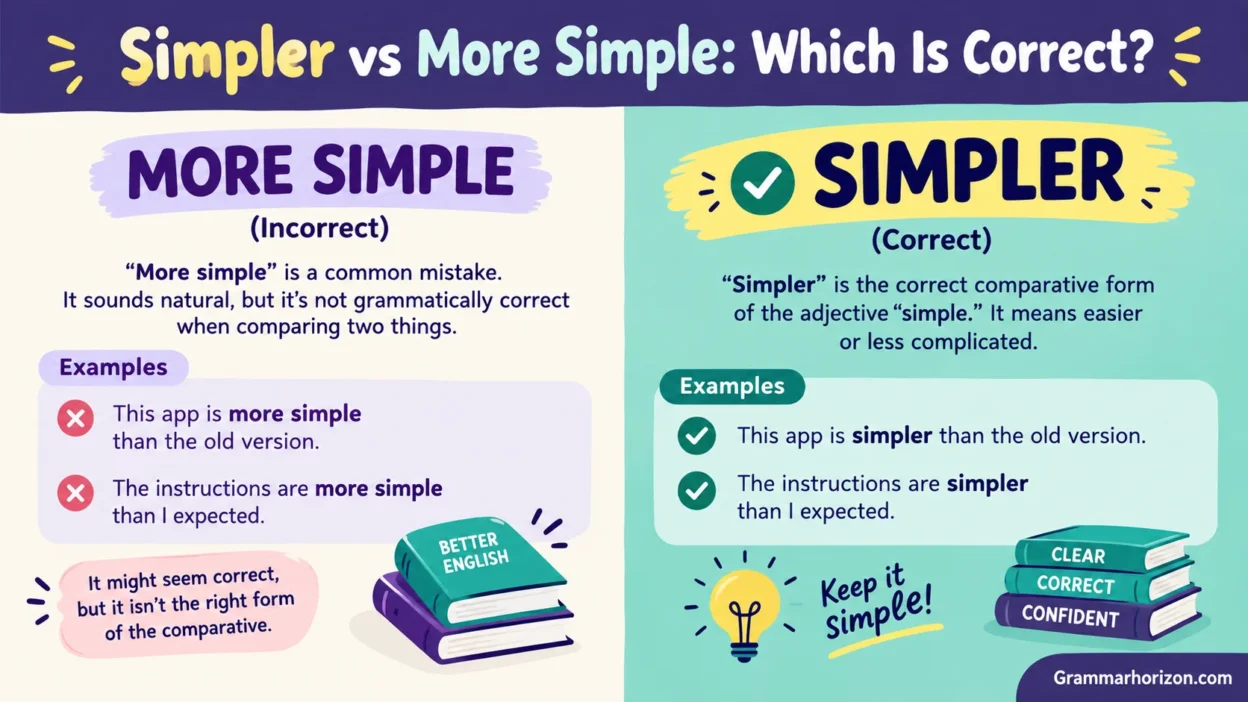
Simpler vs More Simple both express the same basic idea when you compare something that has less complexity or is less complex. In real English, simpler is the usual comparative form of simple, while more simple is an alternative. Both expressions can communicate the intended meaning, and both are grammatically acceptable, but they are not equally common. In most situations, simpler is the better choice because it sounds more natural in everyday conversation, professional writing, and clear explanations. For example, method is simpler sounds direct and natural, while an option that feels more simple can be used for a particular emphasis or contrast.
The main difference between the two forms involves usage, rhythm, and sentence structure rather than a strict grammar rule. Simpler is the standard one-word comparative, whereas more simple is a two-word alternative. Although the two forms can appear in everyday English, the one-word form is generally less common only in the sense that more simple is less frequently chosen. In academic work, technical explanations, and professional contexts, simpler often provides a cleaner and more direct comparison. If you are worrying about whether something more simple is unusual, remember that it remains grammatically possible and can be understood easily when the context supports it.
A useful way to break down the choice is to look at comparative adjectives and their different forms. The natural comparative form of simple is simpler, so choosing it is usually easier and avoids a complicated grammar rule. This can also help with memorising the basic pattern without confusion. More simple may still work when a writer wants a particular style, emphasis, or contrast. For example, “This method is simpler” uses the standard comparative, while “This option feels more simple” uses the two-word alternative. The choice depends on the context, intended comparison, and natural flow of the sentence.
Quick Answer: Simpler vs More Simple
Simpler is generally the preferred and more natural comparative form of simple.
For example:
- This method is simpler than the old method.
- The new instructions are simpler to follow.
- Her explanation was simpler and clearer.
- We need a simpler solution.
More simple isn’t automatically incorrect. English sometimes allows adjectives to form comparatives with more, even when an -er form exists. However, using more simple can sound less natural in many ordinary sentences.
A useful rule is simple: When you’re unsure, choose “simpler.”
That doesn’t mean you should treat it more simple as a grammar error. Instead, think of it as an alternative that has a narrower range of natural uses.
Comparison Overview
| Feature | Simpler | More Simple |
| Basic meaning | Less complex or difficult | Less complex or difficult |
| Grammatical role | Comparative adjective | Comparative adjective phrase |
| Commonness | Very common | Less common |
| Natural everyday choice | Yes | Sometimes |
| Formal writing | Preferred in most cases | Acceptable in suitable contexts |
| Example | “This plan is simpler.” | “We need a more simple approach.” |
| Best default | Yes | Usually no |
The important point is that simpler and more simple expressions usually express the same basic comparison. The main difference concerns form, frequency, rhythm, and context.
Main Differences Between Simpler vs More Simple
The biggest difference between simpler vs more simple is how English normally forms comparatives.
The adjective simple has two syllables. Some two-syllable adjectives can take the -er ending, while others generally use more. Simple belongs to the group that commonly accepts the shorter comparative form.
Therefore:
simple → simpler → simplest
The alternative construction is:
simple → more simple → most simple
The first pattern is considerably more natural in ordinary modern English. Still, the second construction isn’t automatically ungrammatical.
Why “Simpler” Is Usually Preferred
English often favors shorter comparative forms when they sound natural. Instead of adding an extra word, speakers can attach -er directly to the adjective.
Compare these sentences:
- This explanation is simpler.
- This explanation is more simple.
Both communicate a comparison, but the first usually sounds smoother. It gets to the point without adding an unnecessary word.
That economy matters in clear writing. When you’re explaining a process, writing instructions, or communicating with customers, simpler usually feels direct and effortless.
Why “More Simple” Can Still Be Correct
English doesn’t operate like a mathematical formula in every situation. Grammar patterns overlap, especially with adjectives that have two syllables.
More simple can appear when a writer wants particular emphasis or when the surrounding sentence makes the phrase sound natural.
For example:
The revised proposal presents a more simple structure for smaller organizations.
In this sentence, more simple can work because the writer may be emphasizing a particular contrast between a complex structure and a simple one.
Still, a simpler structure would sound more natural to many readers.
The distinction isn’t about one form being “correct” and the other being “wrong.” It’s more useful to think of simpler as the normal choice and more simple as a possible alternative.
What Does “Simpler” Mean?
Simpler is the comparative form of simple. It describes something that has less complexity, fewer complications, or a lower level of difficulty than another thing.
For example:
- Mathematics becomes simpler with the right formula.
- This website has a simpler navigation system.
- The second explanation is simpler than the first.
- We found a simpler way to solve the problem.
Notice that simpler doesn’t always mean “better.” Something can be simpler without being more effective, attractive, powerful, or accurate.
For instance, a basic software tool may have a simpler interface, while advanced software offers more features. The comparison concerns complexity, not overall quality.
What Does “More Simple” Mean?
More simple normally carries the same comparative meaning as simpler: it describes something as having a greater degree of simplicity compared with something else.
Consider:
- The new process is more simple than the previous one.
- We need a more simple explanation.
- The design is more simple and easier to understand.
These sentences can be understood clearly. However, most readers would probably find the following versions more natural:
- The new process is simpler than the previous one.
- We need a simpler explanation.
- The design is simpler and easier to understand.
This is why context and natural usage matter. A construction can be grammatically possible without being the strongest stylistic choice.
How English Forms Comparatives
Comparative adjectives allow you to compare two people, objects, ideas, or situations.
Short adjectives commonly take -er:
- small → smaller
- fast → faster
- bright → brighter
- cold → colder
Longer adjectives commonly use more:
- important → more important
- complicated → more complicated
- expensive → more expensive
- effective → more effective
Two-syllable adjectives are where things become more interesting. Some can use -er, some generally use more, and some permit variation.
Simple commonly follows the -er pattern:
simple → simpler → simplest
That’s why simpler feels so familiar to native English speakers.
Simpler vs More Simple in Real-World Writing
The choice becomes easier when you see the forms working in actual contexts.
Everyday Conversation
In casual speech, simpler is usually the obvious choice.
“Is there a simpler way to do this?”
That sounds natural and conversational.
“Is there a more simple way to do this?”
The meaning remains clear, but the sentence may sound more deliberate or less idiomatic.
Professional Writing
Business writing benefits from direct language.
The updated procedure is simpler and faster.
That sentence is concise and easy to scan. You don’t gain anything by replacing simpler with more simple unless you have a specific stylistic reason.
Technical Writing
Technical writers often need to explain complex systems without making the language complex too.
For example:
The redesigned interface provides a simpler way to manage user permissions.
Here, simpler neatly contrasts the redesigned interface with the previous, more complicated version.
Academic Writing
Academic writing doesn’t require you to choose longer expressions simply because they look formal.
The second model provides a simpler explanation of the observed pattern.
That’s precise and professional. Simpler doesn’t make academic writing informal. In fact, unnecessary wording can make technical arguments harder to follow.
Common Mistakes With Simpler vs More Simple
Writers often confuse simpler and more simple, assuming one is always wrong when both can be acceptable depending on context.
Mistake 1: Thinking “More Simple” Is Always Wrong
This is one of the most common misconceptions.
More simple isn’t automatically incorrect. English permits variation with some comparative adjectives, and simple is one of them.
The better lesson is that simpler is usually preferred, not that more simple must never appear.
Mistake 2: Assuming “More Simple” Is More Formal
Adding more doesn’t automatically make a sentence sophisticated.
Compare:
We need a simpler solution.
with:
We need a more simple solution.
The second version isn’t necessarily more professional. In many contexts, the first is actually cleaner.
Good formal writing focuses on precision and clarity, not extra words.
Mistake 3: Confusing “Simpler” With “More Simply”
These expressions perform different grammatical jobs.
Simpler is an adjective:
This explanation is simpler.
More simply is an adverbial expression:
She explained the concept more simply.
The difference matters because adjectives describe nouns or subjects, while adverbs can describe how an action happens.
Mistake 4: Treating “Simpler” as Meaning “Better”
Something can be simpler without being superior.
A simpler machine might have fewer features. A simpler argument might leave out important evidence. A simpler design might be easier to use but less flexible.
Always look at what kind of simplicity the sentence describes.
Simpler vs More Simply: What’s the Difference?
The words may look similar, but their grammatical roles differ.
| Form | Function | Example |
| simple | Adjective | This is a simple method. |
| simpler | Comparative adjective | This is a simpler method. |
| simplest | Superlative adjective | This is the simplest method. |
| simply | Adverb | She explained it simply. |
| more simply | Comparative adverb | She explained it more simply. |
This distinction prevents a common grammar mix-up.
You wouldn’t say, “She explained the topic simpler.” In standard usage, more simply is the appropriate adverbial form.
Real-World Case Study: Simplicity in Technology
Technology provides a useful example because users constantly compare complicated and streamlined designs.
Imagine two mobile applications that perform the same task. App A requires six steps to complete a purchase. App B requires only three.
You could say:
App B has a simpler checkout process.
That doesn’t necessarily mean App B has fewer features overall. It means the specific checkout process involves less complexity.
Now imagine a technical document discussing a particular design philosophy:
The developers wanted a more simple interface rather than one packed with visual elements.
The wording can work because the writer is deliberately focusing on the quality of simple as a design principle.
Even here, however, simpler interface would usually be the cleaner choice.
The lesson is valuable: choose the comparative form based on natural usage and context, not on a rigid rule that ignores how English actually works.
Synonyms for Simpler
Sometimes neither simpler nor more simple expresses exactly what you mean. A more precise synonym may work better.
Useful Alternatives
- easier — when something requires less effort
- clearer — when something is easier to understand
- more straightforward — when something has fewer complications
- less complicated — when complexity is the main issue
- more manageable — when something becomes easier to handle
- more accessible — when more people can understand or use it
- less elaborate — when something contains fewer decorative or complex elements
For example, an explanation might not actually be simpler. It might be clearer.
That small distinction can make your writing more precise.
Practical Rule for Choosing Simpler or More Simple
When you’re writing and hesitate between the two forms, use this quick decision process:
- Are you making an ordinary comparison? Use simpler.
- Does the sentence sound natural with “simpler”? Prefer it.
- Are you deliberately emphasizing the quality “simple”? Consider more simple.
- Are you writing professional or academic content? Start with simpler unless context suggests otherwise.
- Are you comparing how an action happens? You may need more simply, not more simple.
This approach avoids both extremes: blindly rejecting something more simple and using it everywhere.
Practice Sentences: Simpler vs More Simple
Choose the form that sounds most natural.
- The new instructions are ___ than the old ones.
- We need a ___ explanation.
- This software makes the process ___.
- She explained the concept ___ than before.
- The redesigned machine has a ___ control system.
Answers
- simpler
- simpler
- simpler
- more simply
- simpler
The pattern becomes obvious once you identify the grammatical role of the word. Simpler modifies a noun or describes a subject. More simply describes how an action occurs.
READ MORE: Taken vs Taking: What’s the Difference and When Should You Use Each?
Conclusion
The choice between simpler and more simple is usually straightforward. Simpler is the standard and more natural comparative form of simple, so it works well in everyday conversation, professional writing, academic work, and technical explanations. More simple is also grammatically acceptable, but writers may use it when they want extra emphasis or a specific contrast. In most cases, choosing simpler will make your sentence sound clear, natural, and easy to understand.
FAQs
Q1. Is “simpler” or “more simple” correct?
Both are grammatically acceptable, but simpler is generally the more common and natural choice.
Q2. Is “simpler” the comparative form of “simple”?
Yes. Simpler is the standard one-word comparative form of the adjective simple.
Q3. Can I use “more simple” in English?
Yes. More simple is grammatically possible and can be useful for emphasis or contrast, although it’s less common than simpler.
Q4. Which sounds more natural: “simpler” or “more simple”?
Simpler usually sounds more natural in everyday English and most forms of writing.
Q5. Is “more simpler” correct?
No. Avoid more simpler because it combines two comparative forms. Use either simpler or more simple.
Q6. Should I use “simpler” in formal writing?
Yes. Simpler is completely appropriate for professional, academic, and formal writing when it fits the meaning.
Q7. What is an example of “simpler” and “more simple”?
Simpler: “This method is simpler.”
More simple: “We need a more simple explanation.”