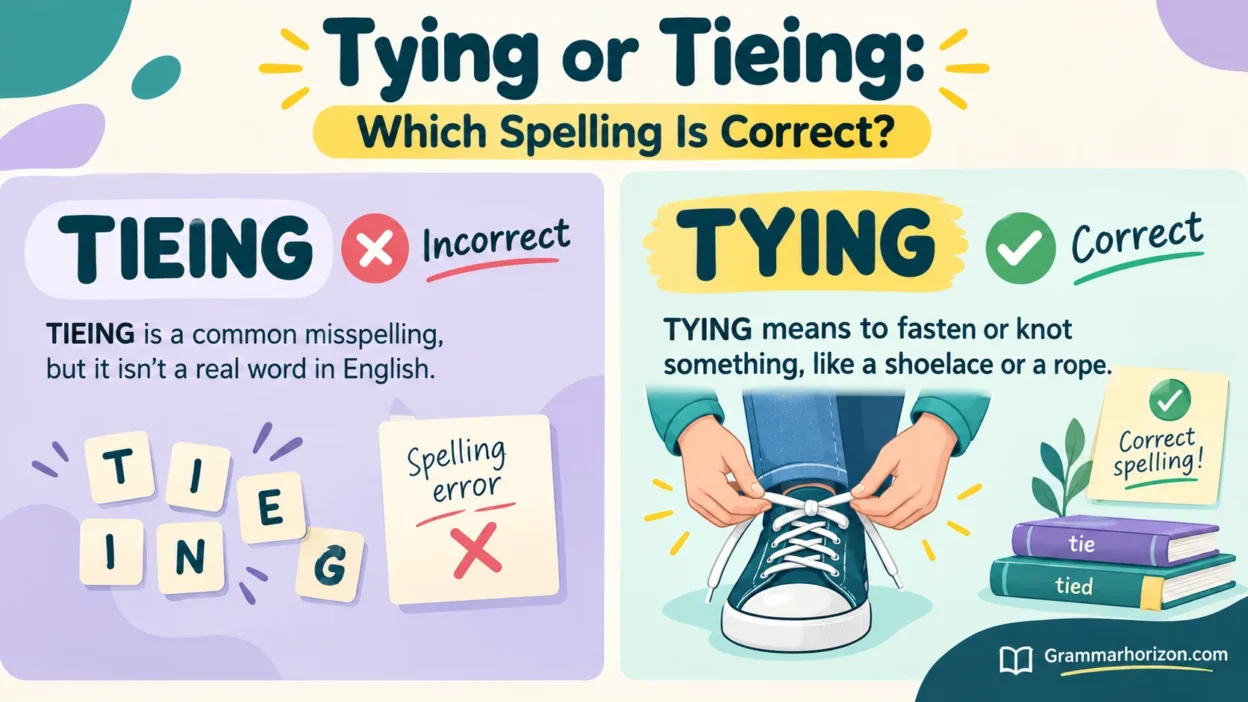
Tying or Tieing can confuse English learners because the verb tie seems to suggest that simply adding the -ING suffix should produce tieing. However, the correct spelling in modern English is tying. This difference matters in writing, speaking, exams, and professional communication, where clear spelling helps your message look polished. Although both forms may appear in older material, tying remains the preferred form in standard modern English.
The base verb tie follows a special spelling pattern when it takes -ING. Verbs ending in -IE change that ending before -ING is added, which explains why we write tying rather than tieing. You can compare this pattern with dying to make the rule easier to remember. This simple grammar rule can help you avoid common spelling mistakes in emails, school assignments, articles, and everyday messages. The spelling may initially feel natural as tieing, but the correct form is tying.
Merriam-Webster lists tying as the usual form and tieing as a less common variant, so modern standard usage strongly favours tying. History, British usage, and American usage may explain why you occasionally encounter the less common spelling, but for ordinary everyday usage, tying is the safest choice. A useful way to remember the rule is to focus on the ending: when tie becomes an -ING form, its -IE ending changes to y. Once this spelling pattern becomes familiar, the confusion becomes much easier to resolve
Quick Answer: Is It Tying or Tieing?
Tying is the standard spelling in modern US English.
The word tieing may appear as a variant in some dictionaries, but tying is the conventional form you should use in normal writing.
The basic spelling change is:
The -ie at the end of tie changes to y before the ending is added.
For example:
- She is tying her shoes.
- He is tying the package with string.
- They are tying the boats together.
- Tying a secure knot takes practice.
The form tieing isn’t the usual choice for contemporary standard writing. If you’re writing an essay, email, report, resume, or article, choose tying.
Tying or Tieing: Comparison Overview
| Feature | Tying | Tieing |
| Standard spelling | Yes | No, not normally preferred |
| Base verb | Tie | Tie |
| Meaning | Fastening, connecting, binding, or making equal | Same underlying meaning |
| Common modern usage | Very common | Rare |
| Recommended for US English | Yes | Generally avoid |
| Example | She is tying her shoes. | She is tieing her shoes. |
The important point is that the two spellings aren’t normally treated as different words with different meanings. The main issue is which spelling follows conventional modern usage.
Why Is Tying Spelled Without the “E”?
The spelling of tying becomes much easier once you know what happens to verbs ending in
English has a common spelling convention in which an ending changes tobefore. This prevents an awkward sequence of letters and creates a conventional spelling pattern that readers recognize immediately.
Consider these examples:
- tie → tying
- lie → lying
- die → dying
- vie → vying
Notice the pattern. Each base verb ends in When g is added, the ending changes to.
So you don’t write:
- tieing
- lieing
- dieing
- viewing
Instead, standard spelling gives you:
- tying
- lying
- dying
- vying
This is one of those English spelling rules that becomes much easier once you see several examples together.
The Difference Between Silent-E and -IE Rules
You may already know that many English verbs ending in silent e drop the e before For example:
- make → making
- write → writing
- hope → hoping
- dance → dancing
At first glance, you might expect the same thing with a tie. But tie doesn’t simply drop its final letter.
If you removed only the e, you’d get timing, which isn’t correct.
Instead, the entire -ie ending changes:
tie → tying
That distinction explains why tying looks unusual if you learned the basic silent-e rule first.
What Does Tying Mean?
Tying is the present participle and gerund form of the verb tie.
The verb tie has several related meanings. Its most familiar meaning involves fastening something with a knot, string, rope, ribbon, or similar material.
For example:
She is tying her shoelaces.
However, tie can describe much more than making knots.
Tying as the Present Participle
When tying works with a form of be, it helps create a progressive verb tense.
Examples include:
- She is tying her shoes.
- He was tying the rope.
- They are tying the boxes together.
- We were tying the decorations to the railing.
- The workers will be tying the cables tomorrow.
Here, tying describes an action that is happening or was happening around a particular time.
Tying as a Gerund
The same word can also function as a gerund, which means an -ing form that performs the grammatical role of a noun.
For example:
Tying a complicated knot requires practice.
In this sentence, tying acts as the subject of the sentence.
Another example is:
Tying your shoes is a simple daily task.
The word doesn’t describe what someone is currently doing. Instead, it names the activity itself.
Main Differences Between Tying and Tieing
The biggest difference between tying and tieing is their spelling and standard usage.
Tying Is the Standard Form
Tying is the spelling you’ll normally find in contemporary writing.
Use it when you mean fastening, connecting, binding, or making something equal.
Examples:
- The boy is tying his shoes.
- She is tying a ribbon around the gift.
- The two teams are tied at the end of the first half.
Tieing Is a Rare Variant
Tieing has appeared as a variant form in historical and dictionary usage. That doesn’t make it the best choice for everyday modern writing.
This distinction matters because a word can exist in a dictionary without being equally common or preferred in every situation.
Think of it like clothing. Something can technically be wearable without being the outfit you’d choose for a formal event. Similarly, tieing may be recorded as a variant while tying remains the natural modern choice.
The Meaning Doesn’t Change
When tieing appears, it isn’t normally expressing a completely different action from tying.
Both relate to the verb tie.
The practical writing rule is simple:
Use “tying.”
Examples of Tying in Sentences
Seeing the word in different contexts makes its usage easier to remember.
Everyday Examples of Tying
- Maria is tying her shoes before the race.
- He is tying the package with a piece of string.
- The child is tying a ribbon around the box.
- She spent several minutes tying the rope.
- They are tying the boats together.
Tying in Figurative Language
The word can also describe connections that aren’t physical.
For example:
- The evidence is tying the two cases together.
- The study is tying sleep quality to academic performance.
- The contract is tying the discount to a membership requirement.
- The final goal is tying the game.
In these examples, tying means connecting things conceptually or producing an equal result.
Tying as a Gerund
You can also use tying as a noun-like form:
- Tying a knot correctly takes practice.
- Tying your shoes is an important childhood skill.
- Tying the cables together keeps them organized.
- Tying the score changed the momentum of the game.
Common Mistakes With Tying
Writers often make common mistakes with tying by spelling it as tieing, forgetting the -ie to -y change, or confusing it with similar words such as lying and dying.
Writing “Tieing” by Simply Adding -ing
This is probably the most understandable mistake.
A writer sees:
tie + ing
and naturally produces:
tieing
However, the conventional spelling changes -ie to -y:
tie + ing → tying
Once you learn that pattern, the spelling becomes much easier to remember.
Confusing Tying With Lying
The same spelling rule applies to lies.
You write:
lie → lying
not:
lie → lieing
This is useful because lying provides a strong memory connection for tying.
Confusing Tying With Dying
The same thing happens with die:
die → dying
not dying.
So three useful examples can reinforce the rule:
tie → tying
lie → lying
die → dying
Applying the Wrong Drop-the-E Rule
The standard rule for verbs ending in silent e doesn’t fully explain tie → tying.
Compare:
| Base Verb | -ing Form |
| make | making |
| write | writing |
| hope | hoping |
| tie | tying |
| lie | lying |
| die | dying |
The first three verbs drop the final e. The last three change -ie to -y.
Tying or Tieing in US English
If you’re writing for an American audience, tying is the clear choice.
You’ll see it in everyday communication, educational writing, journalism, business documents, and professional content. It also matches the spelling pattern readers expect from other common -ie verbs.
Should You Ever Use Tieing?
For most writers, there is little practical reason to choose tieing.
If you’re producing modern US English, especially in formal or professional contexts, use tying.
That applies to:
- School assignments
- College papers
- Business emails
- Reports
- Resumes
- Websites
- Blog posts
- Social media posts
- Professional documentation
The goal isn’t simply to avoid a technically possible variant. It’s to choose the spelling that is clear, familiar, and conventional for your audience.
Tying, Tied, and Tie: Complete Word Forms
Understanding the full set of forms can prevent additional mistakes.
| Grammatical Form | Word | Example |
| Base form | tie | Please tie the rope. |
| Third-person singular | ties | She ties her shoes quickly. |
| Past tense | tied | He tied the package. |
| Past participle | tied | The rope is tied securely. |
| Present participle | tying | She is tying the rope. |
| Gerund | tying | Tying the knot takes practice. |
This table also highlights something important: tying and tied don’t follow exactly the same spelling change.
For the past tense, you get:
tie → tied
For the present participle, you get:
tie → tying
That difference can feel strange at first. English spelling simply uses different conventions for different suffixes.
Tying or Tieing: Easy Memory Trick
Here’s the easiest rule to remember:
When a verb ends in -ie, change -ie to -y before adding -ing.
Keep these three examples together:
- tie → tying
- lie → lying
- die → dying
You can remember it as:
-ie becomes -y + ing
So when you see tie, don’t automatically attach -ing to the existing letters. Change the ending first.
Tie → ty + ing → tying
That’s the spelling you want.
Tying or Tightening
Although tying and tightening can sometimes describe similar actions, they aren’t interchangeable.
Tying usually means fastening or connecting something with a tie, knot, string, rope, or similar method.
Tightening means making something tighter.
Compare these sentences:
- She is tying the rope around the box.
- She is tightening the rope around the box.
The first focuses on fastening the rope. The second focuses on increasing tension.
Tying or Binding
Binding can overlap with tying, but it often suggests holding something together more firmly or permanently.
For example:
- He is tying the branches together.
- The wire is binding the branches together.
Tying emphasizes the action of using a tie or knot. Binding emphasizes restraint or connection.
Tying or Knotting
The words tying and knotting are closely related.
However, knotting specifically emphasizes creating a knot.
For example:
- She is tying her shoes.
- He is knotting the rope.
You can tie something without necessarily emphasizing the formation of a particular knot. The broader word is tying.
A Simple Case Study: Why Writers Choose Tying
Imagine you’re proofreading a sentence that says:
“The athlete was tieing his shoes before the race.”
The meaning is perfectly clear. Most readers would understand the sentence immediately. Yet the spelling creates an unnecessary distraction.
Changing it to:
“The athlete was tying his shoes before the race.”
makes the sentence conform to standard modern spelling.
Now consider a longer paragraph containing tieing several times. Even though readers can understand it, the unusual spelling may make the writing look careless or outdated. Choosing tying removes that distraction.
This illustrates an important principle in practical writing: the best spelling isn’t always the one that seems most logical from the base word. It’s the one that follows established usage.
READ MORE: Annual vs Yearly vs Every Year: What’s the Difference?
Conclusion
Tying is the correct spelling in standard modern English, while tieing is a less common variant that you may occasionally encounter. The key spelling rule is that verbs ending in -IE generally change the ending to y before -ING is added. Remembering this simple pattern can help you avoid spelling mistakes in everyday and professional writing.
FAQs
Q1. Is “tying” or “tieing” correct?
Tying is the standard and preferred spelling in modern English.
Q2. Why is “tying” spelled without the “ie”?
The base verb tie ends in -IE. Before adding -ING, the -IE changes to y, producing tying.
Q3. Is “tieing” ever correct?
Tieing exists as a less common variant, but tying is the normal spelling you should use.
Q4. What is the correct form of tie + ing?
The correct form is tying, not tieing.
Q5. Does British English use “tieing”?
British English generally uses tying as the standard spelling, just like American English.
Q6. How can I remember the spelling of “tying”?
Remember the pattern: The -ie ending changes to y before -ING is added.
Q7. What are some common mistakes with “tying”?
A common mistake is writing tieing instead of tying. Checking the spelling pattern for verbs ending in –IE can help you avoid this error.