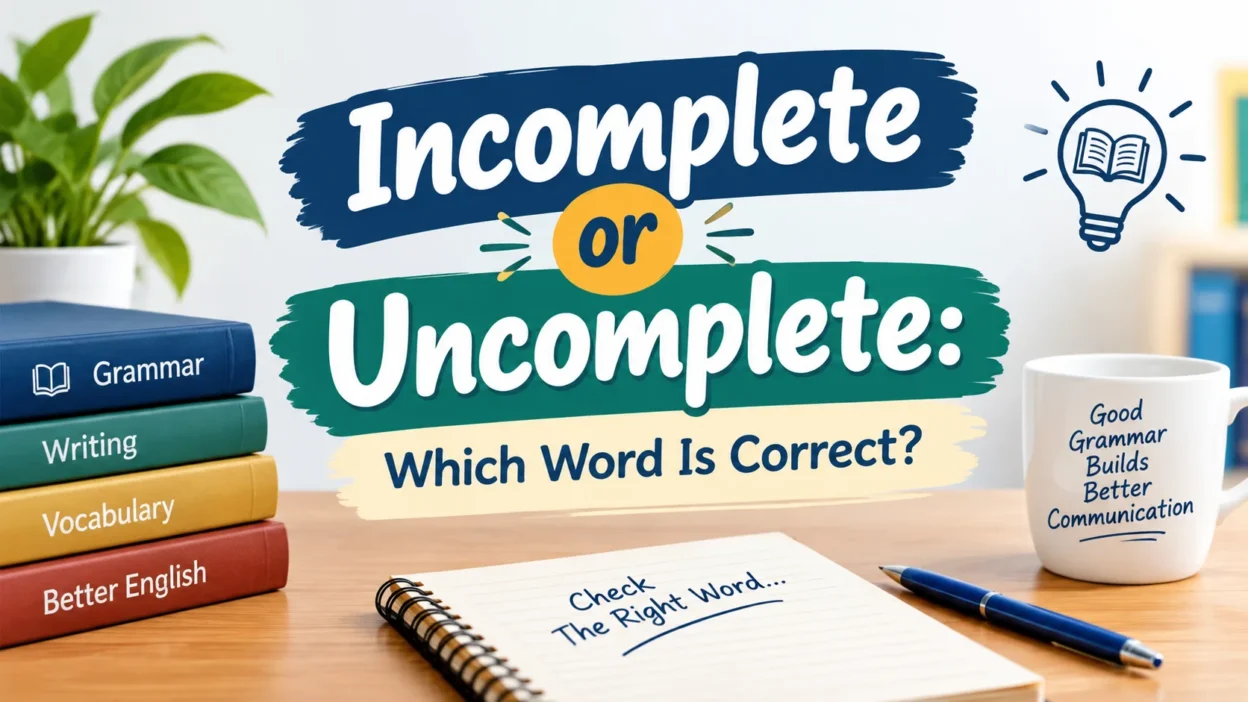
Incomplete or Uncomplete is a common word-choice question because both forms appear logical at first glance. In standard modern English, incomplete is the correct and widely accepted adjective. It describes something that isn’t finished, doesn’t contain all the necessary parts, or fails to include everything needed to make it whole. For example, you can have an incomplete application, an incomplete assignment, or an incomplete sentence. Although the prefix un- often creates opposites, English doesn’t apply that pattern consistently to every adjective.
The main difference between these words comes down to standard usage, spelling, and grammar. Incomplete indicates that something is missing a part, requirement, or element needed for completeness. Words such as unfinished and uncompleted are related because they can describe something that hasn’t reached completion. However, uncomplete has only limited historical or rare uses and isn’t the normal choice in contemporary American English. In formal writing, professional communication, academic work, and everyday speech, incomplete is the safer and more natural form.
A useful way to remember the correct choice is to associate incomplete with something missing. An incomplete project still needs work, an incomplete form lacks required information, and an incomplete sentence may be missing an essential part of its structure. When you’re unsure, first identify what you mean and ask whether the thing is fully complete. If something lacks a necessary part or requirement, incomplete will usually be the precise word. This simple approach helps you avoid common mistakes and use the adjective naturally and confidently.
Quick Answer: Incomplete or Uncomplete?
Incomplete is the correct and standard word in modern American English. Uncomplete is extremely uncommon and generally should be avoided in everyday, academic, business, and professional writing.
For example:
- Correct: The application is incomplete.
- Correct: The report contains incomplete information.
- Correct: She submitted an incomplete assignment.
- Generally avoided: The application is incomplete.
- Generally avoided: The report is incomplete.
The basic rule is simple:
Complete → Incomplete
If you need to say that something isn’t whole, finished, or fully supplied, incomplete is the natural choice.
Comparison Overview
| Feature | Incomplete | Uncomplete |
| Standard modern English | Yes | Rare |
| Common in American English | Yes | No |
| Meaning | Not complete or whole | Intended to mean not complete |
| Formal writing | Recommended | Generally avoided |
| Everyday usage | Very common | Extremely uncommon |
| Common examples | Incomplete form, incomplete report | Rarely used |
| Natural opposite of complete | Yes | No |
The important point is that incomplete isn’t simply one possible choice among two equally acceptable words. In modern English, it is overwhelmingly the normal form.
Main Differences Between Incomplete and Uncomplete
The biggest difference between incomplete and uncomplete is standard usage. Both forms appear capable of expressing the idea of something lacking completion. However, English speakers don’t use them equally.
Incomplete Is the Standard Word
Incomplete is an established adjective used across almost every area of English. You can use it when something hasn’t been finished or when it lacks one or more necessary elements.
Consider these examples:
- The application is incomplete.
- The information is incomplete.
- His explanation was incomplete.
- The project remains incomplete.
- The collection is incomplete.
- The sentence is incomplete.
These sentences sound natural because incomplete has a long-established place in modern English vocabulary.
Uncomplete Is Rare in Modern English
Uncomplete isn’t normally used by contemporary American English speakers. You may encounter it in older texts, unusual writing, or situations where someone has formed the word by analogy with unfinished.
That doesn’t mean every appearance of incompleteness is automatically meaningless. Readers can usually understand what it means from context. Still, being understandable isn’t the same as being the preferred standard form.
For modern writing, incomplete is the better choice.
Meaning and Standard Usage Aren’t Always the Same
English allows speakers to create understandable words that aren’t conventional. That’s one reason why something incomplete can look convincing.
The prefix un- commonly creates opposites:
- happy → unhappy
- clear → unclear
- finished → unfinished
- certain → uncertain
However, English vocabulary doesn’t follow a single mathematical formula. You can’t always attach un- to an adjective and assume the resulting word will become standard.
That’s exactly what happens with complete. The established negative form is incomplete, not incomplete.
What Does Incomplete Mean?
Incomplete means that something isn’t complete, whole, finished, or fully developed. The exact meaning depends on the context.
For example, an incomplete application might have several blank fields. An incomplete project might still need substantial work. Meanwhile, an incomplete explanation might contain useful information while leaving an important point unanswered.
Here are the most common meanings:
- Not finished: The project isn’t finished.
- Missing parts: Something lacks necessary components.
- Missing information: A document doesn’t contain all required details.
- Not fully developed: An idea or explanation needs further development.
- Not whole: A collection or physical object lacks something necessary.
This flexibility makes incomplete useful in both everyday conversation and technical writing.
Incomplete Before a Noun
You can place incomplete directly before a noun to describe something that lacks completion or necessary elements.
Examples include:
- an incomplete application
- an incomplete assignment
- an incomplete report
- incomplete information
- an incomplete sentence
- an incomplete record
- an incomplete collection
For instance, saying “The university rejected the incomplete application” immediately tells the reader that required information or sections were missing.
Incomplete After a Linking Verb
Incomplete also commonly follows linking verbs such as is, was, seems, remains, and appears.
Examples:
- The form is incomplete.
- The report was incomplete.
- His explanation seems incomplete.
- The record remains incomplete.
- The evidence appears incomplete.
This structure is particularly common when describing the current condition of something.
Why Is Incomplete Correct?
The answer involves English word formation. Incomplete uses the prefix in-, which can express negation in certain words.
You can see this pattern in words such as:
- complete → incomplete
- accurate → inaccurate
- visible → invisible
- active → inactive
- direct → indirect
However, prefixes don’t behave like interchangeable building blocks. English developed through centuries of borrowing, adaptation, and usage. As a result, some words use in-, others use un-, and some use entirely different forms.
The Role of the Prefix In-
In incomplete, the prefix in- carries the sense of negation. It changes completely into its established negative counterpart.
The important lesson isn’t that in- always creates the opposite of an adjective. Instead, it’s that incomplete is the form English speakers have established and consistently use.
Why Can’t You Always Add Un-?
This is where many learners get caught.
If you know:
finished → unfinished
it’s natural to assume:
complete → uncomplete
But language doesn’t always reward that kind of logical shortcut.
Think of English vocabulary like a toolbox assembled over centuries. The pieces don’t all come from one manufacturer. Some follow one pattern while others follow another.
That’s why incomplete is correct even though incomplete might seem logically reasonable.
Is Uncomplete a Word?
Uncomplete can be found in English, particularly in older or uncommon sources. However, its existence doesn’t make it the standard modern alternative to incomplete.
This distinction matters because dictionaries and historical texts can contain words that modern speakers rarely use. A word can exist somewhere in the history of English while still sounding unnatural in present-day writing.
For practical purposes, use incomplete.
If you’re writing an email, school assignment, report, application, article, or professional document, there’s little reason to choose incomplete.
How to Use Incomplete Correctly
The best way to understand incomplete is to see how it works in different situations.
Incomplete for Missing Information
Use incomplete when a form, report, record, or document doesn’t provide everything required.
Examples:
- The application is incomplete because the signature is missing.
- The customer submitted incomplete information.
- The medical record contains incomplete details.
- Please review the incomplete form before submitting it.
Incomplete for Unfinished Work
You can also use incomplete when a task or project hasn’t reached its final state.
Examples:
- The construction project remains incomplete.
- She turned in an incomplete assignment.
- The research project is still incomplete.
Incomplete for Missing Parts
The word can describe something that lacks physical or conceptual pieces.
Examples:
- The puzzle is incomplete without the final piece.
- The collection is incomplete.
- The set is incomplete because two items are missing.
Incomplete for Ideas and Explanations
An explanation doesn’t need to be completely wrong to be incomplete. It may simply leave out information that matters.
For example:
His explanation was incomplete because it didn’t address the final question.
That sentence shows an important distinction. Incomplete often means partly adequate but lacking something necessary.
Incomplete or. Unfinished
Although incomplete and unfinished overlap, they don’t always emphasize the same thing.
Unfinished usually focuses on something that hasn’t reached completion. Incomplete can focus more strongly on missing parts or information.
| Sentence | Main idea |
| The report is incomplete. | Information or sections are missing. |
| The report is unfinished. | The work hasn’t been completed. |
| The application is incomplete. | Required details are missing. |
| The painting is unfinished. | The artist hasn’t finished it. |
For example, an application can be incomplete because you forgot to provide your phone number. A painting is more naturally called unfinished when the artist simply hasn’t finished creating it.
Incomplete or. Uncompleted
Another form that sometimes causes confusion is uncompleted.
Unlike uncomplete, uncompleted can function as an adjective in contemporary English. It usually describes something that wasn’t completed.
For example:
- Several uncompleted tasks remained.
- The worker left the project uncompleted.
- The list contained several uncompleted assignments.
Still, incomplete often sounds more natural when something lacks information or necessary parts.
Compare:
- The application is incomplete.
- The application is uncompleted.
The first sentence is much more natural when the application has missing information. Uncompleted focuses more directly on the failure to complete an action.
Common Mistakes With Incomplete and Uncomplete
Common mistakes with incomplete and uncomplete usually come from assuming that un- can always create the opposite of a word, but incomplete is the standard modern form.
Mistake 1: Assuming Every Opposite Uses Un-
Not every adjective forms its opposite with un-. English has several negative prefixes and many irregular word relationships.
So don’t automatically create something uncomplete simply because unfinished exists.
Mistake 2: Using Uncomplete in Formal Writing
Using incomplete in professional or academic writing can make the sentence sound unusual or incorrect to many readers.
Choose incomplete instead:
Better: The report contains incomplete data.
Mistake 3: Confusing Incomplete With Unfinished
These words overlap but can highlight different ideas. If information is missing, incomplete is often the sharper choice. If work hasn’t been finished, unfinished may be more natural.
Mistake 4: Confusing Uncomplete With Uncompleted
Uncomplete and uncompleted aren’t interchangeable. The former is rare while the latter can be used in specific contexts.
Incomplete or Uncomplete in American English
For American English, the practical answer is straightforward: use incomplete.
You’ll see it in schools, workplaces, government forms, technical documents, business communication, and everyday conversation.
Common expressions include:
- incomplete application
- incomplete information
- incomplete sentence
- incomplete answer
- incomplete report
- incomplete record
- incomplete assignment
- incomplete data
These combinations sound natural because English speakers encounter them frequently.
Incomplete or Uncomplete in Formal and Professional Writing
Precision matters in professional communication. A small word choice can make writing sound polished or awkward.
Imagine two employees reviewing a customer form.
Less natural:
The customer’s application is incomplete.
Standard:
The customer’s application is incomplete.
The second sentence immediately sounds more conventional. It also matches the terminology readers expect in business and administrative contexts.
The same principle applies to academic writing:
The student’s answer was incomplete because it didn’t explain the final step.
That’s clearer and more professional than trying to construct an alternative with un-.
Real-Life Examples of Incomplete
From unfinished assignments to missing information in forms, incomplete describes anything that lacks a necessary part or hasn’t reached completion.
School and Education
- The teacher marked the assignment incomplete.
- The answer is incomplete.
- The student submitted an incomplete essay.
- The sentence is incomplete.
Work and Business
- The application remains incomplete.
- The report contains incomplete information.
- The employee submitted incomplete documentation.
- The customer record is incomplete.
Technology and Data
- The database contains incomplete records.
- The dataset includes incomplete information.
- The profile is incomplete.
- The software imported incomplete data.
Everyday Situations
- The puzzle is incomplete.
- The story feels incomplete.
- The plan is incomplete.
- His explanation was incomplete.
Synonyms for Incomplete
The best synonym depends on what exactly is missing.
| Word | Meaning or emphasis |
| Unfinished | Something hasn’t been completed |
| Partial | Only part of something exists |
| Inadequate | Something isn’t sufficient |
| Lacking | Something doesn’t have a needed element |
| Fragmentary | Something exists only in pieces |
| Unresolved | An issue hasn’t been settled |
These words aren’t perfect substitutes. For example, an incomplete report may simply lack two sections. An inadequate report may contain all sections but still fail to meet the required standard.
Read Also:https://grammarhorizon.com/did-you-have-or-did-you-had/
Conclusion
When choosing between incomplete and uncomplete, incomplete is the correct and standard choice in modern English. Use it when something is missing a necessary part, requirement, or element. While uncomplete has appeared in rare or historical usage, it isn’t normally used in contemporary English. For clear, natural, and professional writing, choose incomplete.
FAQs
Q1. Is incomplete or uncomplete correct?
Incomplete is the correct and widely accepted word in standard modern English. Uncomplete is rare and isn’t normally used in contemporary English.
Q2. What does incomplete mean?
Incomplete means something isn’t finished or doesn’t contain all the necessary parts, information, or requirements.
Q3. Is uncomplete a real word?
Uncomplete has existed in some historical and rare uses, but it isn’t the normal word in modern standard English.
Q4. Should I use incomplete in formal writing?
Yes. Incomplete is the preferred choice for formal writing, academic work, professional communication, and everyday English.
Q5. What is the difference between incomplete and unfinished?
Incomplete usually emphasizes that something is missing a necessary part, while unfinished emphasizes that something hasn’t been finished.
Q6. Is incomplete an adjective?
Yes. Incomplete is an adjective used to describe something that isn’t complete.