Entwined vs Intertwined can seem confusing because both words describe things that are twisted, linked, or woven together. However, their meaning, emphasis, and tone can change depending on the context. Entwined often suggests emotional closeness, intimacy, or a strong relationship, so writers may choose it in stories and essays to create warmer imagery and a more poetic tone. It can describe people or objects wrapped around one another, with wrapping and winding adding a sense of closeness.
Intertwined, on the other hand, usually works well for structural, physical, or complex relationships involving multiple elements. It can describe ideas, events, systems, or parts that have become deeply connected, making them difficult to separate. In professional writing and articles, intertwined can be a useful choice when you want to show dependent parts or an underlying connection. The distinction isn’t always absolute, and both words can sometimes appear almost identical in everyday conversation. Choosing between them depends on the underlying idea you want to describe, and a common error is assuming that either word is always correct simply because both can describe something linked.
From my experience, the best way to make the right choice is to check the context first. If a sentence centers on affection, personal relationship, or emphasis on emotional closeness, entwined often feels like the stronger option. If it describes mutual, deeply connected parts, intertwined is usually more precise. This difference becomes especially useful when editing sentences for grammatical clarity and precise word choice. Nuance also matters: entwined can suggest poetic wrapping, while intertwined can highlight complex integration. Both words are valid, but the right word depends on what you want to highlight, whether that’s emotional closeness, physical connection, or how separate parts connect to each other.
Quick Answer: Entwined vs Intertwined
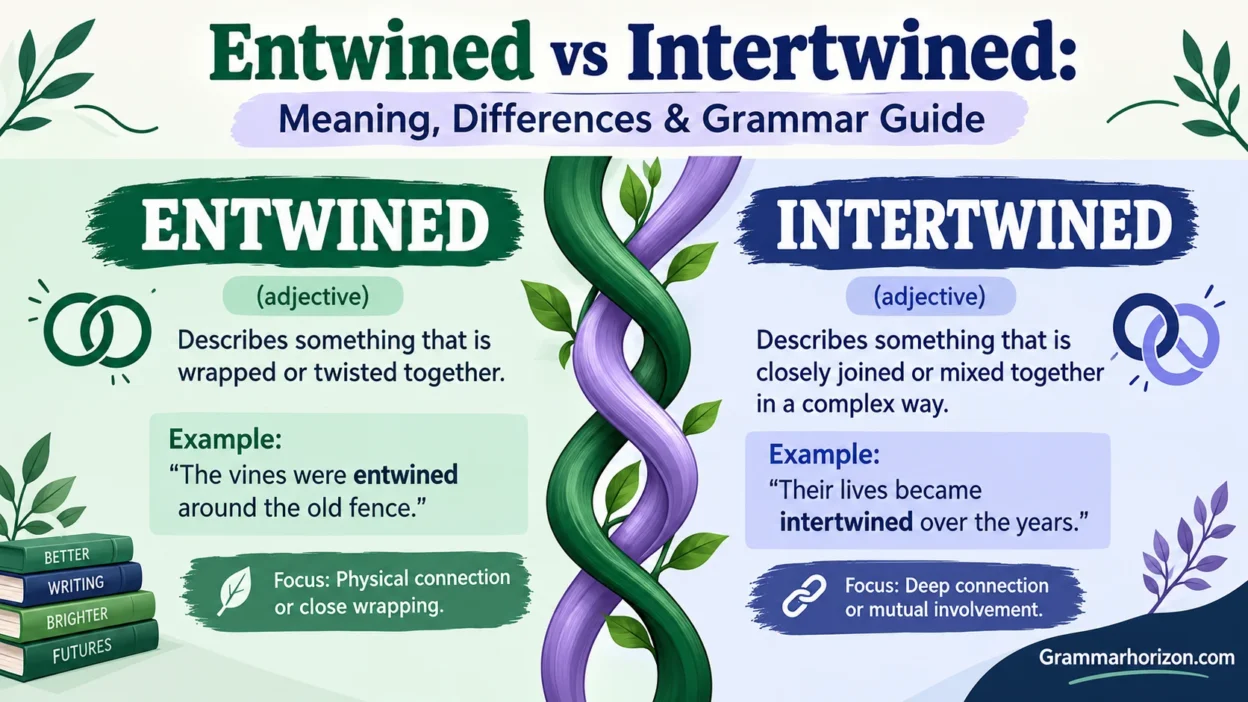
Entwined and intertwined are both correct English words. Both can describe things that are twisted or closely connected.
The easiest distinction is this:
- Entwined = twisted, wrapped, or closely bound together.
- Intertwined = woven or connected with one another, often with a stronger sense of mutual relationship.
- Entwined can sound more poetic, intimate, or romantic.
- Intertwined often sounds more neutral, analytical, or structural.
- Both words work literally and figuratively.
- Neither word is grammatically superior in every situation.
For example:
The vines were entwined around the old fence.
This focuses on the vines wrapping around something.
The country’s history is intertwined with its geography.
This focuses on two subjects influencing and connecting with each other.
The meanings overlap considerably. Context determines which word sounds more natural.
Comparison Overview
| Feature | Entwined | Intertwined |
| Basic meaning | Twisted or wrapped together | Woven, twisted, or connected together |
| Physical use | Very common | Very common |
| Figurative use | Common | Extremely common |
| Emotional tone | Often intimate or poetic | Usually neutral or relational |
| Focus | Closeness or wrapping | Mutual connection or interdependence |
| Common subjects | Vines, bodies, lives, stories | Histories, cultures, systems, ideas |
| Grammar | Correct | Correct |
Both words come from verbs: entwine and intertwine. Their forms can function as past-tense verbs or participles used adjectivally.
For instance, “The branches entwined” uses entwined as part of a verb phrase. In “entwined branches,” it describes the branches. The same pattern applies to intertwined.
Main Differences Between Entwined vs Intertwined
The difference isn’t a strict grammatical rule. Instead, it involves imagery, emphasis, and context.
Entwined Emphasizes Wrapping and Closeness
The word entwined comes from entwine, which means to twist or wind things together. Imagine two vines growing around each other. Their physical form creates the clearest picture of the word.
However, English frequently uses entwines beyond physical objects.
You might describe:
- Entwined vines
- Entwined branches
- Entwined fingers
- Entwined arms
- Entwined bodies
- Entwined lives
- Entwined destinies
- Entwined emotions
Notice how many of these expressions create an image of closeness. When writers describe entwined lives, they often suggest that two people’s experiences have become closely bound together.
Intertwined Emphasizes Mutual Connection
Intertwined comes from intertwine. The prefix inter- carries the general idea of something being between, among, or connected with other things.
That structure makes intertwining especially useful when several elements affect one another.
Consider these examples:
- History and culture are intertwined.
- Technology and education are increasingly intertwined.
- Their careers became intertwined.
- The two economies are deeply intertwined.
- The plot’s several storylines are intertwined.
Here, the emphasis isn’t simply on one thing wrapping around another. Instead, the subjects have become closely connected or mutually related.
That’s why intertwined appears frequently in analytical and explanatory writing.
What Does Entwined Really Mean?
Entwined means twisted, wrapped, or closely connected together, either physically or figuratively.
Definition and Core Meaning of Entwined
Entwined means twisted, wound, or closely connected together.
Its most literal meaning involves physical movement. If two ropes become entwined, they twist around one another. If vines become entwined, they grow around or through each other.
The word also carries figurative meaning.
For example:
Her childhood memories were entwined with the old house.
The memories aren’t literally wrapped around the building. Instead, the speaker connects those memories so strongly with the place that separating the two becomes difficult.
That figurative quality gives entwined considerable expressive power.
Common Contexts for Entwined
Entwined works particularly well when you want to highlight physical closeness or emotional attachment.
A novelist might write:
Their fingers remained entwined as they walked through the garden.
A nature writer might say:
Thick roots lay entwined beneath the forest floor.
A historian might write:
The town’s identity became entwined with the river.
Each sentence focuses on a close bond.
Emotional Connotation of Entwined
Because entwined evokes physical closeness, it can sound more romantic or lyrical than intertwined.
Compare:
Their lives became entwined.
with:
Their lives became intertwined.
Both are correct. The first can feel more intimate and literary. The second can sound slightly more neutral and emphasize the relationship between the two lives.
Neither choice is wrong. The writer simply creates a different shade of meaning.
What Does Intertwined Really Mean?
Intertwined means twisted, woven, or closely connected together, often emphasizing the mutual relationship between people, ideas, events, or things.
Definition and Core Meaning of Intertwined
Intertwined means twisted or woven together, or closely connected so that the separate elements become difficult to consider independently.
The word works particularly well for relationships among ideas, events, systems, and groups.
For example:
Economic growth and technological innovation are intertwined.
This sentence doesn’t describe physical twisting. It explains a relationship in which two factors connect and influence each other.
Common Contexts for Intertwined
You will often see intertwined with abstract nouns such as:
- History
- Culture
- Politics
- Economics
- Identity
- Technology
- Tradition
- Society
- Relationships
- Ideas
- Events
- Storylines
This doesn’t mean entwined cannot describe these subjects. It simply means intertwined often fits the analytical context more naturally.
Emotional Connotation of Intertwined
Intertwined can still describe emotional relationships, but it usually sounds less romantic than entwined.
For example:
Their families have been intertwined for generations.
The sentence suggests a long-standing connection. It doesn’t necessarily imply romance or physical intimacy.
Entwined vs Intertwined in Different Contexts
Context provides one of the best ways to understand the distinction.
Relationships and Love
Both words work naturally with relationships.
Entwined often sounds more intimate:
Their hands were entwined as they watched the sunset.
Intertwined often highlights the broader relationship:
Their lives became intertwined after years of friendship.
If you’re writing romance or literary prose, entwining may create stronger imagery. If you’re discussing how two people’s experiences affect each other, intertwined often feels more precise.
Nature and Physical Objects
Both words describe physical objects.
The vines were entwined around the tree.
The branches were intertwined above the path.
The difference here is subtle. Entwined emphasizes winding or wrapping. Intertwined emphasizes the way the separate branches become woven together.
History, Culture, and Society
Intertwined is especially useful in this context.
The region’s history is intertwined with its trade routes.
The sentence describes a relationship between historical development and commerce.
You could use entwined in some literary contexts, but intertwined generally suits analytical writing better.
Ideas, Events, and Systems
When several factors influence one another, intertwining is usually the stronger choice.
The causes of the conflict were deeply intertwined.
Here, the writer isn’t describing physical movement. The word communicates complex interdependence.
Entwined vs Intertwined: Synonyms and Related Words
These words overlap with several other terms, but each carries its own emphasis.
| Word | Main Idea | Typical Context |
| Entwined | Wrapped or twisted together | Physical or emotional closeness |
| Intertwined | Closely woven or connected | Ideas, systems, histories, relationships |
| Interwoven | Woven together | Themes, cultures, stories, materials |
| Interconnected | Linked through relationships | Systems, causes, technology |
| Interlaced | Crossed through each other | Patterns, fingers, physical structures |
| Tangled | Twisted together, often messily | Hair, wires, problems |
A useful point matters here: synonyms aren’t interchangeable in every sentence.
For example, saying that two economies are interconnected emphasizes links between them. Saying they are intertwined suggests a deeper relationship in which their development has become closely woven together.
Common Mistakes With Entwined and Intertwined
Common mistakes with entwined and intertwined usually come from treating them as completely different words instead of recognizing their overlapping meanings and subtle differences in emphasis.
Mistake: Thinking One Word Is Always Correct
There’s no universal rule saying that entwined is correct while intertwined is incorrect.
Both belong to standard English.
The real question is whether the chosen word expresses the intended relationship.
Mistake: Assuming Entwined Is Always Literal
It isn’t.
You can say:
Their histories became entwined.
This is clearly figurative.
Mistake: Assuming Intertwined Is Only Formal
Although intertwined appears frequently in formal writing, it also works perfectly well in ordinary conversation.
For example:
Our plans are too intertwined to change one without affecting the other.
That’s natural everyday English.
Mistake: Ignoring Prepositions
Common constructions include:
- Entwined with
- Entwined around
- Intertwined with
- Intertwined among
For example:
The roots were entwined around the rocks.
Their careers became intertwined with the company’s growth.
Choosing the right preposition helps make the sentence sound natural.
Case Study: Choosing the Better Word
Imagine you’re writing about two historical nations whose economies, languages, and political development influenced each other for centuries.
You could write:
Their histories became entwined.
That’s grammatical and expressive.
However:
Their histories became deeply intertwined.
This version emphasizes mutual influence and complexity. It tells readers that the histories cannot easily be understood separately.
Now imagine a romantic scene:
Their fingers were intertwined.
This works well.
But:
Their fingers were entwined.
This can sound softer and more physically intimate.
The lesson is simple: choose the word that matches the image or relationship you want readers to notice.
A Simple Test for Entwined vs Intertwined
When you’re unsure, ask yourself one question:
Am I emphasizing wrapping and closeness, or mutual connection and interdependence?
Choose entwined when the image involves:
- Winding
- Wrapping
- Physical closeness
- Emotional attachment
- Poetic imagery
Choose intertwined when the idea involves:
- Mutual influence
- Complex relationships
- Connected systems
- Shared histories
- Multiple ideas or events
When either description fits, both words may be correct.
Read Also:Tying or Tieing: Which Spelling Is Correct?
Conclusion
The difference between entwined vs intertwined mainly depends on the type of connection you want to emphasize. Entwined often suggests physical closeness, affection, intimacy, or poetic imagery, while intertwined more strongly suggests complex, deep, or mutually connected relationships between people, ideas, events, or systems. Both words are correct, and they can overlap in many contexts. The best choice depends on the meaning, context, tone, and emphasis of your sentence. When you want to highlight emotional or physical closeness, entwined may be the better choice. When you want to emphasize complexity, integration, or interconnected parts, intertwined is often more precise.
FAQs
Q1. Is entwined the same as intertwined?
Not exactly. Both words mean connected, twisted, or woven together, but entwined can carry a stronger sense of physical or emotional closeness, while intertwined often emphasizes complex or mutual connections.
Q2. Which is correct, entwined or intertwined?
Both are correct. The appropriate choice depends on the context. Use entwined when emphasizing closeness or wrapping around one another, and intertwined when emphasizing interconnected or complex relationships.
Q3. Can entwined describe people?
Yes. Entwined can describe people who are physically close or emotionally connected. For example, you might describe two lovers as having their lives entwined.
Q4. Can intertwined describe ideas?
Yes. Intertwined works especially well with abstract concepts such as ideas, cultures, histories, economies, events, and systems. For example: Their histories are deeply intertwined.
Q5. Does intertwined mean more complex than entwined?
Often, yes. Intertwined commonly suggests that several parts are connected in a complicated or mutually dependent way. However, this isn’t an absolute rule; context determines the exact meaning.
Q6. Is entwined more poetic than intertwined?
Generally, entwined can sound more poetic, romantic, or literary, especially when describing people, relationships, vines, branches, or physical objects. Intertwined is also used in literary writing but is common in formal and a,.mnalytical contexts.