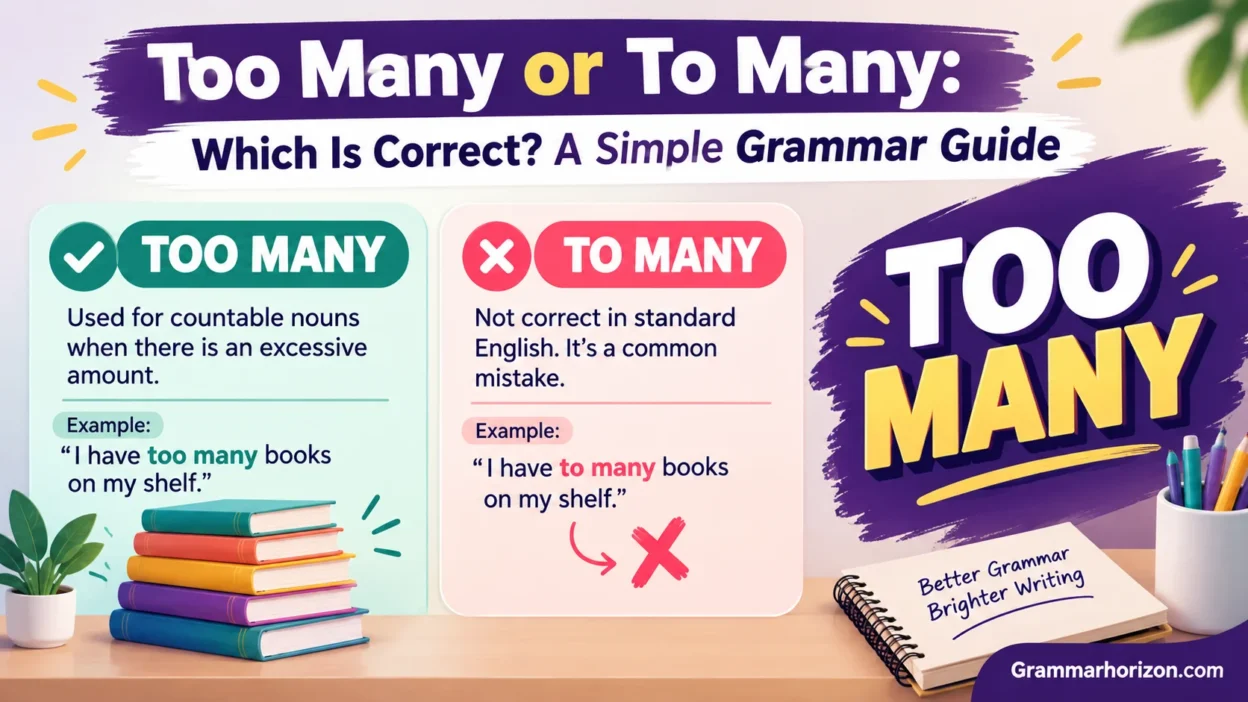
Too many or to many may sound alike in speaking, but their spelling, meaning, and grammatical jobs are different. In writing, the correct word is usually too many when you mean an excessive number of countable things. This distinction matters because too shows excess, while to normally works as a preposition.
Too Many or To Many becomes easier to understand when you focus on the meaning rather than how the words sound. Too many means more than needed or acceptable, so it has a valid quantity meaning. For example, “There are too many books here” is grammatically correct. In contrast, “There are to many books here” is incorrect because to many isn’t the fixed phrase used to show an excessive number.
The rule is straightforward: use too many for an excessive number of countable things, and don’t use to many for this normal role. When you’ve chosen the phrase, check whether it connects to a number or quantity that is greater than needed. This approach is easier than memorizing a complicated grammar rule, especially when you practice the distinction in real sentences.
Quick Answer: Too Many or To Many?
Too many is correct when you mean more than necessary, wanted, suitable, or expected.
For example:
- There are too many people in this room.
- I made too many mistakes.
- She bought too many shoes.
To many isn’t an alternative spelling of too many. It appears when to and many belong to a larger grammatical structure.
For example:
- She spoke to many students.
- The announcement came as a surprise to many people.
- The company sent emails to many customers.
So, if you’re saying “more than enough”, use too many.
If to connect an action, feeling, direction, or relationship with a group, to many may be correct.
Comparison Overview
| Phrase | Function | Meaning | Example |
| too many | too + many | An excessive number | There are too many cars outside. |
| to many | to + many | A prepositional relationship involving many people or things | She spoke to many customers. |
| too much | too + much | An excessive amount | There is too much noise. |
| too few | too + few | An insufficient number | There are too few seats. |
The key difference lies in too versus to. Although they sound the same in many varieties of English, they don’t mean the same thing.
What Does “Too Many” Mean?
The phrase too many describes an amount that exceeds a useful, acceptable, or desired limit.
Here, too works as an adverb meaning more than is appropriate or necessary. Many tell
you that you’re dealing with a number of people or things.
The basic pattern is:
too + many + plural countable noun
For example:
- too many books
- too many questions
- too many employees
- too many notifications
- too many problems
Consider the sentence, “There are too many cars on this road.” The speaker isn’t simply saying that there are many cars. The speaker means the number has become excessive.
That’s an important distinction.
Many describe quantity. Too many expresses excess.
Why “Too” Changes the Meaning
Compare these sentences:
- There are many students in the classroom.
- There are too many students in the classroom.
The first sentence simply tells you that the classroom contains a large number of students. The second suggests that the number creates a problem or exceeds an acceptable limit.
That extra sense of excess is what too contributes.
What Does “To Many” Mean?
Here’s where the confusion gets interesting. To many isn’t automatically wrong.
The word to can function as a preposition. When it does, many may follow it naturally.
For example:
- She talked to many people.
- He gave instructions to many workers.
- The story was familiar to many readers.
- The decision was unexpected to many observers.
In these sentences, to isn’t describing excess. It connects one part of the sentence with another.
Take “She talked to many people.”
The structure is:
talked + to + many people
The phrase means that many people were the recipients or participants of the conversation. It doesn’t mean she talked excessively.
Why “To Many” Can Be Correct
Imagine saying:
“The manager spoke to many employees.”
Replacing to with too would change the sentence:
“The manager spoke too many employees.”
That version is grammatically incorrect because spoke requires the preposition to before the people being addressed.
Now consider:
“The manager spoke to too many employees.”
This sentence is correct, but its meaning changes again. It says the manager spoke to an excessive number of employees.
That tiny extra word creates a completely different meaning.
Main Differences Between Too Many and To Many
Too many means an excessive number, while to many is used as a preposition and does not express excess.
Difference in Meaning
Too many expresses excess.
We have too many boxes.
This means the number of boxes is greater than necessary or manageable.
To many doesn’t express excess.
We delivered the boxes to many customers.
Here, to identify the recipients.
Difference in Grammar
Too acts as an adverb in too many.
It modifies the quantity expressed by many.
To commonly acts as a preposition in to many constructions.
This grammatical difference explains why the two spellings can’t simply be swapped.
Difference in Sentence Structure
You’ll often see too many directly before a plural countable noun:
- too many emails
- too many dishes
- too many questions
By contrast, to many usually appears as part of a larger structure:
- spoke to many people
- sent it to many customers
- important to many voters
- familiar to many readers
Looking at the words around the phrase can quickly reveal which spelling belongs there.
Too Many Examples in Sentences
Real examples make the distinction easier to remember.
Everyday Conversation
- There are too many people in the store.
- I bought too many snacks for the trip.
- You have too many bags to carry alone.
- We received too many calls this morning.
Each sentence describes an excessive quantity.
School and Academic Writing
- The essay contains too many unnecessary details.
- Too many students missed the deadline.
- The assignment asks too many questions.
- There are too many examples in this section.
In academic writing, too many often point to excess that affects clarity or efficiency.
Workplace Writing
- The report contains too many errors.
- We received too many applications this week.
- There are too many meetings on the schedule.
- The system generated too many notifications.
The phrase works naturally in professional communication because it identifies a quantity that has crossed a practical limit.
Correct “To Many” Examples
Now compare sentences where to many is genuinely correct:
- She spoke to many customers.
- The manager explained the policy to many employees.
- The announcement came as a surprise to many people.
- The product is familiar to many consumers.
- The charity provides support to many families.
Notice something important: to many doesn’t mean “excessive.”
In “The manager spoke to many employees,” the sentence simply identifies the people the manager spoke with.
However, you can combine the two constructions:
The manager spoke to too many employees.
Now the sentence means the manager spoke to an excessive number of employees.
That’s the clearest demonstration of the difference.
Too Many vs Too Much
Another common mistake involves too many and too much.
Use too many with plural countable nouns:
- too many books
- too many chairs
- too many questions
- too many people
Use too much with uncountable nouns:
- too much water
- too much money
- too much information
- too much traffic
Quick Comparison
| Correct form | Noun type | Example |
| too many | Plural countable | too many apples |
| too much | Uncountable | too much juice |
| too few | Plural countable | too few apples |
| too little | Uncountable | too little juice |
A useful test is to ask whether you can normally count the noun individually.
You can count books: one book, two books, three books.
You don’t normally count water in the same way. That’s why you say too much water, not too many water.
Common Mistakes With Too Many and To Many
A common mistake is using “to many” when you actually mean “too many,” especially when describing an excessive number of people or things
Writing “To Many” When You Mean Excess
This is probably the most common mistake.
❌ There are to many people here.
✅ There are too many people here.
The intended meaning is clearly more people than appropriate, so too is required.
Confusing Too Many With Too Much
❌ There are too much cars outside.
✅ There are too many cars outside.
Because cars is a plural countable noun, many is the correct quantity word.
Assuming “To Many” Is Always Wrong
This rule sounds simple but isn’t accurate.
❌ To many is always incorrect.
Consider:
She gave the instructions to many workers.
Here, to many is perfectly grammatical. The word to serve as a preposition.
The real issue isn’t whether the two words appear together. It’s what the sentence means and how the words function.
How to Remember the Difference Between Too and To
Remember too when you mean extra or more than needed, while to usually shows direction, connection, or a relationship in a sentence.
Use the “More Than Needed” Test
Ask yourself:
Does the sentence mean more than necessary, wanted, or acceptable?
If yes, choose too.
There are too many people here.
You could replace the idea with:
There are more people here than we need.
That confirms too many.
Use the “Recipient or Relationship” Test
If to connect an action or relationship with someone or something, it may be the right choice.
She spoke to many customers.
The customers are the people she spoke with.
Remember the Extra “O”
A simple memory trick can help:
Too has an extra o.
Think of that extra o as representing extra.
This isn’t a grammatical rule. It’s simply a handy way to remember the spelling when you’re writing quickly.
Too Many or To Many in Different Contexts
The distinction remains the same whether you’re writing a text message or a formal report.
| Context | Correct example |
| Text message | I have too many things to do. |
| We received too many requests today. | |
| School | The paragraph has too many examples. |
| Business | The system creates too many alerts. |
| Conversation | You’re asking too many questions! |
| Formal writing | Too many variables can affect the results. |
The tone may change, but the grammar doesn’t.
Read More:Simpler vs More Simple: Which Is Correct?
Can “Too Many” Stand Alone?
Yes. You don’t always need to put a noun immediately after too many.
For example:
“I ordered ten pizzas, but that was too many.”
The noun pizzas is understood from the earlier sentence.
You could also say:
“Five people should be enough. Ten would be too many.”
The phrase still expresses excessive quantity even though the noun isn’t repeated.
This is especially common in everyday conversation because repeating an obvious noun can sound clumsy.
Conclusion
Understanding too many or to many is simple once you focus on their meaning and grammatical roles. Too many is the correct phrase when you want to say that there is an excessive number of countable things, while to many is not normally correct for this purpose. Remembering that too can express “more than needed” will help you choose the right phrase in everyday writing.
FAQs
Q1. Is “too many” correct?
Yes, too many is correct when you mean more than necessary, expected, or acceptable.
Q2. Is “to many” ever correct?
To many can appear when to has its normal grammatical function and many follows it in a different structure, but it isn’t the correct phrase for expressing an excessive number.
Q3. What does “too many” mean?
Too many means that there is an excessive number of countable people or things.
Q4. Should I write “too many people” or “to many people”?
You should write too many people when you mean that the number of people is excessive.
Q5. What is the difference between “too” and “to”?
Too can mean excessively or also, while to commonly introduces an infinitive or shows direction, movement, or a relationship.
Q6. Is “too many” used with countable nouns?
Yes. Use too many with countable nouns, such as books, students, cars, questions, and mistakes.
Q7. How can I remember “too many”?
Remember that too means more than needed. If you’re talking about an excessive number of countable things, use too many, not to many.