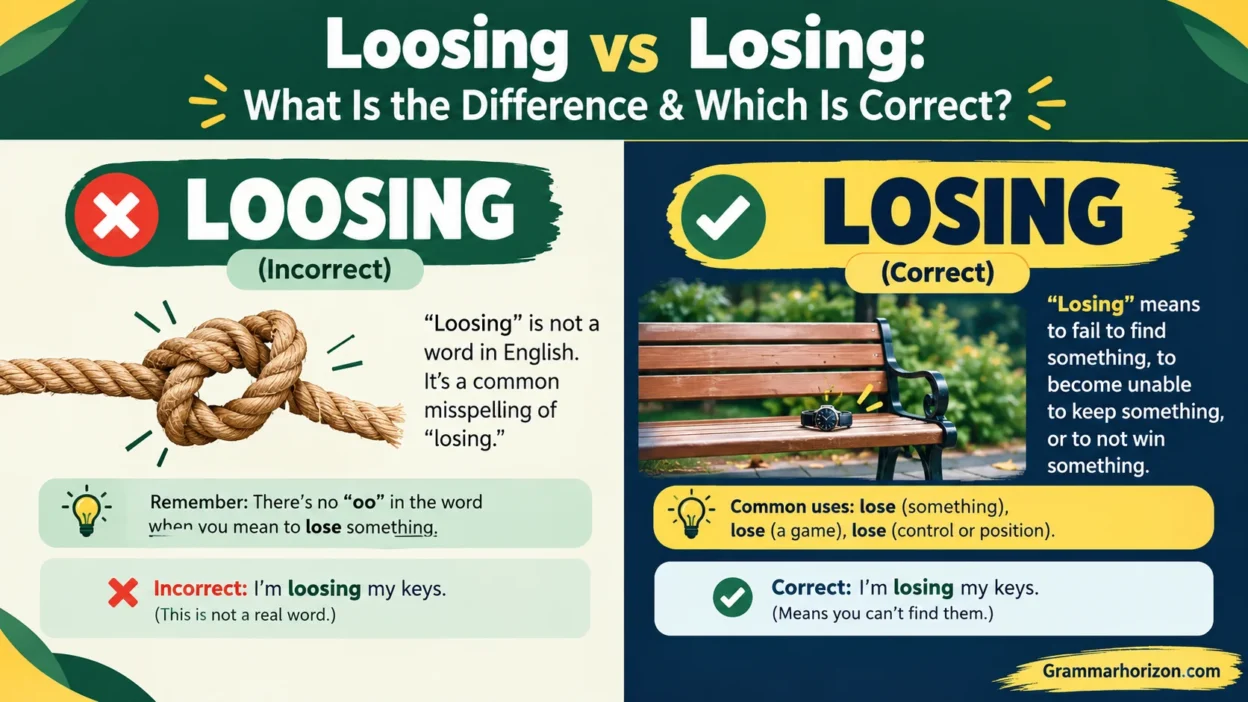
Many people become confused when choosing between loosing vs losing because they look similar and are frequently used in informal writing. However, only one is grammatically correct in most contexts when you mean failing to keep something, misplacing it, or being defeated. Understanding the difference can improve spelling accuracy, writing clarity, and overall English communication skills. In spelling, writing, clarity, grammar, context, and communication in English, the best approach is to connect each word with its correct meaning.
Loosing and losing are two words from different verbs with different meanings, and the extra o changes everything. In everyday English, losing is the word you usually need when something is misplaced, reduced, defeated, or no longer kept. Loosing, by contrast, is legitimate but uncommon, and it means releasing, freeing, or letting something go. The confusion becomes easier to handle when you connect loose with its base verb. Although the forms look almost identical, their pronunciation and distinction are different. When checking a sentence, this simple connection makes the choice easier to remember.
The correct form also matters when choosing the right form for an email, school assignment, article, social media post, or professional document. A single extra letter can turn a normal sentence into one with an entirely different meaning. If you need to describe something that is being released, loosing can fit. If you mean that something is being lost, losing is the appropriate choice.
Quick Answer: Loosing vs Losing?
Losing is correct when you mean failing to keep, find, win, control, or retain something.
Loosing is correct when you mean releasing, freeing, or letting something go. It comes from the verb loose, which can function as a verb meaning to release something.
The simplest rule is:
- Lose → losing
- Loose → loosing
- Loosen → loosening
For example:
- I am losing my keys. → You can’t find or keep your keys.
- Our team is losing the game. → Your team isn’t winning.
- The archer is loosing an arrow. → The archer is releasing an arrow.
- She is loosening the knot. → She is making the knot less tight.
So, if you’re talking about loss or defeat, choose losing. If you’re talking about release, choose loosing.
Comparison Overview
| Word | Base Word | Meaning | Commonness | Example |
| Losing | Lose | Failing to keep, find, win, or maintain something | Very common | “I’m losing my wallet.” |
| Loosing | Loose | Releasing or setting something free | Uncommon | “The archer was loosing an arrow.” |
| Loosening | Loosen | Making something less tight | Common | “He is loosening the bolt.” |
The important point is that loosing isn’t a misspelling of losing. It has its own grammatical identity. The problem occurs when writers use loosing when they actually mean the much more common losing.
Pronunciation also gives you a useful clue. Lose sounds like “looz,” while loose sounds like “loos.” The final consonant changes from a /z/ sound in lose to an /s/ sound in loose.
Main Differences Between Loosing vs Losing
The clearest difference between loosing vs losing comes from their base verbs.
Losing Comes From Lose
Losing is the present participle and gerund form of loss.
The verb lose has several common meanings. You can lose an object, lose a competition, lose money, lose control, lose time, or lose an opportunity.
For example:
- “I’m losing my patience.”
- “She is losing weight.”
- “They are losing the match.”
- “He keeps losing his phone.”
- “The business is losing customers.”
In each case, something is being lost, reduced, or no longer retained.
Loosing Comes From Loose
Loosing comes from the verb loose. As a verb, loose means to release, free, or let go.
For example:
- “The archer was loosing arrows.”
- “The guards were loosing the prisoners.”
- “The movement was loosing a wave of emotion.”
This use is much less common than losing. In modern everyday English, you may encounter loose far more often as an adjective meaning not tight.
For instance:
- “The shirt is loose.”
- “The screw is loose.”
- “The rope became loose.”
Meaning Is the Real Test
Spelling can help you remember the difference, but meaning provides the strongest test.
Ask yourself:
Am I talking about something being lost, or something being released?
If something disappears from your possession, use losing.
If someone releases something that was being held, use loosing.
That small question can prevent most mistakes.
Definition of Loosing
Loosing means releasing, freeing, or letting something go and is the -ing form of the verb “loose.”
What Does Loosing Mean?
Loosing means releasing, freeing, or letting something go. It is the -ing form of the verb loose.
Although the word is grammatically correct, modern writers don’t use it very often. You are more likely to encounter it in literary, historical, religious, or specialized contexts.
Consider an archer preparing to fire:
“The archer was loosing an arrow.”
Here, the arrow isn’t being lost. The archer is releasing it.
That distinction is crucial.
When Is Loosing Correct?
Use loosing when the action involves release.
Common situations include:
- Loosing an arrow from a bow
- Loosing a prisoner from captivity
- Loosing an animal from restraint
- Loosing something held back
- Loosing emotions or forces in figurative writing
The word can therefore have both literal and figurative uses.
For example, “The speech was loosing a wave of anger” describes something being released rather than misplaced.
Loosing vs Loosening
Another common trap involves loosening.
These words aren’t interchangeable.
Loosing means releasing or setting free.
Loosening means making something less tight or less firmly fixed.
Compare these sentences:
- “The soldier was loosing the prisoner.”
- “The mechanic was loosening the bolt.”
The first describes release. The second describes reducing tightness.
Definition of Losing
Losing is the -ing form of “lose” and means failing to keep, find, win, or retain something
What Does Losing Mean?
Losing is the -ing form of the verb lose. It covers many situations involving loss, defeat, failure, or the inability to retain something.
You might be:
- losing your keys
- losing a game
- losing money
- losing confidence
- losing control
- losing interest
- losing time
- losing an opportunity
Because lose has such a broad range of meanings, losing appears constantly in everyday English.
Why Losing Is So Common
Think about ordinary life. People lose things, games, money, patience, sleep, time, and opportunities all the time.
For example:
“I’m losing my phone again.”
The speaker isn’t releasing the phone. The speaker means the phone has gone missing or can’t be found.
Likewise:
“Our team is losing the game.”
The team isn’t releasing the game. It is failing to win.
That practical difference makes losing the correct choice in the overwhelming majority of sentences where people confuse these two words.
Grammar Guide for Loosing vs Losing
The grammar guide for loosing vs losing helps you understand when to use each word based on its meaning, base verb, and role in a sentence.
How Each Term Is Used in Sentences
Both words can appear after forms of be because they function as present participles.
Examples with losing:
- “She is losing confidence.”
- “They were losing money.”
- “He has been losing sleep.”
Examples with loosing:
- “The archer is loosing an arrow.”
- “They were loosing the animals.”
- “The force was loosing energy.”
Both forms follow the same broad -ing pattern. The difference comes from the verb they belong to.
Common Mistakes Learners Make
The most common mistake is writing loosing when the intended word is losing.
For example:
- ❌ “I’m loosing my keys.”
- ✅ “I’m losing my keys.”
Another common error appears when writers confuse loosing with loosening:
- ❌ “He is loosing the screw.”
- ✅ “He is loosening the screw.”
The correct word depends on the intended action. If the screw becomes less tight, use loosening.
Simple Rules to Remember
Use these three rules:
- Lose → losing when something is lost or no longer retained.
- Loose → loosing when something is released or set free.
- Loosen → loosening when something becomes less tight.
A useful memory trick is simple:
Lose has one O. Loose has two.
Don’t let the extra o sneak into losing unless you genuinely mean the verb loose.
When to Use Each One
Use losing for loss, defeat, or failure to retain something, while loosing applies when you mean releasing, freeing, or letting something go.
Use Losing for Loss, Defeat, or Failure
Choose losing when the sentence describes:
- Misplacing something
- Failing to win
- No longer having something
- Experiencing a reduction
- Losing control
- Losing time
- Losing money
- Losing interest
- Losing an opportunity
Examples:
“She is losing her wallet.”
“The company is losing customers.”
“He is losing control of the situation.”
Use Loosing for Release
Choose loosing when something is being released or set free.
Examples:
“The hunter was loosing an arrow.”
“The guards were loosing the prisoners.”
Because this verb is relatively uncommon, many modern sentences that seem to require loosing may actually need loosening.
When NOT to Use Loosing vs Losing
Don’t use loosing simply because the pronunciation or spelling of loose comes to mind.
Incorrect:
“I’m loosing my keys.”
Correct:
“I’m losing my keys.”
Likewise, don’t use losing when the intended meaning is released.
Incorrect:
“The archer was losing an arrow.”
Correct:
“The archer was loosing an arrow.”
And don’t overlook loosening when something becomes less tight.
Incorrect:
“She is loosing the knot.”
Better:
“She is loosening the knot.”
Loosing vs Losing Decision Guide
When you’re unsure, follow this quick decision process:
Is something being lost, misplaced, defeated, reduced, or no longer retained?
→ Use losing.
Is something being released, freed, or let go?
→ Use loosing.
Is something becoming less tight?
→ Use loosening.
This gives you a three-way distinction:
| Meaning | Correct Word |
| Loss or defeat | Losing |
| Release or freedom | Loosing |
| Less tight | Loosening |
Real-World Examples of Loosing and Losing
Real-world examples of loosing and losing show how context separates the two, with losing describing loss or defeat and loosing describing release or freedom.
Loosing Examples
“The archer was loosing another arrow.”
The archer is releasing the arrow from the bow.
“The guards were loosing the prisoners.”
The guards were setting the prisoners free.
“The speaker was loosing a torrent of emotion.”
Here, loosing has a figurative sense involving release.
These examples demonstrate why loosing is a real word. It simply has a narrower range of everyday uses than losing.
Losing Examples
“I’m losing my keys.”
You can’t find or retain the keys.
“The team is losing the final.”
The team isn’t winning.
“She is losing confidence.”
Her confidence is decreasing.
“The company is losing money.”
The company is experiencing financial loss.
“We’re losing valuable time.”
Available time is decreasing.
Each sentence clearly involves loss, which makes losing the correct form.
Case Study: A Tiny Spelling Error With a Big Meaning
Imagine an employee writing this sentence in a report:
“The company is loosing customers every month.”
At first glance, the sentence may look harmless. However, loosing means releasing or setting free. The writer actually means that the company is losing customers.
The corrected sentence is:
“The company is losing customers every month.”
Now the meaning is precise. The company isn’t intentionally releasing its customers. It is failing to retain them.
This example shows why spelling accuracy isn’t merely cosmetic. Word choice controls meaning.
Self-Assessment: Fill in the Blanks
Choose losing, loosing, or loosening.
- She keeps ___ her keys.
- The team is ___ the championship game.
- The archer was ___ an arrow.
- He is ___ the bolt with a wrench.
- We’re ___ too much time.
- The guards were ___ the prisoners.
- The company is ___ money.
- She is ___ patience with the situation.
- The mechanic is ___ the nut.
- The hunter began ___ arrows toward the target.
Answers
- Losing — the keys are being misplaced.
- Losing — the team isn’t winning.
- Loosing — the archer is releasing the arrow.
- Loosening — the bolt is being made less tight.
- Losing — available time is decreasing.
- Loosing — the prisoners are being released.
- Losing — the company is experiencing financial loss.
- Losing — her patience is decreasing.
- Loosening — the nut is being made less tight.
- Loosing — the hunter is releasing the arrows.
Conclusion
Loosing vs Losing is easier to understand when you focus on meaning and verb forms. Losing is the correct and common choice when something is being misplaced, reduced, defeated, or no longer kept. Loosing is a real but uncommon word used for releasing, freeing, or letting something go. Remembering this simple difference can improve your spelling accuracy, writing clarity, and confidence in English communication.
Read More:Gluing vs Glueing: Which Spelling Is Correct? Examples and Rules
FAQs
Q1. Is “loosing” a correct word?
Yes, loosing is a correct word, but it is uncommon. It comes from loose and means releasing, freeing, or letting something go.
Q2. Is “losing” the correct spelling?
Yes. Losing is the correct spelling when you mean failing to keep something, misplacing something, being defeated, or no longer having something.
Q3. What is the difference between loosing and losing?
Loosing means releasing or freeing, while losing means no longer having something, failing to win, or misplacing something.
Q4. Why do people confuse loosing and losing?
People often confuse them because both words look similar, and the extra o in loosing is easy to add by mistake.
Q5. Is “I am loosing my phone” correct?
No, if you mean that you cannot find your phone, the correct sentence is “I am losing my phone.” However, if you mean releasing something, loosing can be correct.