Waste vs Waist is a common spelling confusion among English writers because both words have the same pronunciation but different meanings. Both words sound identical, /weɪst/, but their spelling differences make them easy to distinguish when you understand the context. These words are homophones, which means they share the same pronunciation but cannot be used as interchangeable words. Understanding their word usage, grammatical functions, and meaning differences helps you avoid spelling mistakes, improve your English grammar, and communicate clearly in written communication.
Waste refers to unwanted materials, unnecessary use, or the careless use of valuable things. It can describe wasting time, poor time management, spending money carelessly, food waste, excessive energy consumption, and the misuse of natural resources. For example, resource conservation and proper waste management help reduce unnecessary losses and protect the environment. The sentence “Don’t waste your time” uses the correct word, while “Don’t waist your time” contains incorrect spelling. Checking the intended word and sentence context can help prevent these common writing mistakes.
Waist, on the other hand, refers to the middle part of the human body between the ribs and hips. It is commonly used when discussing human body structure, body anatomy, body measurements, and waist measurement. You may also find this word in conversations about clothing, fashion, dress size, and waistline. For example, “She measured her waist” is correct when referring to a body measurement, whereas “She measured her waste” is incorrect in this context. Recognising this word distinction makes grammatical usage easier and helps you use both words correctly in everyday writing and communication.
Waste vs Waist: Quick Answer
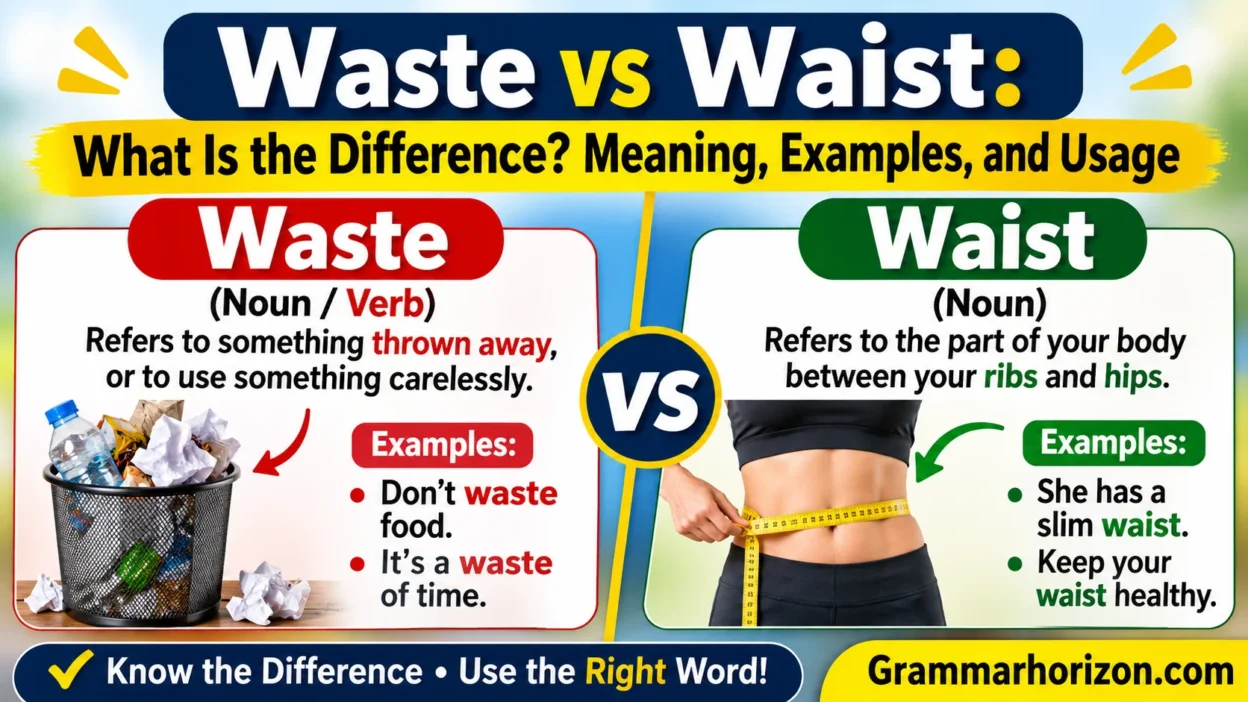
Waste refers to unwanted materials or the unnecessary use of something valuable, such as time, money, or energy. Waist refers to the middle part of the body between the ribs and hips and is commonly used when discussing clothing sizes and body measurements.
- Waste: Something unwanted, unnecessary, or used carelessly.
- Waist: The part of the body between the ribs and hips.
Examples:
- Don’t waste your money on unnecessary things.
- She measured her waist before buying the dress.
Both words are pronounced the same way. However, you should use waste when discussing unnecessary use or unwanted materials and waist when referring to the body or clothing measurements.
What Does Waste Mean?
Waste means something that is unwanted, unused, or used without a useful purpose. It can refer to materials that people throw away, such as plastic, paper, food, and household rubbish. It can also describe the unnecessary use of valuable things, including time, money, energy, and opportunities.
For example, throwing away good food creates food waste. Similarly, spending several hours on an unimportant activity can be described as a waste of time.
The word waste has three main grammatical functions. It can work as a noun, verb, or adjective, depending on the sentence.
Waste as a Noun
As a noun, waste refers to unwanted materials, unnecessary loss, or something used without producing a useful result. It commonly appears in discussions about rubbish, food leftovers, industrial materials, and natural resources.
It is also used in expressions such as waste of time, waste of money, and waste of energy.
For example, if someone purchases an expensive item but never uses it, you might describe the purchase as a waste of money. This means the money was spent without receiving any real benefit.
Here are some examples:
- Throwing away edible food creates unnecessary waste.
- Spending the entire afternoon arguing was a waste of time.
- The factory is working to reduce plastic waste.
- Leaving the lights on all night is a waste of electricity.
- We should find better ways to manage household waste.
- Buying unnecessary products can lead to a waste of money.
In these examples, waste functions as a noun because it identifies unwanted materials or something that has been used unnecessarily.
Waste as a Verb
As a verb, waste means to use something carelessly or unnecessarily. It often describes situations in which people fail to use their time, money, energy, food, or opportunities effectively.
For example, if someone spends hours watching television instead of completing an important assignment, you might say that the person is wasting time.
The verb waste changes according to tense:
- Present: Waste
- Third-person singular: Wastes
- Past tense: Wasted
- Present participle: Wasting
- Past participle: Wasted
Consider these examples:
- Don’t waste your money on unnecessary purchases.
- He wastes too much time playing video games.
- We wasted several hours waiting for the wrong bus.
- Stop wasting food when so many people need it.
- She has never wasted an opportunity to improve her skills.
- You shouldn’t waste your energy on unnecessary arguments.
The verb can also describe failing to develop or use a natural ability.
For example, “He wasted his talent by refusing to practice” means that he failed to make good use of his abilities.
Waste as an Adjective
Waste can also function as an adjective in certain expressions. In this role, it describes something unused, unoccupied, or associated with unwanted materials.
It commonly appears in phrases related to land, industrial activities, and discarded materials.
Examples include:
- The company must dispose of its waste materials properly.
- The building stands on waste land.
- The factory introduced a new system for handling waste products.
- The organization collects waste paper for recycling.
Although waste is more commonly used as a noun or verb, its adjectival use is also important in established expressions such as waste materials and waste land.
What Does Waist Mean?
Waist refers to the part of the human body between the ribs and hips. It is generally the narrower area of the torso and is commonly discussed when describing body shape, clothing sizes, and physical measurements.
Unlike waste, the word waist does not describe unnecessary use or unwanted materials. It is a noun that identifies a specific part of the body.
For example, when someone measures their waist to find the correct size of trousers, they are measuring the area around the middle of their body.
The word also appears in everyday expressions such as waistline, waistband, waist size, and high-waisted clothing.
Waist in Human Anatomy
In human anatomy, the waist is the area of the torso located between the lower ribs and the upper part of the hips. It is commonly associated with the narrower part of the torso, although its exact position and shape vary from person to person.
The waist is different from the stomach, abdomen, and hips, even though people sometimes use these terms loosely in everyday conversations.
Here is a simple explanation:
- Waist: The area between the ribs and hips.
- Abdomen: The front part of the torso between the chest and pelvis.
- Stomach: An internal digestive organ, although people also use this word to describe the belly area.
- Hips: The wider area around the pelvis and upper thighs.
Understanding these differences is useful when discussing body measurements, clothing sizes, and physical appearance.
Examples of waist used in sentences:
- She felt a slight pain around her waist after exercising.
- The doctor asked him to measure his waist.
- He placed his hands on his waist while standing.
- The dress fits tightly around her waist.
- Regular exercise can help strengthen the muscles around your waist.
Waist in Clothing and Fashion
The word waist is frequently used in clothing and fashion. It describes the area where garments fit around the middle of the body.
Clothing manufacturers use waist measurements to determine suitable sizes for trousers, jeans, skirts, shorts, and dresses. An accurate waist measurement helps people choose clothes that fit comfortably.
For example, when shopping for jeans, you might see sizes that include a waist measurement. This information helps you understand how the trousers will fit around your middle.
Some common clothing terms include:
- Waistband: The strip of fabric around the waist of trousers, skirts, or shorts.
- Waistline: The line or area where a garment fits around the waist.
- High-waisted: Clothing designed to sit at or above the natural waist.
- Low-waisted: Clothing designed to sit below the natural waist.
- Waist size: The measurement around the waist.
Here are some sentence examples:
- These jeans have a comfortable waistband.
- She prefers wearing high-waisted trousers.
- The dress has a narrow waistline.
- I need a larger waist size for these pants.
- The skirt sits just below the natural waist.
Common Expressions With Waist
There are several common expressions that use the word waist. Most relate to body measurements, clothing, or the position of something around the middle of the body.
| Expression | Meaning | Example |
| Waist size | Measurement around the waist | My waist size is 32 inches. |
| Waist measurement | Distance around the waist | Take your waist measurement before ordering. |
| Waistline | Line or area around the waist | The dress has a fitted waistline. |
| Waistband | Fabric strip around clothing | The waistband feels too tight. |
| Around the waist | Surrounding the middle of the body | She tied a jacket around her waist. |
| High-waisted | Sitting at or above the natural waist | She bought high-waisted jeans. |
| Low-waisted | Sitting below the natural waist | He prefers low-waisted trousers. |
These expressions make it easier to recognize the correct spelling in everyday conversations and written English.
Waste vs Waist: Key Differences
The main difference between waste vs waist is their meaning and grammatical function. Although they sound identical, they serve different purposes in English sentences.
Waste relates to unnecessary use, unwanted materials, or loss. Waist refers to a specific part of the human body and is commonly used in clothing and measurement contexts.
The following table highlights their main differences:
| Feature | Waste | Waist |
| Meaning | Unwanted material or unnecessary use | Middle part of the body |
| Pronunciation | /weɪst/ | /weɪst/ |
| Part of speech | Noun, verb, adjective | Noun |
| Common use | Waste time, waste money, food waste | Waist size, waistline, waistband |
| Related words | Wasted, wasting, wasteful | Waistband, waistline |
| Example | Don’t waste your energy. | Measure your waist carefully. |
Why Do Waste and Waist Sound the Same?
Waste and waist are known as homophones because they have the same pronunciation but different spellings and meanings.
Both words contain the same vowel sound, represented by /eɪ/, and end with the /st/ sound. As a result, there is no pronunciation difference between them in standard English.
This similarity can make it difficult for English learners and even native speakers to choose the correct spelling when writing.
The best way to avoid mistakes is to focus on the context of the sentence.
For example:
- If you are discussing money, food, time, or resources, use waste.
- If you are discussing the body, clothing, or measurements, use waist.
Remember that pronunciation alone cannot help you distinguish these words. Their meanings provide the correct answer.
Waste vs Waist: Sentence Examples
Looking at complete sentences is one of the easiest ways to understand the difference between these homophones. The following examples show how each word works in everyday English.
Examples of Waste in Sentences
The word waste commonly appears when discussing unnecessary actions, unwanted materials, or the careless use of resources.
Here are some practical examples:
- Don’t waste your money on things you don’t need.
- Spending the whole day doing nothing is a waste of time.
- We should avoid wasting clean drinking water.
- The restaurant tries to reduce food waste.
- He wasted his opportunity to get a better job.
- Too much plastic waste can harm the environment.
- It would be a waste to throw away these useful materials.
- She doesn’t want to waste her energy on unnecessary arguments.
- The company has introduced a better system for managing industrial waste.
- You shouldn’t waste your skills by avoiding new challenges.
In these sentences, waste relates to something being used unnecessarily, lost, or discarded.
Examples of Waist in Sentences
The word waist is used when referring to the body, clothing, or measurements.
Here are some examples:
- She measured her waist before buying the dress.
- The belt fits comfortably around his waist.
- These trousers are too tight around the waist.
- He placed his hands on his waist.
- The jacket has a fitted waistline.
- My waist measurement has changed since last year.
- She prefers wearing high-waisted jeans.
- The tailor adjusted the waistband of my trousers.
- The dress has a beautiful shape around the waist.
- He tied his shirt around his waist.
In each sentence, waist refers to the middle part of the body or something associated with that area.
Common Phrases and Expressions With Waste vs Waist
Both words appear in many common English expressions. Learning these phrases can help you remember their meanings and use them correctly.
Common Expressions With Waste
Waste is frequently used in expressions involving time, money, energy, food, and other resources.
| Expression | Meaning | Example |
| Waste of time | Something that uses time without a useful result | The meeting was a waste of time. |
| Waste of money | Money spent without good reason | Buying another phone would be a waste of money. |
| Waste of energy | Unnecessary use of physical or mental effort | Arguing with him is a waste of energy. |
| Food waste | Food that is discarded or left unused | The restaurant works to reduce food waste. |
| Waste management | Collection and disposal of unwanted materials | The city improved its waste management system. |
| Waste materials | Materials that are no longer needed | The factory recycles waste materials. |
| Waste resources | Use resources carelessly or unnecessarily | We should not waste natural resources. |
These phrases are useful in everyday communication, business writing, environmental discussions, and academic work.
Common Expressions With Waist
Waist appears in expressions related to body shape, clothing, and measurements.
| Expression | Meaning | Example |
| Waist size | Measurement around the waist | What is your waist size? |
| Waist measurement | Distance around the waist | The tailor checked my waist measurement. |
| Waistline | Area or line around the waist | The dress has a defined waistline. |
| Waistband | Part of clothing that surrounds the waist | The waistband is too loose. |
| Around the waist | Surrounding the middle of the body | He wore a belt around his waist. |
| High-waisted | Clothing that sits higher on the waist | High-waisted trousers are popular. |
| Low-waisted | Clothing that sits lower on the waist | She prefers low-waisted jeans. |
Knowing these expressions helps you recognize when waist is the correct word.
Common Mistakes When Using Waste vs Waist
One of the most common spelling mistakes involving these words happens when people rely on pronunciation instead of meaning. Since both words sound the same, it is easy to select the wrong spelling while typing or writing quickly.
However, using one word in place of the other can change the meaning of a sentence or make it grammatically incorrect.
Consider these common mistakes:
| Incorrect Sentence | Correct Sentence |
| Don’t waist your time. | Don’t waste your time. |
| My waste hurts after exercising. | My waist hurts after exercising. |
| This is a waist of money. | This is a waste of money. |
| She measured her waste. | She measured her waist. |
| Stop waisting food. | Stop wasting food. |
| He wore a belt around his waste. | He wore a belt around his waist. |
| We should reduce plastic waist. | We should reduce plastic waste. |
| The pants are tight around the waste. | The pants are tight around the waist. |
Why Do People Confuse Waste and Waist?
There are several reasons why these words are commonly mixed up.
Identical pronunciation: Both words sound the same, so listening to them does not reveal which spelling is correct.
Different meanings: Their meanings belong to completely different contexts. One relates to unnecessary use or unwanted materials, while the other describes a body part.
Typing mistakes: People sometimes choose the wrong spelling because they type quickly or rely on automatic spelling suggestions.
Limited vocabulary knowledge: English learners may understand how a word sounds without knowing its grammatical function or meaning.
The simplest solution is to understand the context before choosing the spelling.
How to Remember the Difference Between Waste vs Waist
If you regularly confuse these words, a few simple memory tricks can help you remember which spelling to use.
Associate Waste With Wasting Something
Remember that waste is connected with actions such as wasting time, money, food, and energy.
You can also associate it with words such as:
- Wasted
- Wasting
- Wasteful
- Waste management
- Food waste
For example, when writing about throwing away food, choose waste because the sentence concerns unwanted or discarded materials.
Memory tip: Waste means something is being used carelessly or thrown away.
Associate Waist With the Human Body
Remember that the waist is connected with the human body and clothing.
You can associate it with words such as:
- Waistband
- Waistline
- Waist size
- Waist measurement
- High-waisted
For example, when discussing the size of trousers or the measurement around your body, choose waist.
Memory tip: Waist is the body part where a belt usually sits.
Use Context to Choose the Correct Word
Another effective method is to check the meaning of the sentence before writing.
Ask yourself what the sentence describes:
- Is it about money, time, food, or resources? Use waste.
- Is it about clothing, body measurements, or the middle of the body? Use your waist.
For example:
- “Don’t ___ your time.” The correct answer is waste because the sentence discusses using time unnecessarily.
- “Measure your ___ before ordering trousers.” The correct answer is waist because the sentence discusses a body measurement.
This simple method works in most everyday situations.
Conclusion
Understanding the difference between waste and waist helps you avoid common English spelling mistakes. Although both words have the same pronunciation, they have completely different meanings and uses. Waste refers to unwanted materials or the careless use of something valuable, while waist describes the middle part of the human body between the ribs and hips. Remember to check the sentence context before choosing either word. With regular practice, you can use both words correctly and make your writing clearer.
Frequently Asked Questions
Q1. What is the main difference between waste and waist?
Waste refers to unwanted materials or the unnecessary use of something, while waist refers to the middle part of the human body between the ribs and hips.
Q2. Are waste and waist pronounced the same?
Yes. Both words are pronounced /weɪst/. They are homophones because they have the same pronunciation but different meanings and spellings.
Q3. Is it waste your time or waist your time?
Waste your time is correct. It means using time carelessly or without achieving something useful. “Waist your time” is incorrect.
Q4. How do you use waist in a sentence?
You use waist when talking about the middle part of the body. For example: “She measured her waist before buying a new dress.”
Q5. How can I remember the difference between waste and waist?
Remember that waste relates to unwanted materials, time, money, and resources. Waist relates to your body, clothing, and measurements. Checking the context will help you choose the correct spelling.