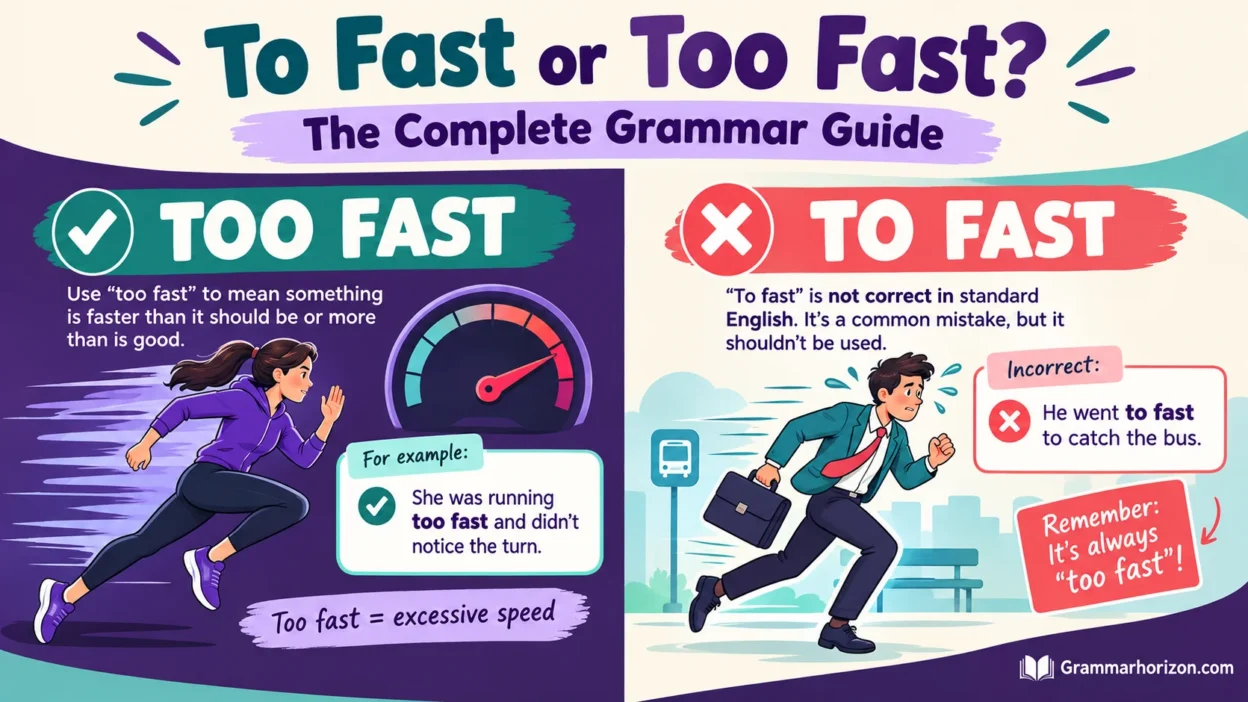
The difference between to fast or too fast is easy to understand when you look at the meaning, function, and context of each expression. To fast uses to as an infinitive marker before the verb fast, meaning to stop eating or abstain from food. For example, She chose to fast before the ceremony means she decided not to eat before an event. On the other hand, too fast uses too as an adverb to modify fast and describe excessive speed. If She ran too fast, the phrase means that she ran at a speed greater than was wanted or appropriate. Although the two expressions may sound similar, their spelling, grammatical function, and core meaning are different.
When you understand the parts of speech, the correct choice becomes even clearer. To can introduce an infinitive verb phrase, such as to run, to use, or to fast, while too is an adverb that can intensify another word. In phrases such as walking too fast, driving too fast, or moving too fast, too modifies fast and tells you that the action is happening at an excessive speed. Compare this with He decided to fast before the ceremony, where to fast describes an intended action involving not eating. This simple comparison shows why you need to consider the entire sentence rather than choosing a form based only on how the words sound.
For writers and English learners, the easiest way to avoid this common mistake is to identify what you actually mean before selecting the spelling. If the sentence describes excessive speed, use too fast, as in He drove too fast or You’re walking too fast for me. If fast means not eating, use to fast, as in They decided to fast before the ceremony. The distinction remains the same in both American English and British English. Remember this practical rule: to fast refers to the action of abstaining from food, while too fast means excessively quick or faster than is appropriate.
Quick Answer: Is It “To Fast” or “Too Fast”?
If you’re talking about excessive speed, use too fast.
- Too fast = faster than is appropriate, safe, comfortable, or desired.
- To fast = the infinitive form of the verb fast, meaning to abstain from food.
For example:
The car is going too fast.
Here, too means “more than is appropriate,” while fast describes the car’s speed.
Now consider:
She decided to fast before the ceremony.
In this sentence, to fast is correct because fast functions as a verb. It means she decided to abstain from food.
So, if you’re describing speed, the answer is almost always too fast.
“Too Fast” or. “To Fast”: Comparison Overview
| Phrase | Grammatical function | Meaning | Example |
| too fast | Adverb + adverb/adjective | Faster than appropriate | You’re driving too fast. |
| to fast | Infinitive verb | To abstain from food | They plan to fast tomorrow. |
| very fast | Adverb + adverb/adjective | At a high speed | The train moves very fast. |
| to move fast | Infinitive + adverb | To move at high speed | We need to move fast. |
The extra o in too isn’t decorative. It changes the word’s meaning and grammatical role.
Main Differences Between To Fast and Too Fast
The clearest way to separate these phrases is to look at what the sentence actually means.
Too fast relates to degree or speed. It tells you that something happens faster than a particular standard or limit.
To fast relates to an action. It is used as an infinitive marker before the verb fast.
Compare these examples:
- The runner is going too fast.
- The runner decided to fast.
The first sentence describes speed. The second describes abstaining from food.
This distinction becomes especially important because fast can have more than one grammatical role. It can describe speed, but it can also function as a verb.
What Does “Too Fast” Mean?
Too fast means faster than is suitable, acceptable, safe, or wanted.
The word too signals an excessive degree. It doesn’t simply mean that something has a high level of speed. Instead, it suggests that the speed has crossed a boundary.
For example:
The car is very fast.
This simply tells you that the car has a high speed.
The car is too fast for this road.
Now the sentence communicates a problem. The car’s speed exceeds what the speaker considers appropriate for the road.
That distinction matters.
When Should You Use “Too Fast”?
Use too fast when the speed creates a problem or exceeds an expected limit.
You might use it when talking about:
- Driving
- Running
- Speaking
- Reading
- Typing
- Video playback
- Machines
- Business processes
- Learning
- Changes or developments
For example:
- You’re driving too fast.
- He talks too fast for me to understand him.
- The video is playing too fast.
- The machine is spinning too fast.
- The lesson moved too fast for beginners.
- The company expanded too fast.
Notice that too fast doesn’t always describe physical movement. It can describe the rate at which an action or process occurs.
“Too Fast” Doesn’t Always Mean Extremely Fast
Context determines what counts as “too fast.”
A race car might safely travel at a speed that would be dangerous in a residential neighborhood. Similarly, an experienced reader might comfortably process information that feels too fast to a beginner.
That’s why too fast is relative to a standard.
What Does “To Fast” Mean?
At first glance, to fast looks like a misspelling of too fast. In some sentences, it is. However, the phrase can also be grammatically correct.
The difference comes from the word fast.
As a verb, fast means to deliberately abstain from food for a period of time. The infinitive form is to fast.
For example:
- They chose to fast for one day.
- She plans to fast tomorrow.
- He decided to fast before the event.
Here, to introduce the verb fast.
“To” as an Infinitive Marker
English frequently uses to + base verb to create an infinitive.
Examples include:
- to run
- to write
- to learn
- to study
- to travel
- to fast
The word “to doesn’t mean “excessively” in these constructions. It simply forms part of the infinitive.
That’s why this sentence is correct:
They decided to fast.
Replacing ” with too” would change the grammar and produce an incorrect sentence for that meaning.
Why “To Fast” Usually Isn’t About Speed
If you want to describe movement at high speed, to fast doesn’t work by itself.
You would say:
I want to move fast.
Not:
I want to fast.
The second sentence means something entirely different. It means the speaker wants to abstain from food.
This is a classic example of how context controls meaning in English.
What Does “Too” Mean in English?
Too has several legitimate uses, although two are especially common.
“Too” for Excess
The most relevant meaning here is more than necessary, desirable, or appropriate.
Examples include:
- too expensive
- too loud
- too difficult
- too late
- too quickly
- too fast
In too fast, the word too modifies the degree of speed.
The internet connection is too slow.
The car is too fast for the narrow road.
The structure works in both directions because too signals an undesirable degree.
“Too” for Addition or Agreement
Too can also mean also or as well.
For example:
I want to come too.
This means:
I also want to come.
Another example:
She likes coffee too.
Here, too, has nothing to do with excess. It adds information.
“Too” for Emphasis
In some expressions, too can provide emphasis.
For example:
That is too true.
You are too kind.
The exact meaning depends heavily on context and tone. In everyday writing, however, the excess and additional meanings are much more important.
Using “To” Correctly
The word appears constantly in English, so learning its main functions makes many grammar decisions easier.
“To” for Direction and Destination
To commonly indicates movement toward a person, place, or destination.
Examples:
- She went to school.
- We drove to the airport.
- Send the document to me.
- He walked to the store.
In these sentences, to has nothing to do with excess.
“To” Before a Verb
To also introduce infinitives.
Examples:
- I want to learn.
- They need to leave.
- She hopes to win.
- We plan to travel.
- He decided to fast.
A useful test is to look at the word immediately after to. If it is a base-form verb, you may be dealing with an infinitive.
Common “To Fast” and “Too Fast” Mistakes
The most common error occurs when someone writes to fast while describing excessive speed.
Mistake: “The car is going to fast.”
Correct:
The car is going too fast.
The sentence describes excessive speed, so too is required.
Mistake: “You are walking to fast.”
Correct:
You are walking too fast.
Again, too indicates that the walking speed exceeds an appropriate level.
Mistake: “I need too study.”
Correct:
I need to study.
Here, to introduce the verb study. The sentence has nothing to do with excess.
A Simple Three-Question Test
When you’re unsure, ask:
- Does the sentence mean “excessively” or “more than appropriate”?
Use too. - Does the sentence mean “also” or “as well”?
Use too. - Does “to” introduce a destination or an infinitive verb?
Used to.
This quick test catches most everyday errors.
“Too Fast” or. “Very Fast”
These phrases look similar, but their meanings aren’t identical.
| Phrase | Meaning | Example |
| very fast | High speed | The train is very fast. |
| too fast | Excessive or inappropriate speed | The train is moving too fast. |
Consider a professional runner. Saying “She runs very fast” praises her speed.
Saying “She runs too fast” suggests that her speed creates some problem or exceeds a relevant limit.
That single word changes the tone.
“Too Fast” or. “Too Quickly”
Fast and quickly overlap considerably in modern English, especially when they function as adverbs.
For example:
He runs too fast.
He runs too quickly.
Both can communicate that his running speed exceeds what is appropriate.
However, fast is especially natural when discussing speed itself. Quickly often emphasizes the rapid completion or manner of an action.
Compare:
- The car is moving too fast.
- She finished the assignment too quickly.
The first focuses strongly on speed. The second can suggest that the task was completed so rapidly that something may have been missed.
Neither word should be treated as universally better. Context decides which sounds more natural.
Why “To” and “Too” Sound the Same
To and too are homophones. That means they have the same pronunciation in many varieties of English while having different spellings and meanings.
English contains many homophone pairs, including:
- to / too / two
- there / their / they’re
- your / you’re
- hear / here
Because to and too sound alike, listening alone won’t tell you which spelling belongs in a sentence.
Writing requires you to identify the word’s grammatical function.
That’s why proofreading should focus on meaning, not just pronunciation.
Easy Tricks to Remember “To” or. “Too”
Simple memory tricks can make to and too much easier to distinguish: remember that too has an extra “o” for something extra, while to often it shows direction or introduces a verb.
Trick: “Too” Has an Extra O
Think of the extra o as representing something extra.
Too can mean:
- more than necessary
- also
For example:
It’s too hot.
There is more heat than desired.
I want one too.
There is an additional person who wants one.
Trick: Think of “To” as a Direction
When to show movement or direction, imagine an arrow:
The arrow doesn’t work for too.
Trick: Look at the Word After “To”
If to comes before a base verb, it often forms an infinitive:
- to run
- to write
- to read
- to fast
That makes to fast correct when fast means abstaining from food.
Real-Life Examples of “To Fast” and “Too Fast”
Real-life examples make the difference between to fast and too fast easier to understand by showing how each phrase works in everyday situations.
Everyday Conversation
“Slow down. You’re driving too fast.”
The speaker believes the driving speed is excessive.
“I decided to fast today.”
Here, fast is a verb meaning to abstain from food.
Professional Communication
“The project is moving too fast, and the team needs more time to review the changes.”
The project is progressing more quickly than the speaker considers appropriate.
Digital and Social Media Context
“The video moves too fast to read the captions.”
The playback speed prevents comfortable reading.
A spelling error such as “to fast” could make an otherwise polished message look careless. The mistake is small, but the distinction is fundamental.
Related Uses of “Fast”
Understanding the different roles of fast makes this entire topic easier.
Fast as an Adjective
Fast can describe a person, animal, object, or vehicle capable of high speed.
That’s a fast car.
She is a fast runner.
Fast as an Adverb
Fast can describe how quickly something happens.
He runs fast.
The car moves fast.
Fast as a Verb
Fast can mean to abstain from food.
They chose to fast.
This third use explains why to fast can be grammatically correct.
Conclusion
Choosing the correct English word or phrase can make your writing clearer, more natural, and grammatically accurate. Although some words may look or sound similar, their meanings, functions, and contexts can be different. Understanding these small distinctions helps you avoid common mistakes and communicate your ideas with greater confidence. When you’re unsure, focus on the meaning of the sentence and the grammatical role of the word rather than relying only on pronunciation.
Read More:Soo vs. So: What’s the Difference and Which One Is Correct?
FAQs
Q1. What is the main difference between these commonly confused words?
The main difference usually involves their meaning, grammatical function, or usage. Even words that sound similar may work differently in a sentence.
Q2. How can I choose the correct word?
Look at the context and ask what you’re trying to express. Then check whether the word needs to function as a noun, verb, adjective, adverb, or another part of speech.
Q3. Why do English words cause so much confusion?
English contains many homophones, similar spellings, irregular forms, and words borrowed from other languages, so two words can appear or sound almost identical while having different meanings.
Q4. Are incorrect forms always considered grammar mistakes?
Not always. Some forms are informal, uncommon, regional, or outdated rather than completely ungrammatical. However, standard forms are usually the safest choice in formal writing.
Q5. Can these words be used interchangeably?
Usually, no. Some similar words can overlap in certain contexts, but replacing one with another may change the meaning or make the sentence sound unnatural.
Q6. Which form should I use in formal writing?
Use the standard and widely accepted form. Academic papers, professional emails, reports, and other formal documents generally require conventional English usage.