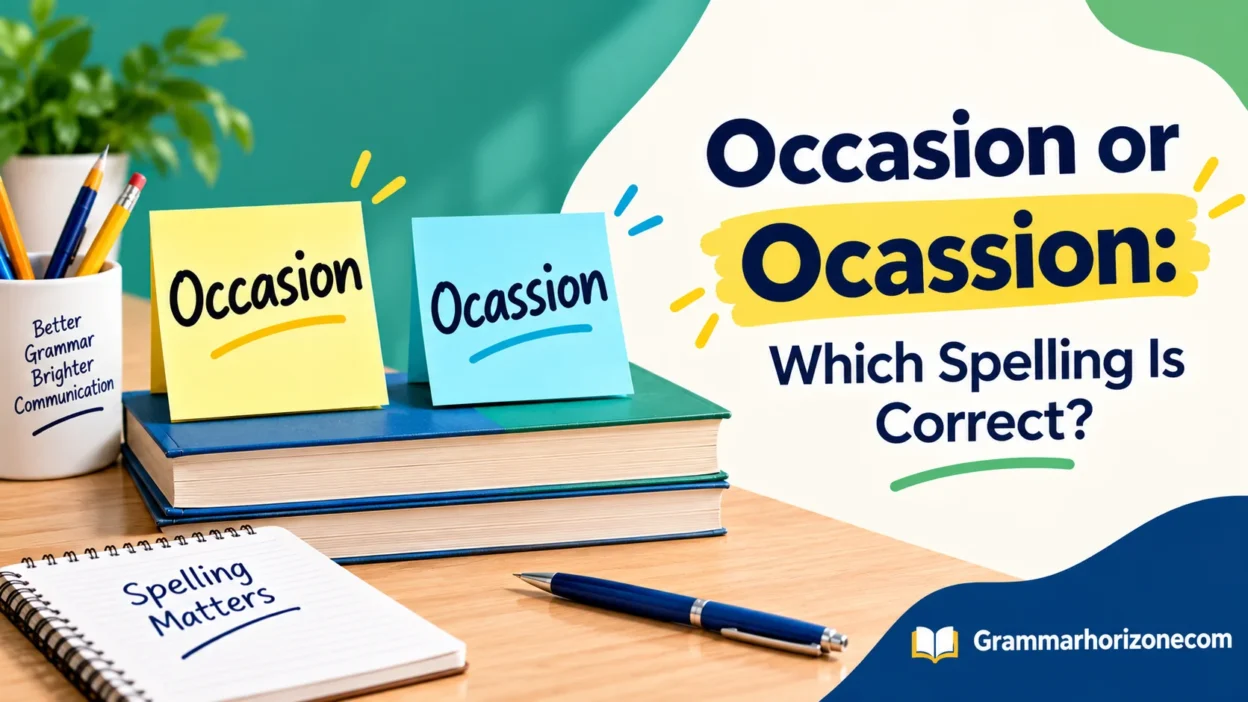
Occasion or Ocassion is a common spelling question when writing about a birthday, wedding, or celebration. Both spellings look similar, but only occasion is correct in standard English, while ocassion is an incorrect spelling and a misspelling. The main difference is the letter pattern: occasion contains a double C followed by a single S. Learning this correct spelling can reduce spelling confusion, improve English spelling, and strengthen word recognition. Instead of memorizing complicated details, focus on the letters in the middle of the word to build spelling memory and recognize the correct form more easily.
The occasion meaning depends on the context and word usage. It can describe a special event, an important event, a particular time, or a situation that provides an opportunity for something to happen. For example, a birthday dinner is a special occasion, while a formal ceremony is another kind of event. You may use the word in everyday conversations, invitations, school assignments, business emails, and formal documents. Understanding its contextual meaning helps you write natural sentences and choose the right word choice. Good vocabulary, grammar knowledge, and sentence structure support clear written communication in everyday English, formal writing, business writing, and personal writing.
To improve spelling accuracy, practice writing occasion in different sentences and check your work through proofreading. Regular spelling practice can reduce spelling errors, improve writing accuracy, and strengthen communication skills. When reviewing schoolwork or preparing professional communication, check your written words carefully and choose correct usage instead of incorrect usage. This habit helps English learners and native English speakers improve their English vocabulary, spelling skills, and understanding of word formation and language conventions. If you notice ocassion spelling in a draft, make the necessary spelling correction before sharing it
Quick Answer: Occasion or Ocassion?
Occasion is correct, while ocassion is incorrect.
The correct spelling contains two C’s and one S. You can use occasion when talking about a special celebration, a particular event, or a specific instance when something happens.
| Spelling | Status | Example |
| Occasion | Correct | Her birthday was a wonderful occasion. |
| Ocassion | Incorrect | Her birthday was a wonderful ocassion. |
| Occassion | Incorrect | We prepared dinner for the special occassion. |
Remember this simple rule: occasion has double C and single S. The spelling stays the same in both American and British English.
What Does Occasion Mean?
An occasion is a particular event, time, or circumstance. People often use the word to describe celebrations, but its meaning extends beyond parties and special gatherings.
For example, a wedding is an occasion because it marks an important event in someone’s life. A business meeting can also be an occasion when colleagues gather to discuss a project. Similarly, a particular moment when someone receives good news can be described as an occasion.
The word is most commonly used as a noun. Depending on the context, it can refer to several things:
- A special event: A birthday, wedding, graduation, or anniversary.
- A particular instance: A specific time when something happens.
- An opportunity: A suitable moment to do something.
- A circumstance: A situation that provides a reason for an action.
Understanding these meanings helps you use occasion naturally in both casual conversations and formal writing.
Occasion as a Special Event
Some days stand out from ordinary routines. Birthdays, weddings, graduations, anniversaries, and retirement parties are examples of special occasions because they mark important moments or achievements.
People often use occasion when discussing celebrations, gifts, invitations, clothing, and family gatherings. For example, someone might buy a new outfit for a wedding or prepare a favorite meal to celebrate a parent’s retirement.
Here are some examples:
- We decorated the house for the special occasion.
- Her graduation was a proud occasion for the entire family.
- He wore a formal suit because the awards ceremony was an important occasion.
- The restaurant prepared a special menu for the anniversary occasion.
An occasion doesn’t have to be expensive or elaborate. A quiet dinner with family can become a meaningful occasion when it celebrates something important.
Occasion as a Particular Time or Situation
Not every occasion involves a celebration. Sometimes, the word simply refers to a particular instance when something happens.
Suppose you have visited a museum three times. You could say, “I have visited the museum on three occasions.” Here, occasions refers to three separate visits rather than three special events.
This meaning also appears when people describe conversations, decisions, experiences, or unusual situations.
Examples include:
- On one occasion, the entire team finished the project early.
- I have seen that bird in our garden on several occasions.
- She remained calm on every occasion when the schedule changed.
- This is an appropriate occasion to discuss our future plans.
The surrounding sentence determines whether occasion refers to a celebration, an instance, or a situation.
Occasion as an Opportunity or Reason
The word can also describe an opportunity or circumstance that makes an action appropriate. This use often appears in formal writing, speeches, announcements, and professional conversations.
For example, a graduation ceremony provides an occasion to thank teachers and family members. A company’s anniversary gives its leaders an opportunity to recognize employees and celebrate achievements.
Consider these sentences:
- The meeting gave us an occasion to review our progress.
- She used the award ceremony as an occasion to thank her mentors.
- The announcement provided an occasion for the community to celebrate.
- There was no occasion to change the original plan.
In these examples, occasion connects an event or situation with a particular action. It doesn’t necessarily suggest a party or celebration.
Why Is Occasion the Correct Spelling?
The correct spelling is occasion, written as O-C-C-A-S-I-O-N. It contains two consecutive C’s followed by A, S, I, O, and N.
The misspelling ocassion changes this letter pattern by using an extra S and omitting one C. Although the difference looks small, standard spelling matters in schoolwork, professional communication, and published content.
The word entered English through French from the Latin occasio. Its modern spelling follows an established convention rather than a rule that writers can freely change.
Here’s the correct letter pattern:
| Part of the Word | Correct Spelling |
| Beginning | Occ |
| Middle | Asi |
| Ending | On |
| Complete word | Occasion |
One reason people make this mistake is that pronunciation doesn’t clearly reveal the spelling. In American English, occasion is commonly pronounced /əˈkeɪʒən/. The middle sound resembles the sound in vision, which can make the written S less obvious.
The best approach is to memorize the complete spelling instead of trying to guess the letters from the sound.
Why Does Ocassion Look Correct to Some Writers?
English contains many words with doubled consonants. Words such as necessary, possession, and discussion include double S in different parts of their spelling. Writers sometimes apply similar patterns incorrectly when writing occasion.
Typing quickly can also cause errors. Someone may repeat a consonant without noticing or remember the sound of a word more clearly than its written form.
For example, a person writing an invitation might type, “Join us for this special ocassion.” The sentence makes sense, but the spelling is wrong.
The solution is simple: learn the correct word pattern and proofread the sentence before sending or publishing it.
Occasion or. Ocassion: Key Differences
The difference between occasion and ocassion is not a difference in meaning. One is the correct spelling, while the other is a spelling error.
Occasion is a standard English word used to describe an event, time, or opportunity. Ocassion is not an accepted alternative spelling in standard English.
| Feature | Occasion | Ocassion |
| Spelling status | Correct | Incorrect |
| Meaning | Event, time, or opportunity | No standard meaning as written |
| Standard English usage | Accepted | Not accepted |
| Suitable for formal writing | Yes | No |
| Correct letter pattern | Double C, single S | Incorrect letter pattern |
Examples of Occasion or. Ocassion in Sentences
Comparing incorrect and correct sentences makes the spelling difference easier to recognize.
Incorrect: We bought flowers for the special ocassion.
Correct: We bought flowers for the special occasion.
Incorrect: This is a rare occassion to meet the entire team.
Correct: This is a rare occasion to meet the entire team.
Incorrect: On this ocassion, everyone arrived early.
Correct: On this occasion, everyone arrived early.
In each example, you only need to correct the spelling. The meaning and sentence structure can stay the same.
Common Variations of the Misspelling
People sometimes write the word incorrectly in several different ways. These mistakes usually involve changing the number or order of letters.
- Ocassion: Uses one C and two S’s.
- Occassion: Uses two C’s and two S’s.
- Ocasion: Leaves out one C.
- Occation: Replaces S with T.
None of these forms is the standard spelling of the word. When referring to an event, a particular time, or an opportunity, use occasion.
Examples of Occasion in Everyday Sentences
Reading the word in different contexts helps you understand its meaning and remember its spelling. The following examples show how occasion works in personal, academic, and professional writing.
Occasion in Personal Life
- My sister’s wedding was a beautiful occasion.
- We gathered at our grandparents’ house for the special occasion.
- He bought his father a watch on the occasion of his retirement.
- The family celebrated the occasion with a homemade dinner.
Occasion in Academic Writing
- The school organized a ceremony on the occasion of its 50th anniversary.
- The teacher used the discussion as an occasion to explain the topic again.
- Students met on several occasions to prepare for the science competition.
- The debate provided an occasion for students to share different viewpoints.
Occasion in Professional Writing
- The conference provided an occasion to discuss new business opportunities.
- The manager thanked the staff on the occasion of the company’s anniversary.
- This meeting is an appropriate occasion to review the project’s progress.
- The announcement gave the team an occasion to recognize its achievements.
These examples show that occasion fits many types of writing. The key is to use it when referring to an event, instance, or opportunity.
Common Expressions That Use Occasion
Several familiar English expressions contain the word occasion. Learning them can improve your vocabulary and help you recognize the correct spelling in context.
On Occasion
The phrase on occasion means sometimes or from time to time. It describes something that happens occasionally rather than regularly.
Examples:
- I eat at that restaurant on occasion.
- She works from home on occasion.
- On occasion, our team meets outside the office.
You can often replace on occasion with sometimes without changing the main meaning.
On This Occasion
Use on this occasion when referring to a specific event or instance. The word this points to a situation that the reader can identify from the context.
Examples:
- On this occasion, we decided to celebrate at home.
- The manager offered additional guidance on this occasion.
- On this occasion, the students worked together exceptionally well.
This expression works well in formal reports, speeches, and everyday conversations.
Special Occasion
A special occasion is an event that deserves particular attention or recognition. Weddings, birthdays, anniversaries, and graduations are common examples.
Examples:
- She saved her favorite dress for a special occasion.
- We ordered a cake for the special occasion.
- They chose a quiet restaurant to mark the special occasion.
A special occasion doesn’t need to involve a large celebration. Even a small personal milestone can be meaningful.
On the Occasion Of
The expression on the occasion of introduces an event connected to a statement, gift, ceremony, or message. It appears frequently in formal announcements and greetings.
Examples:
- We congratulated the couple on the occasion of their wedding anniversary.
- The school held a ceremony on the occasion of its founding.
- The organization released a statement on the occasion of its annual meeting.
In casual writing, a shorter phrase such as for their anniversary may sound more natural. However, the longer expression can suit formal contexts.
Rise to the Occasion
To rise to the occasion means to respond successfully when a situation requires effort, courage, or skill. People often use this expression when someone performs well under pressure.
Examples:
- When the main speaker became ill, Maya rose to the occasion and delivered the presentation.
- The team rose to the occasion during the final minutes of the match.
- Although he felt nervous, he rose to the occasion and led the meeting confidently.
Here, occasion describes a demanding situation rather than a celebration.
Occasion or. Occasional or. Occasionally
The words occasion, occasional, and occasionally belong to the same word family. However, each serves a different grammatical purpose.
| Word | Part of Speech | Meaning | Example |
| Occasion | Noun | An event, time, or opportunity | The ceremony was a memorable occasion. |
| Occasional | Adjective | Happening sometimes, but not often | We have occasional meetings after work. |
| Occasionally | Adverb | Sometimes, but not regularly | We occasionally eat dinner together. |
When to Use Occasion
Use occasion as a noun when referring to an event, a particular instance, or an opportunity.
Example: The award ceremony was an important occasion for the students.
In this sentence, occasion names the event.
When to Use Occasional
Use occasional as an adjective to describe something that happens from time to time.
Example: We experienced occasional delays during the journey.
The adjective occasional describes the delays.
When to Use Occasionally
Use occasionally as an adverb when describing how often something happens.
Example: She occasionally visits her former classmates.
The word explains how often she visits them. Remember that all three words contain the same spelling sequence at their base.
How to Remember the Correct Spelling of Occasion
Spelling becomes easier when you have a reliable memory trick. Instead of guessing between occasion and ocassion, focus on the letter pattern that distinguishes them.
Remember Double C and Single S
The easiest spelling tip is:
Occasion = double C + single S.
Write the word slowly to reinforce its correct order:
- O
- C
- C
- A
- S
- I
- O
- N
Next, write it in a complete sentence: “The graduation ceremony was a special occasion.”
This approach helps you remember the entire word instead of concentrating only on the letters that cause confusion.
Use a Short Memory Phrase
Try remembering this sentence:
One S is enough for every occasion.
The phrase connects the spelling to the word’s meaning. It also reminds you that occasion contains one S rather than two.
Another useful technique is to picture the two C’s as a pair. When writing the word, check that both C’s appear before A and only one S appears later.
Practice With Related Words
Writing related words can strengthen your memory and help you understand their different uses.
- Occasion: The event was a memorable occasion.
- Occasional: We experienced occasional rain during the trip.
- Occasionally: I occasionally read before bed.
Practice using each word in a sentence. This reinforces the spelling while helping you recognize the grammatical differences.
Proofread Before You Submit Your Writing
Even experienced writers make typing mistakes. Before sending an email, submitting an assignment, or publishing an article, search your document for ocassion and occassion.
A spell checker can help identify these errors, but it shouldn’t replace proofreading. Read the entire sentence to ensure the corrected word fits the meaning.
A Practical Case Study: Correcting Occasion in an Invitation
Imagine that a student writes an invitation for a school graduation ceremony:
“Join us as we celebrate this special ocassion and recognize the hard work of our graduating students.”
The message communicates the intended meaning, but the spelling error makes the invitation look less polished.
The Problem
The student wrote ocassion instead of occasion. The word needs two C’s and one S.
The Correction
The revised sentence reads:
“Join us as we celebrate this special occasion and recognize the hard work of our graduating students.”
The Lesson
The writer doesn’t need to change the sentence’s structure or tone. Correcting one word makes the invitation more professional while preserving its original meaning.
The same approach works for business emails, wedding invitations, school assignments, social media posts, and website articles. When you find a spelling mistake, correct the word without changing anything that already works.
Conclusion
Understanding Occasion or Ocassion is simple once you remember that occasion is the correct spelling and ocassion is incorrect. The word describes a special event, a particular time, or a situation that provides an opportunity for something to happen. By practicing the correct letter pattern, checking your writing through proofreading, and learning from common spelling mistakes, you can improve your spelling accuracy and written communication. Whether you’re writing invitations, school assignments, or business emails, always use occasion to keep your writing clear and correct.
Frequently Asked Questions
Q1. Is it occasion or ocassion?
Occasion is the correct spelling in standard English. Ocassion is a misspelling and should be avoided in formal and informal writing.
Q2. Why is occasion spelled with two C’s?
The standard spelling of occasion includes a double C followed by a single S. Remembering this letter pattern can help you avoid common spelling errors.
Q3. What does occasion mean?
An occasion can mean a special event, such as a birthday or wedding. It can also refer to a particular time, situation, or opportunity.
Q4. How can I remember the spelling of occasion?
Remember that occasion has two C’s and only one S. Practice writing the word in sentences and proofread your work to improve spelling accuracy.
Q5. Can I use ocassion in formal writing?
No. Ocassion is incorrect in standard English. Use occasion in formal documents, business emails, invitations, schoolwork, and everyday communication.