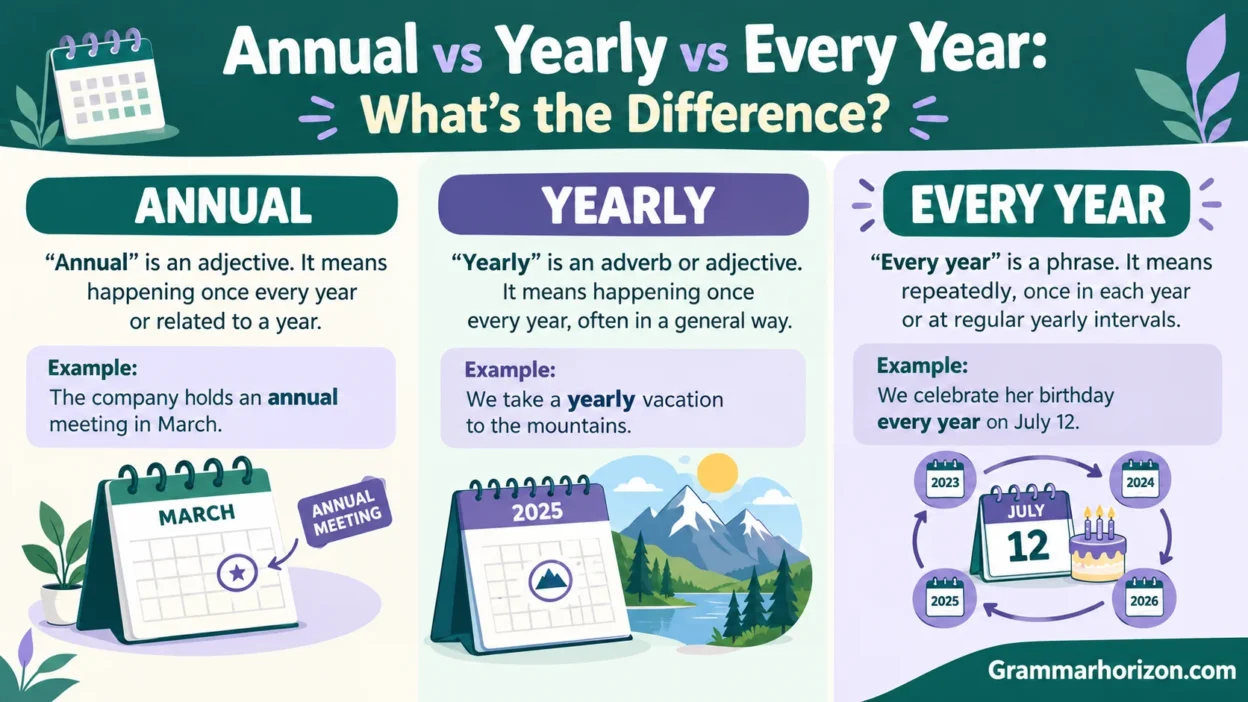
Annual vs Yearly vs Every Year may seem interchangeable, but grammar, tone, and sentence position can affect how naturally each expression sounds. All three expressions usually describe something that occurs once during a period of twelve months. However, they do not always perform the same grammatical role. Annual is mainly an adjective placed before a noun, while yearly can work as both an adjective and an adverb. Every year is an adverbial phrase that functions as a time expression. These differences become useful when learners and writers want to choose the most natural expression for a particular sentence.
The main difference appears in the grammar, structure, and grammatical position of each expression. Annual normally modifies a noun, making it common in phrases such as annual meeting, annual report, and annual event. It often appears in business, education, finance, professional, and official writing because its tone sounds relatively formal and precise. Yearly has a more flexible function because it can describe a noun or tell how frequently an action happens. For example, you can say a yearly report or explain that something happens yearly. Every year usually emphasizes a repeated occurrence and naturally answers the question of when something happens.
In practical writing, real examples make these distinctions easier to understand. An annual report means a report produced once each year, while a yearly report carries essentially the same basic meaning. If you say that a report is prepared every year, the phrase places greater attention on the repeated action rather than simply describing the report. Annual often fits academic, professional, and official contexts, whereas yearly can sound more neutral and conversational. Every year is especially natural in everyday speech and informal writing. Once you understand the tone, grammatical role, and position of each expression, you can use them correctly without memorizing dozens of complicated rules.
Quick Answer: Annual vs Yearly vs Every Year
Annual means happening once a year or relating to a year. It’s an adjective and commonly appears before a noun, as in “annual report” or “annual conference.”
Yearly can work as both an adjective and an adverb. You can say “yearly expenses” or “The company reviews its policies yearly.”
Every year is a phrase that expresses frequency. It means something happens once during each year, as in “We visit our grandparents every year.”
The simplest way to remember the difference is:
- Annual → usually describes a noun.
- Yearly → can describe a noun or an action.
- Every year → tells you how often something happens.
All three can be correct. The best choice depends on the sentence, context, and tone.
Comparison Overview: Annual vs Yearly vs Every Year
| Expression | Grammatical Role | Basic Meaning | Common Use | Typical Tone |
| Annual | Adjective | Happening once a year or relating to a year | Annual report, annual meeting | Formal/neutral |
| Yearly | Adjective or adverb | Happening once a year | Yearly payment, paid yearly | Neutral |
| Every year | Adverbial phrase | Once each year | We travel every year | Conversational/neutral |
| Annually | Adverb | Once a year | The report is published annually | Formal |
The key distinction is grammar, not simply meaning. Two expressions may describe the same yearly occurrence while serving different roles in a sentence.
For example, compare these sentences:
- The annual festival attracts thousands of visitors.
- The yearly festival attracts thousands of visitors.
- The festival takes place every year.
The basic idea remains the same. However, the first two expressions modify the festival, while every year the action takes place.
Main Differences Between Annual, Yearly, and Every Year
The main differences between annual, yearly, and every year involve their grammar, sentence placement, and tone, even though all three can describe something that happens once each year.
What Does Annual Mean?
Annual is an adjective that refers to something connected with a year or something that occurs once each year.
It’s particularly common before nouns. You’ll frequently see it in business, finance, education, government, and professional writing.
Common examples include:
- annual report
- annual meeting
- annual conference
- annual budget
- annual review
- annual fee
- annual subscription
- annual salary
- annual assessment
Consider this sentence:
The company published its annual report in March.
Here, annual describes the noun report. It tells readers that the report relates to the company’s yearly reporting cycle.
The word also appears when discussing amounts calculated over a year. For instance, annual income means income measured over a one-year period. Similarly, an annual fee is a fee charged for a year.
What Does Yearly Mean?
Yearly is more flexible because it can function as either an adjective or an adverb.
As an adjective, it can describe a noun:
The company conducts a yearly review of its safety procedures.
As an adverb, it can describe an action:
The company reviews its safety procedures yearly.
This flexibility makes yearly useful in many situations.
However, annual is often more established in certain combinations. For example, annual report sounds more conventional than a yearly report in professional business writing.
That doesn’t make the yearly report grammatically wrong. It simply means that English speakers have developed stronger preferences for particular word combinations.
What Does Every Year Mean?
Every year is a frequency expression. It tells the reader that something happens once during each year.
For example:
The family visits the lake every year.
The phrase every year explains how frequently the family visits the lake.
You can place it in different positions depending on the sentence:
- We travel abroad every year.
- Every year, the town hosts a summer festival.
- The company releases a new product every year.
This expression is especially natural in everyday conversation because it states the frequency clearly and directly.
Annual vs Yearly: Are They Interchangeable?
In many sentences, annual and yearly have essentially the same meaning. Both can describe something that occurs once each year.
For example:
- annual payment
- yearly payment
Both can refer to a payment made once a year.
Likewise:
- annual inspection
- yearly inspection
Both describe an inspection that occurs once a year.
Still, native usage creates differences in naturalness. Annual tends to appear more often in formal and institutional language.
For example, these combinations sound particularly established:
- annual report
- annual meeting
- annual conference
- annual budget
- annual income
Meanwhile, yearly often feels more straightforward and conversational:
- yearly expenses
- yearly schedule
- yearly payment
- yearly tradition
The distinction isn’t an absolute rule. English allows considerable flexibility.
Annual vs Every Year: Grammar Makes the Difference
The biggest difference between annual and every year is their grammatical structure.
Annual normally comes before a noun:
The annual conference begins tomorrow.
Every year usually describes when an action occurs:
The conference takes place every year.
You can’t normally replace annual with every year while keeping the same structure.
For example:
The annual conference begins tomorrow.
This doesn’t sound natural in standard English.
Instead, use:
The annual conference begins tomorrow.
Or restructure the sentence:
The conference takes place every year.
That simple change solves the problem.
Yearly vs Every Year: Which Sounds More Natural?
Both yearly and every year can describe repeated annual activity.
Compare:
The company publishes the figures yearly.
and:
The company publishes the figures every year.
Both sentences are grammatical. However, every year often sounds more natural in ordinary conversation because it explicitly communicates frequency.
Now compare them in a noun phrase:
The company prepares a yearly report.
Here, yearly works as an adjective.
You can’t use every year in exactly the same position:
The company prepares an every year report.
Instead, say:
The company prepares an annual report.
or:
The company prepares a report every year.
That difference illustrates why grammar matters more than simply asking which expression is “correct.”
Annual vs Yearly vs Every Year in Different Contexts
Annual, yearly, and every year can all describe events that happen once a year, but the best choice depends on the context, sentence structure, and level of formality.
Business and Professional Writing
Professional writing often favors annual because it fits established business terminology.
Examples include:
- annual report
- annual meeting
- annual performance review
- annual budget
- annual revenue
A company might write:
Employees receive an annual performance review.
That sounds polished and conventional.
Academic Writing
Academic contexts also commonly use annual and annually.
For example:
The university publishes its annual enrollment report.
Or:
Enrollment data is reviewed annually.
However, every year remains perfectly acceptable when the writer wants a more direct expression.
Finance and Payments
Financial language creates an important distinction.
Consider the annual salary. It refers to the amount earned over a year.
Likewise, an annual fee usually refers to a charge for one year.
You could say:
The membership costs $120 annually.
or:
The membership costs $120 every year.
Both communicate a yearly charge, although annually sounds more formal.
Everyday Conversation
In casual conversation, every year is often the easiest choice.
For example:
We go to the beach every year.
You could say:
We go to the beach yearly.
That’s grammatical, but the first version generally sounds more natural and conversational.
Annual vs Annually vs Yearly vs Every Year
These four expressions are closely related, but their grammatical jobs differ.
| Word/Phrase | Function | Example |
| Annual | Adjective | We held our annual meeting. |
| Annually | Adverb | We hold the meeting annually. |
| Yearly | Adjective | We hold a yearly meeting. |
| Yearly | Adverb | We meet yearly. |
| Every year | Adverbial phrase | We meet every year. |
One common mistake is using annual where an adverb is required.
Incorrect:
The company publishes its report annual.
Correct:
The company publishes its report annually.
You could also write:
The company publishes its report every year.
The important point is that annual modifies nouns, while annually modifies actions or describes frequency.
Common Mistakes With Annual, Yearly, and Every Year
Common mistakes with annual, yearly, and every year usually happen when writers confuse their grammatical roles, use them in the wrong sentence structure, or assume that one expression is always more correct than the others.
Using “Every Year” Before a Noun
A common mistake is writing:
an every year meeting
Instead, use:
an annual meeting
or:
a yearly meeting
You can also restructure the sentence:
The meeting occurs every year.
Assuming Yearly Is Incorrect
Some writers mistakenly believe yearly is somehow less correct than annual.
That’s not true.
Yearly is a standard English word. It functions as both an adjective and an adverb.
The real issue is often style or collocation rather than grammatical correctness.
Using Annual Instead of Annually
Because annual and annual look similar, they’re easy to confuse.
Remember:
- annual → adjective
- annually → adverb
Compare:
We conduct an annual inspection.
We conduct inspections annually.
Thinking Every Year Is Always More Correct
Every year isn’t automatically better than annual or yearly.
Each expression has its own grammatical role. The sentence determines which one fits.
Case Study: Choosing the Right Expression
Imagine a company wants to explain its employee review process.
Here are three possible sentences:
The company conducts an annual employee review.
The company conducts a yearly employee review.
The company reviews employee performance every year.
All three communicate a yearly review process.
The first sounds the most conventional in formal business writing. The second is grammatically sound and slightly more straightforward. The third changes the structure and uses every year to emphasize frequency.
This example shows an important lesson: good word choice isn’t always about finding one “correct” word. It’s about choosing the expression that fits the sentence and purpose.
Practical Guide: Which One Should You Use?
Use annual when:
- You’re modifying a noun.
- You’re writing formal or professional content.
- The phrase is a common established combination.
- You’re discussing yearly amounts or reports.
Use yearly when:
- You need an adjective meaning once a year.
- You want an adverb meaning once a year.
- The wording sounds natural in your sentence.
Use every year when:
- You want to clearly express frequency.
- You’re writing conversational or general-audience content.
- You’re describing an action that repeats each year.
Use annually when:
- You need a formal adverb.
- You’re describing an action that happens once a year.
Final Verdict: Annual vs Yearly vs Every Year
The difference between annual vs yearly vs every year is mainly about grammar, sentence structure, and style.
Annual is an adjective and commonly appears before nouns: annual meeting, annual report, annual fee.
Yearly is more flexible. It can act as an adjective or adverb: yearly payment or paid yearly.
Every year is a frequent phrase: We visit every year.
A quick rule makes the distinction easy:
- Annual = describes something related to a year or occurring once a year.
- Yearly = means once a year and can function as an adjective or adverb.
- Every year = means once during each year and usually describes when something happens.
- Annually = the formal adverbial form related to annual.
So, if you’re writing an “annual report,” keep it annual. If you’re saying “We visit every year,” keep every year. When both yearly and annual could work, choose the one that best matches the tone and established wording of your sentence.
Once you understand their grammatical roles, annual vs yearly vs every year becomes much less confusing. The trick isn’t memorizing a complicated rule. It’s recognizing what the expression needs to do in the sentence.
Conclusion
Annual, yearly, and every year share a similar basic meaning because they can all describe something that happens once during twelve months. However, their grammatical roles and tones are different. Annual is mainly an adjective and works well in formal, professional, academic, and official contexts. Yearly can be used as both an adjective and an adverb, making it more flexible in everyday English. Every year is an adverbial time expression that clearly emphasises repetition or regular occurrence. Understanding these small distinctions helps you choose the expression that sounds most natural and communicate your meaning accurately.
Read More:Eventhough vs Even Though: What’s Correct? Grammar Rules, Meaning
FAQs
Q1. Is annual the same as yearly?
Annual and yearly often have the same basic meaning: something that happens or is done once a year. However, annual usually sounds more formal, while yearly is more neutral and flexible.
Q2. Is it correct to say every year?
Yes, every year is completely correct. It is an adverbial phrase used to show that something happens repeatedly once each year.
Q3. Is annual a noun or an adjective?
Annual is normally an adjective. It describes a noun, as in annual report, annual meeting, or annual event.
Q4. Can yearly be used as an adverb?
Yes. Yearly can function as both an adjective and an adverb. For example, “We publish a yearly report” uses it as an adjective, while “The event occurs yearly” uses it as an adverb.
Q5. Which is better for formal writing: annual, yearly, or every year?
Annual is generally the best choice for formal, professional, academic, and official writing when it modifies a noun. Yearly and every year are also correct, but the best choice depends on the sentence and the grammatical role required.