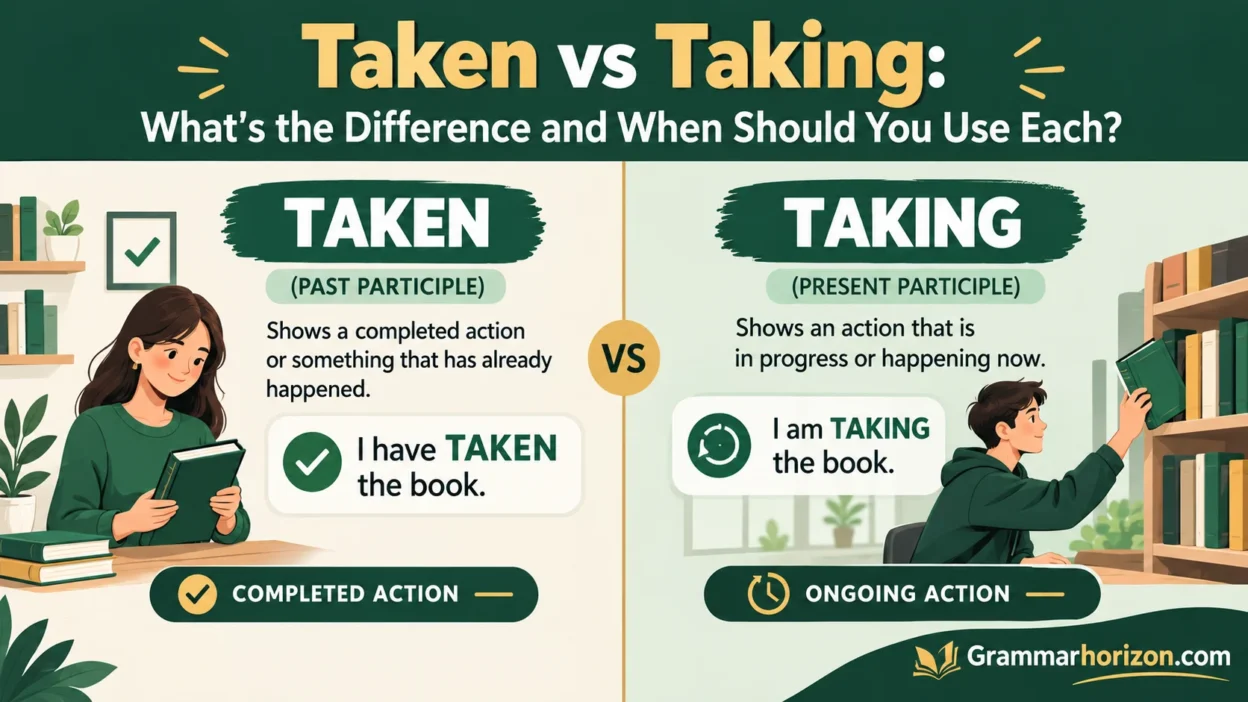
Taken vs Taking can be confusing for English learners because both forms come from the same verb, take, but they have a different grammatical purpose. The correct choice depends on the sentence structure and the helping verb. Taking usually describes an action in progress, while taken is the past participle form. For example, she is taking the exam shows an action that is happening or continuing, while she has taken the exam shows that it is already completed. This difference can completely change the meaning of a sentence.
The key is to look at the entire verb phrase instead of treating taken and taking as simple alternatives. These forms of take work together, but their function, tense, and role can be very different. Taken commonly appears with has, have, or had, while taking can follow is, am, or are. When you compare these patterns, the distinction becomes easier to understand. This practical tip can help you avoid mistakes in both writing and speaking.
A useful guide is to break down each sentence and identify the helping verb before choosing the right form. Then, look at whether the action is continuing or has been completed. You can also say the sentence aloud to hear which form sounds correct. This trick makes the choice clearer and helps you use taken and taking more confidently in formal writing, everyday English, and exams.
Quick Answer: Taken vs Taking
Taken is the past participle of take, while taking is the present participle and -ing form of the verb.
Use taking mainly with progressive or continuous structures:
- I am taking an English class.
- She was taking a photograph.
- They are taking the bus.
- He will be taking the test tomorrow.
Use taken mainly in perfect constructions and passive structures:
- I have taken the test.
- She had taken the wrong train.
- The photograph was taken yesterday.
- The documents have been taken from the office.
A simple comparison is:
| Word | Grammatical form | Common use | Example |
| take | Base form | Simple present, infinitives, commands | I take the bus. |
| took | Simple past | Completed past action | I took the bus yesterday. |
| taken | Past participle | Perfect and passive constructions | I have taken the bus. |
| taking | Present participle | Progressive constructions, gerunds | I am taking the bus. |
The important point is that taken isn’t simply the past tense of take. The simple past is taken.
Comparison Overview
The difference between taken and taking becomes clearer when you look at the auxiliary verb that comes before them.
| Feature | Taken | Taking |
| Verb | Take | Take |
| Form | Past participle | Present participle |
| Common pattern | Has/have/had + taken | Am/is/are/was/were + taking |
| Main grammatical role | Perfect and passive constructions | Progressive constructions |
| Example | She has taken the test. | She is taking the test. |
| Can it act as a noun? | Usually no | Yes, as a gerund |
| Common meaning | Completed action or resulting state in many contexts | Ongoing action or activity |
However, this table shouldn’t lead you to believe that taken always means finished and taking always means happening now. English grammar is more nuanced.
For instance, “She has taken the course” is used because the present perfect requires a past participle. Meanwhile, “She is taking the course” uses taking because the present progressive requires an -ing form.
The grammatical structure determines the form.
Understanding the Forms of “Take”
The verb take is irregular. Its major forms are:
- take — base form
- took — simple past
- taken — past participle
- taking — present participle
Consider this progression:
I take the train every day.
I took the train yesterday.
I have taken the train many times.
I am taking the train right now.
The basic meaning remains connected to the verb take, but the grammatical construction changes.
Why “Taken” Is Not the Simple Past
One of the most common mistakes is using taken where took belongs.
Incorrect:
I taken the bus yesterday.
Correct:
I took the bus yesterday.
Also correct:
I have taken the bus before.
The difference comes from tense and sentence structure. Took can stand alone as the simple past form. Taken normally needs an auxiliary verb when it functions as a verb form in perfect constructions.
What Does “Taken” Mean?
Taken is the past participle of take. It appears in several important grammatical structures.
“Taken” in Perfect Tenses
Perfect tenses use a form of have followed by the past participle.
Examples include:
- I have taken the test.
- She has taken three courses this year.
- They had taken the wrong road.
- We will have taken several flights by then.
Here, taken doesn’t establish the tense by itself. The auxiliary verb does much of that work.
Compare:
She has taken the medicine.
The word has created the present perfect structure, while taken supplies the past participle.
“Taken” in Passive Voice
The past participle taken also appears in passive constructions.
For example:
The photograph was taken yesterday.
Here, the photograph receives the action rather than performing it.
Compare the active version:
The photographer took the photograph yesterday.
The passive version changes the focus:
The photograph was taken yesterday.
This is why taken can appear with was, is, were, are, and other forms of be.
“Taken” as an Adjective
In some sentences, taken describes a condition or state.
For example:
Is this seat taken?
Here, taken means the seat is already occupied or unavailable.
Another example is:
She is taken.
In informal English, this can mean that someone is already in a romantic relationship.
The exact meaning depends heavily on context.
What Does “Taking” Mean?
Taking is the present participle of take. It can also function as a gerund when the -ing form acts like a noun.
“Taking” in Continuous Tenses
Progressive or continuous constructions use be + taking.
Examples include:
- I am taking an online course.
- She is taking a photograph.
- They are taking the train.
- He was taking notes.
- We were taking a break.
- She will be taking the exam tomorrow.
The form taking highlights an action or activity in progress within the relevant time frame.
For example:
She is taking a test.
This suggests that the test is currently underway.
Compare that with:
She has taken the test.
The second sentence uses the present perfect and presents the test as an experience or completed event.
“Taking” as a Gerund
The word taking doesn’t always function as part of a verb phrase. Sometimes it acts as a noun.
For example:
Taking notes improves memory.
Here, taking notes functions as the subject of the sentence.
Another example:
I enjoy taking long walks.
The phrase taking long walks functions as the object of enjoyment.
This is an important distinction because taking can appear without a form of be when it functions as a gerund.
Main Differences Between Taken and Taking
The main difference between taken and taking is that taken is the past participle used mainly in perfect and passive structures, while taking is the present participle used in progressive forms and as a gerund.
Taken vs Taking in Completed and Ongoing Actions
The clearest contrast appears in sentences such as:
She is taking the exam.
She has taken the exam.
The first sentence uses the present progressive. The action is presented as ongoing.
The second uses the present perfect. The action is presented as an experience or completed event with relevance to the present.
That distinction is more accurate than simply saying taking means present and taken means past.
Taken vs Taking in Perfect and Progressive Structures
A useful formula can help:
Progressive:
Subject + form of be + taking
Perfect:
Subject + form of have + taken
For example:
They are taking the train.
They have taken the train.
The auxiliary verb gives you a major clue about which form belongs in the sentence.
Taken vs Taking in Active and Passive Sentences
Consider these examples:
The photographer is taking the picture.
The picture is being taken by the photographer.
The first sentence is active. The photographer performs the action.
The second is passive. The picture receives the action.
Notice that passive progressive structures can contain both being and taken:
The picture is being taken.
This shows why grammatical form matters more than trying to memorize one-word definitions.
Taken vs Taking in Common Expressions
Certain expressions make the difference especially easy to see.
Taking Care of vs Taken Care of
I am taking care of the problem.
The problem has been taken care of.
The first describes an ongoing responsibility or action.
The second presents the problem as already handled.
Taking Place vs Taken Place
Both expressions are grammatical, but they appear in different structures.
The ceremony is taking place now.
The ceremony has taken place already.
Taking place commonly appears with progressive forms.
Taken place appears after forms of have in perfect constructions.
The phrase “take place” means “happen” or “occur.” It doesn’t involve physically taking something.
Taking a Break vs Taken a Break
Compare:
We’re taking a break.
We’ve taken a break.
The first describes the activity as happening now.
The second uses the present perfect to describe an action that has occurred.
Taking a Photo vs Taken a Photo
She is taking a photo.
She has taken a photo.
The difference is straightforward once you identify the auxiliary verb.
Is taking → progressive.
Has taken → perfect.
Common Mistakes With Taken and Taking
Common mistakes with taken and taking usually happen when writers confuse their grammatical roles, such as using taken after am or taking after has.
“I Am Taken the Test”
This is incorrect because the progressive requires the -ing form.
Correct:
I am taking the test.
“I Have Taking the Test”
This is incorrect because having a perfect construction requires the past participle.
Correct:
I have taken the test.
“I Taken the Test”
This construction is normally incorrect because taken needs the appropriate auxiliary in a perfect construction.
Depending on the intended meaning, use:
I took the test.
or:
I have taken the test.
“He Was Taken the Train”
This sentence can create a major meaning problem.
If the person was using the train, say:
He was taking the train.
If someone physically removed or carried him, the passive construction could be:
He was taken on the train.
The auxiliary and sentence structure can completely change the meaning.
How Auxiliary Verbs Help You Choose Taken or Taking
When you’re unsure about taken vs taking, look at the word immediately before the verb.
Common Patterns With “Taking”
You will often see taking after forms of be:
- am taking
- is taking
- are taking
- was taking
- were taking
- will be taking
Examples:
I am taking a class.
They were taking photographs.
Common Patterns With “Taken”
You will often see taken after forms of have:
- has taken
- have taken
- had taken
- will have taken
You’ll also see it in passive constructions:
- was taken
- were taken
- is taken
- are taken
- has been taken
- was being taken
The auxiliary isn’t merely a grammatical decoration. It tells you what structure you’re dealing with.
Taken vs Taking: Real-Life Examples
Real-life examples of taken vs. taking show how taking describes an ongoing action, while taken commonly appears in perfect or passive structures.
At School
I’m taking an English course this semester.
I’ve taken several English courses before.
The first focuses on the current course. The second refers to previous experience.
At Work
She is taking notes during the meeting.
She has taken responsibility for the project.
The first describes an ongoing activity. The second describes the responsibility that she has assumed.
During Travel
We’re taking the train to Chicago.
We’ve taken this train before.
Again, the progressive highlights an activity, while the perfect emphasizes prior experience.
In Photography
The photographer is taking pictures.
The pictures were taken yesterday.
The first sentence is active and progressive. The second is passive.
A Simple Way to Remember Taken vs Taking
Here’s a practical shortcut:
Taking usually appears when you see an -ing/progressive structure or when taking functions as a gerund.
Taken usually appears when you see a perfect or passive structure.
Remember these two patterns:
am/is/are/was/were + taking
has/have/had + taken
Don’t treat these as absolute rules for every possible sentence. Instead, use them as quick grammatical clues.
Practice: Choose Taken or Taking
Fill in each blank with taken or taking.
- She is ___ a photography class.
- He has ___ the wrong bus.
- They were ___ notes during the lecture.
- We have ___ this route before.
- The picture was ___ last summer.
- I’m ___ a short break.
- She had ___ the documents home.
- He is ___ responsible for the mistake.
Answer Key
- She is taking a photography class.
- He has taken the wrong bus.
- They were taking notes during the lecture.
- We have taken this route before.
- The picture was taken last summer.
- I’m taking a short break.
- She had taken the documents home.
- He is taking responsibility for the mistake.
The pattern becomes much easier to spot when you examine the auxiliary verb first.
Read Also:Onsite or On Site: What Is the Difference and Which Is Correct?
Conclusion
Understanding the difference between taken and taking becomes easier when you focus on the sentence structure, helping verb, and meaning. Taking generally shows an action in progress, while taken works as a past participle and often appears with forms of “have.” Once you recognize these patterns, you can use both forms more confidently in everyday English, formal writing, and exams.
FAQs
Q1. Is “taken” a verb?
Yes. Taken is the past participle form of the verb “take.” It usually needs a helping verb, such as “has,” “have,” or “had.”
Q2. Is “taking” a verb?
Yes. Taking is the -ing form of the verb “take.” It commonly appears with “is,” “am,” or “are” to describe an action in progress.
Q3. What is the difference between taken and taking?
Taking generally describes an action that is happening or continuing, while taken usually describes an action that has been completed when used with a suitable helping verb.
Q4. Is “she is taking the exam” correct?
Yes. She is taking the exam is correct because “is taking” describes an action that is happening or in progress.
Q5. Is “she has taken the exam” correct?
Yes. She has taken the exam is correct because “has taken” uses the past participle form to show a completed action.