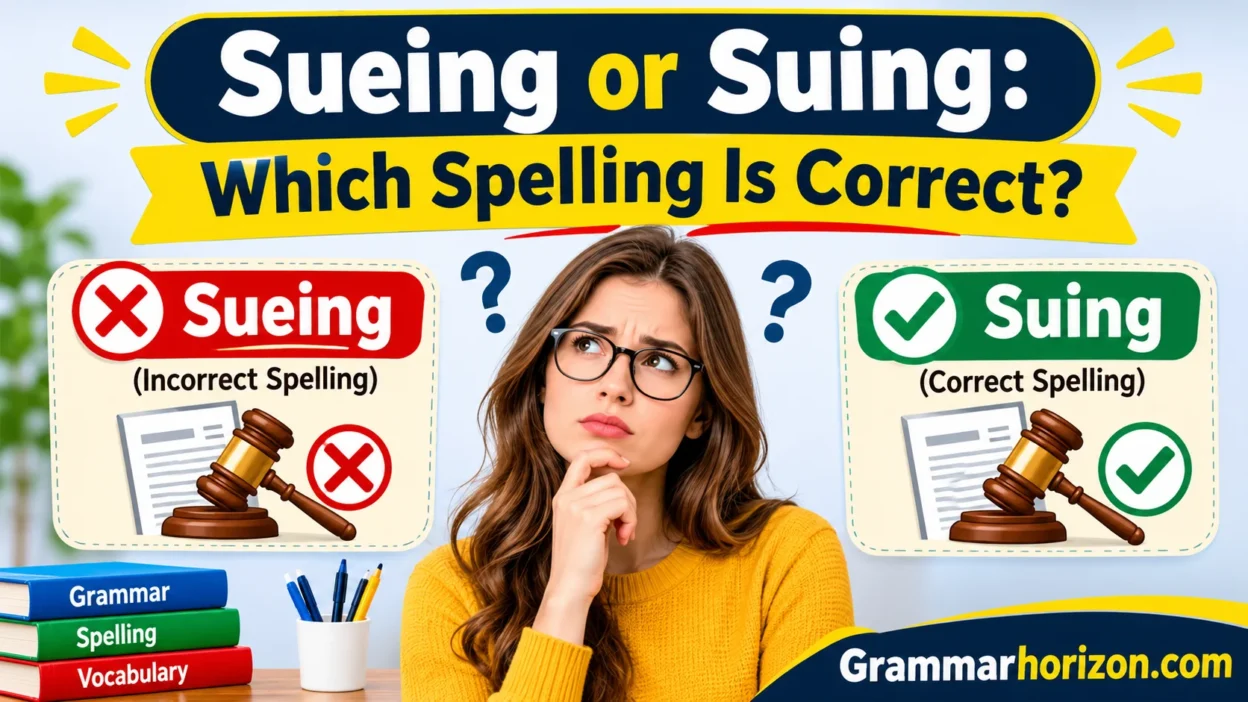
Sueing or Suing is a common English spelling confusion caused by verb endings and changes that happen when adding suffixes. The correct spelling is suing, not sueing. The base verb is sue, and you must remove its final silent e before adding the suffix -ing. This spelling rule applies to many English verbs and explains an important part of word formation. Some writers add an extra letter to preserve the original spelling, but this creates a common spelling error. The correct spelling change, known as final e deletion, follows standard English grammar and language rules. Understanding this silent letter rule helps writers avoid mistakes and follow accepted spelling conventions.
In legal writing, the word suing describes taking legal action against a person, company, or organization. You may find it in an email, while preparing a document, or during a legal discussion. For example, a company might be suing a contractor over an unpaid bill or broken agreement. Good written communication requires spelling accuracy, grammatical accuracy, and correct usage. In my experience, checking suffix addition before document submission can prevent noticeable writing mistakes. Writers should understand the difference between the two spellings instead of guessing. A simple example is: The company is suing the contractor. This common example shows the correct form in everyday and professional communication.
Good professional writing depends on writing clarity, accurate spelling, and a proper understanding of grammar rules. Remember that when a verb ends in a silent e, you generally remove that letter before adding an ending that begins with a vowel. This verb spelling pattern makes words such as suing easier to recognize and use correctly. Paying attention to English spelling, spelling confusion, and verb endings also improves the quality of legal documents and other formal writing. With regular practice, writers can apply this rule naturally, avoid unnecessary errors, and produce clear sentences with greater confidence.
Quick Answer: Sueing or Suing?
Suing is the correct spelling in standard English. Sueing is incorrect because the final silent e in the verb sue is dropped before adding the suffix -ing.
- Correct: She is suing the company for damages.
- Incorrect: She is sueing the company for damages.
The word suing is the present participle of sue. It can describe someone taking legal action against another person, business, or organization. It can also function as a gerund when the action is used as a noun.
Remember this simple spelling rule: When a verb ends in a silent e, you usually drop that e before adding -ing.
Sueing or Suing: Which One Is Correct?
When choosing between sueing or suing, always use suing in standard English. The word comes from the verb sue, which means to take legal action against someone or bring a legal case before a court.
The confusion happens because the original verb contains the letter e. Some writers assume they should keep every letter when adding an ending. However, English spelling rules do not always preserve the original form of a word.
When you add -ing to sue, you remove the final e and attach the suffix. This produces suing, not sueing.
Why Is Suing the Correct Spelling?
The main reason is the silent-e spelling rule. In many English verbs, the final e disappears when you add a suffix that begins with a vowel, such as -ing.
For example:
- Sue becomes suing.
- Make becomes making.
- Write becomes writing.
- Hope becomes hoping.
- Take becomes taking.
The same pattern applies to sue. The final e is removed, but the pronunciation and basic meaning of the original verb remain connected to the new form.
Correct and Incorrect Examples
| Sentence | Correct or Incorrect |
| She is suing her former employer. | Correct |
| She is suing her former employer. | Incorrect |
| They are suing the manufacturer. | Correct |
| They are suing the manufacturer. | Incorrect |
| He considered suing for damages. | Correct |
The easiest way to remember the correct form is to think of make/making or write/writing. You would not normally write making or writing. The same spelling principle applies to sue/suing.
What Does Suing Mean?
Suing is the present participle of the verb sue. It describes the action of bringing a legal claim against another person, company, employer, or organization. When someone sues another party, they ask a court to consider a legal dispute and provide an appropriate remedy.
For example, a customer might sue a company if a defective product causes an injury. Similarly, an employee might sue an employer over an alleged violation of employment law.
The word commonly appears in legal documents, news reports, business discussions, and everyday conversations about disputes.
Common Reasons for Suing Someone
People and organizations may file lawsuits for different legal reasons. The exact grounds depend on the applicable law and the facts of the dispute.
Common examples include:
- Breach of contract: One party fails to fulfill an obligation agreed upon in a contract.
- Personal injury: Someone claims that another party’s negligence caused physical harm.
- Property damage: A person seeks compensation for damage to their property.
- Defamation: Someone claims that a false statement harmed their reputation.
- Unpaid debts: A creditor takes legal action to recover money owed.
- Employment disputes: An employee brings a claim involving issues such as discrimination, unpaid wages, or wrongful termination, depending on the law.
Examples of Suing in Sentences
- The customer is suing the manufacturer because the product allegedly caused an injury.
- The former employee is suing the business over unpaid wages.
- Several homeowners are considering suing the construction company.
- The family discussed suing the hospital after the incident.
- The company is suing its business partner for breach of contract.
In each example, suing describes an ongoing legal action or the possibility of taking legal action.
What Does Sueing Mean?
Sueing is not the standard English spelling of the word. It is a common spelling mistake that occurs when writers add -ing to sue without removing the final silent e.
Although readers can usually understand what someone means when they write sueing, the spelling is not accepted in standard written English. It should be corrected to suing in school assignments, professional documents, emails, articles, and legal writing.
Why Do People Write Sueing Instead of Suing?
There are several reasons behind this mistake.
Keeping the original spelling: Some writers believe they must preserve every letter of the base verb when adding a suffix. They see sue and assume that sueing is the natural result.
Uncertainty about silent letters: English has many words with silent letters. Writers may not understand when a silent letter should be removed during word formation.
Pronunciation confusion: Since the spelling change does not create an entirely new spoken word, some people assume the original letters should remain unchanged.
Typing habits: Writers who frequently use incorrect forms may repeat them without checking the spelling.
The solution is to learn the spelling pattern rather than memorize only one word. Once you understand how verbs ending in silent e behave, you can apply the same rule to many other words.
Why Is Suing Spelled Without an Extra E?
The spelling of suing follows a common English word-formation rule. When a verb ends in a silent e and you add the suffix -ing, you generally remove the final e.
This rule helps avoid unnecessary letter combinations and creates the accepted spelling of the new word.
For example, the base verb write becomes writing. The final e disappears before the suffix is added. Similarly, hope becomes hoping, and make becomes making.
The verb sue follows the same pattern.
The Silent-E Rule in English
A silent e is a letter at the end of a word that is not usually pronounced. It often affects the pronunciation of the vowel before it.
When adding -ing, the final silent e is generally dropped.
| Base Verb | Correct -ing Form | Incorrect Form |
| Sue | Suing | Sueing |
| Make | Making | Makeing |
| Write | Writing | Writeing |
| Hope | Hoping | Hopeing |
| Take | Taking | Takeing |
| Bake | Baking | Bakeing |
| Dance | Dancing | Danceing |
| Use | Using | Using |
These examples show that the spelling change is not unique to sue. It is part of a broader English spelling pattern.
Are There Exceptions to the Silent-E Rule?
Yes. English spelling has exceptions, so you should not assume that every word ending in e follows exactly the same pattern.
For example, some words retain the final e before a suffix to preserve pronunciation or distinguish their spelling from another word.
Consider these examples:
- Dye → dyeing: The e remains to distinguish dyeing from dying.
- Singe → singeing: The e remains to distinguish singeing from singing.
- Age → aging: The final e is generally dropped in American English.
These examples show why it helps to learn the general rule along with common exceptions. However, sue does not require an exception. Its standard -ing form is always suing.
Suing in Different Sentence Structures
The word suing can appear in several grammatical structures. It is not limited to legal news or formal documents. You can use it in everyday conversations, professional writing, and discussions about possible legal action.
Depending on the sentence, suing can function as a present participle or a gerund. Understanding these two uses will help you place the word correctly.
Suing as a Present Participle
A present participle is a verb form that ends in -ing. It often works with a form of the verb be to describe an ongoing action.
For example:
- She is suing her former employer.
- The customers are suing the company.
- The family was suing the hospital when the report appeared.
- Several investors will be suing the business next month.
In these sentences, suing describes an action connected to a particular time. The helping verb changes according to the tense, but the spelling of suing stays the same.
Suing as a Gerund
A gerund is an -ing verb form that functions as a noun. It names an activity rather than describing an action directly.
For example:
- Suing a company can be expensive.
- Suing someone should not be a decision made without careful thought.
- She discussed suing her former business partner.
- They avoided suing because they reached an agreement.
In the first two examples, suing acts as the subject of the sentence. In the other examples, it follows a verb.
Using Suing After Auxiliary Verbs
The word suing also appears after auxiliary verbs such as is, are, was, and were when forming continuous tenses.
Consider these examples:
| Sentence | Grammatical Structure |
| She is suing the company. | Present continuous |
| They are suing the landlord. | Present continuous |
| He was suing his former partner. | Past continuous |
| We were suing for compensation. | Past continuous |
| The customers have been suing the manufacturer. | Present perfect continuous |
Remember that the spelling remains suing in every example. You do not add another e when changing the tense.
Suing vs. Sue: Understanding the Difference
Although sue and suing come from the same verb, they have different grammatical uses. The base form sue is used when talking about an action without adding the -ing ending. The form suing describes an ongoing action or names the activity.
For example, you might say, “I plan to sue the company.” However, if the legal action is already happening, you can say, “I am suing the company.”
The difference is important because using the wrong verb form can make a sentence grammatically incorrect.
Difference Between Sue, Suing, Sued, and Sues
The verb sue has several forms. Each one serves a different purpose in a sentence.
| Word | Grammatical Form | Example |
| Sue | Base form | I may sue the company. |
| Suing | Present participle or gerund | She is suing the company. |
| Sued | Simple past or past participle | They sued the contractor. |
| Sues | Third-person singular present | He sues businesses for damages. |
When Should You Use Sue?
Use sue when referring to the base form of the verb. It commonly follows modal verbs such as can, could, may, might, and will.
Examples:
- I might sue if the company refuses to pay.
- They plan to sue the contractor.
- She wants to sue for damages.
- You can sue if you have valid legal grounds.
When Should You Use Suing?
Use suing when describing an ongoing action or referring to the activity itself.
Examples:
- The customer is suing the manufacturer.
- They are considering suing the landlord.
- Suing an employer can involve several legal steps.
- He regrets suing his former business partner.
When Should You Use Sued?
Use sued when describing a completed legal action in the past or when forming a perfect tense.
Examples:
- She sued the company last year.
- The customer has sued the manufacturer.
- Several employees sued their former employer.
- The business was sued over the disputed contract.
These forms are related, but they are not interchangeable. Choosing the correct one depends on the time and structure of your sentence.
Common Mistakes to Avoid When Using Suing
Even though suing is a simple word, writers sometimes make mistakes when using it. Most errors involve spelling, verb forms, or sentence structure.
Learning these common problems can improve your grammar and make your writing more accurate.
Writing Sueing Instead of Suing
This is the most common spelling mistake. Writers sometimes keep the final e from the base verb.
- Incorrect: The customer is sueing the company.
- Correct: The customer is suing the company.
Always remove the final silent e before adding -ing.
Confusing Suing With Sued
Both words come from sue, but they describe different grammatical forms.
- Incorrect: She is sued the manufacturer.
- Correct: She is suing the manufacturer.
Use suing with forms of be when describing an ongoing action. Use sued when describing a completed past action or forming a passive construction.
Using the Wrong Verb Form After a Modal Verb
Modal verbs such as will, can, and might are followed by the base form of a verb.
- Incorrect: They might suing the company.
- Correct: They might sue the company.
However, you can use suing in a continuous construction with an appropriate auxiliary verb.
– Correct: They might be suing the company.
Forgetting the Correct Spelling in Professional Writing
Spelling errors can reduce the clarity of business emails, reports, and legal correspondence. If you are writing about an actual legal dispute, it is particularly important to use accurate language.
For example:
- Incorrect: We are considering sueing the supplier.
- Correct: We are considering suing the supplier.
A quick spelling check can prevent this mistake.
Examples of Suing in Everyday Sentences
The best way to understand a word is to see how people use it in different situations. The following examples demonstrate how suing fits into everyday English.
Suing in Business and Commercial Disputes
- The customer is suing the retailer over a defective product.
- The company is suing its former business partner.
- Several investors are suing the financial organization.
- The manufacturer is facing a lawsuit from customers.
- The business is considering suing the supplier for breach of contract.
Suing in Workplace and Employment Situations
- The former employee is suing the company for unpaid wages.
- She discussed suing her employer after the dispute.
- The workers are suing over alleged discrimination.
- He considered suing after losing his job.
- The employee is not interested in suing the organisation.
Examples Related to Personal Disputes
- The homeowner is suing the neighbor over property damage.
- They are considering suing after the accident.
- She threatened to sue for defamation.
- The family is suing for compensation.
- He avoided suing because both parties reached an agreement.
Examples Using Different Sentence Structures
| Sentence | Use of Suing |
| She is suing the company. | Present continuous |
| They were suing for damages. | Past continuous |
| Suing can take time. | Gerund as subject |
| He considered suing. | Gerund after a verb |
| The people who are suing want compensation. | Present participle in a relative clause |
A Practical Example: Suing a Company
Imagine that a customer purchases an electronic device that stops working shortly after purchase. The customer contacts the manufacturer several times but does not receive a satisfactory response.
After reviewing the available options, the customer considers taking legal action. You could describe the situation in several ways:
- The customer plans to sue the manufacturer.
- The customer is considering suing the manufacturer.
- The customer is suing the manufacturer for damages.
Each sentence communicates a different stage of the situation. The first describes an intention, the second describes consideration, and the third describes an ongoing legal action.
This example also shows why choosing the correct verb form matters. The spelling remains suing, but the surrounding words determine how the action is presented.
Note: These are illustrative examples, not legal advice. Whether someone can bring a successful claim depends on the relevant law and evidence.
Conclusion
The correct spelling is suing, not sueing. The difference comes from a simple English spelling rule: remove the final silent e before adding -ing to the verb sue. Whether you are writing an email, preparing legal documents, or discussing a court case, using suing correctly makes your writing clearer and more professional. Remembering this small rule can help you avoid similar spelling mistakes with other English verbs.
Frequently Asked Questions
Q1. Is it sueing or suing?
Suing is the correct spelling. Sueing is incorrect because the final silent e must be removed before adding -ing.
Q2. Why does sue become suing?
The verb sue ends in a silent e. English spelling rules generally require removing this letter before adding a suffix that begins with a vowel, such as -ing.
Q3. What does suing mean in legal terms?
Suing means taking legal action against someone through a court. A person or organisation may sue another party over unpaid debts, broken agreements, or other legal disputes.
Q4. Is suing a verb or a noun?
Suing is the -ING form of the verb sue. It can function as a present participle or gerund, depending on how it appears in a sentence.
Q5. What is an example of suing in a sentence?
Here is an example: The customer is suing the company for failing to deliver the promised services.In this sentence, suing describes the legal action the customer is taking against the company.