Choosing between feel or felt becomes easier when you focus on verb tense, time, and the action in a sentence. Feel and felt are two forms of the same verb, but they describe different situations. Feel usually describes something happening now or something that happens generally, while felt refers to something that happened in the past. For English learners, the main difference can seem confusing because both words relate to emotions, sensations, and opinions and belong to different time frames. The confusion often comes from tense changes, spoken habits, and uncertainty about when an action is happening.
Your sentence structure can help you understand which grammatical forms and usage you need. Feel describes a present experience, while felt marks the past tense. For example, “I feel tired” describes how you feel now, while “I felt tired” describes how you felt before. Helping verbs and the helping verb used in a question or negative sentence can also change the structure. A useful example is “Did you feel tired?” Even though the question refers to the past, feel is correct because Did already marks the past tense. When choosing between the forms, look at the other verbs, the time, and the context to find the right key.
The difference can become noticeable when you use questions, negative sentences, or everyday spoken English. Many learners may choose a form based on spoken habits rather than the actual time frame of the action, which can lead to mistakes. When you write a sentence, check when the action is happening, whether it happens generally, or whether it happened earlier. Once the tense is clear, the choice becomes simple and easier. You can refer to the first sentence as a quick guide: use feel for the present and felt for the past.
Quick Answer: Felt or Feel?
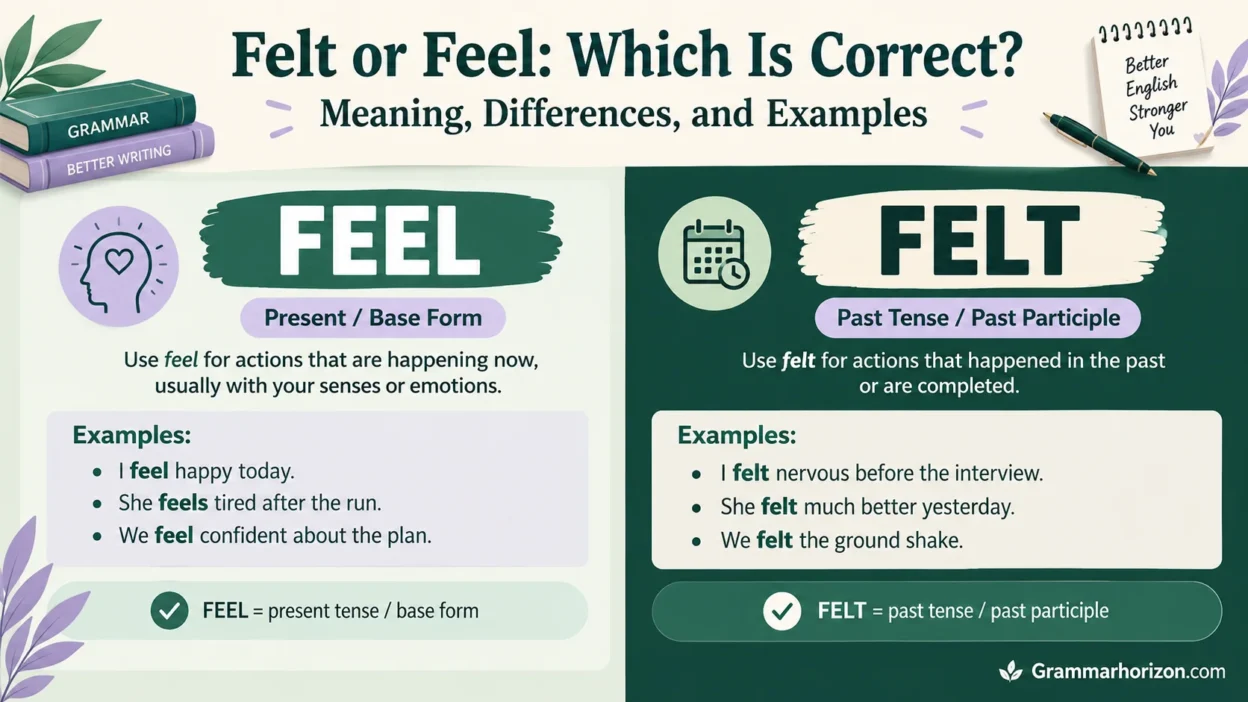
Feel is the base form of the verb and commonly describes a present experience, general condition, opinion, or physical sensation. Felt is the simple past and past participle form of feel.
- Feel: I feel happy today.
- Felt: I felt happy yesterday.
- Feel after did: Did you feel better?
- Felt after having: I have felt this way before.
A useful rule is simple: use feel for the present and felt for the past. However, helping verbs can change which form you need.
For example, did already expresses past tense, so you must use the base form feel, not felt.
Comparison Overview: Feel or Felt
| Feature | Feel | Felt |
| Basic form | Feel | Felt |
| Verb type | Base/present form | Past and past participle |
| Main time reference | Present or general | Past or completed experience |
| Example | I feel tired. | I felt tired. |
| With do/does | Do you feel okay? | Not normally used |
| With did | Did you feel okay? | Incorrect after did |
| With have/has/had | Not used as the main form | I have felt better. |
The most important distinction is grammatical form. Feel can stand alone as the present form, while felt serves as both the simple past and past participle.
What Does “Feel” Mean?
The verb feel has several meanings. It can describe an emotion, a physical sensation, an opinion, or the way something seems.
Feel as a Present-Tense Verb
When something is happening now, feel is often the right choice.
For example:
- I feel tired.
- We feel ready.
- They feel excited.
- I feel much better today.
With he, she, or it, the present simple form becomes felt.
- She feels nervous.
- He feels confident.
- The room feels cold.
Notice that feels is not a different tense. It is simply the third-person singular present form of feel.
Feel for Opinions and Impressions
You can also use feel when expressing an opinion or personal impression.
For example:
- I feel that this is the right choice.
- She feels the plan needs more work.
- They feel strongly about the issue.
Here, feel doesn’t describe physical touch. Instead, it introduces someone’s judgment, belief, or emotional response.
Feel for Physical Sensations
Feel can describe something you experience through your body or sense of touch.
Consider these examples:
- I feel the heat.
- These shoes feel comfortable.
- The surface feels smooth.
- I feel pressure in my hand.
The word can describe both the person experiencing the sensation and the object producing an impression.
What Does “Felt” Mean?
Felt is the past form of feel. It tells the reader that the feeling, sensation, or impression occurred in the past.
Examples include:
- I felt nervous before the interview.
- She felt sick yesterday.
- We felt relieved after the test.
- The fabric felt soft.
The important point is that felt doesn’t necessarily mean the experience lasted for only a moment. It simply places the experience in the past.
Felt as the Past Participle
The verb forms are:
feel → felt → felt
The first form is the base form. The second is the simple past. The third is the past participle.
The past participle appears with perfect tenses:
- I have felt this before.
- She has felt much better recently.
- They had felt uncertain about the decision.
This explains why felt can appear in sentences that don’t describe a simple past action.
Main Differences Between Felt and Feel
The main differences between felt and feel depend on tense, time reference, and the helping verbs used in a sentence.
Difference in Time Reference
The clearest difference is when the experience occurs.
Use feel for something happening now or something generally true:
I feel tired after long meetings.
Use felt for an experience that happened previously:
I felt tired after yesterday’s meeting.
Words such as now, today, usually, yesterday, last night, earlier, and last year can provide useful clues.
However, don’t rely on time words alone. The entire sentence determines the meaning.
Difference in Verb Form
Feel is the base form:
- I feel
- You feel
- We feel
- They feel
Felt is the past form:
- I felt
- You felt
- She felt
- They felt
Unlike feel, felt doesn’t change according to the subject in the simple past.
You say:
- I felt
- He felt
- She felt
- We felt
- They felt
You never write “she feels” in standard English.
Difference With Subject Agreement
In the present tense, third-person singular subjects require feels.
- I feel happy.
- You feel happy.
- She feels happy.
- They feel happy.
In the past tense, everyone uses felt.
- I felt happy.
- She felt happy.
- They felt happy.
That makes the past form particularly easy once you recognize the tense.
Feel or Felt in Questions
Questions create some of the most common mistakes.
Present Questions With Do or Does
When do or does introduces a present-tense question, use the base form feel.
Correct:
- Do you feel better?
- Does she feel nervous?
- Do they feel ready?
Incorrect:
- Does she feel nervous?
- Do they feel ready?
The helping verb carries the grammatical information, so the main verb returns to its base form.
Past Questions With Did
The same principle applies to did.
Correct:
- Did you feel sick?
- Did she feel nervous?
- Did they feel comfortable?
Incorrect:
- Did you felt sick?
- Did she felt nervous?
Why? Because it already marks the past tense. Adding felt would place past marking on both the auxiliary and the main verb.
Think of it as a division of labor: did handle the past tense while feel carries the main meaning.
Feel or. Felt in Negative Sentences
Negative sentences follow the same pattern.
Present Negatives
Use don’t or don’t with feel.
- I don’t feel well.
- We don’t feel ready.
- She doesn’t feel comfortable.
Not:
- She doesn’t feel comfortable.
Again, doesn’t carry the present-tense agreement, so the main verb stays in its base form.
Past Negatives
For the past, use didn’t + feel.
- I didn’t feel well yesterday.
- She didn’t feel nervous.
- They didn’t feel comfortable.
The common error is:
- ❌ I didn’t felt well.
- ✅ I didn’t feel well.
This rule is worth remembering because it applies consistently to English verbs. After did and didn’t, use the base form.
Feel, Felt, and Feeling: Understanding All Three Forms
English learners sometimes confuse feel, felt, and feeling because each describes an experience differently.
- Feel: I feel better now.
- Felt: I felt better yesterday.
- Feeling: I am feeling better now.
The form feeling is the present participle. It commonly appears with forms of be in progressive constructions.
For example:
I’m feeling tired after working all day.
This construction often emphasizes a temporary or changing condition. Meanwhile, I feel tired and can sound more direct and neutral.
Both can be natural. The choice depends on what you want to emphasize.
When “Feel” Becomes “Feels”
The form feels like it belongs with third-person singular subjects in the present simple.
Compare:
- I feel cold.
- You feel cold.
- He feels cold.
- She feels cold.
- The room feels cold.
- They feel cold.
However, once does appears, use feel again:
- She feels tired.
- Does she feel tired?
This pattern is easy to remember because it takes the grammatical ending away from the main verb.
Common Mistakes With Felt and Feel
Common mistakes with felt and feel usually happen when writers confuse verb tense or use the wrong form after helping verbs such as did, didn’t, do, and does.
“I Felt Tired Now”
This combination usually creates a tense mismatch because it now points to the present.
Better:
I feel tired now.
If you’re talking about a previous moment, felt works:
I felt tired earlier.
“Yesterday I Feel Sick”
Because yesterday clearly places the experience in the past, use felt.
Correct:
Yesterday, I felt sick.
“Did You Felt Better?”
Afterwards, use the base verb.
Correct:
Did you feel better?
“I Didn’t Felt Well”
This is another double-past construction.
Correct:
I didn’t feel well.
The word didn’t already mark the past.
“She Feel Happy”
A third-person singular subject needs feelings in the present simple.
Correct:
She feels happy.
“Does She Feels Better?”
Afterwards, return to the base form.
Correct:
Does she feel better?
Feel vs. Felt in Different Contexts
The difference between feel and felt changes with context, as feel usually describes a present or general experience while felt refers to a past emotion, sensation, opinion, or impression.
Talking About Emotions
Present:
I feel excited about the trip.
Past:
I felt excited before the trip.
The difference is small in wording but significant in time.
Talking About Physical Conditions
Present:
I feel sick.
Past:
I felt sick yesterday.
This pattern works for pain, tiredness, weakness, dizziness, and many other sensations.
Talking About Opinions
Present:
I feel that this plan will work.
Past:
I felt that the plan would work.
The past version shifts the viewpoint backward in time.
Talking About Touch and Sensation
Present:
The fabric feels soft.
Past:
The fabric felt soft.
Here, the subject can be an object rather than a person.
Feel and Felt With Different Tenses
| Tense | Correct Form | Example |
| Present simple | feel/feels | I feel better. |
| Simple past | felt | I felt better. |
| Present perfect | have/has felt | I have felt better before. |
| Past perfect | had felt | I had felt nervous earlier. |
| Future | will feel | I will feel better tomorrow. |
| Present progressive | am/is/are feeling | I am feeling better. |
This table shows why felt shouldn’t simply be labeled “the past form” and left there. It also functions as the past participle, while feel appears after modal and auxiliary constructions such as will feel and did feel.
Is “Feel” a Stative Verb?
Feel can behave like a stative verb when it describes a condition or mental state.
For example:
I feel confident about the decision.
However, English also commonly uses feel in progressive forms when the speaker emphasizes a temporary or developing condition:
I’m feeling much better today.
The distinction isn’t something you need to memorize as a rigid rule. Focus instead on the meaning you want to communicate.
Felt or Fell: Don’t Confuse These Words
Felt and fell sound different and come from completely different verbs.
- Feel → felt
- Fall → fell
Compare:
I felt tired after work.
I fell down the stairs.
There’s another useful distinction in the expression fell in love.
You say:
She fell in love with him.
But you can also say:
She felt love for him.
The first describes the process or experience of falling in love. The second describes an emotion she experienced.
Pronunciation of Feel and Felt
Feel is pronounced with a long ee sound, while felt has a shorter vowel sound followed by a clear t.
- Feel: /fiːl/
- Felt: /felt/
The pronunciation difference becomes especially useful in conversation because the two words can otherwise blur together for language learners.
Practice them in pairs:
- feel / felt
- feel better / felt better
- feel tired / felt tired
- feel happy / felt happy
Feel and Felt in Everyday English
These verbs appear constantly in ordinary conversation.
At work:
How do you feel about the new schedule?
After an event:
How did you feel after the presentation?
Talking about health:
I feel much better today.
Talking about yesterday:
I felt terrible last night.
Talking about an opinion:
I feel this is the best option.
These examples show that feel isn’t limited to emotions. It can describe physical sensations, impressions, opinions, and reactions.
Quick Decision Rule: Should You Use Feel or Felt?
When you’re unsure, ask these questions:
Is the experience happening now?
Use feel or feels.
Did the experience happen in the past?
Use felt.
Does the sentence contain did or didn’t?
Use feel.
Does the sentence contain have, has, or had?
Use felt.
Is the subject he, she, or it in the present simple?
Use feels.
A simple mental shortcut works well:
Present → feel/feels
Past → felt
Did/didn’t → feel
Have/has/had → felt
Felt or Feel Examples
| Incorrect | Correct | Reason |
| I felt tired now. | I feel tired now. | Present time |
| I feel tired yesterday. | I felt tired yesterday. | Past time |
| Did you felt sick? | Did you feel sick? | Did + base verb |
| I didn’t felt well. | I didn’t feel well. | Didn’t + base verb |
| She feel nervous. | She feels nervous. | Third-person singular |
| Does she feels okay? | Does she feel okay? | Does + base verb |
| I have feel this before. | I have felt this before. | Have + past participle |
Conclusion
Understanding feel and felt becomes much easier when you pay attention to time, verb tense, and context. Use feel for the present or general situations, and use felt when describing something in the past. Once you recognise the time frame of the action, choosing the correct form becomes simple.
Read More:Shown vs. Showed: What’s the Difference and Which One Should You Use?
FAQs
Q1. Is “feel” present tense or past tense?
Feel is generally the present-tense form. You use it to describe how someone feels now or how they generally feel.
Q2. Is “felt” the past tense of “feel”?
Yes. Felt is the past-tense form of feel. For example, “I feel tired today” refers to the present, while “I felt tired yesterday” refers to the past.
Q3. Should I say “I feel tired” or “I felt tired”?
Use “I feel tired” when you’re tired now. Use “I felt tired” when you’re talking about a previous time.
Q4. Is “Did you felt tired?” correct?
No. The correct sentence is “Did you feel tired?” The helping verb did already shows the past tense, so the main verb stays in its base form, feel.
Q5. Can “feel” describe a general situation?
Yes. Feel can describe something that happens generally, such as “I feel nervous before exams.”
Q6. Can “felt” be used for emotions and sensations?
Yes. Felt can describe past emotions, sensations, opinions, or physical experiences. For example, “She felt happy after the good news.”
Q7. How can I quickly choose between “feel” and “felt”?
Look at the time frame first. If the action is happening now or happens generally, use feel. If it happened in the past, use felt.