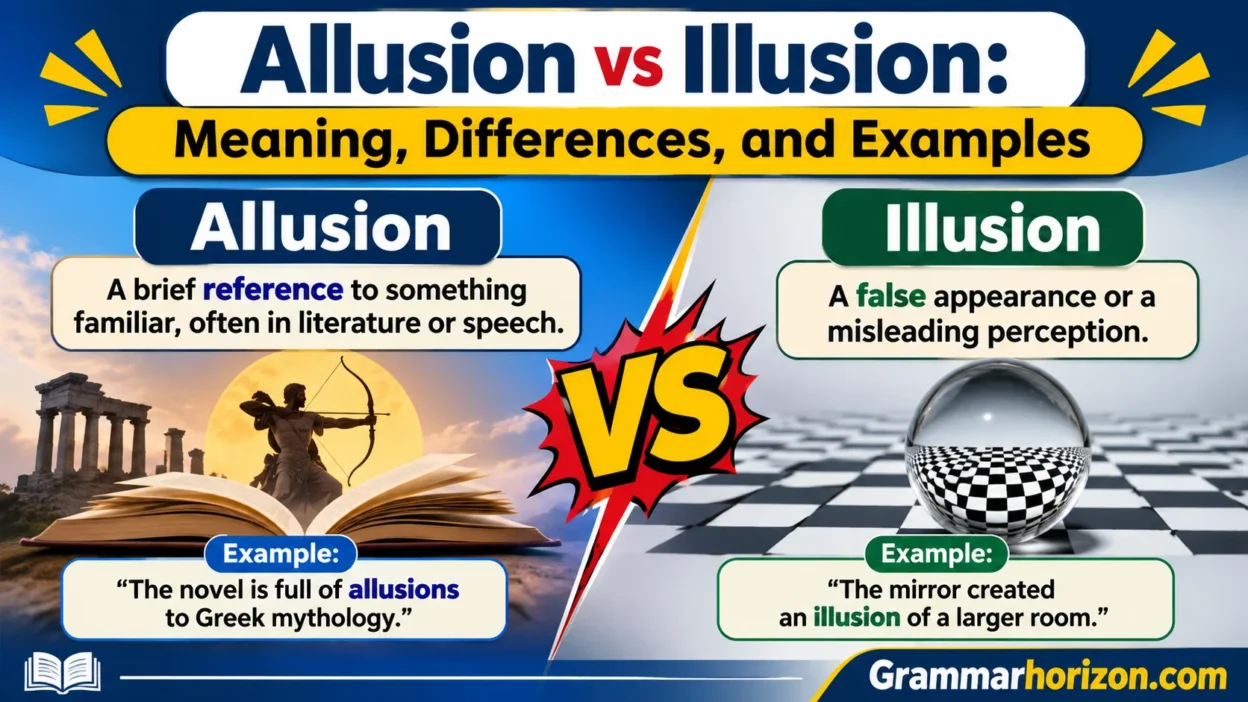
Allusion vs Illusion is a common source of confusion because these two English words have similar spellings and similar pronunciations, but their meanings are different. Both words are nouns, yet their grammatical function, contextual meaning, and word usage are not the same. An allusion is an indirect reference to a person, place, event, book, or historical subject. Writers use allusions to make a connection with familiar stories, historical events, and cultural references. For example, a novel might include a literary reference to Greek mythology to give readers a deeper understanding of its message.
An illusion, in contrast, creates a false appearance, impression, or belief that does not reflect reality or actual reality. It relates to perception and the way something appears to the human mind. A magician, for instance, uses magic to create the impression of making an object disappear, even though the object is still present. This creates a difference between a real appearance and a false belief. While allusion connects ideas through literature, writing, and a literary technique, illusion makes something appear different from what it actually is. Both words have distinct different meanings and different uses, so their meaning depends on the context in which they appear.
Understanding these word differences can improve your English vocabulary and overall language skills. You may encounter allusions in academic writing, professional communication, and everyday conversations, particularly when people discuss books, history, or culture. Illusions also appear in daily communication when someone describes something misleading or difficult to believe. Their common confusion often leads to spelling mistakes, vocabulary mistakes, and incorrect sentence usage. Learning their correct usage, correct spelling, and correct word choice makes it easier to use each term naturally.
Allusion vs Illusion: Quick Answer
Allusion means an indirect or brief reference to something or someone. It often appears in literature, conversations, speeches, and other forms of communication.
Example: The author made an allusion to Shakespeare’s famous play Hamlet.
Illusion means a false appearance, misleading impression, or belief that does not match reality. It can describe something that deceives the eyes, ears, or mind.
Example: The magician created the illusion that the rabbit had disappeared.
The easiest way to remember the difference is to associate allusion with a reference and illusion with something unreal or misleading.
| Word | Meaning | Example |
| Allusion | An indirect reference | The poem contains an allusion to Greek mythology. |
| Illusion | A false appearance or belief | The mirror created an illusion of a larger room. |
What Does Allusion Mean?
Allusion is a noun that describes a brief or indirect reference to a person, place, event, story, historical figure, or cultural subject. Instead of explaining the entire subject, a speaker or writer mentions something that reminds the audience of it.
For example, when someone describes a difficult situation as a person’s Achilles’ heel, they are making an allusion to Greek mythology. The expression refers to a weakness that can lead to someone’s failure. The speaker does not need to explain the complete myth because many readers already understand the reference.
Allusions are common in books, poems, movies, songs, speeches, and everyday conversations. They allow writers to communicate additional meanings without using long explanations. A familiar reference can help readers understand an idea, emotion, or situation more clearly.
An allusion can also make writing more interesting by connecting a new idea with something readers already know. However, the reference works best when the audience understands its background.
Examples of Allusion in Sentences
Here are some examples that show how to use allusion correctly:
- The novelist included an allusion to Shakespeare’s Romeo and Juliet.
- Her speech contained an allusion to an important historical event.
- The teacher explained the biblical allusion in the poem.
- His comment was a subtle allusion to their previous disagreement.
- The movie contains several allusions to ancient Greek mythology.
- The author used an allusion to make the story more meaningful.
- I noticed an allusion to the American Revolution in the article.
- The song includes an allusion to a famous literary character.
In each sentence, allusion refers to a connection or reference to another subject. It does not describe something fake or deceptive.
Common Types of Allusion
Allusions can refer to different subjects depending on the writer’s purpose and the audience’s background knowledge. Some of the most common types include the following.
Biblical Allusion
A biblical allusion refers to a person, story, event, or teaching from the Bible. Writers often use these references to communicate ideas about faith, morality, sacrifice, temptation, and forgiveness.
For example:
- The story describes his struggle as a David-and-Goliath battle.
- Her decision was an allusion to the biblical story of the Good Samaritan.
- The character’s betrayal reminded readers of Judas.
These references help readers connect a fictional or real situation with familiar biblical stories.
Mythological Allusion
A mythological allusion refers to characters, stories, gods, or events from ancient mythology, particularly Greek and Roman traditions.
For example:
- His confidence became his Achilles’ heel.
- She opened Pandora’s box of problems.
- The athlete’s strength reminded everyone of Hercules.
These expressions use familiar mythological references to explain modern situations.
Historical Allusion
A historical allusion refers to an important person, event, period, or situation from history.
For example:
- The speech included an allusion to the American Civil War.
- His leadership reminded people of Abraham Lincoln.
- The article made an allusion to the fall of the Roman Empire.
Historical allusions allow writers to connect present-day situations with important events from the past.
Literary Allusion
A literary allusion refers to a famous book, poem, play, character, or writer.
For example:
- The novel contains an allusion to Charles Dickens.
- Her difficult journey resembles the challenges faced by Odysseus.
- The poet included an allusion to Shakespeare’s Macbeth.
Literary allusions are particularly useful when authors want to add deeper meaning to their stories.
Cultural Allusion
A cultural allusion refers to a familiar person, event, tradition, movie, song, or popular cultural subject.
For example:
- His appearance was an allusion to a famous movie character.
- The advertisement included an allusion to a popular television show.
- Her comment contained an allusion to a well-known song.
Cultural allusions often make conversations more engaging because they connect ideas with shared experiences.
What Does Illusion Mean?
Illusion is a noun that describes something that appears real but is not what it seems. It can refer to a misleading image, false impression, incorrect belief, or experience that tricks the senses or mind.
An illusion does not always involve someone intentionally trying to deceive another person. Sometimes, the human brain interprets information incorrectly because of lighting, distance, movement, sound, or other conditions.
For example, a mirage in a desert can make the ground appear as though it contains water. A person might see what looks like a pool in the distance, but the appearance is caused by the way light travels through layers of air with different temperatures.
Illusions can also involve beliefs rather than physical appearances. Someone might believe that money guarantees happiness or that success always comes easily. These beliefs can create an illusion when they do not reflect reality.
The word is commonly used in psychology, science, entertainment, art, and everyday communication.
Examples of Illusion in Sentences
The following examples demonstrate the correct use of illusion:
- The magician created the illusion of making a coin disappear.
- The painting produces an optical illusion of movement.
- He lived under the illusion that everything was perfect.
- The mirror created the illusion of a much larger room.
- The desert traveler saw a mirage that turned out to be an illusion.
- The advertisement created an illusion of a perfect lifestyle.
- The stage lighting gave the audience the illusion of a sunset.
- She finally realized that her expectations were based on an illusion.
- The moving pattern creates an unusual visual illusion.
- He had no illusion about the difficulties of starting a business.
In these examples, illusion describes something that appears different from reality or a belief that is not true.
Common Types of Illusion
Illusions can affect different senses and mental processes. The following are some common categories.
Optical Illusion
An optical illusion is a visual experience in which something appears different from its actual shape, size, position, color, or movement.
For example, two lines of equal length might appear different because of the shapes surrounding them. Similarly, a flat drawing can look three-dimensional because of shading and perspective.
Optical illusions are often used in art, photography, education, and psychology to demonstrate how the human visual system interprets information.
Visual Illusion
A visual illusion occurs when the brain interprets something seen by the eyes differently from its physical properties.
For example, a still image containing repeated patterns may appear to move when someone looks at it. The image itself remains stationary, but the viewer experiences an impression of movement.
Visual illusions show that seeing something does not always mean understanding its actual appearance or structure.
Auditory Illusion
An auditory illusion is a sound-related experience in which someone hears something differently from the actual sound.
For example, certain sound recordings can make a repeated sequence seem to rise continuously in pitch. The sound creates a misleading impression even though the sequence does not increase forever.
Auditory illusions help researchers understand how people recognize, process, and interpret sounds.
Cognitive Illusion
A cognitive illusion occurs when the mind processes information in a misleading way. It can affect how people interpret situations, evaluate information, and make decisions.
For example, someone might believe that a product is better simply because it has a higher price. However, a higher price does not automatically guarantee better quality.
Cognitive illusions are connected to judgment, memory, expectations, and decision-making.
Illusion of Control
The illusion of control describes a belief that someone has more influence over an outcome than they actually do.
For example, a person might believe that performing a particular routine will change the result of a random event. The routine may make the person feel more confident, but it does not necessarily affect the outcome.
This term is often discussed in psychology and behavioral research.
Allusion vs Illusion: Key Differences
The main difference between allusion and illusion is their meaning. An allusion refers to something else, while an illusion creates or describes a misleading impression of reality.
Although both words are nouns, they appear in different situations and communicate different ideas.
Allusion vs Illusion Comparison Table
| Feature | Allusion | Illusion |
| Meaning | An indirect reference | A false appearance or belief |
| Part of speech | Noun | Noun |
| Main purpose | To refer to another subject | To describe something misleading |
| Common usage | Literature, history, culture | Psychology, science, art |
| Related verb | Allude | No commonly used corresponding verb |
| Example | An allusion to Shakespeare | An optical illusion |
| Opposite idea | An explicit statement | Reality |
Both words can appear in formal and informal writing. However, their meanings are not interchangeable.
Difference in Meaning
An allusion points toward another subject. It helps readers recognize a connection between the current message and something familiar.
An illusion, on the other hand, describes an appearance or belief that does not match reality. It can involve the senses or someone’s understanding of a situation.
Consider these examples:
- Allusion: The author made an allusion to the Trojan War.
- Illusion: The artist created an illusion of depth in the painting.
The first sentence describes a reference to a historical or mythological story. The second describes an appearance that makes a flat painting look deeper.
Difference in Grammatical Usage
Both words function as nouns. They can appear as subjects, direct objects, or objects of prepositions.
Examples:
- Allusion as a subject: The allusion made the poem more interesting.
- Allusion as an object: I recognized the allusion to Greek mythology.
- Illusion as a subject: The illusion disappeared when the lights changed.
- Illusion as an object: The magician created an illusion for the audience.
Understanding their grammatical functions is easy once you know what each word means.
Allusion vs Illusion: More Sentence Examples
Looking at both words in complete sentences can help you understand how their meanings change according to context.
Examples Using Allusion
- The professor discussed an allusion to ancient Roman history.
- The writer’s latest novel contains an allusion to a famous fairy tale.
- His statement was a clear allusion to the company’s previous failure.
- The poet used a biblical allusion to communicate the theme of forgiveness.
- The film includes an allusion to several classic horror movies.
- Her speech contained a subtle allusion to the country’s political history.
- The character’s journey is an allusion to the adventures of Odysseus.
- The advertisement makes an allusion to a popular television series.
Examples Using Illusion
- The magician performed an illusion that surprised the audience.
- The artist used shadows to create the illusion of depth.
- The empty street created the illusion that the town was abandoned.
- He was under the illusion that his friend had agreed with him.
- The beautiful landscape was partly an illusion created by the lighting.
- The company gave customers the illusion of having more choices.
- The glass walls created an illusion of open space.
- The moving image was only an illusion produced by a visual effect.
Comparing Both Words in Similar Situations
| Allusion sentence | Illusion sentence |
| The author made an allusion to a famous painting. | The painting created an illusion of movement. |
| His speech included an allusion to World War II. | His speech created the illusion that everything was under control. |
| The novel contains an allusion to Greek mythology. | The magician created the illusion of a magical transformation. |
| The poem includes an allusion to Shakespeare. | The stage design created an illusion of a royal palace. |
| Her comment was an allusion to their past. | Her belief that everything would improve was an illusion. |
These examples show why replacing one word with the other can change the entire meaning of a sentence.
Allusion vs Illusion in Literature and Writing
Allusions and illusions both play important roles in literature, but authors use them for different purposes.
An allusion helps writers connect their stories with familiar people, events, books, and cultural subjects. It allows readers to recognize additional meanings without requiring a detailed explanation.
For example, a novelist might describe a character as having an Achilles’ heel. Readers familiar with Greek mythology understand that the character has a particular weakness. This reference adds meaning without interrupting the story.
An illusion can serve a different purpose in literature. Writers may use illusions to explore deception, mistaken beliefs, imagination, unreliable appearances, and the difference between reality and perception.
For example, a character might believe that a friend is trustworthy, only to discover that the friendship was based on a false impression. The original belief becomes an illusion.
How Writers Use Allusions
Writers use allusions for several reasons:
- Adding meaning: A reference can communicate more than its literal words suggest.
- Creating connections: Readers can connect a new story with familiar literature or history.
- Saving explanations: A short reference can replace a lengthy background description.
- Developing characters: A character’s references can reveal education, interests, or cultural knowledge.
- Strengthening themes: Allusions can reinforce ideas such as love, courage, betrayal, and sacrifice.
How Writers Use Illusions
Illusions also serve several purposes in creative writing:
- Creating suspense: A misleading appearance can make readers question what is happening.
- Showing deception: Characters may believe something that is not true.
- Exploring reality: Authors can examine the difference between appearance and truth.
- Developing conflict: False assumptions can create misunderstandings between characters.
- Building symbolism: An illusion can represent unrealistic expectations or false hopes.
A Simple Writing Example
Consider a story about a young man who believes he will become successful without making any effort.
The writer might describe his belief as an illusion because it does not reflect reality. Later, the character could compare his struggle to the journey of Hercules, creating an allusion to Greek mythology.
Both words can appear in the same story, but they perform different jobs.
Common Mistakes When Using Allusion and Illusion
Many people confuse these words because they look similar. However, choosing the wrong word can make a sentence unclear or change its intended meaning.
Here are some common mistakes and their corrections.
Using Illusion Instead of Allusion
Incorrect: The novel contains several illusions to Shakespeare’s plays.
Correct: The novel contains several allusions to Shakespeare’s plays.
Explanation: The sentence discusses references to Shakespeare, not false appearances.
Using Allusion Instead of Illusion
Incorrect: The magician created an allusion of a disappearing bird.
Correct: The magician created an illusion of a disappearing bird.
Explanation: The magician creates a misleading appearance rather than referring to another subject.
Confusing an Illusion With a Lie
An illusion is not always an intentional lie. A person can experience an illusion without anyone trying to deceive them.
For example, a mirage can make someone believe that water is visible in the distance. This experience results from the way light behaves rather than a deliberate attempt to mislead.
Assuming Allusions Must Be Literary
Allusions are not limited to novels, poems, or plays. People use them in everyday conversations, advertisements, movies, speeches, and social media.
For example, saying that someone has opened a Pandora’s box is an allusion to Greek mythology.
How to Remember the Difference Between Allusion vs Illusion
A simple memory trick can help you remember these words without repeatedly checking a dictionary.
Associate Allusion With Allude
The word allusion is related to the verb allude, which means to refer to something indirectly.
For example:
- The speaker alluded to an earlier disagreement.
- The speech contained an allusion to an earlier disagreement.
Both sentences describe a reference to something.
Whenever you think about a reference, connection, or indirect mention, remember allusion.
Associate Illusion With Imaginary Appearances
You can associate illusion with the word image. An illusion can involve an image or appearance that does not match reality.
For example:
- The mirror created an illusion of extra space.
- The magician performed an optical illusion.
This association can help you remember that illusion describes something misleading or unreal.
Quick Memory Tips
| Memory trick | Correct word |
| A reference to another subject | Allusion |
| Related to the verb allude | Allusion |
| A misleading image | Illusion |
| Something that appears unreal | Illusion |
| A reference to mythology | Allusion |
| A false impression of reality | Illusion |
Allusion vs Illusion: Which Word Should You Use?
Choosing between allusion and illusion becomes easier when you focus on the meaning of your sentence.
Use allusion when you want to describe a reference to another person, place, event, story, or cultural subject. It is especially useful in literature, academic writing, historical discussions, and everyday communication.
For example:
- The writer included an allusion to a famous historical event.
- Her poem contains an allusion to Greek mythology.
- His comment was an allusion to an earlier conversation.
Use illusion when you want to describe something that appears different from reality or a belief that is not true.
For example:
- The magician created the illusion of a floating object.
- The painting produces an optical illusion.
- She lived under the illusion that the business was successful.
Before choosing either word, ask yourself one simple question: Am I referring to something else, or am I describing something misleading?
If you are referring to another subject, choose allusion. If you are describing a false appearance or belief, choose illusion.
Conclusion
Understanding the difference between allusion vs illusion makes your English writing clearer and more accurate. An allusion is an indirect reference to a person, event, book, or cultural idea, while an illusion is a false appearance or impression that does not reflect reality. Although both words have similar spellings and pronunciations, their meanings and uses are completely different. Remember that writers use allusions to connect ideas, while magicians create illusions to make things appear different from reality. Learning these differences will help you avoid spelling mistakes and use both words correctly in everyday conversations, academic writing, and professional communication.
Frequently Asked Questions
Q1. What is the main difference between allusion and illusion?
An allusion is an indirect reference to something familiar, such as a historical event, person, or literary work. An illusion is a false appearance or impression that makes something seem different from reality.
Q2. Is allusion a noun or a verb?
Allusion is a noun. It describes an indirect reference to a person, place, event, book, or cultural subject.
Q3. Is illusion the same as delusion?
No. An illusion is a false appearance or impression, while a delusion is a firmly held false belief that does not match reality.
Q4. What is an example of allusion in a sentence?
“Her strength was like Hercules’ strength.” This sentence contains an allusion to Hercules from Greek mythology because it indirectly references a familiar mythological character.
Q5. What is an example of illusion in a sentence?
“The magician created the illusion that a coin had disappeared.” This sentence uses illusion because the coin only appeared to disappear, even though it was still there.