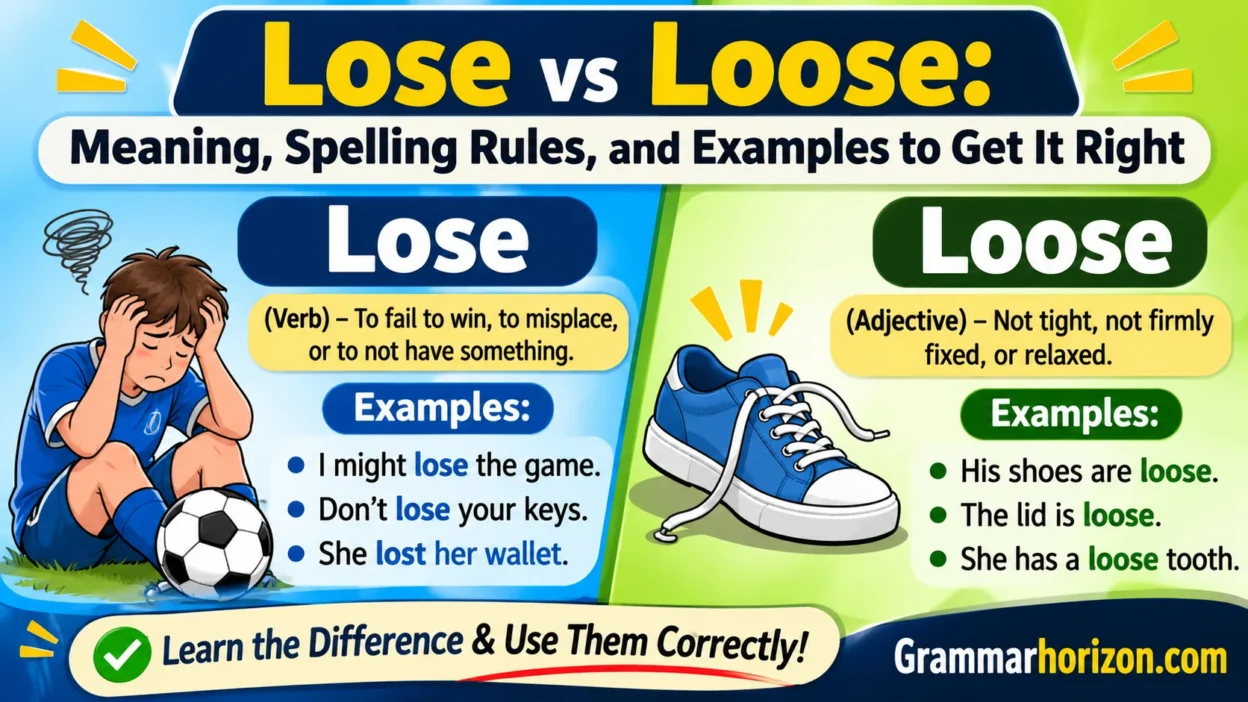
Lose vs Loose often confuses English writers because both words look similar but have different meanings and grammatical uses. Although they share a similar long vowel sound, their pronunciation, spelling differences, and grammatical functions affect the sentence’s meaning. Lose is a verb that means to misplace something, fail to win, or no longer have something. For example, you might lose your phone, lose a competition, or lose something valuable. In contrast, loose is an adjective that describes something not tight, not firmly attached, or not restricted.
Many writers make spelling mistakes in written English because they focus on how words look instead of understanding their meanings. This creates spelling confusion, leading to the use of the wrong word or incorrect word selection. To avoid these errors, pay attention to word meanings, sentence structures, and correct word usage. Ask yourself whether you are describing something or explaining an action. This simple habit improves writing accuracy, word choice, and sentence construction. It also helps you communicate clearly in conversations, emails, academic writing, and professional documents.
A clear understanding of English grammar strengthens your vocabulary and supports language learning. It also improves English communication and everyday communication. For example, misplaced items, losing a game, and losing possessions involve the verb lose. However, tightness, attachment, and restriction relate to the adjective loose. Learning the correct spelling and meaning of each word helps prevent confusion and allows you to express your meaning accurately.
Lose vs Loose: Quick Answer
The main difference between lose and loose is that lose describes an action or result, while loose describes a condition or state. Both are correct English words, but they cannot replace each other.
- Lose (verb): Means to misplace something, fail to win, or stop having something. Example: I don’t want to lose my wallet.
- Loose (adjective): Means not tight, secure, or firmly attached. Example: My jacket is too loose.
| Feature | Lose | Loose |
| Part of speech | Verb | Usually an adjective |
| Meaning | Misplace or fail to win | Not tight or secure |
| Pronunciation | /luːz/ | /luːs/ |
| Past tense | Lost | Loosed (as a verb) |
| Present participle | Losing | Loosing (as a verb) |
| Opposite | Win or gain, depending on context | Tight or secure |
| Example | Don’t lose your keys. | My shoes are loose. |
Remember: You lose something when you cannot find it or fail to keep it. Something is loose when it is not tight or firmly attached.
What Does Lose Mean?
Lose is a verb that means to misplace something, fail to win, or no longer have something you previously possessed. It can describe losing personal belongings, money, opportunities, confidence, or a competition. The exact meaning depends on how you use it in a sentence.
Definition and Meaning of Lose
Lose means to misplace something, become deprived of something, fail to achieve a desired result, or no longer possess something. It describes an action or situation in which someone cannot keep or find something they previously had or expected to have.
You can use lose in different situations. For example, someone might lose their house keys, lose a football match, lose money in a business, or lose confidence before an important presentation. The meaning changes with the context, but the word always expresses some form of loss.
Consider these examples:
- I always lose my sunglasses when I travel.
- Our team might lose the final match.
- She doesn’t want to lose her job.
- You can lose valuable time by arriving late.
- He is trying to lose weight through regular exercise.
- Never lose hope when facing a difficult situation.
In each sentence, lose describes something a person might misplace, fail to achieve, or no longer have.
Lose as a Verb: Different Forms
The word lose is an irregular verb. This means it does not follow the usual spelling pattern of adding -ed to form the past tense. Instead, its past tense and past participle both change to lost.
Here are its main grammatical forms:
| Verb Form | Word | Example |
| Base form | Lose | Don’t lose your ticket. |
| Third-person singular | Loses | He loses his patience quickly. |
| Past tense | Lost | I lost my wallet yesterday. |
| Past participle | Lost | She has lost her phone. |
| Present participle | Losing | They are losing the game. |
Notice that losing contains only one O. Writing “loosing” when you mean misplacing something is a common spelling mistake.
For example:
- Correct: I am losing interest in the conversation.
- Incorrect: I am loosing interest in the conversation.
What Does Loose Mean?
Loose is an adjective that means not tight, firmly attached, or restricted, and it describes something that has extra space or freedom of movement.
Definition and Meaning of Loose
Loose is usually an adjective that means not tight, not firmly attached, or free from restriction. It describes the condition of a person, object, or situation rather than an action of misplacing something.
For example, if your trousers are too big around the waist, you can describe them as loose. Similarly, a loose button might fall off a shirt because it is not firmly attached.
The word can also describe something that is not controlled or restricted. For example, a dog running without a leash can be described as running loose.
Here are some examples:
- My new jacket is too loose around the shoulders.
- There is a loose screw in the chair.
- The dog was running loose in the garden.
- She prefers wearing loose clothing during summer.
- The teacher gave students some loose guidelines for the assignment.
In these sentences, loose describes a condition or quality. It tells the reader that something is not tight, secure, or strictly controlled.
Loose as an Adjective
An adjective describes a noun or gives additional information about it. The word loose usually works this way by explaining the condition, size, or level of security of something.
You can place loose before a noun or after a linking verb such as is, are, was, and feels.
Before a noun:
- I found a loose button on my shirt.
- She bought a loose dress for the summer.
- The mechanic noticed a loose wire.
- He repaired the loose handle on the door.
After a linking verb:
- These trousers are loose.
- The handle feels loose.
- My shoes were loose around the heels.
- The connection seems loose.
Loose also has comparative and superlative forms:
| Form | Word | Example |
| Positive | Loose | This shirt is loose. |
| Comparative | Looser | This shirt is looser than mine. |
| Superlative | Loosest | These are the loosest trousers in the store. |
These forms help you compare the fit or condition of different objects.
Loose as a Verb
Although loose usually functions as an adjective, it can also be a verb. As a verb, loose means to release something, set something free, or allow something to move without restraint.
This use is less common in everyday conversation and often appears in formal, literary, or descriptive writing.
For example:
- The soldier loosed an arrow toward the target.
- The farmer loosed the horses in the field.
- The sudden announcement loosed a wave of excitement.
When loose functions as a verb, its forms are different from those of lose:
- Present: Loose
- Past: Loosed
- Past participle: Loosed
- Present participle: Loosing
This distinction is important because loosing can be a correct word when it means releasing something. However, it is incorrect when you mean misplacing something or failing to win.
Examples of Loose in Everyday Sentences
Here are additional examples that show how loose works in different situations.
Clothing and accessories:
- These jeans are too loose around my waist.
- He prefers loose shirts for comfortable movement.
- The loose shoelace made her trip.
- Her dress has a loose fit.
Objects and connections:
- The chair has a loose leg.
- A loose cable caused the computer to stop working.
- The door handle became loose after several years.
- One of the screws is loose.
Freedom and restrictions:
- The dog was running loose near the park.
- The organization follows loose rules.
- The children were allowed to play freely in the garden.
- The horse broke loose from its enclosure.
These examples demonstrate that loose can describe physical conditions, freedom, and a lack of strict control.
Lose vs Loose: Key Differences Explained
Understanding the main differences between these words makes it easier to choose the correct spelling. Although both contain similar letters, their pronunciation, grammatical roles, and meanings are different.
Difference in Meaning
The biggest difference between lose and loose is what each word communicates.
Lose describes an action or result involving something you no longer have, cannot find, or fail to achieve.
Loose describes a condition in which something is not tight, firmly attached, or restricted.
For example:
- I don’t want to lose my favorite jacket.
- My favorite jacket is too loose.
The first sentence describes the possibility of misplacing something. The second describes how the jacket fits.
Difference in Parts of Speech
Lose is primarily a verb. It describes actions such as misplacing belongings, failing to win, or losing money.
Loose is primarily an adjective. It describes the condition of a person or object. However, it can also function as a verb meaning to release something.
Compare these examples:
| Word | Grammatical Function | Example |
| Lose | Verb | I might lose the match. |
| Loose | Adjective | The shirt is loose. |
| Loose | Verb | They loosed the animals. |
Difference in Pronunciation
Another important difference between lose and loose is their final consonant sound.
- Lose: /luːz/ — The final sound is /z/, like the sound in “zoo.”
- Loose: /luːs/ — The final sound is /s/, like the sound in “sun.”
Both words have the same long /uː/ vowel sound, but their final sounds are different.
You can practice the difference by saying these words aloud:
- Lose, choose, shoes.
- Loose, goose, moose.
This pronunciation difference can help you recognize the correct word when speaking or writing.
Difference in Spelling
The spelling difference is simple:
- Lose has one O.
- Loose has two Os.
However, the extra O does not mean that loose is a longer or stronger form of lose. They are separate words with different meanings.
A useful memory trick is to associate the extra O in loose with extra room in clothing. If something has extra room and does not fit tightly, it is loose.
Lose vs Loose: How to Use Them Correctly
Knowing the definitions is helpful, but understanding how to use both words in everyday sentences is even more important.
When to Use Lose
Use lose when you are talking about misplacing something, failing to win, or no longer having something.
Common situations include:
- Misplacing belongings: I don’t want to lose my car keys.
- Sports and competitions: Our team could lose the final.
- Weight changes: She wants to lose five pounds.
- Financial situations: The business may lose money this month.
- Personal feelings: Don’t lose hope during difficult times.
- Time and opportunities: We cannot afford to lose another hour.
Remember that lose is also used in several common expressions.
| Expression | Meaning | Example |
| Lose your temper | Become angry | He lost his temper during the meeting. |
| Lose your way | Become unable to find the correct direction | We lost our way in the forest. |
| Lose confidence | Stop feeling confident | She began to lose confidence. |
| Lose control | No longer control something | The driver lost control of the car. |
| Lose interest | Stop being interested | I started to lose interest in the movie. |
| Lose sleep | Have trouble sleeping because of worry | Don’t lose sleep over a small mistake. |
When to Use Loose
Use loose when describing something that is not tight, securely attached, or restricted.
Common situations include:
- Clothing: These pants are too loose.
- Shoelaces: Your shoelaces are loose.
- Furniture: The table has a loose leg.
- Electrical connections: A loose wire may cause problems.
- Animals: The dog was running loose outside.
- Rules: The organization follows loose guidelines.
Loose is also part of several common English expressions.
| Expression | Meaning | Example |
| Loose change | Coins carried in your pocket | I found some loose change in my bag. |
| Loose ends | Unfinished details | We need to tie up a few loose ends. |
| Loose cannon | An unpredictable person | Nobody wants a loose cannon on the team. |
| Let loose | Relax or behave freely | Everyone let loose at the party. |
| All hell breaks loose | A situation suddenly becomes chaotic | All hell broke loose after the announcement. |
These expressions demonstrate that loose has uses beyond describing clothing or objects.
Why Do People Confuse Lose and Loose?
Even though lose and loose have different meanings, many English writers confuse them. This usually happens because their spellings are similar and their vowel sounds are identical.
Similar Spelling
Both words begin with the letters L and O and have a similar overall appearance. The only spelling difference is the additional O in loose.
When people write quickly, they may accidentally choose the wrong spelling without thinking about the meaning.
Different Final Sounds
The words have different final consonant sounds, but some learners may not notice this distinction when speaking. Lose ends with a /z/ sound, while loose ends with an /s/ sound.
Learning these sounds can help you recognize the difference.
Confusion Between Verbs and Adjectives
Another reason is the difference in grammatical functions. Some writers focus on how the words look rather than how they work in a sentence.
For example:
- Incorrect: I don’t want to loose my job.
- Correct: I don’t want to lose my job.
The sentence needs a verb describing an action or possibility. Therefore, lose is correct.
Compare that with:
- Incorrect: My shirt is too lose.
- Correct: My shirt is too loose.
Here, the sentence describes the condition of the shirt, so the adjective loose is required.
Common Lose vs Loose Grammar and Spelling Mistakes
The following mistakes frequently appear in emails, social media posts, school assignments, and professional writing.
| Incorrect Sentence | Correct Sentence | Explanation |
| I don’t want to loose my phone. | I don’t want to lose my phone. | Lose means misplace. |
| My shoes are too lose. | My shoes are too loose. | Loose means not tight. |
| She is loosing weight. | She is losing weight. | Losing is the correct form of lose. |
| The screw is lose. | The screw is loose. | Loose describes an unsecured screw. |
| Don’t loose your temper. | Don’t lose your temper. | Lose is used in this expression. |
| His shirt feels lose. | His shirt feels loose. | Loose describes the fit. |
| They could loose the match. | They could lose the match. | Lose means fail to win. |
| The dog was running lose. | The dog was running loose. | Loose means free from restraint. |
Confusing Lose With Lost
Another common mistake involves the words lose and lost.
Lose is the base form of the verb, while lost is its past tense and past participle.
Examples:
- Present: I don’t want to lose my wallet.
- Past: I lost my wallet yesterday.
- Present perfect: I have lost my wallet.
You cannot use lost in every situation because the tense and sentence structure determine the correct form.
Confusing Loose With Loosen
Loose and loosen are related, but they do not have the same grammatical function.
- Loose: An adjective meaning not tight.
- Loosen: A verb meaning to make something less tight.
For example:
- My shoelaces are loose.
- Please loosen your shoelaces.
This distinction is useful when describing an existing condition versus an action that changes that condition.
Memory Tricks to Remember Lose vs Loose
If you frequently confuse these words, a few simple memory tricks can help you choose the correct one.
Remember That Lose Has One O
Think of lose as the word connected to loss. When you lose something, you no longer have it or cannot find it.
For example:
- I don’t want to lose my money.
- We could lose the game.
- He might lose his job.
The word loss can help you remember the spelling of lose.
Remember That Loose Has Two Os
Think of the two Os in loose as extra space. Something loose has additional room or freedom because it is not tightly fitted or attached.
For example:
- My shirt is loose.
- The screw is loose.
- Her hair hangs loose.
This association makes it easier to remember which spelling describes something that is not tight.
Use the Opposite-Word Test
Another useful technique is to replace the word with its opposite.
If the sentence means the opposite of winning or gaining something, use lose.
If the sentence means the opposite of tight, use loose.
Examples:
- I don’t want to lose the match. (Opposite: win)
- These shoes are loose. (Opposite: tight)
This simple test works in many everyday writing situations.
Lose vs Loose in American and British English
Some English words have different spellings in American and British English. However, lose and loose are spelled the same way in both varieties. Their meanings and grammatical functions also remain unchanged.
Lose vs Loose in American English
American English uses lose as a verb meaning to misplace something, fail to win, or no longer possess something.
Loose is generally used as an adjective describing something that is not tight or secure. It can also function as a verb meaning to release something.
Examples:
- I don’t want to lose my wallet.
- These jeans are too loose.
- The dog was running loose.
- She doesn’t want to lose her job.
Lose vs Loose in British English
British English follows the same spelling and usage rules. Neither word is an alternative spelling of the other.
Examples:
- She doesn’t want to lose her keys.
- His jacket is too loose.
- The horse broke free and ran loose.
- We cannot afford to lose another match.
Therefore, neither word is an American or British spelling variation of the other. Both are standard English words used in the USA, UK, and other English-speaking countries.
Conclusion
Understanding the difference between lose and loose helps you avoid common spelling mistakes and improve your English writing. Remember that lose is a verb used when you misplace something, fail to win, or no longer have something. Loose is an adjective that describes something that is not tight, firmly attached, or restricted. Although these words look and sound similar, their meanings are different. Learning their correct usage will make your sentences clearer and help you communicate confidently in everyday and professional writing.
Frequently Asked Questions
Q1. What is the main difference between lose and loose?
Lose is a verb that means to misplace something or fail to win. Loose is an adjective that describes something that is not tight or firmly attached.
Q2. Is loose a verb or an adjective?
Loose is usually an adjective. It describes something that is not tight, secure, or restricted.
Q3. Is lose spelled with one O or two?
Lose is spelled with one O, while loose is spelled with two O’s.
Q4. How do you use lose in a sentence?
You can use lose when talking about misplaced items, losing a competition, or no longer having something. For example: “I don’t want to lose my phone.”
Q5. How do you use loose in a sentence?
Use loose to describe something that is not tight or securely attached. For example: “My jacket feels loose around the waist.”