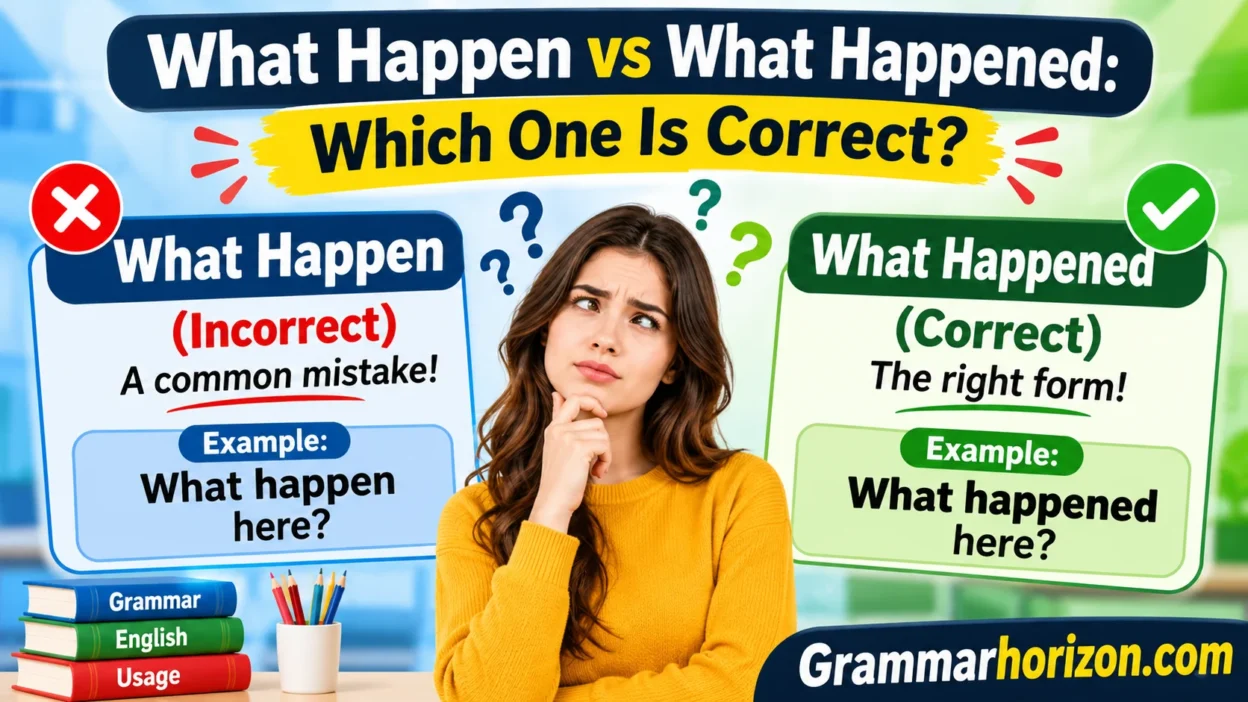
What Happen vs What Happened is a common English grammar confusion because both expressions use different forms of the same verb but refer to different times. People often mix them up in everyday conversations, spoken English, and written communication because they do not always recognize the difference between present, past, and future tense. For example, “What happened yesterday?” is correct when asking about a past event, while “What will happen tomorrow?” is correct when asking about a future possibility. The first question uses happened, the past form of the main verb happen, whereas the second uses the base form after the helping verb will.
When discussing past events, use happened to describe something that already took place, such as an accident, meeting, or unexpected situation. In contrast, happen is the base form used with auxiliary verbs such as will, do, and does in suitable questions. For example, “What happened yesterday?” asks about a completed event, while “What will happen tomorrow?” asks about something expected in the future. The time reference, including words such as yesterday and tomorrow, helps you choose the correct verb tense. In my experience, checking the helping verb and the time of an event is a simple way to improve sentence structure, verb agreement, and grammatical accuracy.
For better English writing and English speaking, pay attention to verb forms, tense usage, and sentence construction whenever you ask questions about events. The difference between these expressions becomes easier when you remember that happened describes past occurrences, while happen usually needs a helping verb when forming present or future questions. This simple method improves your word choice, communication skills, and overall grammar understanding. It also supports language learning by helping you recognize correct usage, understand the difference between similar English expressions, and choose the proper expression for each situation.
Quick Answer: What Happen vs What Happened
What happened is correct when asking about something that took place in the past. Happen is the base form of the verb and is used after modal verbs such as will, can, could, and might, or after the auxiliary verb did.
Here are some examples:
- What happened yesterday? (Correct: Asking about a past event.)
- What will happen tomorrow? (Correct: Asking about a future event.)
- What can happen next? (Correct: Asking about a possibility.)
- What did happen at the meeting? (Correct: Using the base verb after did.)
Remember this simple rule: Use happened for past events when there is no past-tense auxiliary before the main verb. Use happen when a modal or auxiliary verb requires the base form.
What Is the Difference Between What Happen vs What Happened?
The main difference between what happen and what happened is the form of the verb. Happen is the base form, while happened is the simple past form and past participle. Both words belong to the same verb, but they serve different grammatical purposes.
The verb happen means to take place, occur, or come about. For example, “What happened during the meeting?” asks about an event that already took place. In contrast, “What will happen during the meeting?” asks about a future event.
The phrase what happen is generally incomplete as a standalone question in standard English. It normally needs a helping verb, such as will, can, or did, to form a grammatically correct question.
What Happen vs What Happened: Main Differences
| Feature | Happen | Happened |
| Verb form | Base form | Simple past and past participle |
| Main meaning | To take place or occur | Took place or occurred |
| Time reference | Depends on sentence structure | Usually past |
| After modal verbs | Correct | Incorrect |
| After did | Correct | Incorrect |
| Example | What will happen next? | What happened yesterday? |
The most important point is that happen and happened are not interchangeable. You must consider the helping verb and the time reference before choosing the correct form.
What Does Happen Mean?
Happen is a verb that means to take place, occur, or come about. It describes an event or situation without necessarily identifying the person or thing responsible for it. It is the base form of the verb and appears in several sentence structures.
For example, “What will happen if we miss the train?” asks about a possible future result. Similarly, “What can happen during a storm?” asks about possible events. In both sentences, happen follows a modal verb, so it does not take the -ed ending.
When to Use Happen in a Sentence
Use happen when the grammatical structure requires the base form of the verb. This commonly occurs after modal verbs and auxiliary verbs.
Here are some common situations:
- Future events: What will happen if we arrive late?
- Possibilities: What can happen when you ignore the instructions?
- Uncertain situations: What might happen during the next meeting?
- Hypothetical situations: What could happen if the weather changes?
- Expected results: What should happen after the final inspection?
In each example, the helping verb comes before happen. The main verb stays in its base form because the modal verb establishes the grammatical structure.
Happen After Modal Verbs
Modal verbs include will, would, can, could, may, might, and should. These verbs express ideas such as possibility, ability, intention, prediction, and advice.
When a modal verb is followed by happen, you should always use the base form.
Correct examples:
- What will happen if the company changes its policy?
- What would happen if nobody attended the meeting?
- What can happen when you leave food outside?
- What could happen if we miss the deadline?
- What might happen during the winter?
- What should happen after the application is approved?
Incorrect examples:
- What will happened next?
- What can happened during the process?
- What might happened tomorrow?
The correct forms are will happen, can happen, and might happen. Never add -ed to the main verb after these modal verbs.
Happen After Do, Does, and Did
The base form happen also appears after the auxiliary verbs do, does, and did. These helping verbs are used to form questions and negative statements in different tenses.
Examples include:
- What do you think will happen?
- What does happen when the temperature drops?
- What did you expect to happen?
- I don’t know what will happen next.
- Nothing did happen during the inspection.
Notice that did is already in the past tense. Therefore, the verb following it remains happen, not happened.
What Does Happened Mean?
Happened is the simple past form and past participle of the verb happen. It describes an event, action, or situation that took place before the present moment.
For example, “What happened at school yesterday?” asks someone to explain a past event. Similarly, “Something unusual happened during the trip” describes an incident that has already occurred.
The word happened is a regular verb form because it is created by adding -ed to the base verb happen.
When to Use Happened in a Sentence
Use happened when discussing completed past events or asking someone to explain a previous situation.
Consider these examples:
- What happened at the office yesterday?
- What happened to your old computer?
- Something unexpected happened during the journey.
- I don’t understand what happened last night.
- Can you explain what happened after the meeting?
- Nobody knows what happened to the missing documents.
In these sentences, happened tells the reader that the event belongs to the past. You don’t need to mention an exact date or time if the context already makes the past meaning clear.
Happened in Direct Questions
A direct question asks for information without using another introductory expression. What happened? is a common direct question when someone wants to know about an incident or unexpected situation.
Examples:
- What happened to your phone?
- What happened during the interview?
- What happened after the game?
- What happened at the hospital?
- What happened between the two friends?
The past-tense verb appears directly after what. This is a normal question structure because what acts as the subject of the verb.
Happened in Indirect Questions
An indirect question includes an introductory expression such as do you know, can you explain, or I wonder. These questions usually follow statement word order rather than direct-question word order.
Examples:
- Do you know what happened yesterday?
- Can you explain what happened during the meeting?
- I wonder what happened to the documents.
- Please tell me what happened after the announcement.
Compare these two structures:
| Direct question | Indirect question |
| What happened yesterday? | Do you know what happened yesterday? |
| What happened to him? | Can you tell me what happened to him? |
| What happened after lunch? | I wonder what happened after lunch. |
Both forms use happened because they refer to past events. The important difference is the sentence structure, not the verb tense.
When Should You Use What Happen?
Use happen when the surrounding sentence requires the base form of the verb. In most everyday questions, you need a helping verb before happen.
The choice depends on whether you are asking about a future event, a possible result, or an action connected to another verb.
When Asking About Future Events
Use what will happen when asking about something expected or possible in the future. The modal verb will indicate the future, while happen remains in its base form.
Examples:
- What will happen if we cancel the meeting?
- What will happen after the new rules take effect?
- What will happen when the school year ends?
- Do you know what will happen next week?
When Discussing Possibilities
Use what can happen or what could happen when asking about possible events or outcomes.
Examples:
- What can happen if you don’t follow the instructions?
- What could happen if the company loses its main customer?
- What might happen if we change the schedule?
- What may happen during the inspection?
These expressions do not describe something that definitely occurred. Instead, they explore possible situations.
When Asking Questions With Did
You can also use happen after” when asking about a past event. This is an important exception to remember because the question still refers to the past.
Examples:
- What did happen after the announcement?
- Why did this happen?
- When did the accident happen?
- How did this happen?
The word did carry the past tense, so the main verb stays in its base form. In ordinary conversation, “What happened?” is usually more natural than “What did happen?” The latter often adds emphasis or expresses surprise.
When Should You Use What Happened?
Use what happened when you want to ask about an event that took place in the past. It is one of the most common ways to request an explanation, understand an unexpected situation, or discuss a previous experience.
When Asking About Past Events
Use what happened when the event has already taken place.
Examples:
- What happened at the office yesterday?
- What happened during the football match?
- What happened after the meeting ended?
- What happened when you arrived home?
These questions focus on completed events rather than future possibilities.
When Discussing Unexpected Situations
The phrase is also useful when something unusual or surprising occurs. You can use it to ask someone for an explanation.
For example:
- What happened to the broken window?
- What happened to your car?
- What happened to the electricity?
- What happened to the original documents?
In these examples, the speaker wants to understand a previous incident or a change in someone’s situation.
When Using Past-Time Expressions
Certain time expressions help establish that an event belongs to the past. These expressions often appear with happened.
| Time expression | Example |
| Yesterday | What happened yesterday? |
| Last night | What happened last night? |
| Last week | What happened last week? |
| A few minutes ago | What happened a few minutes ago? |
| Earlier | What happened earlier? |
| In 2024 | What happened in 2024? |
However, a past-time expression is not always necessary. If the conversation already makes the time clear, you can simply ask, “What happened?”
What Happen vs What Happened: Examples in Sentences
The easiest way to understand what happen vs what happened is to study complete sentences. The following examples demonstrate how the verb changes according to the helping verb and time reference.
Examples of Happen in Sentences
- What will happen if we don’t complete the project?
- What can happen when someone ignores safety instructions?
- What could happen if the temperature drops suddenly?
- What might happen during the next few days?
- What should happen after the final examination?
- What did you expect to happen after the announcement?
- Do you know what will happen at the event?
- I don’t know what might happen tomorrow.
Each example uses happen because the sentence requires the base form. Some refer to future events, while others discuss possibilities or expectations.
Examples of Happened in Sentences
- What happened during your vacation?
- What happened to the old building?
- What happened after the manager left?
- Something unusual happened in the neighborhood.
- I don’t know what happened at the station.
- Can you tell me what happened last weekend?
- Nobody understood what happened during the presentation.
- What happened when the power went out?
These examples use happened because they refer to completed events in the past.
Correct and Incorrect What Happen vs What Happened Examples
| Incorrect sentence | Correct sentence | Explanation |
| What happen yesterday? | What happened yesterday? | Use past tense for a past event. |
| What will happened next? | What will happen next? | Use the base form after will. |
| What can happened here? | What can happen here? | Use the base form after can. |
| What did happened? | What did happen? | Use the base form after. |
| What might happened later? | What might happen later? | Use the base form after might. |
| What happened tomorrow? | What will happen tomorrow? | Use future wording for a future event. |
These examples show why you should consider the complete sentence instead of choosing a verb based only on the time expression.
What Did Happen vs What Did Happened?
What did happen is grammatically correct, while what did happened is incorrect in standard English. Both expressions may look similar, but only the first follows the correct past-tense question structure.
The reason is simple: did is already the past-tense form of the auxiliary verb do. When you use it to form a question, the main verb must return to its base form.
Why Is What Did Happen Correct?
The sentence follows this structure:
What + did + subject + base verb?
Examples:
- What did happen after the accident?
- Why did the lights go out?
- When did the problem happen?
- How did the situation change?
In these sentences, did indicates the past, so the main verb does not need another past-tense ending.
Why Is What Did Happened Incorrect?
The sentence what did happened uses two past-tense forms in the same verb construction. The auxiliary did already mark the past, so adding -ed to happen creates an incorrect structure.
Compare these examples:
- Incorrect: What did happened to the car?
- Correct: What happened to the car?
- Correct: What did happen to the car?
The last two sentences are both grammatically correct. However, “What happened to the car?” is more common in ordinary conversation. “What did happen to the car?” places extra emphasis on the question.
More Examples With Other Verbs
The same rule applies to other regular and irregular verbs.
| Incorrect | Correct |
| Did you go home? | Did you go home? |
| Did she call you? | Did she call you? |
| Did they finish the work? | Did they finish the work? |
| Did he see the accident? | Did he see the accident? |
| Did it happened yesterday? | Did it happen yesterday? |
Learning this pattern will help you form correct past-tense questions beyond the specific difference between happen and happened.
What Happens vs What Happened?
What happens and what happened differ in their tense and time reference. The first expression uses the simple present tense, while the second uses the simple past tense.
Use what happens when asking about regular events, general facts, or situations that usually occur. Use what happened when asking about a specific event that has already taken place.
When to Use What Happens
Examples:
- What happens when water reaches its boiling point?
- What happens after you submit the application?
- What happens if someone misses the deadline?
- What happens during the first lesson?
These questions focus on general processes, repeated situations, or expected results.
When to Use What Happened
Examples:
- What happened when the water started boiling?
- What happened after you submitted the application?
- What happened when someone missed the deadline?
- What happened during the first lesson yesterday?
These questions refer to events that occurred in the past.
What Happens vs What Happened: Comparison Table
| What happens | What happened |
| What happens after the payment? | What happened after the payment? |
| What happens during the meeting? | What happened during the meeting? |
| What happens when it rains? | What happened when it rained? |
| What happens at the beginning of the course? | What happened at the beginning of the course? |
A useful way to remember the difference is to ask whether you mean a usual process or a specific past event.
What Happened vs What Has Happened?
What happened and what has happened both refer to events before the present, but they use different verb tenses. The first uses the simple past, while the second uses the present perfect.
When to Use What Happened
Use what happened when focusing on an event that occurred in the past. You can mention a specific past time or leave it understood from the conversation.
Examples:
- What happened yesterday?
- What happened during the last meeting?
- What happened after the storm?
- What happened to your computer last week?
When to Use What Has Happened
Use what has happened when a past event has a connection to the present. This often happens when you can see a current result or when the event’s effects are still important.
Examples:
- What has happened to your computer? It no longer works.
- What has happened here? The room is completely different.
- What has happened to the project? Nobody is working on it.
- Do you know what has happened since yesterday?
What Happened vs What Has Happened: Comparison
| What happened | What has happened |
| What happened yesterday? | What has happened since yesterday? |
| What happened to the garden last summer? | What has happened to the garden? |
| What happened after the meeting? | What has happened since the meeting? |
| What happened to the company last year? | What has happened to the company recently? |
Remember: The simple past focuses on a completed past event. The present perfect connects an earlier event or situation to the present. In standard English, avoid using the present perfect with a finished past-time expression such as yesterday or last year.
Common Grammar Mistakes to Avoid
Even though what happen vs what happened seems like a simple grammar difference, several mistakes can make your sentences incorrect. Most of these errors happen when writers forget the role of helping verbs or confuse present and past tenses.
Using What Happen for a Past Event
Using what happen without a helping verb is incorrect when asking about a completed past event.
Incorrect: What happen during the interview yesterday?
Correct: What happened during the interview yesterday?
The word yesterday indicates that the event occurred in the past. Therefore, you need the past-tense form happened.
Adding -Ed After a Modal Verb
Never add -ed to the main verb when it follows a modal verb.
Incorrect: What might happened next?
Correct: What might happen next?
Modal verbs such as might, could, will, and can require the base form of the main verb.
Using Happened After Did
Another common mistake is using two past-tense forms together.
Incorrect: What did happened at school?
Correct: What did happen at school?
The auxiliary did already express past tense, so the main verb must remain in its base form.
Confusing Happen, Happens, and Happened
These three forms have different grammatical purposes. Using the wrong one can change the meaning or make a sentence grammatically incorrect.
| Verb | Grammatical use | Example |
| Happen | Base form | What will happen next? |
| Happens | Simple present | What happens after the lesson? |
| Happened | Simple past | What happened yesterday? |
Mixing Different Time References
Always check whether your sentence discusses a past event, a present situation, or a future possibility.
Incorrect: What happened tomorrow?
Correct: What will happen tomorrow?
Incorrect: What happen last night?
Correct: What happened last night?
Choosing the correct time reference makes your writing clearer and more natural.
Conclusion
Understanding What Happen vs What Happened becomes easier when you focus on verb tense and sentence structure. Use happened when asking about something that took place in the past, such as “What happened yesterday?” Use happen with helping verbs such as will, do, or does when forming suitable questions. Remembering this simple difference will help you avoid common grammar mistakes and improve your English writing and speaking skills.
Frequently Asked Questions
Q1. Is What Happens Grammatically Correct?
No, What Happen is not normally correct as a complete question. You need a helping verb, such as will, do, or does, depending on the intended meaning.
Q2. Is What Happened correct English?
Yes, What Happened is correct English when asking about something that occurred in the past.
Q3. What is the difference between What Happen and What Happened?
What Happened asks about a past event, while happen is the base form used with suitable helping verbs to discuss present or future situations.
Q4. Should I say What Happened Yesterday or What Happen Yesterday?
You should say What Happened Yesterday? because the question refers to an event that already took place.
Q5. Is What Will Happen Tomorrow correct?
Yes, What Will Happen Tomorrow? is correct because will is a helping verb followed by the base form happen to discuss a future event.