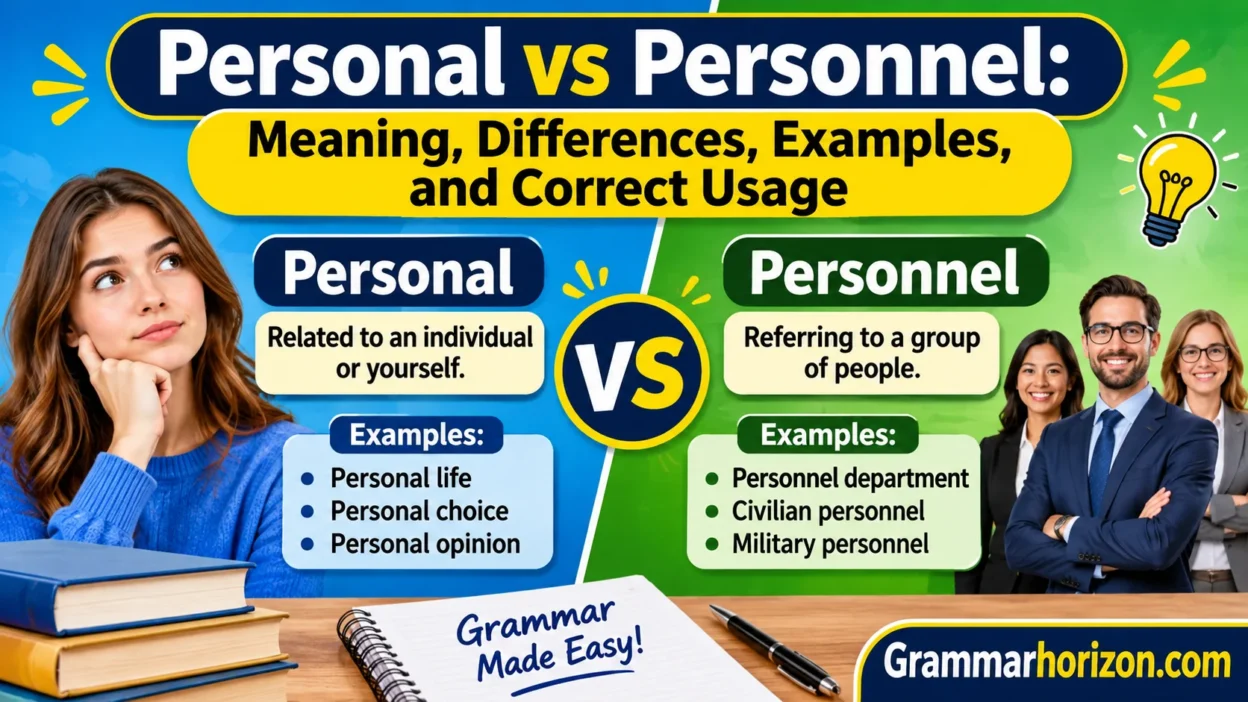
Personal vs Personnel is a common English word comparison because both words look and sound similar, but they have different meanings and grammatical functions. Many writers and learners confuse these words in everyday conversations, professional emails, business documents, and academic writing. In English grammar, personal is an adjective that describes something related to an individual, while personnel is a noun that refers to employees, staff members, or workers in an organization. Understanding this distinction helps you choose the correct word according to the context, sentence structure, and intended meaning.
The word personal describes private matters, including feelings, opinions, belongings, experiences, and individual preferences. It also refers to personal belongings and personal information that someone wants to keep private for reasons of privacy. In contrast, personnel refers to an employee workforce or organizational staff. A company may hire additional personnel to manage its increasing workload. Similarly, a hospital employs medical personnel, while a military unit depends on military personnel to perform different duties. Although both words relate to people, they are not interchangeable.
In workplace communication, professional communication, and business communication, using these words correctly makes your writing clearer. The human resources team or personnel department usually handles employee management, hiring, and recruitment for company employees. However, a personal meeting, personal opinion, or personal request relates to an individual rather than a group of employees. When checking sentences, I find it helpful to ask whether the subject concerns private information or an organization’s staff. This simple approach makes the comparison easier, helps create correct sentences, and improves your vocabulary by teaching you the usage differences and grammatical differences between these two words.
Personal vs Personnel: Quick Answer
The main difference between personal and personnel is their meaning and grammatical function. Personal is an adjective that describes something related to an individual or their private life. Personnel is a noun that refers to employees or staff members working for an organization.
| Personal | Personnel |
| Relates to an individual. | Refers to employees or staff. |
| Primarily an adjective. | Primarily a noun. |
| Describes private or individual matters. | Describes a group of workers. |
| Example: Personal belongings. | Example: Hospital personnel. |
| Example: Personal opinion. | Example: Military personnel. |
Examples:
- Personal: She shared her personal experience with the students.
- Personnel: All hospital personnel must follow safety procedures.
Remember this simple rule: Use personal when discussing an individual’s private or individual matters. Use personnel when referring to the people employed by an organization.
What Does Personal Mean?
The word personal is an adjective that describes something belonging to, concerning, or affecting a particular person. It often refers to an individual’s private life, thoughts, feelings, choices, or possessions. You can use it when talking about something that is unique to you or directly connected to another individual.
For example, when someone says, “This is my personal opinion,” they mean the statement reflects their own views rather than an official position or a belief shared by everyone. Similarly, personal belongings are items that belong to an individual, such as a wallet, phone, bag, or clothing.
The word personal is common in everyday conversations, professional communication, education, and formal writing. It helps explain whether something relates to an individual rather than a group or organization.
Different Meanings of Personal
The meaning of personal can change slightly depending on the context. Here are its most common uses.
Relating to an individual: Personal describes something that belongs to or concerns one particular person.
- This is my personal laptop.
- Everyone has a personal learning style.
- She made a personal choice about her career.
Relating to private life: It can describe matters that someone does not want to share publicly.
- I don’t discuss my personal problems at work.
- He needs some time to handle personal matters.
- Please don’t share my personal information.
Expressing individual opinions or feelings: Personal can describe someone’s own thoughts, preferences, or experiences.
- That’s just my personal opinion.
- Her personal experience helped others understand the problem.
- I have a personal preference for simple designs.
Involving direct attention or action: It can also describe something handled directly by a particular person.
- The manager gave the project personal attention.
- The director made a personal appearance at the event.
- She personally contacted every customer.
Common Expressions That Use Personal
Several everyday expressions contain the word personal. Understanding these phrases can help you use the adjective naturally.
| Expression | Meaning | Example |
| Personal information | Private details about an individual | Never share your personal information with strangers. |
| Personal belongings | Items owned by someone | Take your personal belongings before leaving. |
| Personal opinion | An individual’s own view | My personal opinion is different. |
| Personal experience | Something someone has experienced | She described her personal experience. |
| Personal responsibility | An individual’s duty or accountability | Everyone has personal responsibility for their actions. |
| Personal space | The physical area someone wants around them | Please respect other people’s personal space. |
| Personal development | Improving your own skills and abilities | Reading supports personal development. |
| Personal life | Matters outside someone’s professional life | He keeps his personal life separate from work. |
These expressions show that personal usually describes an individual matter rather than an organization’s workforce.
What Does Personnel Mean?
The word personnel is a noun that refers to the employees, workers, or staff members of an organization. It commonly appears in business, government, healthcare, education, and military settings. When an organization discusses its personnel, it means the people who work for it or provide services within its structure.
For example, the sentence “The company needs more technical personnel” means that the company needs additional workers with technical skills. Similarly, “Hospital personnel helped the injured passengers” refers to the hospital’s employees and professional staff.
Personnel can describe different groups of workers, including full-time employees, trained specialists, administrative staff, and members of the armed forces. It is especially common in formal and professional communication.
Different Types of Personnel
The word personnel can describe employees in almost any organization. The exact meaning depends on the workplace or professional environment.
Here are some common examples:
- Military personnel: Members of the armed forces who serve in military roles.
- Medical personnel: Doctors, nurses, and other healthcare workers.
- Hospital personnel: Employees who provide medical, administrative, and support services in a hospital.
- Office personnel: People who perform administrative and general office duties.
- Administrative personnel: Workers responsible for managing records, communication, scheduling, and other office operations.
- Security personnel: Employees responsible for protecting people, buildings, and property.
- Technical personnel: Workers who handle technical tasks, equipment, systems, and specialized services.
- Rescue personnel: People trained to respond to emergencies and help those in danger.
Example Sentences With Personnel
The following sentences demonstrate how to use personnel correctly.
- The company hired additional personnel to manage its growing workload.
- All hospital personnel must follow hygiene and safety guidelines.
- Military personnel received new training before deployment.
- Only authorized personnel can enter the restricted area.
- The manager discussed the staffing shortage with senior personnel.
- Emergency personnel arrived shortly after the accident.
- The school needs qualified personnel to support its students.
- The organization is recruiting experienced technical personnel.
In each example, personnel refers to a group of employees or workers rather than one person’s private matters.
Personnel as a Collective Noun
One important grammatical point is that personnel generally refers to a group of people. It is commonly treated as a plural noun when discussing employees as individuals.
For example:
- The personnel are preparing for the inspection.
- All personnel have received their instructions.
- The medical personnel were working throughout the night.
However, when personnel refers to the department responsible for managing employees, it can take a singular verb.
For example:
- Personnel is reviewing the company’s hiring policy.
- The personnel department is updating employee records.
Therefore, the correct verb depends on whether you mean the employees themselves or the department that manages them.
Personal vs Personnel: Key Differences
Although personal and personnel have similar spellings, their meanings, grammatical roles, and uses are different. Understanding these differences makes it easier to select the right word when writing sentences.
The most important distinction is that personal describes something related to an individual, while personnel identifies the employees or staff members of an organization.
Personal vs Personnel Comparison Table
| Feature | Personal | Personnel |
| Part of speech | Adjective | Noun |
| Main meaning | Related to an individual | Employees or staff |
| Refers to | Individual matters | A group of workers |
| Common setting | Everyday and professional communication | Business and organizational communication |
| Private matters | Yes | No, not in its usual meaning |
| Workplace use | Personal opinions and responsibilities | Employees and staffing |
| Example | Personal experience | Medical personnel |
Differences in Grammatical Usage
Personal usually appears before a noun because it describes that noun.
Examples:
- Personal information
- Personal belongings
- Personal choices
- Personal responsibility
In these phrases, personal explains what kind of information, belongings, choices, or responsibility you are discussing.
On the other hand, personnel can function as the main noun in a sentence or as a noun modifier in a compound expression.
Examples:
- The personnel are ready.
- The company needs more personnel.
- The personnel department handles recruitment.
Notice that personnel identify the employees or the department rather than describing someone’s private life.
Differences in Meaning and Context
Consider these two sentences:
- She shared her personal experience with the team.
- The company hired additional personnel for the project.
The first sentence discusses an individual’s experience. The second describes a group of workers hired by an organization.
Changing these words would change the meaning and make the sentences incorrect or unnatural.
Personal vs Personnel in Example Sentences
One of the easiest ways to understand the difference between these words is to examine them in complete sentences. The examples below show how each word works in everyday and professional communication.
Examples of Personal in Sentences
Personal describes an individual’s private matters, belongings, opinions, or experiences.
- I prefer to keep my personal life separate from my professional responsibilities.
- She shared her personal experience during the classroom discussion.
- Please bring your personal identification to the appointment.
- This decision reflects my personal opinion.
- He takes personal responsibility for completing the assignment.
- Everyone should respect other people’s personal space.
- The manager gave the new project personal attention.
- She uses her personal computer for studying.
- My personal preference is to work in a quiet environment.
- They discussed several personal matters after the meeting.
In all these examples, personal provides information about an individual or something directly connected to that person.
Examples of Personnel in Sentences
Personnel refers to employees, staff members, or workers within an organization.
- The company hired additional personnel to improve customer service.
- Hospital personnel worked together during the emergency.
- All military personnel must follow official instructions.
- Only authorized personnel can access the control room.
- The organization needs experienced technical personnel.
- Security personnel checked visitors before allowing entry.
- The school recruited qualified personnel for its science department.
- Emergency personnel helped evacuate the building.
- The manager organized a training session for all personnel.
- The organization is reviewing its personnel requirements.
Each sentence uses personnel to identify a group of workers or employees.
Personal vs Personnel: Side-by-Side Examples
Sometimes, using both words in similar sentences makes their meanings easier to remember.
| Personal | Personnel |
| She discussed her personal problems. | The personnel discussed the new workplace rules. |
| I need my personal documents. | The company updated its personnel records. |
| He shared his personal opinion. | The manager consulted senior personnel. |
| She takes personal responsibility. | The organization needs additional personnel. |
| Please respect my personal space. | Only authorized personnel can enter. |
The key is to look at the subject of the sentence. If you are describing an individual’s private or individual matters, use personal. If you are referring to employees or staff, use personnel.
Personal vs Personnel: Which Word Should You Use?
Choosing between personal and personnel becomes simple when you understand what you want to communicate. Instead of focusing only on their spelling, consider the meaning of the sentence.
Use personal when you want to describe something connected to a particular individual. Use personnel when you are talking about the people employed by an organization.
When to Use Personal
Choose personal in the following situations:
- When discussing someone’s private life.
- When describing individual opinions or preferences.
- When referring to belongings owned by a person.
- When explaining someone’s experiences or feelings.
- When discussing individual duties and responsibilities.
- When describing something handled directly by a particular person.
Examples:
- She shared her personal thoughts about the new policy.
- Please keep your personal documents in a safe place.
- He made a personal decision to change his career.
- The teacher discussed personal development with the students.
When to Use Personnel
Choose personnel when discussing:
- Employees working for a business.
- Staff members in a hospital or school.
- Workers responsible for specific organizational duties.
- Members of the military.
- Employees involved in recruitment and staffing.
- Groups of professionals working in an organization.
Examples:
- The business needs more personnel to manage daily operations.
- Medical personnel provided emergency treatment.
- The company is training its technical personnel.
- Only authorized personnel can access the office.
Personal Matters vs Personnel Matters
These two expressions are particularly useful because they demonstrate how changing one word changes the meaning.
Personal matters refers to private issues that concern an individual.
Example: “She requested a day off to take care of personal matters.”
Personnel matters refers to issues involving employees or workforce management.
Example: “The director handles personnel matters, including hiring and staff performance.”
The same distinction appears in other expressions:
| Expression | Meaning |
| Personal information | Private information about an individual |
| Personnel information | Information concerning employees |
| Personal decisions | Choices made by an individual |
| Personnel decisions | Decisions about employees or staffing |
| Personal records | Records belonging to or concerning an individual |
| Personnel records | Employment records maintained by an organization |
These examples are useful in business writing because both words can appear in similar contexts but communicate different ideas.
Personal vs Personnel in Workplace and Business Writing
Both personal and personnel are common in professional communication. However, they serve different purposes in business documents, employee records, workplace policies, and official emails.
Understanding the distinction is especially important when writing about employees because confusing these words can change the meaning of a sentence.
Personal in Professional Communication
In the workplace, personal usually describes something related to an individual employee rather than the organization as a whole.
For example, an employee might discuss personal responsibilities, personal goals, or personal information with a manager.
Common workplace expressions include:
- Personal leave: Time off requested for individual reasons.
- Personal development: Improving an individual’s professional and personal abilities.
- Personal information: Private details about an employee.
- Personal responsibility: Duties that an individual must handle.
- Personal preferences: Individual choices about work arrangements or tasks.
Example: “Employees should update their personal information whenever their contact details change.”
Here, personal refers to information belonging to individual employees.
Personnel in Professional Communication
In business writing, personnel refers to employees, staffing, and workforce management. It frequently appears in company policies, recruitment documents, organizational reports, and administrative communication.
Common workplace expressions include:
- Personnel records: Documents containing employment-related information.
- Personnel management: Managing an organization’s workforce.
- Personnel department: The department responsible for employee-related matters.
- Personnel manager: A person responsible for staffing and employee administration.
- Personnel training: Training provided to employees.
- Personnel requirements: The number and types of workers an organization needs.
Example: “The personnel department is responsible for maintaining employee records.”
Here, personnel identifies the department that manages the organization’s workforce.
Personal vs Personnel in Business Examples
Consider these sentences to understand how the words work in professional situations.
| Sentence | Correct word | Reason |
| Employees must protect their _____ information. | Personal | Refers to private information. |
| The company needs additional _____ for its new branch. | Personnel | Refers to employees. |
| She requested leave for _____ reasons. | Personal | Refers to individual circumstances. |
| The manager reviewed the company’s _____ records. | Personnel | Refers to employment records. |
| Everyone should take _____ responsibility for their work. | Personal | Refers to individual accountability. |
The main point is that personal describes an individual’s matters, whereas personnel refers to the workforce or employee-related functions of an organization.
Conclusion
Understanding the difference between personal vs personnel helps you use both words correctly in everyday and professional writing. Personal describes something related to an individual, such as private information, feelings, opinions, or belongings. Personnel, on the other hand, refers to employees or staff members working for an organization, company, hospital, or military unit. Although these words look and sound similar, they have different meanings and grammatical functions. Remembering this simple distinction will help you avoid confusion and improve your English grammar, vocabulary, and writing skills.
Frequently Asked Questions
Q1. What is the main difference between personal and personnel?
Personal describes something related to an individual or private matters, while personnel refers to employees or staff members working for an organization.
Q2. Is personal an adjective or a noun?
Personal is an adjective. It describes something connected to an individual, such as personal information, personal belongings, or personal opinions.
Q3. Is personnel singular or plural?
Personnel is a collective noun that refers to the employees or staff of an organization. It generally takes a plural verb in American English when referring to individual staff members.
Q4. Can personal and personnel be used interchangeably?
No. Personal and personnel have different meanings. Using one instead of the other can change the meaning of a sentence and create grammatical confusion.
Q5. What is an example of personal and personnel in a sentence?
- Personal: I prefer to keep my personal information private.
- Personnel: The company hired additional personnel to manage its growing workload.