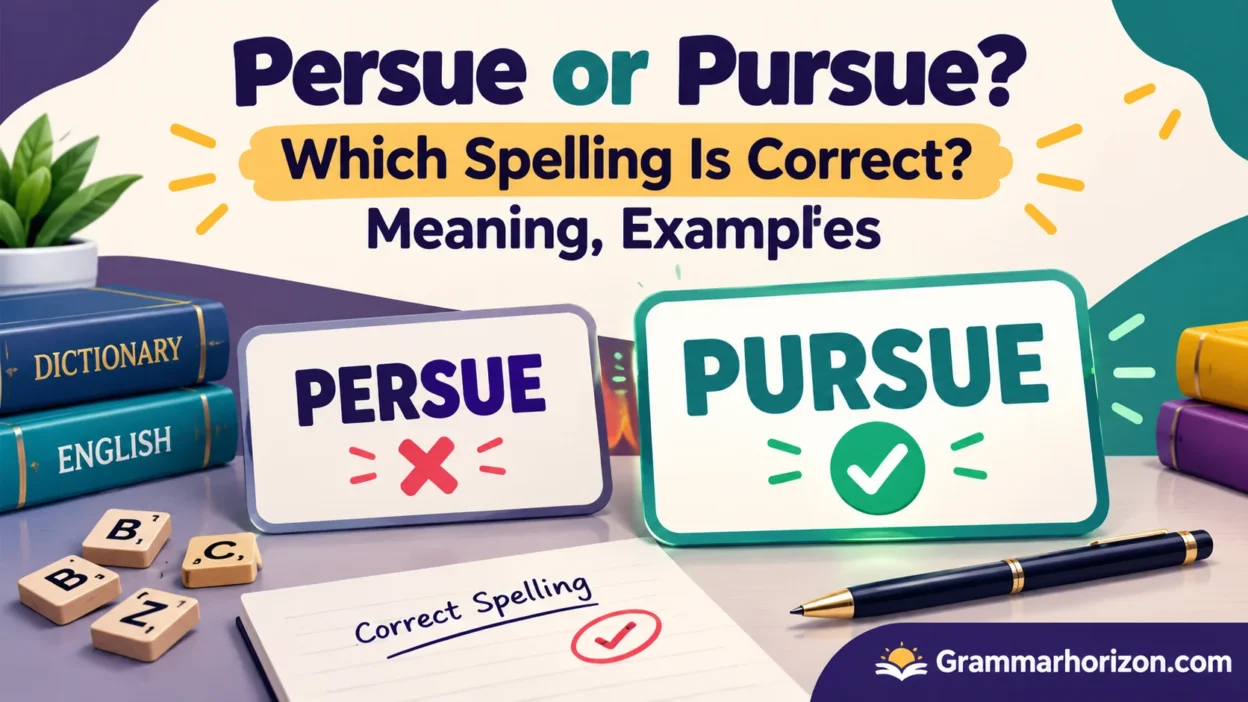
Persue or Pursue is a common English spelling confusion, but pursue is the correct form, while persue is incorrect. People often wonder why Persue and Pursue cause a common mix-up. The difference looks minor because both forms appear similar and have a nearly identical sound in spoken English. However, only pursue is the correct spelling in American English and standard English. The truth is clear: persue is an incorrect spelling, while pursue is the proper and standard form. This spelling mistake can affect clarity and credibility in tweets, emails, essays, blog posts, resumes, job applications, and academic work.
The mistake often arises when learners guess instead of checking actual usage in a dictionary or trusted sources. A school teacher may remind students about this error from time to time, especially when it becomes a noticed habit. Learning to avoid errors matters because a small spelling problem can quietly signal inattention, damage credibility, and influence how readers judge writing in professional settings and educational settings. The word persue is an incorrect spelling, whereas pursue is the correct answer and the proper English word. Thousands of people may search for the correct spelling each month because the two spellings seem almost identical.
Many writers forget the second u, making the incorrect form look convincing for a second. The straightforward rule is that there is only correct spelling for this standard English word: pursue. The misspelling may appear in emails, social media posts, and online discussions, but it isn’t a standard English word. To commonly misspell a word doesn’t change its meaning or meanings; it creates a problem with spelling accuracy. In everyday writing, an essay, professional email, or English exam, confidence and accuracy improve when you know the difference. For language learners, it helps to remember pursue through context, grammar, word meaning, spelling rules, and memory techniques. When you write accurately and confidently, you can use pursue naturally in everyday English and professional English, while careful checking supports better writing quality, professional writing, educational writing, professional communication, and academic writing.
Quick Answer
If you’re looking for a quick answer, here it is.
- Pursue is the correct spelling.
- Persue is incorrect and should never be used in standard English.
- The verb pursue means to follow, continue, work toward, seek, or try to achieve something.
Correct Examples
- She decided to pursue a career in medicine.
- They continue to pursue new opportunities.
- Never stop pursuing your dreams.
- The detectives pursued every lead.
Incorrect Example
- She wants to persue her goals.
The sentence above contains a spelling mistake. The correct spelling is pursue.
Comparison Overview
| Feature | Pursue | Persue |
| Correct spelling | ✔ Yes | ✘ No |
| Recognized English word | ✔ Yes | ✘ No |
| Found in dictionaries | ✔ Yes | ✘ No |
| Appropriate for academic writing | ✔ Yes | ✘ No |
| Appropriate for business writing | ✔ Yes | ✘ No |
| Accepted in exams | ✔ Yes | ✘ No |
| Means to follow or achieve something | ✔ Yes | ✘ Not a word |
Quick Summary
Whenever you’re deciding between persue and pursue, always choose pursue. It is the only spelling accepted in modern English. Using persue can make your writing appear careless, especially in professional or academic settings.
Main Differences Between Persue and Pursue
At first glance, persue and pursue look almost identical. Only one letter separates them. Despite this small difference, one is a valid English word while the other is simply a common spelling mistake.
Understanding the distinction helps you avoid an error that many people make repeatedly.
| Difference | Pursue | Persue |
| Standard English word | ✔ | ✘ |
| Listed in dictionaries | ✔ | ✘ |
| Accepted in formal writing | ✔ | ✘ |
| Used in books and newspapers | ✔ | ✘ |
| Correct for exams and assignments | ✔ | ✘ |
| Professional spelling | ✔ | ✘ |
Pursue Is the Correct Spelling
The word pursue is an English verb that has been used for centuries. It comes from Old French and ultimately traces back to Latin, where it carried the idea of following, continuing, or pressing forward.
Today, the word appears in almost every type of writing, including:
- Academic papers
- Business reports
- Books
- Newspapers
- Legal documents
- Everyday conversations
You’ll also hear it in speeches, podcasts, interviews, and television programs because it’s a common part of modern English vocabulary.
Persue Is a Misspelling
The spelling persue isn’t recognized as a standard English word.
It doesn’t have its own meaning. Instead, it results from people accidentally leaving out the second u in pursue.
Because the mistake is so common, many spell-check tools automatically suggest changing persue to pursue.
Even though readers may understand what you intended, using the wrong spelling can weaken your credibility. That’s especially true in resumes, cover letters, professional emails, research papers, and school assignments.
Is “Persue” Ever a Correct Word?
Many English learners wonder whether persue might be an accepted spelling in another English-speaking country.
The answer is no.
Whether you’re writing American English, British English, Canadian English, Australian English, or any other standard variety of English, pursue is always the correct spelling.
There are no regional exceptions.
Dictionary Status
Every major English dictionary recognizes pursue as the correct spelling.
If you search for persue, you’ll usually find one of two things:
- A suggestion to search for pursue
- A note explaining that persue is a misspelling
This consistency makes it easy to remember. If you’re writing for school, work, or publication, pursue is the only acceptable choice.
Why Do You Still See “Persue” Online?
If persue is incorrect, why does it appear so often on the internet?
The reason is simple.
Millions of people publish content online every day without professional editing. Small spelling mistakes naturally spread across blogs, discussion forums, social media platforms, and comment sections.
Common places where you might see persue include:
- Social media posts
- Online forums
- Text messages
- Informal emails
- Personal blogs
- Draft documents
Search engines also recognize that many users mistakenly type persue, so they often display results related to the correct spelling. This doesn’t make persue a real word. It simply reflects how frequently people misspell pursue.
What Does “Pursue” Mean?
The verb pursue generally means to follow, continue, seek, or work toward something over time.
The exact meaning depends on the situation.
Sometimes it refers to achieving a goal. In other cases, it means physically following someone. It can even describe continuing legal action or conducting research.
Let’s look at the most common uses.
Pursue a Goal or Dream
One of the most common meanings involves working steadily toward a personal objective.
Examples include:
- pursue a dream
- pursue success
- pursue excellence
- pursue happiness
- pursue your ambitions
Example sentences
- She plans to pursue her dream of becoming a pilot.
- They continued to pursue success despite several setbacks.
- Never stop pursuing your goals.
In these examples, pursue suggests determination, patience, and consistent effort rather than immediate success.
Pursue a Career or Education
You’ll often hear pursue in discussions about education and professional development.
People commonly say they want to:
- pursue a degree
- pursue higher education
- pursue a career
- pursue certification
- pursue graduate studies
Example sentences
- He decided to pursue a degree in engineering.
- Many students pursue careers in healthcare.
- She hopes to pursue a master’s degree next year.
Here, the word emphasizes making a deliberate decision to continue learning or developing professionally.
Pursue Knowledge or Personal Interests
Not everything people pursue is related to work or education.
Many people pursue hobbies, creative passions, and lifelong learning.
Examples include:
- pursue photography
- pursue research
- pursue music
- pursue writing
- pursue scientific discovery
Example sentences
- Scientists continue to pursue new medical treatments.
- She enjoys pursuing photography during her travels.
- Researchers pursued several promising theories before reaching a conclusion.
In this context, pursue means dedicating time, energy, and attention to something meaningful.
Pursue Someone or Something
Another common meaning is to physically follow someone or something.
Examples include:
- pursue a suspect
- pursue an animal
- pursue a thief
- pursue a vehicle
Example sentences
- The police pursued the suspect through the city.
- The lion pursued its prey across the grassland.
- Rescue teams pursued every possible lead.
This meaning frequently appears in news reports, crime stories, and action novels.
Pursue Legal Action
The word also has an important legal meaning.
In legal contexts, pursue means to continue a claim or begin formal legal proceedings.
Common phrases include:
- pursue legal action
- pursue compensation
- pursue a lawsuit
- pursue a claim
- pursue an appeal
Example sentence
- The company decided to pursue legal action after the contract was violated.
This usage is common in legal documents, contracts, and business communication.
Conclusion
The correct spelling is pursue, not persue. Although both forms may look and sound similar, persue is an incorrect spelling. Remembering the second u in pursue can help you improve spelling accuracy, writing quality, and confidence in professional and academic writing.
FAQs
Q1. Is Persue a correct English word?
No. Persue is an incorrect spelling. The correct English word is pursue.
Q2. Is Pursue the correct spelling?
Yes. Pursue is the standard and correct spelling in English.
Q3. Why do people spell pursue as persue?
People often make this mistake because the two forms look and sound similar. Writers may also forget the second u.
Q4. What does pursue mean?
Pursue means to follow, seek, or work toward something. For example, you can pursue a goal, pursue a career, or pursue an opportunity.
Q5. Is persue accepted in American English?
No. Persue isn’t a standard spelling in American English. Pursue is the correct form.
Q6. How can I remember the spelling of pursue?
A simple way is to remember that pursue contains two u’s: p-u-r-s-u-e.