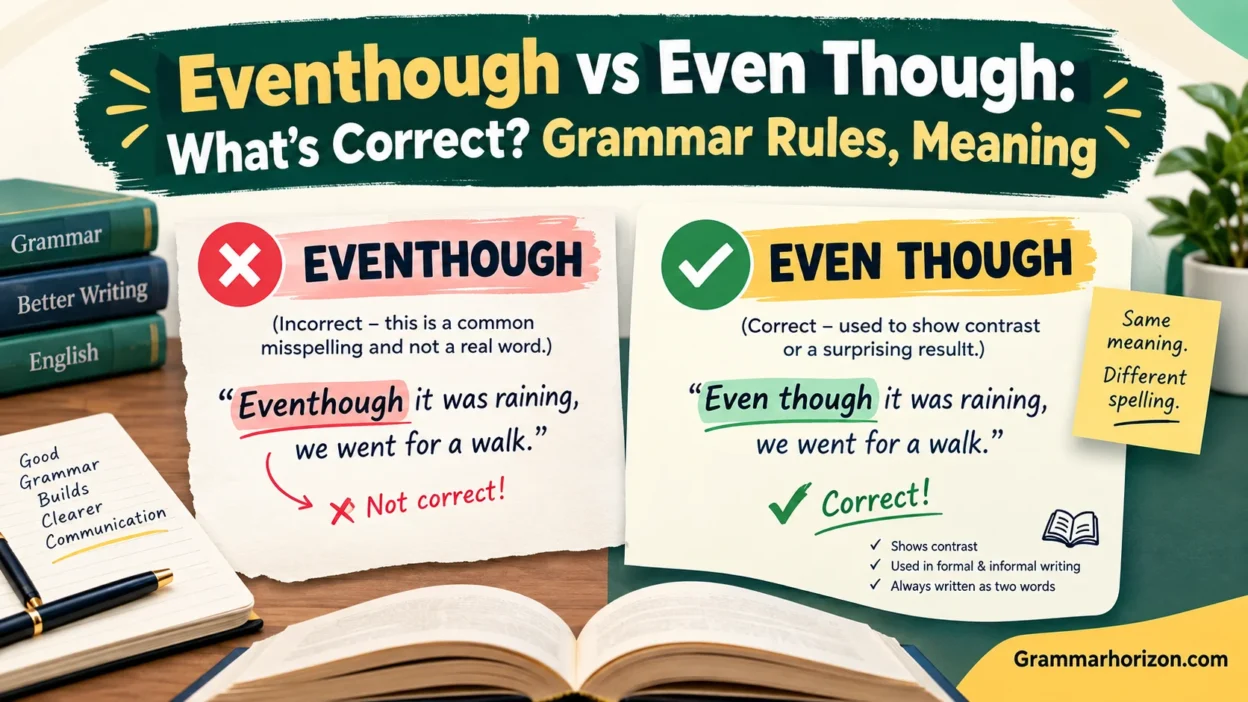
Eventhough vs Even Though is simple once you know the correct spelling and standard English usage. Even though is the correct, grammatical, and grammatically accepted phrase in English, while Eventhough is an incorrect spelling and incorrect form. It isn’t recognised as a standard English word in standard usage. Both forms may sound identical when spoken, which creates confusion in everyday conversation, especially when native speakers pronounce the phrase quickly. However, when you write, always use two words, never one. Even though works as a conjunction showing contrast, similar to although, though, and, in certain contexts, even if.
The spelling questions usually come from the way the two forms sound in spoken English. A writer may accidentally type the wrong version, creating a common mistake in English writing. You might notice this misspelling in an essay, email, report, social media post, or other content, but seeing it doesn’t make it a correct spelling. The correct form uses separate words: even though. A useful memory trick is to treat even though as a fixed pair instead of a single word. This helps you avoid the misspelling, use the phrase correctly, and understand its context. Once learners connect the meaning with grammar and spelling, the distinction becomes much easier to remember.
The difference also matters for grammar, correctness, recognition, semantics, syntax, and vocabulary. Writers should recognize the incorrect form, learn the correct form, and check their usage before creating articles, emails, reports, or posts. Practical examples, grammar tips, and memory tricks can make this rule easier during English language learning. The important point is that words, phrases, and sentences should match their intended meaning and grammatical role. The Quick takeaway is clear: write even though as two words, never one, and use the correct phrase with confidence instead of continuing to hesitate.
Quick Answer
Here’s the short answer if you’re looking for a quick solution.
- Even though is correct.
- Eventhough is incorrect.
- Even though is a subordinating conjunction that introduces a contrast between two ideas.
- Eventhough is simply a spelling mistake caused by combining two separate words.
Examples
| Correct | Incorrect |
| Even though it was raining, we went hiking. | Eventhough it was raining, we went hiking. |
| She smiled even though she felt nervous. | She smiled eventhough she felt nervous. |
| Even though the test was difficult, everyone finished on time. | Eventhough the test was difficult, everyone finished on time. |
Remember: Even though is always written as two words.
Comparison Overview
The difference between eventhough and even though is straightforward once you compare them side by side.
| Feature | Even Though | Eventhough |
| Correct spelling | ✔ Yes | ✘ No |
| Standard English | ✔ Yes | ✘ No |
| Listed in dictionaries | ✔ Yes | ✘ No |
| Used in academic writing | ✔ Yes | ✘ No |
| Accepted in business writing | ✔ Yes | ✘ No |
| Part of speech | Subordinating conjunction | Not a word |
| Meaning | Shows contrast | No meaning |
Although the only visible difference is a space, that space matters. English grammar recognizes even though as a fixed expression made up of two separate words. Removing the space creates a spelling error rather than a new word.
Main Differences Between Eventhough vs Even Though
At first glance, eventhough and even though seem almost identical. However, they aren’t interchangeable. Only one belongs in standard English.
Here’s a closer comparison.
| Even Though | Eventhough |
| Two separate words | One combined word |
| Grammatically correct | Grammatically incorrect |
| Used by professional writers | Considered a typo |
| Found in dictionaries | Not recognized |
| Appropriate in all writing | Should never be used |
Even Though Has a Clear Meaning
Even though introduces a fact that contrasts with another fact.
For example:
- Even though she practiced every day, she didn’t win the competition.
- Even though the road was busy, traffic moved smoothly.
- Even though they disagreed, they remained good friends.
In each example, the second part of the sentence is unexpected based on the first part.
Eventhough Has No Grammatical Function
Unlike even though, eventhough has no accepted meaning in English grammar. It isn’t a conjunction, an adverb, or a compound word. Editors, teachers, and grammar checkers treat it as a spelling error.
Why This Difference Matters
Using the correct spelling does more than improve grammar.
It also helps you:
- Build credibility with readers.
- Avoid losing marks in school assignments.
- Write professionally in business settings.
- Improve readability.
- Present polished, error-free writing.
A small spelling mistake can make readers question the quality of the rest of your work.
Eventhough vs Even Though: Which One Is Correct?
The answer is simple.
Even though is always correct.
Eventhough is always incorrect.
This rule applies whether you’re writing formally or informally. You’ll find even though in books, newspapers, academic journals, business reports, and professional websites. You’ll never find eventhough in carefully edited writing.
Is “Eventhough” Ever Correct?
No.
There are no situations where eventhough is considered correct in standard English.
Sometimes people assume it might be an acceptable alternative spelling because English contains many compound words. However, this isn’t one of them.
Why Isn’t It One Word?
English has many words that evolved from separate words into compounds, such as:
- Nowadays
- Nonetheless
- Everywhere
- Everyone
- Therefore
However, not every commonly used phrase follows that pattern.
Some expressions remain separate forever. Even though is one of them.
What Does “Even Though” Mean?
Understanding the meaning makes it much easier to use the phrase correctly.
Even though means despite the fact that or although. It introduces information that contrasts with the result in the main clause.
Simple Definition
Even though is used to show that something happened despite another fact.
Think of it as saying:
- Despite the fact that…
- Although…
- In spite of the fact that…
Examples
- Even though it was cold, we went swimming.
- Even though the project was difficult, the team completed it early.
- Even though she was nervous, she gave an excellent presentation.
Each sentence contains two ideas that don’t seem to fit together at first. That’s exactly why even though is useful.
What Does It Do in a Sentence?
Grammatically, even though introduces a dependent clause.
That clause cannot stand on its own. It needs an independent clause to complete the thought.
For example:
Even though the weather was terrible, the football match continued.
The first clause depends on the second to form a complete sentence.
Why Writers Use It
Writers often choose even though because it creates a stronger sense of contrast than many other conjunctions.
Compare these two sentences.
- Although the restaurant was crowded, we found a table.
- Even though the restaurant was crowded, we found a table.
Both are correct. However, even though places slightly more emphasis on the surprising result.
Why “Eventhough” Is Incorrect
Many people assume eventhough is simply another accepted spelling. It isn’t.
Instead, it’s a spelling error created by combining two separate words into one.
It’s a Spelling Mistake, Not a Grammar Rule
English grammar recognizes even though as a fixed phrase.
When you remove the space, you create a word that doesn’t exist.
This isn’t similar to spelling differences like color and colour, where both versions are accepted in different varieties of English.
Even eventhough, there is no accepted variation.
Dictionaries Don’t Recognize It
Modern dictionaries only include words that are accepted in standard English.
Since professional writers consistently use even though, dictionaries don’t list even though as an alternative spelling.
Why Spell Check Doesn’t Always Catch It
Many people trust spell check completely, but it’s not perfect.
Some writing tools focus more on grammar than spelling. Others rely on context, which means unusual errors can sometimes slip through.
That’s why proofreading remains important, especially when writing academic or professional documents.
Why People Still Write “Eventhough”
If eventhough is wrong, why do so many people write it?
Several factors contribute to the confusion.
Fast Pronunciation
When native speakers say even though, the words often blend together.
Instead of hearing two separate words, learners hear something that sounds like even though.
This natural feature of spoken English causes many spelling mistakes.
Typing Too Quickly
People often skip spaces when typing fast.
This happens with many expressions, including:
- Alot
- Atleast
- Infact
- Eachother
These forms are common mistakes, just like even though.
Confusion With Compound Words
English contains thousands of compound words.
Examples include:
- Nevertheless
- However
- Therefore
- Nowadays
- Everywhere
Because these words exist, many learners naturally assume eventhough should also be one word.
Unfortunately, English spelling doesn’t always follow predictable patterns.
Mobile Phones and Autocorrect
Autocorrect can be helpful, but it isn’t perfect.
Some keyboards fail to flag uncommon spelling errors immediately. Others may even learn incorrect spellings based on repeated typing.
That’s another reason to proofread important writing before submitting or publishing it.
Conclusion
Even though is the correct form, while Eventhough is an incorrect spelling. Because the phrase can sound like one word in everyday speech, it’s easy to make this common mistake. Remember to always write even though as two separate words when you want to show contrast.
FAQs
Q1.Is “Eventhough” a correct word?
No. Eventhough is an incorrect spelling. The correct form is even though, written as two words.
Q2.What does “even though” mean?
Even though is a conjunction used to show contrast between two ideas or situations.
Q3.Is “even though” one word or two?
Even though is always written as two words. Writing it as eventhough is incorrect in standard English.
Q4.Why do people write “eventhough”?
People often write eventhough because even though can sound like one word when native speakers pronounce it quickly.
Q5.Can I use “even though” in formal writing?
Yes. Even though is completely acceptable in formal and informal English writing, including essays, emails, reports, and articles.
Q6.Is “even though” the same as “although”?
They can have similar meanings because both can introduce contrast. However, they aren’t always interchangeable in every sentence.
Q7.How can I remember the correct spelling?
Use a simple memory trick: remember that even though is a fixed two-word phrase. Never combine the words into eventhough.