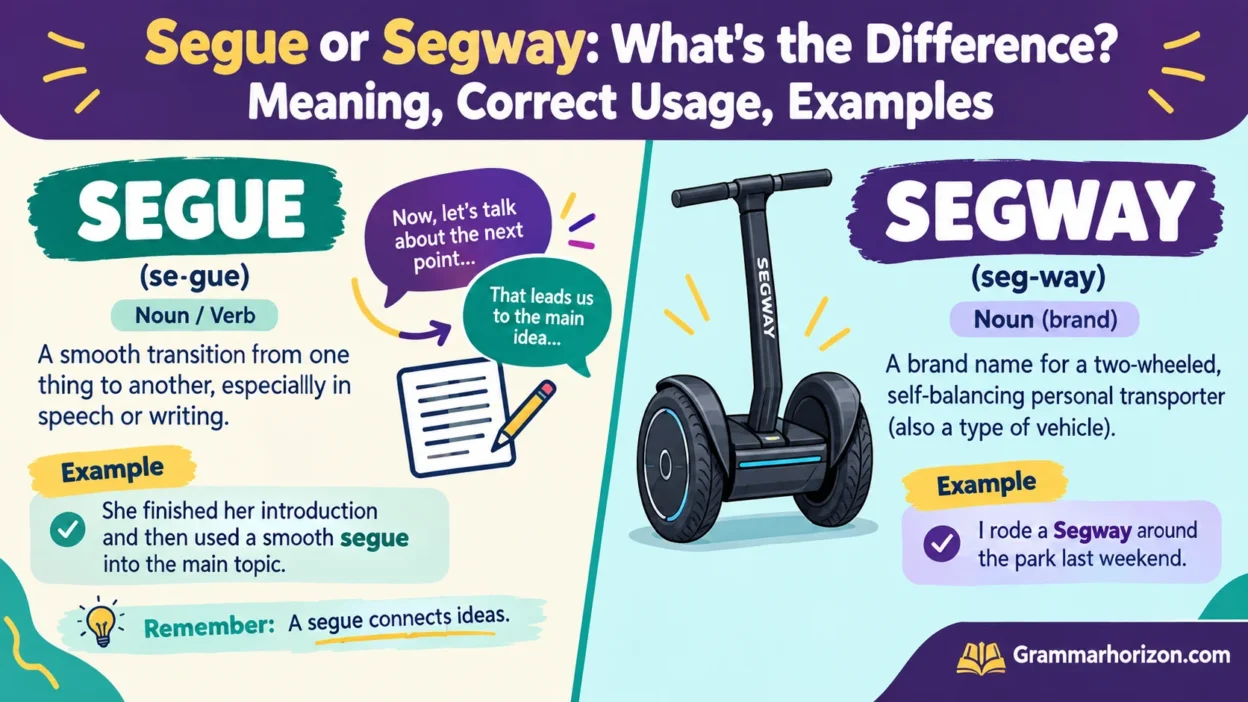
Segue or Segway can confuse readers because both words sound exactly alike when pronounced, but their different spellings have different meanings. In English grammar and writing, segue means to move smoothly from one topic, idea, or transition to another, especially when talking or giving a presentation. You might say, “Let’s segue into our next topic” when moving naturally between ideas. This word choice can mix up even skilled writers, editors, students, and professionals, so choosing the correct word helps make polished writing clearer and avoids confusion.
Segway, in contrast, is a brand name for a two-wheeled personal transporter and self-balancing personal vehicle. You use Segway when referring to the brand, its vehicle, or learning to ride one, rather than describing a change from one topic to the next topic. For example, “She learned to ride a Segway at the park.” The difference becomes easier to remember when you connect each word with its contextually appropriate meaning. Segue is linked with linguistics, writing, publishing, transition, and word choice, while Segway refers to a brand, technology, and personal transporter.
When writers, editors, students, and professionals confuse these terms, otherwise correct writing may appear incorrect or unprofessional. A simple guide is to choose segue when you want to move smoothly from one idea to another, and Segway when discussing the brand or personal transporter. Their same pronunciation doesn’t make them interchangeable because their different spellings, meaning, and distinct use determine which word belongs in a sentence. Practical examples can help you recognize the difference quickly, whether you’re talking, writing a business email, preparing a presentation, or moving from one topic to another.
Quick Answer
Use segue when you’re talking about moving smoothly from one topic, idea, conversation, or activity to another.
Use Segway only when you’re referring to the self-balancing personal transporter or the company that makes it.
Here’s the easiest way to remember the difference:
- Segue = a smooth transition.
- Segway = a two-wheeled electric vehicle.
Quick Examples
Correct
- Let’s segue into our next topic.
- Her introduction provided a smooth segue to the conclusion.
- We rented Segways during our vacation.
Incorrect
- Let’s segway into today’s discussion.
- His presentation segwayed perfectly into the next section.
Comparison Overview
The table below highlights the key differences between segue and Segway.
| Feature | Segue | Segway |
| Meaning | A smooth transition between ideas or topics | A brand of self-balancing personal transporters |
| Part of Speech | Verb and noun | Proper noun |
| Used in grammar | Yes | No |
| Used in professional writing | Frequently | Only when discussing the brand |
| Pronunciation | SEG-way | SEG-way |
| Capitalization | Usually lowercase | Always capitalized |
| Example | Let’s segue into the next section. | We toured the city on a Segway. |
Key Takeaway
Although the words sound identical, they have completely different meanings. Segue is a standard English word. Segway is a brand name. They are never interchangeable.
Main Differences Between Segue and Segway
At first glance, these words appear nearly identical. Once you understand what each one represents, however, the difference becomes easy to remember.
Segue Means a Smooth Transition
A segue connects one idea to another without creating an abrupt break. Writers, speakers, teachers, journalists, and presenters use segues to keep information flowing naturally.
Examples include:
- The professor segued from history into economics.
- That story is the perfect segue to our next topic.
- She smoothly segued into discussing the new proposal.
Whenever you’re talking about changing topics, introducing a new point, or moving naturally between ideas, segue is the correct choice.
Segway Is a Brand Name
Segway refers to the well-known self-balancing electric personal transporter.
Examples include:
- We explored the city on Segways.
- The company offers guided Segway tours.
- He bought a used Segway for commuting around town.
Outside discussions about the vehicle or the company, Segway has no grammatical meaning.
They Sound Exactly the Same
One reason people confuse these words is that they’re perfect homophones.
Both are pronounced:
SEG-way
Because English contains many words that share the same pronunciation but have different meanings, relying on sound alone often leads to spelling mistakes.
One Is a Dictionary Word While the Other Is a Trademark
Another important distinction is their purpose.
Segue appears in dictionaries as both a verb and a noun.
Segway is a trademarked brand name.
That means writing “Let’s segway into another topic” is the same as replacing a regular English verb with a company name.
What Does “Segue” Mean?
The word segue means to move smoothly from one thing to another without interruption.
Most often, it describes transitions between:
- Topics
- Ideas
- Paragraphs
- Conversations
- Presentations
- Songs
- Arguments
- Events
Rather than making an abrupt jump, a segue creates a natural bridge that helps readers or listeners follow your thoughts.
Dictionary Meaning
As a verb, segue means to transition smoothly from one subject or activity to another.
As a noun, it refers to the transition itself.
While both forms are correct, the verb appears more frequently in modern English.
The Origin of the Word
Segue comes from Italian, where the word literally means “it follows.”
Musicians originally used the term to indicate that one musical passage should continue directly into the next without stopping.
English later adopted the word, gradually expanding its meaning beyond music. Today, it describes smooth transitions in writing, speaking, broadcasting, education, and everyday conversation.
From Musical Instruction to Everyday English
The journey of segue into everyday language is an interesting example of how words evolve.
In music, performers used segue to continue seamlessly from one movement into another. There was no pause, no interruption, and no break in rhythm.
Writers and speakers eventually borrowed the concept.
Instead of stopping suddenly before introducing a new subject, they began creating smooth transitions that connected ideas naturally. The word segue became the perfect description for that technique.
Today, millions of people use it without realizing it originally belonged to the language of music.
Segue as a Verb
The verb form is by far the most common.
Examples include:
- Let’s segue into our next lesson.
- She segued effortlessly into another discussion.
- The host segued from sports to politics.
- He segues naturally between different topics.
These examples all describe the act of transitioning smoothly.
Segue as a Noun
Although less common, segue also functions as a noun.
For example:
- That joke was the perfect segue.
- The documentary included a smooth segue between interviews.
- His question provided a natural segue to the next section.
In these sentences, segue refers to the transition itself rather than the action.
Why Writers Use Segues
Strong writing depends on clear organization.
Imagine reading an article that jumps from one subject to another without explanation. The information would feel disconnected and confusing.
A good segue creates a logical path.
Instead of forcing readers to connect unrelated ideas themselves, the writer guides them from one point to the next.
For example:
Without a segue
The company expanded internationally. Employee training also increased.
These ideas seem unrelated.
With a segue
The company’s international expansion created new challenges. As a result, employee training increased significantly.
The relationship becomes much clearer.
Good transitions improve readability, strengthen arguments, and keep readers engaged.
Common Places You’ll See “Segue”
You’ll encounter this word across many forms of communication.
In Academic Writing
Students use segues to connect paragraphs and develop stronger arguments.
Example:
- The evidence presented above naturally segues into the next section.
In Public Speaking
Professional speakers rely on smooth transitions to maintain audience attention.
Example:
- That brings us to our next point.
Although the sentence doesn’t include the word segue, it performs exactly the same function.
In Journalism
News reporters frequently transition between related developments without interrupting the flow of information.
Example:
- Those economic figures raise another important question. Let’s segue into employment trends.
In Podcasts
Podcast hosts often introduce new segments by saying:
- Let’s segue into…
- Speaking of that…
- On a related note…
- That brings us to…
Each phrase helps listeners follow the conversation naturally.
In Business Meetings
Professionals regularly use segues when moving between agenda items.
For example:
- Now that we’ve reviewed last quarter’s performance, let’s segue into next year’s strategy.
Smooth transitions make meetings feel organized and professional.
Examples of Correct Usage
Here are several examples showing segue used correctly in different situations.
- Let’s segue into today’s main discussion.
- The speaker segued from marketing to customer service.
- Her story served as a perfect segue to the lesson.
- The article includes a smooth segue between each section.
- The interviewer segued into more difficult questions.
- His opening remarks created a natural segue to the keynote presentation.
- The documentary segued from historical footage to modern interviews without feeling abrupt.
In every example, segue refers to a transition between ideas rather than a vehicle, making it the correct choice.
Conclusion
Segue and Segway sound alike, but they have completely different meanings and uses. Segue describes a smooth transition from one idea or topic to another, while Segway refers to a brand of two-wheeled personal transporters. Remembering this simple difference will help you choose the correct spelling and avoid confusion in your writing.
FAQs
Q1. Is segue or Segway correct?
Both are correct, but they have different meanings. Segue means to move smoothly from one topic to another, while Segway is a brand name for a personal transporter.
Q2. What does segue mean?
Segue means to transition smoothly from one subject, idea, or topic to another.
Q3. What does Segway mean?
Segway is a brand name associated with self-balancing, two-wheeled personal transportation devices.
Q4. Are segue and Segway pronounced the same?
Yes. Segue and Segway are generally pronounced the same, which is why they can be confusing.
Q5. How do you use segue in a sentence?
You can say, “Let’s segue into our next topic,” when you want to move naturally from one subject to another.
Q6. How do you use Segway in a sentence?
You could say, “She learned to ride a Segway at the park,” when referring to the personal transporter.