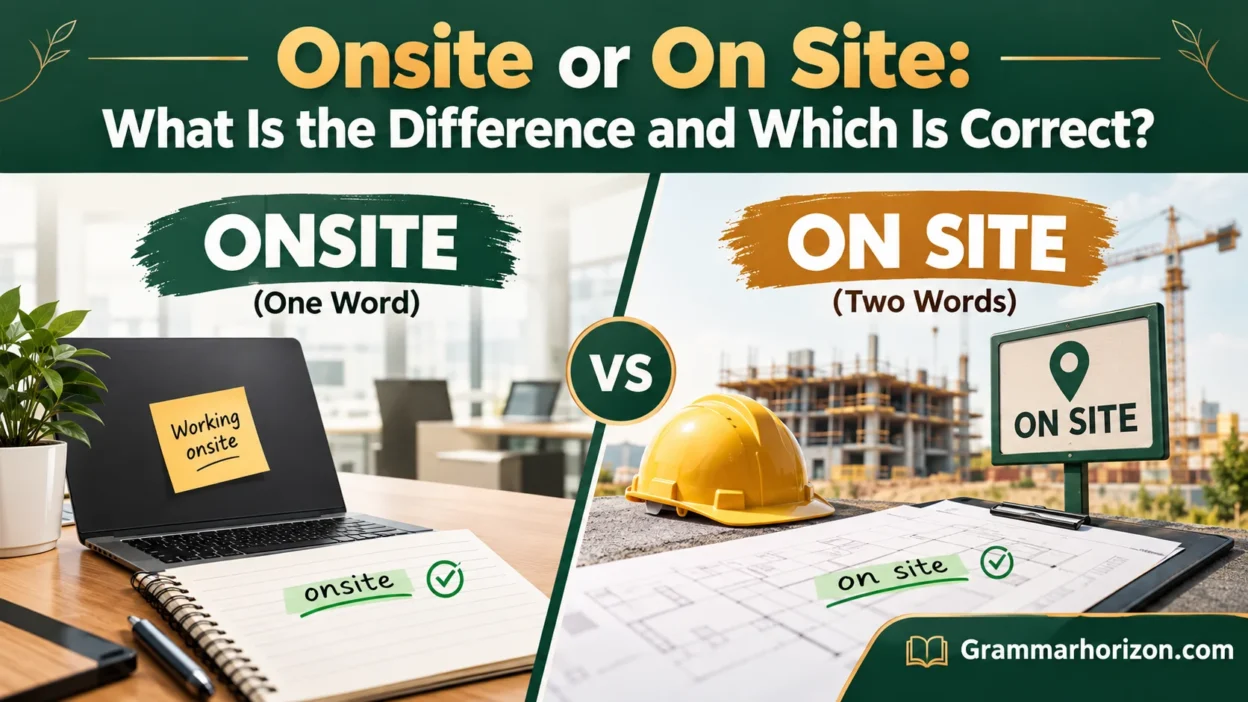
Onsite or On Site helps writers choose the right form by improving grammar, clarity, and professionalism in workplace and online writing contexts. The terms onsite, on site, and on-site look nearly identical, but they are not always used in the same way. Their spelling difference affects grammar, clarity, and professionalism in writing for work, school, and online content. Proper understanding of their use helps you communicate more accurately and select the correct form for each expression and sentence in English.
The difference between these compound expressions, separate words, and single words shows the evolution of language. For example, onsite is commonly used in workplace communication, job descriptions, construction documents, IT services, healthcare, education, and business writing. Many writers become inconsistent because the recognizable grammatical role creates confusion, but each form has a clear distinction. These words can describe a location, someone, something, service, facility, employee, activity, or resource associated with a particular location. This descriptive function is common in edited writing and formal writing.
Choosing between the three forms becomes easier when you understand their purpose and usage. One example is how all three forms may appear in a workplace, communication, jobs, descriptions, construction, and documents related to information technology, services, health care, learning, and business. The grammar role determines whether the word works as descriptive, formal, or edited language connected to a particular situation. Understanding onsite or on site through content, contextually and semantically related meanings, along with NLP, related entities, helps readers use these words correctly.
Quick Answer: Onsite or On Site?
Both onsite and on site can be correct. The choice depends mainly on how the expression functions in the sentence.
Use on site when you’re talking about a physical location or someone’s presence at that location.
- The technician is on site.
- The manager arrived on site at 8 a.m.
- Several engineers are working on site today.
Use onsite when it functions as a compound adjective describing something provided, located, or performed at a particular location.
- The company offers onsite training.
- We provide onsite technical support.
- The hospital has onsite parking.
You may also see on-site in the same adjective role:
- The company offers on-site training.
- We provide on-site technical support.
- The hospital has on-site parking.
The hyphenated form is especially useful when the expression appears directly before a noun and functions as a compound modifier.
| Form | Typical function | Example |
| on site | Location phrase | The technician is on site. |
| onsite | Compound adjective | We provide onsite support. |
| on-site | Hyphenated compound adjective | We provide on-site support. |
So, if you’re wondering whether onsite or on site is correct, don’t treat the question as a simple spelling contest. Grammar and sentence position matter.
Comparison Overview
The distinction becomes clearer when you compare the forms side by side.
On Site
On site consists of two separate words. It commonly works as a phrase that tells you where an action occurs or where someone is located.
The supervisor is on site.
Here, on site answers the question Where is the supervisor?
That makes the location’s meaning obvious.
Onsite
Onsite is a closed compound commonly used as an adjective in modern American business and workplace English.
The company provides onsite training.
Here, onsite describes the type of training. It tells you that the training takes place at the relevant physical location rather than somewhere else.
On-Site
On-site is the hyphenated form. It commonly works as a compound modifier before a noun.
The company provides on-site training.
In this sentence, on-site modifies training. The hyphen connects the words so readers immediately recognize them as one descriptive unit.
The important point is that onsite and on-site usually carry the same basic meaning when they function as adjectives. The difference is primarily spelling and style preference.
Main Differences Between Onsite, On Site, and On-Site
The main difference between onsite or on site comes down to grammatical function, position, and modern usage.
Difference in Grammatical Function
Consider these two sentences:
- The technician is on site.
- The company provides onsite support.
In the first sentence, on site identifies a location.
In the second, onsite describes support.
That distinction provides a useful shortcut:
Location → on site
Description → onsite or on-site
This isn’t an absolute rule for every possible sentence because English usage evolves. Still, it works remarkably well for everyday writing.
Difference in Sentence Position
Compound adjectives often appear directly before nouns.
For example:
- onsite staff
- onsite services
- onsite training
- onsite facilities
- on-site inspection
- on-site repairs
By contrast, location phrases commonly appear after a verb.
- The staff are on site.
- The inspector arrived on site.
- The workers remained on site.
Compare the pairs:
| Location | Description |
| The doctor is on site. | The clinic has an onsite doctor. |
| The technician is on site. | We have onsite technicians. |
| The manager arrived on site. | The company offers onsite management. |
| The team works on site. | The company provides onsite services. |
This pattern isn’t merely a spelling trick. It reflects how the expression functions within the sentence.
Difference Between Onsite and On-Site
The difference between onsite and on-site is much smaller.
Both can function as compound adjectives:
- onsite training
- on-site training
- onsite support
- on-site support
- onsite inspection
- on-site inspection
The choice often depends on the dictionary, publication, organization, or style guide being followed.
For general American business writing, onsite is increasingly familiar and natural. However, on-site remains a well-established form and can be a useful choice when you want the compound relationship to be visually explicit.
What Does On Site Mean?
On site means at the location where a particular activity is taking place.
The phrase often appears in situations involving construction projects, workplaces, events, repairs, inspections, medical facilities, and other physical locations.
For example:
- The architect is on site.
- The crew arrived on site early.
- Security personnel remained on site overnight.
- The inspector will be on site tomorrow.
In each case, on site tells the reader where someone is.
On Site in Construction
Construction provides some of the clearest examples.
The project manager is on site to inspect the foundation.
The phrase doesn’t describe the manager as a type of manager. Instead, it tells you that the manager is physically present at the construction location.
You might also write:
Several contractors are currently on site.
Again, the expression answers the question Where are they?
On Site in IT
IT companies frequently distinguish between remote and physical support.
The technician is on site and should finish the repair shortly.
Here, on site means the technician has physically traveled to the customer’s location.
That’s different from:
The company provides onsite technical support.
In the second sentence, onsite describes the kind of support being offered.
What Does Onsite Mean?
Onsite generally means located, provided, or performed at a particular physical location.
It frequently appears in professional and commercial language.
Common combinations include:
- onsite support
- onsite training
- onsite services
- onsite staff
- onsite employees
- onsite consultation
- onsite maintenance
- onsite parking
- onsite facilities
- onsite childcare
For example:
Employees receive onsite training during their first week.
The word onsite modifies training. It tells you where the training occurs.
Onsite Services
Businesses often use onsite when explaining where a service takes place.
For example:
The company offers onsite equipment repairs.
The sentence doesn’t say that the company itself is physically present at a location at that moment. Instead, onsite describes the nature of the repair service.
Onsite Employees
You may also encounter the expression in discussions about workplace arrangements.
The company has both remote and onsite employees.
Here, onsite contrasts with remote. The distinction tells readers that some employees work physically at the workplace.
This usage has become particularly common as organizations distinguish between remote, hybrid, and onsite work.
Why Does the Confusion Between Onsite and On Site Happen?
The confusion exists partly because English compound words don’t always follow a fixed path.
Some expressions begin as separate words. Over time, frequent use can turn them into hyphenated compounds and eventually closed compounds.
English contains many examples of this kind of development:
- web site → website
- on line → online
- e mail → email
The same general language process helps explain why onsite appears so frequently today.
Workplace English Accelerated the Change
Modern professional language uses onsite constantly.
Job advertisements might mention:
- onsite positions
- onsite interviews
- onsite employees
- onsite work
- onsite training
Service companies might advertise:
- onsite repairs
- onsite consultations
- onsite installation
As these combinations became routine, the closed spelling became increasingly familiar.
Different Style Preferences Add to the Confusion
Not every publication or organization uses the same editorial preferences.
One company might write:
We offer onsite support.
Another might write:
We offer on-site support.
Neither sentence creates a meaningful difference in the underlying service.
The best approach is to choose a style and remain consistent throughout the document.
Onsite vs On Site: Grammar Guide
A practical grammar guide can make the distinction almost automatic.
How On Site Is Used in Sentences
Use on site when the expression functions as a location phrase.
Common sentence patterns include:
Subject + verb + on site
- The engineer is on site.
- The doctor is on site.
- The workers remained on site.
Subject + verb + on site + time expression
- The inspector will be on site tomorrow.
- The technician was on site all afternoon.
These sentences focus on physical presence.
How Onsite Is Used in Sentences
Use onsite when it describes a noun.
Examples:
- onsite training
- onsite assistance
- onsite staff
- onsite storage
- onsite services
The structure is usually:
onsite + noun
For example:
We provide onsite support.
The word onsite modifies support.
Common Mistakes With Onsite and On Site
One common mistake is treating the two forms as completely interchangeable in every sentence.
For example, a traditional and especially clear choice is:
The technician is on site.
Then:
We offer onsite repairs.
Another mistake involves dropping the hyphen when a writer’s chosen style requires it.
If a publication uses on-site consistently, then write:
on-site training
rather than switching randomly between:
onsite training
and:
on-site training
Consistency makes professional writing look deliberate rather than accidental.
Simple Rules to Remember
Here are three practical rules that cover most everyday situations.
Rule One: Use On Site for Location
Ask yourself:
Where is the person or thing?
If the answer involves the location, use on site.
- The manager is on site.
- The crew arrived on site.
- The doctor will be on site tomorrow.
Rule Two: Use Onsite or On-Site Before a Noun
Ask:
What type of service, employee, facility, or activity is it?
If you’re describing a noun, use onsite or on-site.
- onsite training
- onsite support
- onsite staff
- on-site inspection
- on-site maintenance
Rule Three: Follow the Style Used by Your Organization
If your employer consistently uses on-site, don’t change every document to onsite simply because you prefer the shorter spelling.
Professional writing rewards consistency.
When to Use Onsite
Onsite works particularly well in modern American workplace and business writing.
Use it when describing:
Onsite Training
- The company provides onsite training.
- New employees receive onsite safety training.
Onsite Support
- Customers can request onsite technical support.
- The contract includes onsite maintenance.
Onsite Facilities
- The building has onsite parking.
- Employees have access to onsite dining.
Onsite Employees
- The company employs both remote and onsite workers.
- Onsite employees must follow the building’s access policy.
These examples all use onsite as a descriptive modifier.
When to Use On Site
Use on site when you’re talking about physical presence.
Describing Where Someone Is
- The supervisor is on site.
- The technician is already on site.
- The engineers are working on site.
Describing Where an Action Happens
- The inspection will take place on site.
- Repairs are completed on site.
- The equipment was tested on site.
Giving Instructions
- Please report to the supervisor on site.
- Visitors must sign in when they arrive on site.
- Staff should remain on site until the inspection ends.
Here, on site has a clear locational meaning.
When Not to Use Onsite or On Site
Sometimes neither form is the right choice.
Don’t Use Onsite When You Mean Online
Onsite and online aren’t interchangeable.
Compare:
The company held an online meeting.
The meeting occurred through the internet.
The company held an onsite meeting.
The meeting occurred at a physical location.
That single prefix changes the meaning completely.
Don’t Use On Site When You Mean At the Site
The phrases at the site and on site can overlap, but they aren’t always interchangeable.
Compare:
The workers arrived at the site.
This emphasizes their arrival at a particular site.
The workers are on site.
This emphasizes their current physical presence there.
The distinction is subtle, but context determines which expression sounds more natural.
Onsite or On Site: Decision Guide
When you’re stuck, use this quick process.
Ask “Where?”
If you’re answering a location question, choose on site.
Where is the technician?
The technician is on site.
Ask “What Kind?”
If you’re describing a service, facility, employee, or activity, choose onsite or on-site.
What kind of support do you provide?
We provide onsite support.
Check What Comes Next
If a noun immediately follows the expression, the compound form usually makes sense.
- onsite training
- onsite support
- onsite staff
- on-site inspection
If the expression stands independently after a verb, on site is often the clearest choice.
- The team is on site.
- The manager arrived on site.
Real-World Examples of Onsite and On Site
Seeing the difference in realistic situations is often more useful than memorizing rules.
Construction Industry
On site:
The project manager is on site to inspect the concrete work.
Onsite:
The contractor provides onsite safety training.
The first sentence identifies where the manager is. The second describes the type of training.
IT Industry
On site:
The technician arrived on site within two hours.
Onsite:
The contract includes onsite technical support.
Again, the distinction is location versus description.
Healthcare
On site:
A physician is on site during regular clinic hours.
Onsite:
The facility provides onsite medical services.
Education
On site:
Students must remain on site until the field trip ends.
Onsite:
The school offers onsite tutoring after classes.
Workplace
On site:
The manager will be on site this afternoon.
Onsite:
The company offers onsite childcare for eligible employees.
Onsite or On Site in American English
American English increasingly uses onsite as a closed compound, particularly in workplace and business contexts.
You’ll frequently encounter phrases such as:
- onsite work
- onsite interview
- onsite support
- onsite training
- onsite services
That doesn’t make on-site wrong. The hyphenated form remains established and perfectly understandable.
For formal documents, the safest choice is often the spelling preferred by the relevant style guide or organization.
If no specific style guide applies, onsite is a natural modern choice when the word functions as an adjective. Use on site when you’re clearly describing location.
Case Study: A Simple Workplace Example
Consider this short paragraph:
The technician is on site today. The company scheduled an onsite inspection for the afternoon. After the inspection, the technician will remain on site to monitor the equipment.
Notice how the spelling changes according to function.
Sentence one:
The technician is on site because the phrase identifies his location.
Sentence two:
The inspection is onsite because the word describes the inspection.
Sentence three:
The technician remains on site because the phrase again describes physical presence.
This is the key to mastering onsite or on site. Don’t memorize the spelling in isolation. Look at what the expression is doing in the sentence.
Comparison Table With Sentence Examples
| Form | Meaning | Example |
| on site | At a particular physical location | The engineer is on site. |
| on site | Physically present during an activity | The doctor will be on site today. |
| onsite | Located or provided at a particular location | We offer onsite support. |
| onsite | Describing workplace arrangements | The position requires onsite work. |
| on-site | Hyphenated compound adjective | The company provides on-site training. |
| on-site | Describing a service or activity | We scheduled an on-site inspection. |
Self-Assessment: Onsite or On Site?
Fill in each blank with on site, onsite, or on-site.
- The technician is currently ___.
- The company provides ___ training.
- The inspector arrived ___ early.
- We offer ___ technical support.
- The manager will be ___ tomorrow.
- The hospital provides ___ medical services.
- Employees must remain ___ until the work is complete.
- The contractor scheduled an ___ inspection.
Answers
- The technician is currently on site.
- The company provides onsite training.
- The inspector arrived on site early.
- We offer onsite technical support.
- The manager will be on site tomorrow.
- The hospital provides onsite medical services.
- Employees must remain on site until the work is complete.
- The contractor scheduled an onsite inspection.
For number eight, on-site inspection is also acceptable if that is the spelling used by your chosen style guide.
Conclusion
Understanding Onsite or On Site is important because a small spelling choice can change the accuracy and professionalism of your writing. While onsite, on site, and on-site may appear similar, each form has a different grammatical role. When you understand their roles, you can write clearer business writing, workplace communication, and professional documents without confusion. The key is not only knowing the spelling but also recognizing the context where each form fits naturally.
FAQs
Q1. What is the difference between onsite and on site?
Onsite is usually used as an adjective to describe something located at a specific location, such as an onsite employee or onsite training. On site is generally used as a phrase referring to being physically present at a particular location, such as “the technician arrived on site.”
Q2. Is onsite one word or two words?
Both onsite and on site are used in English, but their usage depends on the sentence and expression. Modern professional writing often uses onsite as a single word, especially in areas like business, IT services, and job descriptions.
Q3. Is on-site still a correct spelling?
Yes, on-site is still a correct form, especially when it works as a compound expression before a noun. For example, “on-site support” clearly describes support provided at a specific location.
Q4. Should I use onsite or on site in formal writing?
In formal writing, choose the form that matches the grammar role. Use onsite when describing a service, employee, activity, or resource connected to a location. Use on site when referring to physical presence at a place.
Q5. Which industries commonly use the word onsite?
Many industries use onsite, including construction, healthcare, education, information technology, and workplace communication. It often appears in job descriptions, services, and professional documents.
Q6. Why do people confuse onsite and on site?
People confuse these terms because they look nearly identical and have similar meanings. The difference is mainly related to grammar, clarity, spelling, and whether the word describes a location or an activity happening at that location.