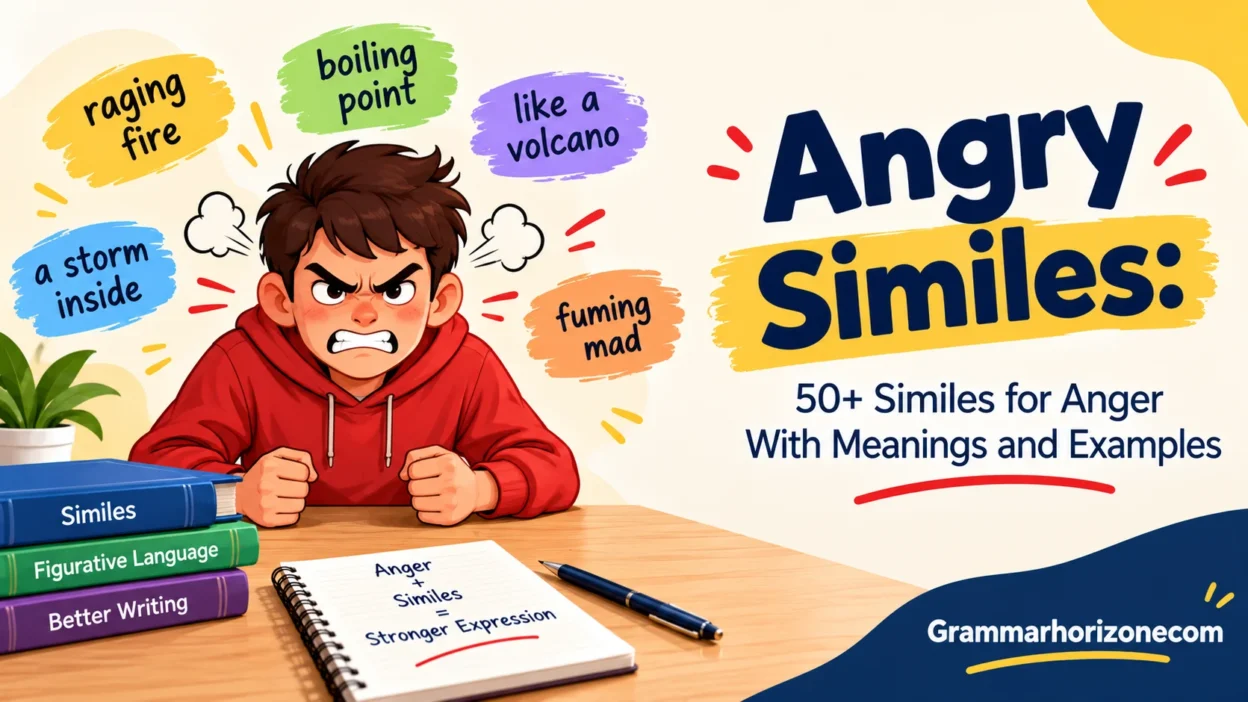
Angry Similes help writers describe anger through vivid comparisons, clear examples, and different levels of emotional intensity. Anger can appear in many forms, from mild irritation to uncontrollable rage. For example, a person may be as angry as a raging bull when someone challenges them, while another person’s frustration may feel like a volcano about to erupt. A sudden fire can describe anger that flares up quickly, whereas a storm gathering in the distance can represent frustration that builds slowly. Comparing an irritated person to a buzzing fly can express annoyance without suggesting extreme anger. These comparisons create vivid imagery and help readers imagine how a person feels.
Using angry similes is a practical writing technique for students, poets, English learners, and experienced writers. These figurative expressions support creative writing, descriptive writing, storytelling, poetry, and school assignments. A carefully selected simile can improve vocabulary, word choice, sentence structure, and expressive language while making descriptions more engaging. For example, instead of simply saying that a character was angry, you could describe their face as red as a burning fire. However, the comparison should fit the context and emotional tone. Avoid clichéd expressions, recycled lists, forced language, and unnecessary drama. Natural comparisons make writing more authentic and help you develop stronger prose.
A practical guide to 47 angry similes can provide useful examples, meanings, and example sentences for everyday conversations and modern writing. Although some collections advertise more than 50 angry similes, the goal is to choose expressions that communicate strong emotions clearly. These literary devices help writers explore anger-related comparisons, improve figurative language, and create powerful descriptions. Whether you are working on English writing, digital content creation, or a creative story, the right simile can strengthen your writing style and improve literary expression. By choosing comparisons carefully, you can make your content more engaging, improve your writing skills, and help readers picture the anger without explaining every emotion directly.
Quick Answer: What Are Angry Similes?
Angry similes are comparisons that describe anger using words such as “like” or “as.” They connect an emotion to something familiar, such as fire, storms, wild animals, or boiling water, to make the description more vivid.
Here are five examples of angry similes:
- As angry as a raging bull: Extremely furious and ready to confront someone.
- Like a volcano about to erupt: Holding in intense anger that may soon burst out.
- Like a boiling kettle: Becoming increasingly irritated or frustrated.
- As mad as a hornet: Extremely annoyed and quick to react.
- Like a storm gathering on the horizon: Experiencing anger that builds beneath the surface.
These expressions make writing more engaging because they help readers picture how anger feels rather than simply telling them that someone is upset.
What Is an Angry Simile?
An angry simile is a figure of speech that compares anger to another thing to explain its intensity, appearance, or effect. It often uses the words like or as to connect two different ideas.
For example, consider this sentence:
“Mark was angry.”
This sentence tells readers how Mark feels, but it doesn’t explain the intensity of his emotion. Now consider this version:
“Mark was like a volcano about to erupt, his fists clenched and his face turning red.”
The second sentence creates a clearer picture. The volcano suggests that Mark’s anger has been building and could burst out at any moment.
Angry similes can describe many emotional states, including:
- Mild irritation: Feeling bothered by something small or repetitive.
- Growing frustration: Becoming increasingly upset because of a problem.
- Sudden anger: Reacting strongly to an unexpected event.
- Suppressed anger: Hiding intense feelings instead of expressing them.
- Extreme rage: Experiencing overwhelming anger that is difficult to control.
The best angry simile depends on the situation and the emotion you want to communicate.
50+ Angry Similes With Meanings
The following angry similes cover different levels of anger. Some are familiar expressions, while others are creative comparisons that can add fresh imagery to your writing.
Similes for Extreme Anger
Extreme anger can feel intense, overwhelming, and difficult to hide. Similes involving fire, storms, and powerful animals help communicate this kind of emotion.
| Angry simile | Meaning |
| As angry as a raging bull | Extremely furious and confrontational |
| Like a volcano about to erupt | Holding intense anger that may soon burst out |
| As furious as a storm at sea | Experiencing powerful, turbulent emotions |
| Like a ticking time bomb | Close to losing control after building tension |
| As fierce as a wild tiger | Showing intense and threatening anger |
| Like a fire spreading out of control | Becoming increasingly difficult to manage |
| As mad as a hornet | Extremely annoyed and ready to react |
| Like thunder rumbling before a storm | Showing signs of anger that may grow stronger |
Example: “When Daniel discovered that someone had damaged his car, he was as angry as a raging bull.”
The comparison emphasizes Daniel’s fury and suggests that he is ready to confront the person responsible. It makes his emotional reaction easier to imagine than the simple statement “Daniel was angry.”
Similes for Sudden Anger
Some people remain calm until a particular event triggers an immediate reaction. These angry similes describe emotions that flare up quickly.
- Like a match catching fire: Becoming angry almost instantly.
- Like a volcano erupting without warning: Bursting into anger unexpectedly.
- As quick to anger as a striking snake: Reacting almost immediately.
- Like a spark igniting dry grass: Turning a small trigger into a strong emotional reaction.
- Like a kettle suddenly boiling over: Losing patience after reaching a limit.
- As explosive as a firecracker: Expressing anger in a sudden, forceful way.
Example: “When his coworker took credit for his work, his temper flared like a spark igniting dry grass.”
This comparison shows how one event can trigger an intense emotional response. It works well in stories about arguments, workplace disagreements, and unexpected disappointments.
Similes for Quiet or Suppressed Anger
Anger doesn’t always appear through shouting or aggressive behavior. Sometimes, an angry person becomes unusually quiet, gives short answers, or hides their frustration behind a calm expression.
These similes describe anger that remains beneath the surface.
- Like a volcano simmering beneath the surface: Hiding intense anger.
- As tense as a wire pulled too tight: Struggling to contain frustration.
- Like a storm gathering on the horizon: Becoming angrier without showing it openly.
- As cold as ice after an insult: Responding with emotional distance.
- Like a pot simmering with its lid on: Keeping irritation inside.
- Like a predator waiting to strike: Remaining quiet while preparing to confront someone.
Example: “She smiled politely, but her silence was like a storm gathering on the horizon.”
The contrast between her smile and the approaching storm creates suspense. Readers can sense that she is upset even though she hasn’t expressed her feelings directly.
This technique is particularly useful in fiction because it allows writers to build tension before a character finally speaks or acts.
Similes for Uncontrollable Anger
Sometimes, anger becomes so intense that a person struggles to manage their emotions. These similes use images of destruction, pressure, and uncontrolled movement to describe that experience.
- Like a raging wildfire: Spreading quickly and becoming difficult to contain.
- As fierce as a lion defending its territory: Showing powerful anger when challenged.
- Like a storm tearing through a town: Creating turmoil and disruption.
- As wild as a horse that has bolted: Acting without restraint.
- Like a dam bursting under pressure: Releasing emotions after holding them in for a long time.
- As destructive as a tornado: Creating disorder through an intense reaction.
Example: “After months of unfair treatment, her frustration burst out like a dam breaking under pressure.”
This comparison suggests that her anger developed over time. The outburst reflects several unresolved problems rather than a single frustrating moment.
Similes for Mild Irritation
Not every form of anger is dramatic. Everyday annoyances, such as repeated interruptions, irritating sounds, or unnecessary delays, can gradually wear down someone’s patience.
These similes describe milder emotions in a relatable way.
- As irritated as a buzzing fly: Feeling persistently annoyed.
- Like a pebble stuck in a shoe: Experiencing continuous discomfort.
- As prickly as a cactus: Being easily offended or unpleasant to approach.
- Like a mosquito that won’t go away: Dealing with repeated irritation.
- As annoyed as a cat being disturbed: Resenting an unwanted interruption.
- Like a dripping faucet testing your patience: Becoming irritated by something repetitive.
Example: “The constant tapping was like a dripping faucet, slowly wearing down everyone’s patience.”
The dripping faucet represents a small annoyance that becomes harder to tolerate over time. This type of simile works well in humorous stories, everyday conversations, and descriptions of minor frustrations.
Similes for Anger Mixed With Frustration
Anger often develops when people feel blocked, ignored, or unable to solve a problem. Frustration can build gradually until even a small inconvenience feels overwhelming.
These similes capture that feeling of reaching an emotional limit.
- Like a car engine refusing to start: Feeling frustrated by repeated failure.
- As frustrated as a trapped animal: Feeling restricted or powerless.
- Like a pressure cooker nearing its limit: Holding increasing emotional pressure.
- As tense as a rope about to snap: Feeling close to losing patience.
- Like a computer freezing in the middle of a task: Becoming annoyed by an unexpected obstacle.
- As restless as a caged tiger: Feeling unable to settle because of frustration.
Example: “After trying to fix the same problem for three hours, Ben felt like a pressure cooker nearing its limit.”
The pressure cooker represents his growing frustration. Each failed attempt adds more pressure until he feels close to an outburst.
Funny Similes for Anger
Funny angry similes use exaggeration to make frustration sound amusing rather than frightening. They’re useful in casual conversations, humorous stories, and playful descriptions of everyday situations.
Funny Similes for Everyday Annoyance
- As angry as a cat in a bathtub: Extremely displeased and uncomfortable.
- Like a toddler denied a cookie: Upset about not getting what they want.
- As grumpy as a bear woken from hibernation: Irritable after being disturbed.
- Like a boiling kettle with an attitude: Getting increasingly annoyed.
- As mad as a rooster at sunrise: Loudly expressing displeasure.
Example: “When the Wi-Fi stopped working during his favorite show, Dad was as grumpy as a bear woken from hibernation.”
The comparison exaggerates a familiar frustration for comic effect. It makes the situation entertaining without suggesting that the person’s anger is especially serious.
Sarcastic Similes for Anger
Sarcastic similes describe someone or something in a deliberately exaggerated way. They can add humor to dialogue, although the tone should fit the audience and situation.
- As pleasant as a thunderstorm indoors: Being extremely unpleasant to deal with.
- Like a porcupine having a bad day: Acting prickly and difficult to approach.
- As welcoming as a guard dog at the gate: Looking unfriendly or intimidating.
- Like a pressure cooker with a broken valve: Struggling to contain frustration.
- As cheerful as a wasp at a picnic: Being in a distinctly unpleasant mood.
Example: “After waiting two hours for his appointment, Jake was as cheerful as a wasp at a picnic.”
The sarcasm comes from describing an obviously unpleasant mood as if it were the opposite. This type of comparison can make writing lively, especially when a character uses humor to express irritation.
Creative and Descriptive Similes for Anger
Creative similes help writers move beyond familiar expressions. They connect anger to sensory experiences, such as heat, smoke, darkness, and powerful sounds.
Similes for Anger in Creative Writing
- Like a red-hot coal burning in the chest: Anger that feels painful and difficult to ignore.
- As fierce as lightning splitting the sky: A powerful, sudden expression of anger.
- Like dark clouds swallowing the sunlight: Anger that changes a person’s mood from cheerful to gloomy.
- As relentless as waves crashing against a cliff: Persistent anger that refuses to fade.
- Like a furnace roaring at full heat: Intense anger that continues to burn.
Example: “Every time she remembered the betrayal, resentment burned inside her like a red-hot coal.”
This comparison connects anger with heat and discomfort. It suggests that the character cannot easily escape the emotion, even when the person who caused it is no longer present.
Similes for Anger in Poetry
Poetry often uses sound, rhythm, and imagery to communicate emotions indirectly. Angry similes can help poets create powerful mental pictures without explaining every feeling.
- Like fire eating through the night: Anger that grows and consumes everything around it.
- As bitter as smoke in the throat: Anger mixed with pain or resentment.
- Like thunder trapped inside the heart: Powerful feelings that cannot be expressed.
- As fierce as a flame fighting the wind: Anger that continues despite opposition.
- Like winter frost spreading across a window: Cold resentment gradually taking over.
Example:
“His anger rumbled like thunder trapped inside his heart, A storm he could not release, a wound that would not part.”
The image of trapped thunder suggests powerful emotions that the character cannot express. It also creates a sense of pressure and inner conflict.
When writing poetry, choose similes that match the mood of the poem. Images of fire and thunder may suit intense rage, while frost and smoke may communicate quiet resentment or emotional pain.
Angry Similes for Different Situations
The most effective angry simile depends on what caused the anger and how the person responds. Someone who feels insulted may react differently from someone who has endured months of frustration.
Similes for Someone Who Is Angry at Another Person
These comparisons work well when describing arguments, rivalries, disagreements, or protective reactions.
- Like a dog guarding its bone: Unwilling to give up something or accept a challenge.
- As fierce as a lion protecting its cubs: Showing strong anger when someone threatens a loved one.
- Like a storm breaking over a calm sea: Suddenly disturbing a peaceful situation.
Example: “When someone insulted her younger brother, she became as fierce as a lion protecting its cubs.”
The comparison suggests protective anger. It explains why the character reacts strongly without requiring a lengthy description of her feelings.
Similes for Anger After Being Insulted
An insult can trigger embarrassment, hurt, resentment, or immediate anger. These similes help describe the emotional impact of disrespectful words.
- Like a match struck in dry grass: Becoming angry after a painful trigger.
- As sharp as a thorn under the skin: Feeling persistent anger caused by hurtful words.
- Like a volcano awakened by a tremor: Experiencing an outburst after an unexpected insult.
Example: “His mocking comment felt like a thorn under the skin, irritating her long after the conversation ended.”
The thorn represents an insult that continues to hurt. This comparison works especially well when anger is connected to emotional pain rather than an immediate confrontation.
Similes for Anger Caused by Frustration
Frustration often builds when someone cannot achieve a goal or resolve a problem. These similes communicate the feeling of reaching a limit.
- Like a pressure cooker ready to burst: Holding frustration that has become difficult to manage.
- As tense as a stretched rubber band: Feeling close to losing patience.
- Like a storm trapped behind a closed window: Experiencing strong emotions without an easy way to express them.
Example: “After explaining the same issue for the fifth time, she felt as tense as a stretched rubber band.”
This comparison gives readers a sense of mounting pressure. It works well in workplace stories, family disagreements, and situations where repeated problems cause irritation.
Angry Similes in Sentences
Learning individual similes is helpful, but seeing them in complete sentences shows how they work in context. The following examples demonstrate how you can use angry similes in stories, school assignments, and everyday writing.
| Angry simile | Example sentence |
| As angry as a raging bull | He was as angry as a raging bull when he discovered the broken window. |
| Like a volcano about to erupt | Her voice trembled like a volcano about to erupt. |
| Like a ticking time bomb | After another unfair accusation, he sat like a ticking time bomb. |
| As mad as a hornet | My sister was as mad as a hornet when I borrowed her laptop without asking. |
| Like a boiling kettle | His frustration grew like a boiling kettle as the meeting dragged on. |
| Like a raging wildfire | Resentment spread through the team like a raging wildfire. |
| As cold as ice | After the argument, she treated him as cold as ice. |
| Like a storm gathering on the horizon | His tight smile made him seem like a storm gathering on the horizon. |
| As prickly as a cactus | He was as prickly as a cactus after a sleepless night. |
| Like a dam bursting under pressure | Years of resentment poured out like a dam bursting under pressure. |
| As fierce as a lion | She became as fierce as a lion when someone threatened her family. |
| Like a dripping faucet | The repeated complaints became like a dripping faucet, wearing down everyone’s patience. |
Notice how each comparison communicates a different shade of anger. A ticking time bomb suggests a possible outburst, while ice suggests emotional distance. A boiling kettle shows rising frustration, and a bursting dam suggests that anger has finally been released.
A Case Study: Choosing the Right Angry Simile
Imagine a student named Alex who receives an unfair grade on an important assignment. The way you describe Alex’s reaction can change how readers understand the situation.
Version A: Sudden anger
“Alex’s face turned red, and he exploded like a firecracker when he saw the grade.”
This version emphasizes a quick, visible reaction. The firecracker creates an image of an immediate burst of emotion.
Version B: Suppressed anger
“Alex folded the paper carefully, his frustration simmering like a volcano beneath the surface.”
This version shows anger that remains hidden. His careful movements contrast with the powerful emotion he feels inside.
Version C: Growing frustration
“After three unsuccessful attempts to discuss the grade, Alex felt like a pressure cooker nearing its limit.”
This version highlights frustration that develops over time. Each unsuccessful conversation adds to his emotional pressure.
All three examples describe anger, but each creates a different scene. The lesson is simple: choose a simile based on the kind of anger you want readers to experience, not just because the comparison sounds dramatic.
Conclusion
Angry similes make writing more vivid by comparing anger to familiar things, such as a raging bull, a burning fire, or a volcano about to erupt. These comparisons help readers understand different levels of anger, from mild irritation to uncontrollable rage. Whether you are writing a story, completing a school assignment, composing poetry, or creating online content, the right simile can make your descriptions clearer and more engaging. Choose expressions that fit the situation, avoid unnecessary clichés, and use natural language to express emotions effectively.
Frequently Asked Questions
Q1. What is an angry simile?
An angry simile compares anger or an angry person to something else using words such as like or as. For example, “He was as angry as a raging bull” describes someone experiencing intense anger.
Q2. What are some common angry similes?
Some common examples include:
- As angry as a raging bull.
- Like a volcano about to erupt.
- Like a fire spreading out of control.
- Like a storm ready to break.
- As irritated as a buzzing fly.
Q3. How do angry similes improve writing?
Angry similes make descriptions more expressive and help readers imagine a character’s feelings. They also add vivid imagery, strengthen storytelling, and make emotional scenes more memorable.
Q4. What is a simile for extreme anger?
“Like a volcano about to erupt” is a strong simile for extreme anger. It suggests that someone has reached a breaking point and may soon lose control of their emotions.
Q5. Can I use angry similes in everyday conversations?
Yes. You can use angry similes in everyday conversations, creative writing, poetry, and school assignments. For example, you might say, “He was like a raging bull when he discovered the mistake.” Choose a comparison that suits the situation and sounds natural.