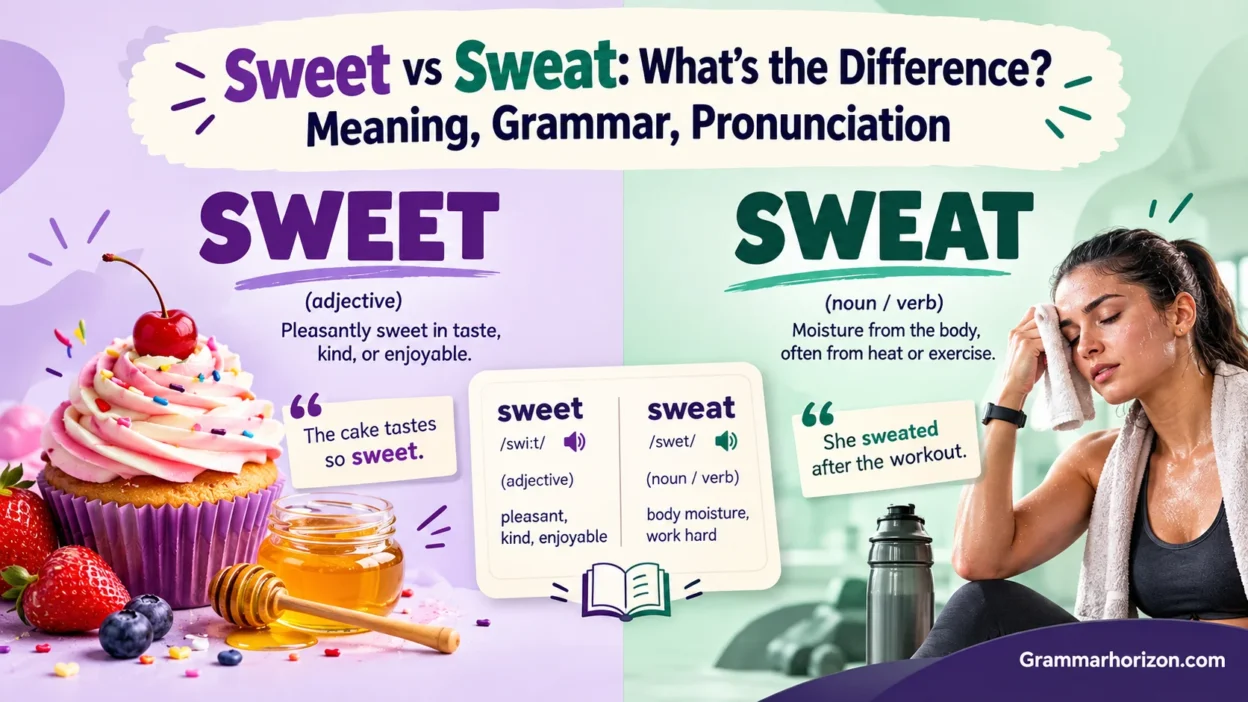
Sweet vs. Sweat can confuse language learners because these common English words have similar spelling and pronunciation but completely different meanings. Sweet relates to sugar, a pleasant taste, or a kind experience, while sweat means the moisture your body produces when perspiring. Understanding this clear difference helps you use the two words correctly in everyday English.
When choosing the correct word, always consider the context and how the word fits the sentence. Sweet can describe food, drinks, people, or expressions, while sweat relates to working hard, exercise, heat, or worrying. Native speakers may occasionally make a mistake, so learning these word meanings can improve accuracy, confidence, writing, and speaking. Useful grammar, collocations, and idioms also help learners understand how each word works in natural conversations.
A simple memory trick is to connect sweet with sugar and sweat with the body. Instead of memorizing definitions, practice real-life examples such as “The cake is sweet” and “I began to sweat after running.” These examples make the distinction easier to remember and use. With regular practice, you can avoid this common mistake, strengthen your vocabulary, understand everyday expressions, and improve your overall communication.
Quick Answer
The difference between sweet and sweat is straightforward.
- Sweet describes something sugary, pleasant, enjoyable, or kind.
- Sweat refers to the body’s perspiration, the act of perspiring, working very hard, or worrying about something.
Here is a quick comparison.
| Word | Meaning | Example |
| Sweet | Sugary or pleasant | The strawberries are sweet. |
| Sweet | Kind or thoughtful | She’s a sweet friend. |
| Sweat | Body moisture | Sweat ran down his face. |
| Sweat | To perspire | I sweat during workouts. |
| Sweat | To worry | Don’t sweat the exam. |
Easy memory trick:
- Sweet → Treat (both have ee)
- Sweat → Wet (both have ea)
Comparison Overview
The table below highlights the most important differences between sweet and sweat.
| Feature | Sweet | Sweat |
| Main meaning | Sugary, pleasant, kind | Perspiration or producing perspiration |
| Part of speech | Mostly an adjective | Noun and verb |
| Pronunciation | Long ee sound | Short e sound |
| Related to | Taste, personality, enjoyable experiences | Exercise, heat, stress, hard work |
| Common expressions | Sweet dreams, sweet tooth | Don’t sweat it, break a sweat |
| Can be used figuratively | Yes | Yes |
Main Differences Between Sweet vs. Sweat
Although sweet and sweat differ by only one letter, they belong to different parts of English vocabulary and appear in completely different situations.
Sweet
Sweet is most commonly an adjective. It describes taste, personality, sounds, smells, memories, and experiences that are pleasant or enjoyable.
Examples include:
- Sweet apples
- Sweet perfume
- Sweet child
- Sweet music
- Sweet smile
Sweat
Sweat is both a noun and a verb.
As a noun, it means the moisture your body produces to cool itself.
As a verb, it means to produce perspiration. It also has figurative meanings such as working hard or worrying.
Examples include:
- Sweat covered his forehead.
- I sweat during exercise.
- She sweated over the presentation.
- Don’t sweat the small things.
Side-by-Side Comparison
| Sweet | Sweat |
| Related to sugar or pleasant qualities | Related to perspiration and effort |
| Mostly an adjective | Noun and verb |
| Positive meaning in most contexts | Neutral or negative depending on context |
| Used for compliments | Used for physical activity or stress |
| Example: The dessert is sweet. | Example: He broke into a sweat. |
Whenever you’re describing food, kindness, happiness, or compliments, you almost certainly need sweet.
Whenever you’re talking about exercise, heat, nervousness, or hard work, sweat is the correct choice.
What Does “Sweet” Mean?
The word sweet has several meanings in English. While many people first associate it with sugar, native speakers use it in many different situations.
Understanding these meanings helps you recognize the word naturally in conversations, books, movies, and everyday writing.
Sweet as an Adjective for Taste
The most common meaning of sweet refers to food or drinks that contain sugar or naturally taste sugary.
Many fruits contain natural sugars, so they taste sweet even without added sugar.
Examples include:
- The peaches are sweet.
- This tea is too sweet for me.
- Honey has a naturally sweet flavor.
- The watermelon tastes incredibly sweet.
Common foods described as sweet include:
- Chocolate
- Ice cream
- Cake
- Cookies
- Candy
- Fruit
- Donuts
- Syrup
- Soft drinks
A sweet taste is one of the five basic tastes recognized by the human tongue, alongside salty, sour, bitter, and umami.
Sweet Meaning Kind or Thoughtful
One of the most common figurative uses of sweet describes someone’s personality.
A sweet person is caring, gentle, thoughtful, and pleasant to be around.
Examples include:
- She’s a sweet little girl.
- That was a sweet gesture.
- You have very sweet parents.
- Thank you for your sweet message.
This meaning often appears in compliments because it emphasizes warmth and kindness rather than appearance.
For example:
- He has a sweet smile.
- She’s always sweet to everyone.
- That was a sweet thing to do.
Sweet Meaning Pleasant or Enjoyable
The word sweet also describes experiences that bring happiness or satisfaction.
Examples include:
- Sweet memories
- Sweet victory
- Sweet success
- Sweet music
- Sweet relief
Example sentences:
- Winning the championship was a sweet moment.
- We enjoyed a sweet evening together.
- The violin produced a sweet sound.
- The vacation ended with many sweet memories.
Here, sweet has nothing to do with sugar. Instead, it emphasizes something emotionally rewarding or enjoyable.
Sweet as an Informal Expression
In American English, sweet often functions as an informal expression of excitement or approval.
Instead of saying “Great!” or “Awesome!” people sometimes simply say:
Sweet!
Examples:
Friend: We got free movie tickets.
You: Sweet!
Friend: I finished the project early.
You: Sweet!
This casual use is especially common among younger speakers, though people of all ages understand it.
Sweet as a Noun
Although much less common in American English, sweet can also function as a noun.
In British English, sweets usually refers to candy or confectionery.
Example:
The children bought some sweets after school.
In American English, candy is much more common than sweets in this context.
Conclusion
Sweet and sweat may look and sound similar, but their meanings are completely different. Sweet usually describes sugar, a pleasant taste, or something kind, while sweat refers to the moisture your body produces when you are perspiring. Remembering this simple difference can help you avoid common mistakes in writing and speaking. The easiest memory trick is to connect sweet with sugar and sweat with exercise, heat, or physical effort.
FAQs
Q1. Is “sweet” and “sweat” the same?
No. Sweet describes taste, pleasant qualities, or kindness, while sweat refers to moisture produced by the body.
Q2. What is the difference between sweet and sweat?
Sweet relates to sugar or something pleasant. Sweat means the moisture released by your body, especially during exercise or heat.
Q3. How do you remember sweet vs. sweat?
Connect sweet with sugar and sweat with perspiration. This simple association makes the difference easier to remember.
Q4. Are sweet and sweat pronounced the same?
No. They have different pronunciations. Sweet rhymes with “meet,” while sweat sounds closer to “set.”
Q5. Can sweet describe a person?
Yes. Sweet can describe someone who is kind, caring, gentle, or thoughtful.
Q6. Can sweat be used as a verb?
Yes. Sweat works as both a noun and a verb. For example, “I wiped the sweat from my face” uses it as a noun, while “I sweat when I exercise” uses it as a verb.
Q7. What is an easy example of sweet and sweat?
You can remember the difference with two simple sentences: “The candy is sweet.” and “I started to sweat after running.”