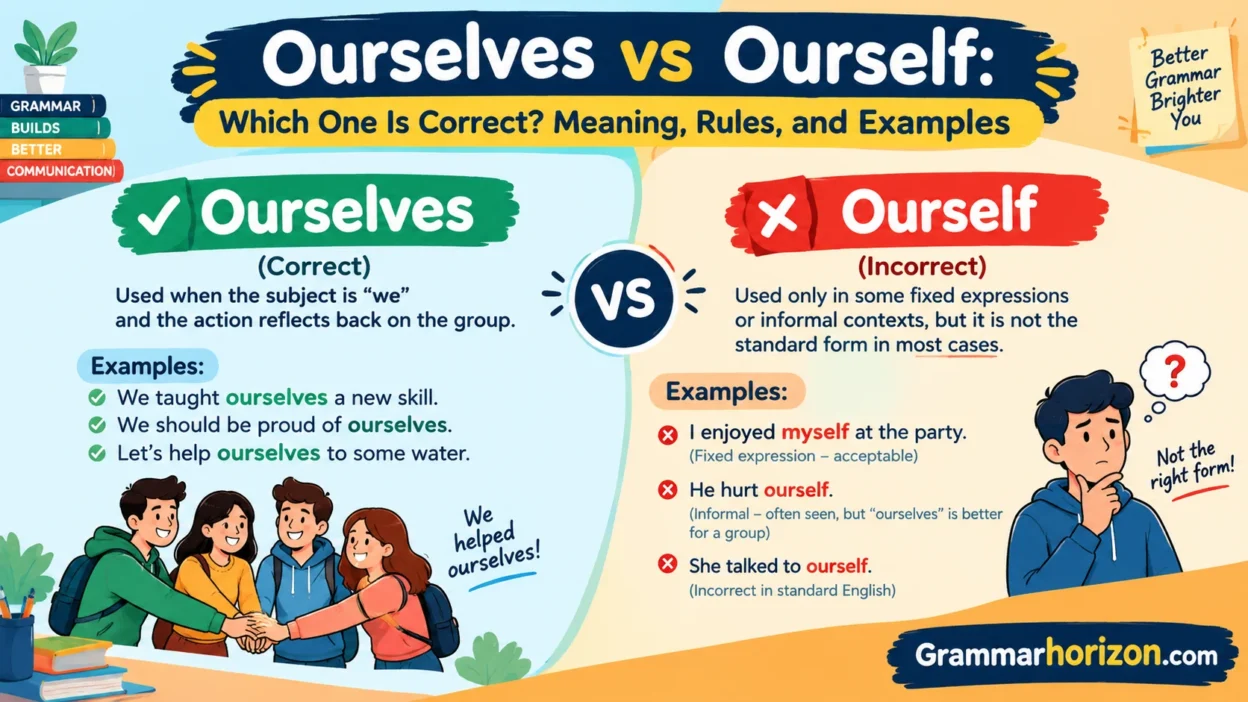
Ourselves vs Ourself can be confusing for English learners, but understanding the difference helps improve English writing, clear English, and grammatical correctness. Both words are reflexive pronouns, but their usage depends on the subject and context. In standard English, ourselves is the correct form when we refer to two or more people. For example, “We prepared ourselves for the meeting.” In contrast, ourself is an uncommon form used in specialized contexts, especially traditional royal language, where a monarch may use we instead of I. This historical usage explains why ourself sometimes appears in older texts.
The main grammatical distinction concerns pronoun agreement. Ourselves is the standard first-person plural reflexive pronoun, while ourself is a singular reflexive pronoun associated with limited historical or specialized usage. In modern English and contemporary English, ourselves is the appropriate choice for everyday English, conversations, emails, school assignments, and professional documents. For example, “We taught ourselves English” is correct, while “We taught ourself English” is generally incorrect in ordinary writing. Checking the subject before selecting a pronoun helps English learners and writers avoid common mistakes and maintain writing accuracy.
To choose the correct form, consider the grammatical context and the meaning of the sentence. When we refer to a group, use ourselves; reserve ourself for a clearly established traditional royal language context. These practical tips can help students, editors, and writers improve pronoun choice, word choice, and sentence accuracy. By learning reflexive pronoun rules and studying practical examples, you can understand these tricky pronouns, strengthen your grammar knowledge, and write confidently in formal writing, informal writing, and other forms of written communication.
Quick Answer: Ourselves vs Ourself
Ourselves is the standard plural reflexive pronoun used when we refers to multiple people. Ourself is a rare singular reflexive form that may appear when one person uses we, particularly in traditional royal or formal language.
Examples:
- Correct: We prepared ourselves for the examination.
- Correct: We introduced ourselves to the new employees.
- Specialized use: A monarch using the royal we may use ourself in certain traditional constructions.
Simple rule: If we refer to several people, use ourselves. In ordinary modern English, this is almost always the correct choice.
Definition of Ourselves and Ourself
Ourselves is the standard reflexive pronoun used with the plural subject we, while ourself is a rare form used when a singular speaker refers to themselves using we.
What Does Ourselves Mean?
Ourselves is a reflexive and emphatic pronoun associated with we and us when they refer to multiple people. It can show that the people performing an action also receive that action, or it can emphasize who performs the action.
Examples:
- We taught ourselves how to use the software.
- We enjoyed ourselves at the wedding.
- We completed the project ourselves.
- We ourselves made the final decision.
In the first two examples, ourselves refers back to the subject we. The people who taught or enjoyed something are the same people who experienced the action.
In the final two examples, the pronoun adds emphasis. It highlights that the group personally completed the project or made the decision.
Because ourselves serves both purposes, it appears frequently in everyday English.
What Does Ourself Mean?
Ourself is a rare singular reflexive pronoun traditionally associated with using we to refer to one person. This use is especially connected with the royal we, in which a monarch speaks as we rather than I.
For example, a traditional royal statement might use ourself to refer back to the monarch who is speaking as we.
The important point is that ourself isn’t the normal reflexive pronoun for a group. If several people are speaking together, standard modern English normally requires ourselves.
You may encounter ourself in historical documents, older formal language, or literary works. Its appearance in these contexts doesn’t make it a suitable substitute in everyday conversation.
The Core Difference Between Ourselves and Ourself
The main difference between ourselves and ourself is the number and meaning of the people represented by us.
Ourselves is the standard form for a plural subject. Ourself may occur when we represent one person in a specialized traditional usage.
Consider these examples:
- We prepared ourselves for the interview.
- We reminded ourselves about the deadline.
- We organized the event ourselves.
Each sentence refers to a group, so ourselves is appropriate.
In contrast, a historical text might use ourself when a monarch refers to themself as we. This is a specialized construction, not an ordinary plural use.
The main differences include:
- Number: Ourselves normally refers to multiple people, while ourself may refer to one person using a special plural form.
- Frequency: Ourselves is common, while ourself is rare.
- Context: Ourselves works in everyday English, while ourself is limited mainly to specialized formal, royal, or literary contexts.
- Practical usage: Use ourselves for ordinary plural subjects.
Ourselves vs Ourself: Comparison Table
| Feature | Ourselves | Ourself |
| Main use | Standard plural reflexive pronoun | Rare singular reflexive pronoun |
| Associated subject | We, referring to multiple people | We, referring to one person |
| Everyday usage | Common | Rare |
| Professional writing | Standard for groups | Generally avoided |
| Historical contexts | Used for groups | May appear in specialized language |
| Example | We prepared ourselves. | A monarch may refer to ourself. |
The practical lesson is straightforward: use ourselves for ordinary plural subjects, and reserve ourself for contexts that specifically support the singular use of we.
Historical Development of Ourselves and Ourself
Understanding the history of these words helps explain why both forms exist.
Early English Pronoun Patterns
English has used reflexive constructions for centuries. Over time, combinations involving personal pronouns and words related to self developed into the forms used today.
The word ourselves combines our with selves, the plural of self. This structure fits its usual role as the reflexive pronoun for we when we refer to multiple people.
The word ourself also has historical roots. It developed from an older combination of our and self. Although the form has existed for a long time, its historical presence doesn’t mean that it is interchangeable with ourselves in contemporary writing.
The Development of the Singular Ourself
English sometimes uses a plural pronoun to refer to one person. This practice is known as nosism and includes the royal we.
A monarch may say we instead of I when speaking in an official capacity. The speaker is still one person, but the pronoun represents the authority or dignity of the office.
In this specialized context, ourself can serve as a reflexive pronoun referring to that singular speaker.
Ourselves in Modern English
In contemporary standard English, ourselves is the established reflexive form for plural we.
Examples include:
- We reminded ourselves about the meeting.
- We gave ourselves enough time to finish.
- We organized the event ourselves.
These sentences refer to multiple people, so ourselves is the natural choice.
Although ourself survives in specialized contexts, it isn’t a general replacement for the standard plural form.
Understanding Reflexive Pronouns in English
A reflexive pronoun refers back to the subject of a sentence. It helps readers understand that the person or people performing an action are also affected by that action.
Here are the common English reflexive pronouns:
| Subject pronoun | Reflexive pronoun |
| I | Myself |
| You (one person) | Yourself |
| He | Himself |
| She | Herself |
| It | Itself |
| We (multiple people) | Ourselves |
| You (multiple people) | Yourselves |
| They | Themselves |
Reflexive Use of Ourselves
Use ourselves when the subject and object refer to the same group.
Examples:
- We prepared ourselves for the interview.
- We taught ourselves to play the guitar.
- We challenged ourselves to finish the task.
- We looked at ourselves in the photograph.
In each sentence, the people represented by we also receive or experience the action.
Compare these examples:
- We blamed ourselves for the mistake.
- We blamed them for the mistake.
In the first sentence, the group accepts responsibility for its own mistake. In the second, the group blames other people.
Emphatic Use of Ourselves
An emphatic pronoun adds emphasis without changing the basic meaning of a sentence.
Examples:
- We ourselves checked every document.
- We completed the repairs ourselves.
- We ourselves approved the proposal.
These sentences highlight that the group personally performed the actions.
You can often remove an emphatic ourselves without making the sentence incomplete. For example, “We completed the repairs” is still grammatically complete. Adding ourselves emphasizes that the group did the work personally.
Why the Royal We May Use Ourself
The royal we is a traditional way for a monarch to refer to one person using we rather than I. It may express the authority of the office or the idea that the monarch is speaking in an official capacity.
This practice is also called the majestic plural. Similar forms of plural self-reference have appeared in other formal settings.
Consider these examples:
- Ordinary singular: I must remind myself of my responsibilities.
- Ordinary plural: We must remind ourselves of our responsibilities.
- Specialized singular: We must remind ourself of our responsibilities.
The third sentence illustrates the rare grammatical pattern. It isn’t a quotation from a specific monarch.
Using the royal we doesn’t automatically require ourself. Some speakers and writers may use ourselves even when we refer to one person. The choice depends on the style and context.
Ourself in Institutional, Editorial, and Formal Writing
The word we can represent a person, a group of writers, a company, a committee, or an entire organization. However, these uses aren’t grammatically identical.
An editorial writer may use we to express a personal view while adopting the voice of a publication. A company may use we to speak for its employees. A committee may use we because its members have reached a shared decision.
When we represent multiple people, ourselves remains the standard reflexive form.
Examples:
- Our editorial team reviewed the article ourselves.
- We at the company must hold ourselves accountable.
- We, the committee members, prepared ourselves for the hearing.
In each example, we refer to a group. Using ourself simply because the writing sounds formal would be unusual.
Important: Formality doesn’t change the normal grammar rule. Identify who we represent before choosing the reflexive pronoun.
When to Use Ourselves in Modern English
In almost all ordinary situations, ourselves is the form you should choose when we refer to more than one person.
When the Subject Refers to Multiple People
Use ourselves when a group performs an action that affects its own members.
Examples:
- We introduced ourselves to the new neighbors.
- We prepared ourselves for the competition.
- We gave ourselves enough time to complete the assignment.
- We reminded ourselves to remain calm.
The pronoun refers back to the subject we. Because the subject represents multiple people, ourselves is the standard form.
When Adding Emphasis
You can also use ourselves to stress that a group completed an action personally.
Examples:
- We built the website ourselves.
- We ourselves selected the final design.
- We cleaned the entire office ourselves.
In these sentences, the pronoun adds emphasis. It can suggest that the group did the work without outside help or personally took responsibility for the decision.
When Ourself Is Not Appropriate
Avoid ourself when we clearly refer to a group in ordinary modern English.
| Incorrect | Correct |
| We prepared ourself for the test. | We prepared ourselves for the test. |
| We introduced ourself to the guests. | We introduced ourselves to the guests. |
| We enjoyed ourself at the party. | We enjoyed ourselves at the party. |
| We completed the work ourself. | We completed the work ourselves. |
These corrections follow the standard reflexive-pronoun pattern.
When Ourself Is Still Used
Although ourself is uncommon, it has recognized uses in English. Understanding these exceptions helps you distinguish a deliberate grammatical choice from an ordinary mistake.
The Royal or Singular Formal We
A monarch or another speaker may use we to refer to one person in an official or traditional context. In this setting, ourself can serve as a singular reflexive pronoun.
For example:
In a traditional royal voice: We shall remind ourself of the duties of the crown.
This is an illustrative sentence, not a verified historical quotation. It shows how ourself may refer back to one speaker who uses we.
Historical and Literary Contexts
Writers may use ourself when reproducing older speech, creating a royal voice, or preserving the wording of a historical source.
When reading older literature, consider the speaker and the time period before deciding whether a pronoun is incorrect.
However, don’t copy a rare historical form into an ordinary email or essay just because you encountered it in a book. Modern writing generally favors ourselves for plural subjects.
Ourselves vs Ourself in Everyday Communication
The difference becomes easier to remember when you apply the rule to common writing situations.
Examples Using Ourselves
In an email:
“We have reviewed the documents ourselves and will send the final version tomorrow.”
The pronoun refers to the people who reviewed the documents.
In an academic assignment:
“We challenged ourselves to explain the topic using clear examples.”
The group challenged its own members.
In a workplace conversation:
“We can handle the task ourselves without hiring another team.”
The group will complete the work independently.
In everyday conversation:
“We enjoyed ourselves during the trip.”
The people who traveled also experienced the enjoyment.
Examples Using Ourself
Because ourself is rare, ordinary modern examples require a special context.
- Royal voice: “We must examine ourself before making this decision.”
- Editorial voice: “In this article, we shall limit ourself to the main question.”
These examples illustrate a singular speaker using we. They aren’t the preferred wording for a group of people in standard contemporary writing.
For a general audience, you can usually write ourselves or rephrase the sentence to avoid uncertainty.
Common Misconceptions About Ourselves and Ourself
Many people think ourselves and ourself are interchangeable, but ourselves is the standard reflexive pronoun for plural we, while ourself is mainly used in rare, formal, or special contexts involving a singular speaker using we.
Myth: Ourself Is Always Incorrect
This claim is too broad. Ourself is a recognized word with limited uses, particularly when a singular speaker uses we. However, it isn’t the normal plural reflexive pronoun.
Myth: Ourselves Can Refer Only to a Fixed Number of People
Ourselves doesn’t specify an exact number. It can refer to two people, a small team, or a large group.
For example:
- We two introduced ourselves.
- The five employees organized themselves into teams.
- We all prepared ourselves for the event.
The size of the group doesn’t change the standard form.
Myth: Ourselves and Ourself Are Interchangeable
They aren’t freely interchangeable in standard English. When we refers to multiple people, ourselves is the expected choice.
Although ourself can occur in special contexts, substituting it in an ordinary plural sentence usually sounds incorrect or nonstandard.
Myth: Ourself Is Only an Old English Word
The form has historical roots, but it also appears in discussions of modern usage and specialized writing. Its history explains its existence; it doesn’t restrict it exclusively to Old English.
Myth: Formal Writing Always Requires Ourself
Formal writing still follows ordinary pronoun rules. A group writing a business report should normally say, “We reviewed the findings ourselves.”
Using ourself won’t automatically make the sentence more professional. In most cases, it will make the wording less natural.
How to Choose Between Ourselves and Ourself
Use this simple process whenever you’re unsure which word to write.
- Identify the subject: Find the word we in your sentence.
- Determine the meaning: Do we refer to several people or one person using a specialized plural form?
- Choose the pronoun: Use ourselves for an ordinary plural subject.
- Check the context: Consider ourself only if the sentence follows a recognized singular use of we.
- Review the style: If you’re writing an essay, email, report, or everyday message, prefer standard modern English.
A Quick Memory Trick
Remember this sentence:
A group looks after itself as a group, so we look after ourselves.
If we mean you and other people, choose ourselves. If one person deliberately speaks as we do in a royal or similarly specialized context, ourself may be appropriate.
When you’re unsure, ourselves is the safer choice for ordinary plural usage.
Practical Grammar Tips for Correct Usage
Keep these tips in mind when editing your writing:
- Match reflexive pronouns to the meaning of their subjects.
- Don’t use ourself simply to make a sentence sound formal.
- Remember that ourselves can be reflexive or emphatic.
- Check historical quotations in their original context rather than judging them by present-day conventions alone.
- Follow your organization’s style guide when working on formal publications.
- Read the complete sentence to confirm that the pronoun refers to the intended person or group.
These habits will help you use reflexive pronouns more accurately without memorizing complicated rules.
Case Study: Choosing the Correct Reflexive Pronoun
Imagine that four employees are preparing a presentation for an important client. They decide to research the subject, prepare the slides, and rehearse the presentation without outside assistance.
Their original sentence reads:
“We prepared ourself for the client meeting.”
The sentence is understandable, but ourself is not the standard choice because we refer to four employees.
The corrected version is:
“We prepared ourselves for the client meeting.”
Why is this correct? The subject represents multiple people, and ourselves refers back to that group.
Now consider a different situation. A historical monarch uses we to speak in an official capacity and refers to the same singular speaker. In that specialized context, ourself may be appropriate.
The lesson is simple: look at what the subject means, not just how the sentence sounds. Ordinary groups use ourselves, while ourself belongs to narrower contexts.
Conclusion
Understanding ourselves vs ourself helps you use reflexive pronouns correctly in everyday English and professional writing. Ourselves is the standard form when we refer to a group, while ourself is mainly found in specialized historical contexts, such as traditional royal language. By learning this simple grammar rule, you can avoid common mistakes, improve sentence accuracy, and write with greater confidence.
FAQs
Q1. Is ourselves or ourself correct?
Ourselves is the standard form in modern English when we refers to a group. Ourself is uncommon and mainly appears in specialized or historical contexts.
Q2. What is the difference between ourselves and ourself?
Ourselves refers to a plural subject, while ourself is sometimes used with the royal we in traditional or historical language.
Q3. Can I use ourself in formal writing?
You should generally use ourselves in formal writing. Use ourself only when a specific historical, royal, or specialized context requires it.
Q4. Is ourself grammatically incorrect?
Not in every context. Although ourself is usually considered nonstandard in ordinary modern English, it has a recognized history of use with the royal we.
Q5. How can I remember when to use ourselves?
Remember this simple rule: when we refer to a group, use ourselves. For example, “We completed the project ourselves.” Reserve ourself for rare, specialized contexts.