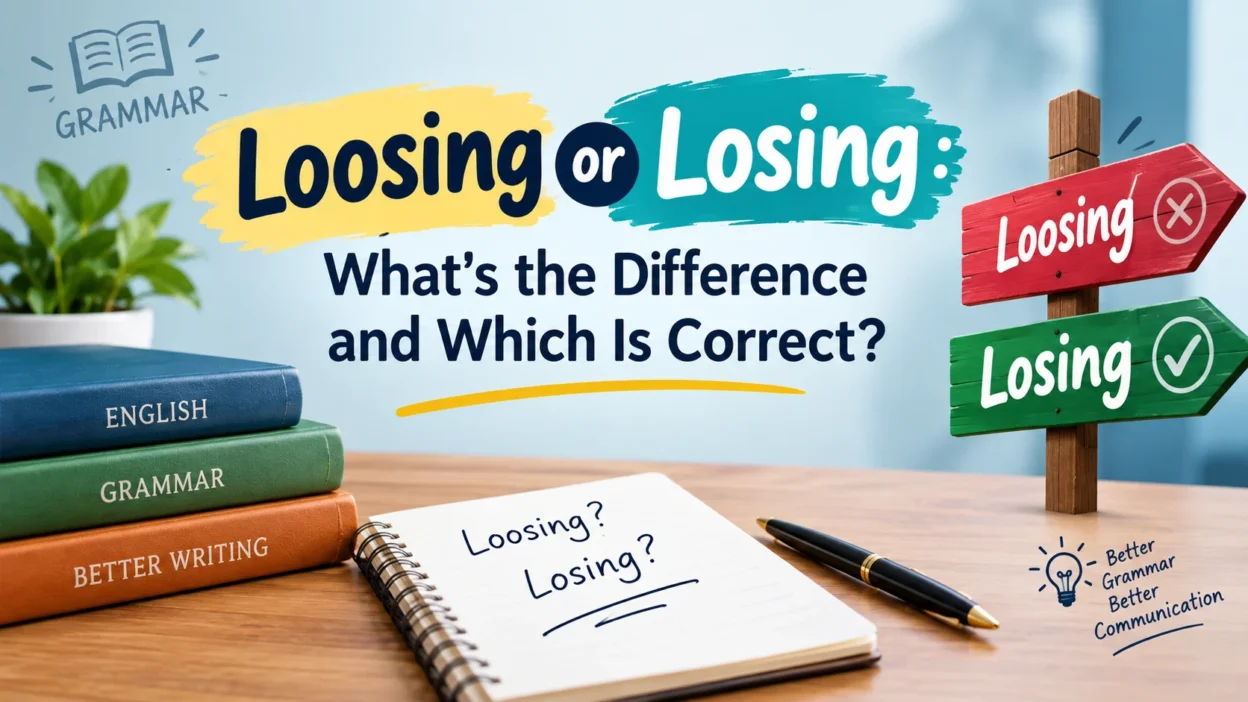
The Loosing or Losing confusion usually begins with a small spelling change: the extra “o”. Although both words look similar, their meaning, uses, and forms are completely different. Many students, bloggers, English learners, native speakers, and non-native English writers confuse them when searching for words online, where Google and a spellchecker can sometimes produce mixed results. The quick answer is that losing is the correct word for disappearing, when someone fails to win, no longer has something, or is losing weight. Loosing is a legitimate word related to loose, meaning releasing or setting free. Once you understand the correct meaning of each word, the spelling difference becomes easier to remember.
The easiest way to avoid the wrong word is to check what the verbs mean in the sentence. Losing is the common form in everyday English, such as “She is losing weight,” “Our team is losing the game,” or “He is losing his keys.” By contrast, loosing means releasing or setting free something that was held, as in “The archer is loosing an arrow.” This distinction helps English learners understand why the forms are not interchangeable. Looking at the origins, pronunciation, and practical uses can also reduce confusion and prevent common spelling mistakes in writing and speaking.
In real life, choosing the correct form matters in emails, social media, and formal writing, especially when you want your English to sound clear and accurate. A useful way to remember the difference is to connect losing with something you no longer have or something you fail to win, while loosing connects with loose, releasing, or setting free. These examples make the spelling easier to recognize and help you become more confident when using the words correctly every time.
Quick Answer: Loosing or Losing?
Losing is correct when you mean failing to keep, win, find, or maintain something.
Loosing is correct when you mean releasing, freeing, or letting something go. It’s the present participle of the verb loose, although this use is relatively uncommon in modern everyday English.
| Word | Comes From | Meaning | Example |
| Losing | Lose | Failing to keep, win, find, or maintain something | She is losing her keys. |
| Loosing | Loose | Releasing or setting free | The soldiers were loosing the prisoners. |
| Loosening | Loosen | Making something less tight | He is loosening the knot. |
A simple rule covers most situations:
Comparison Overview of Loosing and Losing
The easiest way to understand loosing or. losing is to return to their base words.
Losing comes from lose. The verb lose has many everyday meanings. You can lose your phone, lose a game, lose money, lose patience, or lose an opportunity.
Loosing comes from loose when loose functions as a verb. In this sense, it means to release something from restraint. The word appears more often in literary, historical, or formal contexts than in casual conversation.
Lose → Losing
When you add -ing to lose, the final e disappears:
lose → losing
The spelling contains only one o between the l and s.
Examples include:
- I’m losing my patience.
- They’re losing the match.
- She’s losing weight.
- We’re losing valuable time.
- He keeps losing his glasses.
Loose → Loosing
When loose acts as a verb meaning release, its present participle is loosing:
loose → loosing
Here, the original e remains before -ing.
For example:
- The archer was loosing an arrow.
- They were loosing the animals from their cages.
- The soldiers were loosing the prisoners.
The meaning comes from the base verb, not simply from the number of letters in the word.
Main Differences Between Loosing and Losing
The biggest difference between loosing and losing is their meaning.
Losing Means Failing to Keep or Win Something
The verb lose describes situations where something is no longer possessed, achieved, controlled, or retained.
For instance, if your phone disappears and you can’t find it, you’re losing your phone. If your team doesn’t win a competition, the team is losing.
The same word works for many abstract situations:
- losing confidence
- losing control
- losing interest
- losing focus
- losing patience
- losing money
- losing time
- losing an opportunity
This explains why losing appears so frequently in everyday English.
Loosing Means Releasing Something
Loosing has a narrower meaning. It describes the act of releasing, freeing, or setting something loose.
Imagine an animal held by a rope. When someone releases it, they could describe the action as loosing the animal.
Similarly, an archer can loose an arrow, meaning the archer releases the arrow from the bow.
This verb is grammatically correct, but modern speakers usually choose simpler alternatives such as releasing, freeing, or letting go.
When to Use “Losing”
Use “losing” when someone or something is no longer having, failing to win, disappearing, or experiencing a loss, such as losing weight, losing a game, or losing your keys.
Losing Something You Can’t Find
Use losing when you mean that you no longer have something or can’t locate it.
For example:
- I keep losing my keys.
- She is afraid of losing her phone.
- He apologized for losing the document.
- They were worried about losing their luggage.
Notice that none of these sentences involves releasing something. They describe something being misplaced or no longer available.
Losing a Competition or Game
You also use losing when someone fails to win.
Consider these examples:
- Our team is losing the game.
- They ended up losing the final.
- She hates losing competitions.
- The company is losing customers to competitors.
Here, losing expresses the opposite of winning.
Losing Weight, Money, Time, or Control
Some expressions with losing are extremely common.
You might say:
- losing weight
- losing money
- losing time
- losing sleep
- losing patience
- losing control
- losing focus
- losing confidence
So, “I am losing weight” is correct. “I am loosing weight” is not.
The same principle applies to abstract nouns. You can lose something you physically possess, but you can also lose something less tangible.
Losing an Opportunity or Advantage
English also uses lose for things that you fail to retain or take advantage of.
For example:
The company risked losing an important contract.
She didn’t want to lose the opportunity.
The team is losing its advantage.
These examples all describe something being forfeited or no longer available. Therefore, losing is the correct form.
When to Use “Loosing”
Loosing is used when you mean releasing or setting free something, such as loosing an arrow or loosing an animal from its cage.
Loosing as “Releasing”
For example:
The keeper was loosing the horses from their stalls.
The action involves releasing the horses. That’s why loosing works.
However, in modern American English, releasing would usually sound more natural:
The keeper was releasing the horses from their stalls.
This difference matters because a grammatically possible word isn’t always the most natural choice.
Loosing an Arrow
One of the clearest examples appears in descriptions of archery.
An archer can loose an arrow, meaning the archer releases it from the bow.
For example:
The archer drew the bow and loosed the arrow.
This usage is recognizable, but it has a literary or traditional feel. In ordinary conversation, speakers are more likely to say released the arrow or simply describe the archer as firing.
Loosing or. Loosening
Here’s another important distinction.
Loosing means releasing.
Loosening means making something less tight.
Compare these sentences:
- She is loosing the prisoner. → She is releasing the prisoner.
- She is loosening the rope. → She is making the rope less tight.
That difference prevents another common spelling mistake. If you’re talking about a screw, knot, belt, grip, or bolt becoming less tight, loosening is generally the word you need.
Common Mistakes With Loosing and Losing
Common mistakes with loosing and losing usually happen when writers confuse loss, defeat, or disappearance with the much less common idea of releasing something.
“I Am Loosing Weight”
This is one of the most common mistakes.
❌ I am loosing weight.
✅ I am losing weight.
The sentence describes a reduction in weight. It has nothing to do with releasing something.
“Our Team Is Loosing”
When a team isn’t winning, use losing.
❌ Our team is loosing.
✅ Our team is losing.
The extra o changes the word into a form related to loose.
“She Is Loosing Her Keys”
If someone can’t find her keys, she is losing them.
❌ She is loosing her keys.
✅ She is losing her keys.
The confusion happens because lose and loose look and sound similar.
“Loosing the Knot”
If someone makes a knot less tight, loosening is usually correct.
❌ He is loosing the knot.
✅ He is loosening the knot.
The verb loose means release, while loosen means make less tight.
Losing or Loosing in Different Contexts
The correct choice between losing or loosing depends on the context, with losing used for loss or defeat and loosing used for releasing something.
Everyday Conversation
In everyday American English, losing is much more common.
You’ll hear it when people discuss games, possessions, money, weight, time, relationships, opportunities, and emotions.
Loosing rarely appears in casual speech unless someone is deliberately using the verb loose.
Academic and Professional Writing
In professional writing, choosing the correct form matters because a spelling error can distract readers from the message.
A sentence such as “The business is loosing customers” immediately looks incorrect.
The correct version is:
“The business is losing customers.”
Clear word choice strengthens professional communication.
Historical or Literary Writing
Loosing appears more naturally in historical or literary contexts. Descriptions of archers, prisoners, animals, or warriors may use the verb because it has a traditional flavor.
That doesn’t make loosing an alternative spelling of losing. The words still carry different meanings.
Easy Ways to Remember Losing or Loosing
Remember losing for loss or defeat and loosing for releasing or setting something free.
Use the “Loss” Trick
Think of:
loss → lose → losing
If something involves a loss, choose losing.
You can lose a game. You can lose money.
Use the “Loose” Trick
Think of:
loose → loosing
If something is being released, losing may be appropriate.
This is much less common in ordinary conversation.
Remember the One-Line Rule
Losing is about loss. Loosing is about release.
That short distinction handles most cases without memorizing a long grammar rule.
Examples of Losing and Loosing in Sentences
Here are clear examples showing how losing or loosing work in different sentences and contexts.
Examples With Losing
- She is losing her keys again.
- We are losing valuable time.
- The team is losing the match.
- He worries about losing his job.
- They are losing money every month.
- She is losing confidence.
- Don’t risk losing this opportunity.
- He keeps losing track of time.
Examples With Loosing
- The handler was loosing the dogs.
- The guards were loosing the prisoners.
- The archer was loosing an arrow.
- The rider was loosing the horses from their restraints.
The second group has one common idea: something is being released.
Read Also.https://grammarhorizon.com/mei-fun-vs-chow-fun/
Conclusion
Loosing or Losing can be easy to distinguish once you focus on the meaning of each word. Losing refers to no longer having something, failing to win, or losing weight, while loosing means releasing or setting something free. Remembering this simple difference can help you avoid common spelling mistakes and use both words correctly.
FAQs
Q1. Is “loosing” a correct word?
Yes. Loosing is a correct word, but it means releasing or setting free something.
Q2. Is “losing” the correct spelling?
Yes. Losing is the correct spelling when you mean no longer having something, failing to win, or losing weight.
Q3. What is the difference between loosing and losing?
Loosing means releasing or setting free, while losing means no longer having something or failing to win.
Q4. Why do people confuse loosing and losing?
People often confuse them because both words look similar, but loosing contains an extra “o” and has a different meaning.
Q5. Is “losing weight” correct?
Yes. Losing weight is the correct expression. Loosing weight is incorrect in this context.
Q6. Is “loosing an arrow” correct?
Yes. Loosing an arrow is grammatically correct because loosing can mean releasing an arrow from a bow.
Q7. How can I remember losing or. loosing?
Remember losing for something you no longer have or fail to win, and loosing for releasing or setting free something.
Q8. Which word is more common, loosing or losing?
Losing is much more common in everyday English. Loosing is a legitimate but less frequently used word.