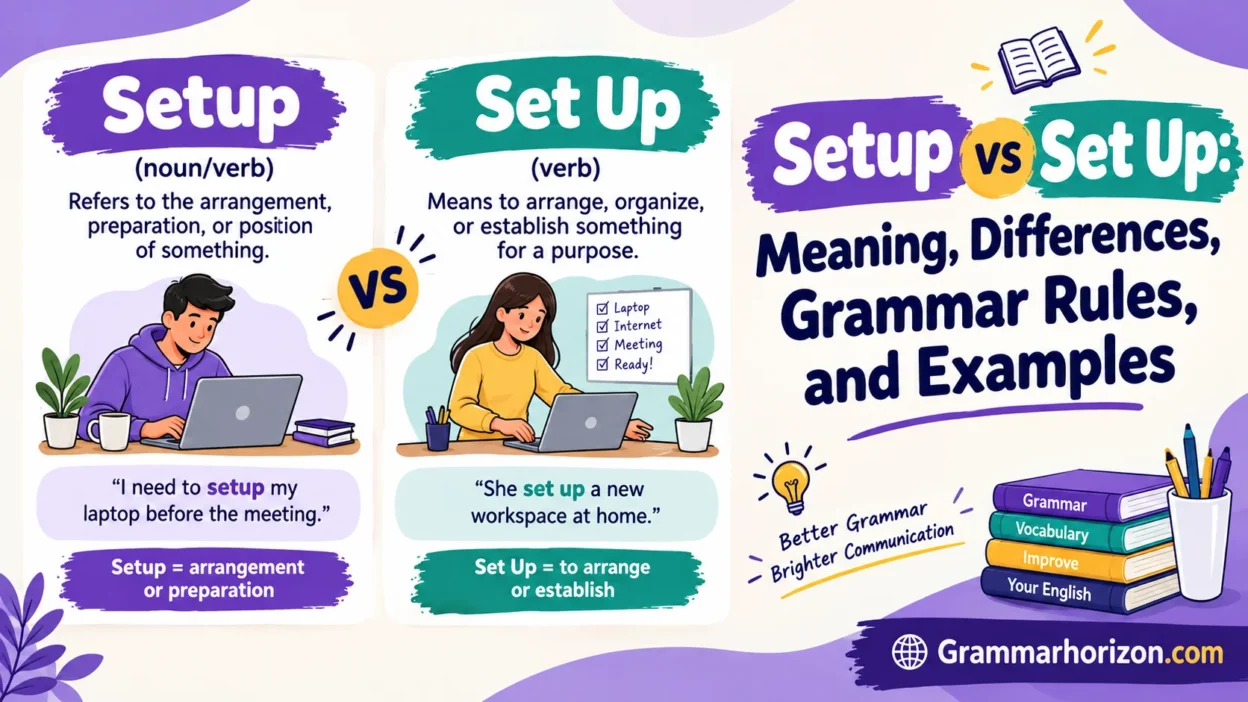
Setup vs Set Up becomes easier to understand when you learn the core rule, meaning, spelling, and grammatical differences. In standard English, setup is a noun, while set up is a phrasal verb. Although these forms look similar, their grammatical functions and usage differ. Simple English explanations, clear definitions, and practical examples can help English learners understand the correct form and improve their word choice.
The main difference between setup and set up lies in their parts of speech and sentence structure. Setup describes an arrangement, preparation, organization, or system put in place. For example, “The computer setup is ready” uses the noun form. In contrast, set up describes an action, such as arranging, preparing, installing, configuring, or establishing something. For example, “I will set up the computer” uses the verb phrase. Understanding these usage rules helps prevent common grammar mistakes and improves writing accuracy in everyday English, emails, and professional writing.
To remember the correct usage, use a simple memory trick: setup names a thing, while set up describes an action. These practical examples make the grammatical rules easier to remember and improve vocabulary, language skills, and written communication. A helpful grammar guide should explain the definitions, contextual meaning, and word distinction without vague advice or unnecessary complexity. By learning the correct spelling, noun usage, verb usage, and common sentence patterns, you can strengthen your grammatical correctness, writing skills, and confidence when using standard English.
Quick Answer: Setup vs Set Up
Setup is usually a noun or modifier that refers to an arrangement, configuration, or preparation process. Set up is a verb phrase that means to arrange, prepare, install, organize, or establish something.
Here are simple examples:
- Setup (noun): The new office setup looks professional.
- Setup (modifier): Please read the setup instructions.
- Set up (verb): We need to set up the new office.
Remember this simple rule: Use setup for an arrangement and set up for an action.
Comparison Overview
Although setup and set up share a similar meaning, their grammatical functions differ. Understanding these differences will help you choose the correct form in everyday writing.
| Feature | Setup | Set Up |
| Part of speech | Noun; sometimes a modifier | Verb phrase |
| Main meaning | An arrangement, configuration, or system | To arrange, prepare, install, or establish |
| Grammatical function | Names something or modifies another noun | Describes an action |
| Example | The computer setup is complete. | Please set up the computer. |
| Common contexts | Technology, offices, events, and equipment | Installing devices, arranging meetings, and starting businesses |
| Past tense | Not applicable as a noun | Set up |
| Present participle | Not applicable as a noun | Setting up |
Consider these two sentences:
- Action: The technician will set up the network.
- Arrangement: The network setup is reliable.
In the first sentence, the technician performs an action. In the second, setup describes the resulting configuration. This distinction is the foundation of the entire rule.
Main Differences Between Setup and Set Up
What Does Setup Mean?
The word setup usually functions as a noun. It describes how something is arranged, organized, configured, or prepared for a particular purpose.
A setup might include physical equipment, digital settings, workplace arrangements, or a system of procedures. For example, a photographer’s setup could include a camera, lights, tripods, and a backdrop. A business setup might involve office furniture, software, employees, and daily procedures.
The word can also describe a situation designed to deceive someone or make them appear guilty. For example, someone might say, “The entire situation was a setup,” meaning that another person deliberately arranged the circumstances to trick them.
Examples of setup as a noun:
- My home office setup helps me stay focused.
- The restaurant has an efficient kitchen setup.
- We tested the new computer setup before the presentation.
- The classroom setup encourages group discussions.
- He claimed that the entire situation was a setup.
In each example, setup names an arrangement, configuration, or situation. It doesn’t describe the action of preparing something.
What Does Set Up Mean?
Set up is a phrasal verb. It combines the verb set with the particle up to express an action.
Depending on the context, it can mean arranging something, preparing equipment for use, establishing an organization, creating an account, or organizing an event. It can also mean tricking someone or making them appear responsible for something they didn’t do.
Examples of set up as a verb:
- I need to set up my new laptop.
- Sarah will set up a meeting with the client.
- They plan to set up a small business.
- The teacher set up an online classroom.
- The investigators discovered that someone had set him up.
Notice that every example describes an action or event. That’s the clearest sign that set up is the correct form.
Setup as an Adjective or Modifier
Although setup is mainly a noun, it can also appear before another noun to describe something related to preparation or configuration. In this position, it functions as a noun modifier.
Common examples include:
- Setup instructions: Directions for preparing or configuring something.
- Setup process: The steps involved in getting something ready.
- Setup file: A file used to begin installing or configuring software.
- Setup wizard: A program that guides users through configuration.
- Setup fee: A charge for preparing a service or account.
For example, “Read the setup instructions before connecting the printer” uses setup to describe the type of instructions.
This usage is common in American English, especially in technical writing. The word remains one word because it identifies the kind of instructions, process, or file being discussed.
How Set Up Works in Different Verb Tenses
One reason people confuse setup and set up is that the verb changes according to tense. However, the spelling rule remains the same: write the verb as two words.
The verb set has the same form in the present and past tense. Its present participle is setting.
| Tense or Form | Example | Explanation |
| Simple present | I set up my desk every morning. | Describes a regular action. |
| Simple past | I set up my desk yesterday. | Describes a completed action. |
| Present continuous | I am setting up my desk. | Describes an action in progress. |
| Present perfect | I have set up my desk. | Connects a past action to the present. |
| Past perfect | I had set up my desk before the meeting. | Shows an action completed before another past event. |
| Simple future | I will set up my desk tomorrow. | Describes a future action. |
Pay particular attention to the past tense. You don’t write. The correct form is set up, as in “She set up the account last week.”
Also, remember that the noun setup doesn’t change with tense. You can describe a setup as new, old, complete, or outdated, but you don’t conjugate it like a verb.
How to Use Setup and Set Up Correctly
Choosing the correct form becomes much easier when you focus on the purpose of your sentence.
Use Setup When You Mean an Arrangement
Choose setup when you want to name an arrangement, configuration, system, or situation. It often appears after words such as the, a, my, your, and their.
For example:
- The setup is ready for the presentation.
- Your gaming setup needs better lighting.
- We reviewed the new security setup.
- The equipment setup takes up too much space.
- Her desk setup includes a laptop and two monitors.
A helpful trick is to replace setup with arrangement or configuration. If the sentence still makes sense, the noun form is probably correct.
For example, “The office setup is efficient” becomes “The office arrangement is efficient.” The meaning remains clear, which confirms that setup works as a noun.
Use Set Up When You Mean an Action
Use set up when someone needs to arrange, prepare, install, organize, or establish something.
Consider these examples:
- Please set up the projector before class.
- I’ll set up an appointment with the dentist.
- The company plans to set up another branch.
- We need to set up a password for the new account.
- They set up the tables before the guests arrived.
In each sentence, someone does something. The verb phrase describes that action rather than naming the resulting arrangement.
You can also test the sentence by replacing set up with arrange, prepare, or establish. For example, “We need to set up a meeting” becomes “We need to arrange a meeting.” The sentence retains its main meaning.
What Happens When a Pronoun Comes Between Set and Up?
Here’s a useful grammar rule that many people overlook: when the separable phrasal verb set up takes a pronoun as its object, the pronoun normally goes between set and up.
Compare these sentences:
- Correct: Please set it up before noon.
- Correct: Please set the system up before noon.
- Incorrect: Please set it up before noon.
When the object is a noun, both positions work: “Set up the system” and “Set the system up.” However, when the object is a pronoun such as it, them, or him, place it between set and up.
More examples include:
- We need to set it up today.
- She set them up in the conference room.
- Can you set the account up for me?
This rule helps you write naturally and avoid awkward sentence structures.
Setup vs Set Up in Different Contexts
The easiest way to understand this difference is to see how both forms appear in everyday situations.
Technology and Computers
Technology is one of the most common areas where people use these terms. You might configure a computer, install software, connect a printer, or adjust a Wi-Fi network.
Use set up when describing the process of preparing a device or system. Use setup when referring to the configuration, instructions, or arrangement itself.
Examples:
- I need to set up my new laptop.
- The laptop setup took only ten minutes.
- Follow the setup instructions to connect your printer.
- We will set up the Wi-Fi network this afternoon.
- My computer setup includes a wireless keyboard.
The distinction also matters in technical documentation. An instruction such as “Set up your account” tells the reader what to do. A heading such as “Account Setup” names the subject of the guide.
Business and Workplace Communication
Professional writing often includes both forms because employees arrange meetings, establish systems, and discuss how their work is organized.
For example:
- We need to set up a meeting with the client.
- The meeting setup includes a projector and conference phone.
- The manager will set up the new employee’s account.
- Our current office setup supports remote collaboration.
- The company plans to set up a new department.
Using the right form makes workplace instructions easier to understand. If you’re asking a colleague to perform an action, use set up. If you’re describing an existing arrangement, use setup.
Events and Meetings
Event planning provides another clear example. Organizers prepare venues, arrange seating, test sound systems, and coordinate equipment. The action and the resulting arrangement are closely related, but the grammar differs.
Compare these sentences:
- The staff will set up the wedding venue at 8 a.m.
- The wedding setup looks elegant.
- We need to set up the chairs before the guests arrive.
- The stage setup includes microphones and lighting.
- The coordinator has set up a meeting with the vendors.
Think about a conference room. Someone sets up the room by arranging chairs and connecting equipment. Once the work is complete, the room has a particular setup.
Home and Personal Use
You can apply the same rule when discussing household arrangements, study spaces, gaming stations, or home offices.
Examples:
- I want to set up a reading corner in my bedroom.
- My home office setup is comfortable.
- We set up the television in the living room.
- The kitchen setup makes cooking easier.
- He plans to set up a gaming station this weekend.
These examples show that the rule doesn’t depend on how formal the situation is. The grammatical role determines the spelling.
Education and Online Learning
Teachers, students, and administrators also use these expressions when preparing classrooms and digital learning tools.
- The teacher will set up an online classroom.
- The classroom setup encourages teamwork.
- I need to set up my student account.
- The exam room setup allows enough space between desks.
- The school has set up a new learning portal.
In academic writing, clear word choice helps distinguish instructions from descriptions. “Set up your account” gives students an instruction, while “Account Setup” works as a heading for a guide.
Setup vs Set Up: Is the Hyphenated Form Correct?
The hyphenated spelling set-up can cause additional confusion because English sometimes uses different spellings for nouns, verbs, and compound terms.
In standard American English, setup is the usual noun spelling, while set up is the standard verb phrase. However, set-up also appears as a noun in some dictionaries and editorial conventions.
Compare the three forms:
| Form | Typical Use | Example |
| Setup | Noun or modifier | The setup is complete. |
| Set up | Verb phrase | Please set up the equipment. |
| Set-up | Alternative noun spelling in some conventions | The set-up seemed unusual. |
For American English writing, the simplest approach is to use setup as the noun and set up as the verb. If you’re writing for a publication or organization with a specific style guide, follow its preferred spelling consistently.
Is Setup or Set Up More Formal?
Neither form is inherently more formal than the other. They perform different grammatical jobs, so you can’t choose between them based on tone alone.
For example:
- Professional instruction: Please set up the equipment before the demonstration.
- Professional report: The equipment setup reduced preparation time.
Both sentences are appropriate for professional communication. The difference lies in whether the sentence describes an action or names an arrangement.
Common Mistakes to Avoid
Even when you understand the main rule, a few common errors can slip into emails, articles, and instructions.
Using Setup as a Verb
Incorrect: I need to setup my new phone.
Correct: I need to set up my new phone.
The sentence describes an action, so the two-word verb phrase is necessary. You can also write, “My phone setup is complete,” when you want to describe the configuration.
Using Set Up as a Noun
Incorrect: My computer set up is complicated.
Correct: My computer setup is complicated.
Here, setup names the computer’s arrangement or configuration. It doesn’t describe an action, so the one-word noun is appropriate.
Writing Set Up Instructions When You Mean Setup Instructions
Incorrect for the intended meaning: Read the set up instructions.
Preferred: Read the setup instructions.
In the preferred sentence, setup modifies instructions. The phrase refers to instructions for configuring or preparing something.
However, the wording changes if you’re giving a direct command:
- Setup instructions: A type of instruction document.
- Set up the instructions: An action involving the preparation or arrangement of instructions.
The surrounding words determine which form fits.
Assuming Setup and Set Up Are Interchangeable
Incorrect: We will setup the meeting room.
Correct: We will set up the meeting room.
Consider another sentence: “The team finished setting up, and the setup was excellent.” Both forms work here, but they express different things. Setting up describes the action, while setup names the resulting arrangement.
Understanding these roles helps you avoid errors even when both spellings look familiar.
Easy Tricks to Remember Setup vs Set Up
If you still find yourself hesitating, these quick tests can help you choose the right spelling.
Use the Arrangement Test
Ask yourself whether you’re naming a thing, system, or configuration.
If the answer is yes, setup is usually correct.
- The sound system setup is excellent.
- My desk setup needs more space.
- The setup process was straightforward.
You can often replace setup with arrangement or configuration to check whether the noun makes sense.
Use the Action Test
Ask yourself whether someone is arranging, preparing, installing, or establishing something.
If the answer is yes, use set up.
- We need to set up the projector.
- She will set up an online account.
- They set up the new office last month.
If you can replace set up with arrange or establish without changing the main meaning, the verb phrase is probably correct.
Use the Pronoun Test
Try replacing the object with it.
For example:
- Original: Please set up the computer.
- Pronoun version: Please set it up.
The two-word form remains clear. This test is particularly useful because it reminds you that set up functions as a verb phrase.
Setup vs Set Up: Example Sentences
The following examples bring the rules together so you can see how each form works in everyday English.
Examples Using Setup
- The new office setup gives everyone enough room to work.
- Her gaming setup includes a mechanical keyboard and two monitors.
- We checked the equipment setup before starting the presentation.
- The software setup was easier than expected.
- Their business setup allows employees to work remotely.
- The classroom setup makes group activities more convenient.
- Please review the setup instructions before installing the printer.
- The studio setup includes a camera, lighting, and a microphone.
Each sentence uses setup as a noun or modifier. The word names an arrangement or identifies something related to preparation.
Examples Using Set Up
- I need to set up my email account.
- The assistant will set up a meeting for Friday.
- They set up the tables before the guests arrived.
- We are setting up the new computer system.
- The organization plans to set up a scholarship fund.
- She has set up a workspace in the spare bedroom.
- Can you set up the projector before the lecture?
- The company will set up another office next year.
Each example describes an action. That’s why the two-word form is correct.
Side-by-Side Examples of Setup and Set Up
| With Setup | With Set Up |
| My computer setup is simple. | I need to set up my computer. |
| The meeting setup was excellent. | We will set up the meeting room. |
| Her gaming setup looks impressive. | She plans to set up a gaming station. |
| The office setup needs improvement. | They will set up a new office. |
| The account setup was quick. | I will set up an account. |
These pairs make the central rule easy to see: The noun describes the arrangement, while the verb describes the action that creates it.
A Practical Case Study: Writing a Clear Workplace Email
Imagine that a team leader wants an employee to prepare a conference room for an important client meeting. The leader drafts this message:
“Please setup the conference room before 10 a.m. The setup should include a projector, six chairs, and a speakerphone.”
The second sentence uses setup correctly because it names the required arrangement. However, the first sentence uses setup incorrectly because it describes an action.
The corrected version reads:
“Please set up the conference room before 10 a.m. The setup should include a projector, six chairs, and a speakerphone.”
Only one space changes, but the grammar becomes correct. More importantly, the message now follows standard American English usage and reads naturally.
This example illustrates why proofreading matters. Spelling tools may not catch every mistake when both forms are legitimate words. You need to check the role each form plays in its sentence.
Conclusion
Understanding Setup vs Set Up helps you improve your English grammar, spelling, and writing accuracy. Setup is a noun that refers to an arrangement, configuration, or preparation, while set up is a phrasal verb that describes an action. Remember this simple rule: use setup for a thing and set up for an action. With regular practice and clear examples, you can avoid common grammar mistakes and use both forms correctly in everyday and professional writing.
FAQs
Q1. What is the difference between setup and set up?
Setup is a noun that describes an arrangement or configuration. Set up is a phrasal verb that means to arrange, prepare, or install something.
Q2. Is setup one word or two words?
Setup is one word when used as a noun. For example, “My computer setup is simple.”
Q3. Is set up a phrasal verb?
Yes, set up is a phrasal verb that describes an action. For example, “I need to set up my new computer.”
Q4. How can I remember setup vs set up?
Remember that setup names a thing, while set up describes an action. This simple rule helps you choose the correct form.
Q5. Is setup or set up correct in professional writing?
Both forms are correct, depending on the sentence. Use setup as a noun and set up as a verb phrase to maintain grammatical accuracy in professional writing.