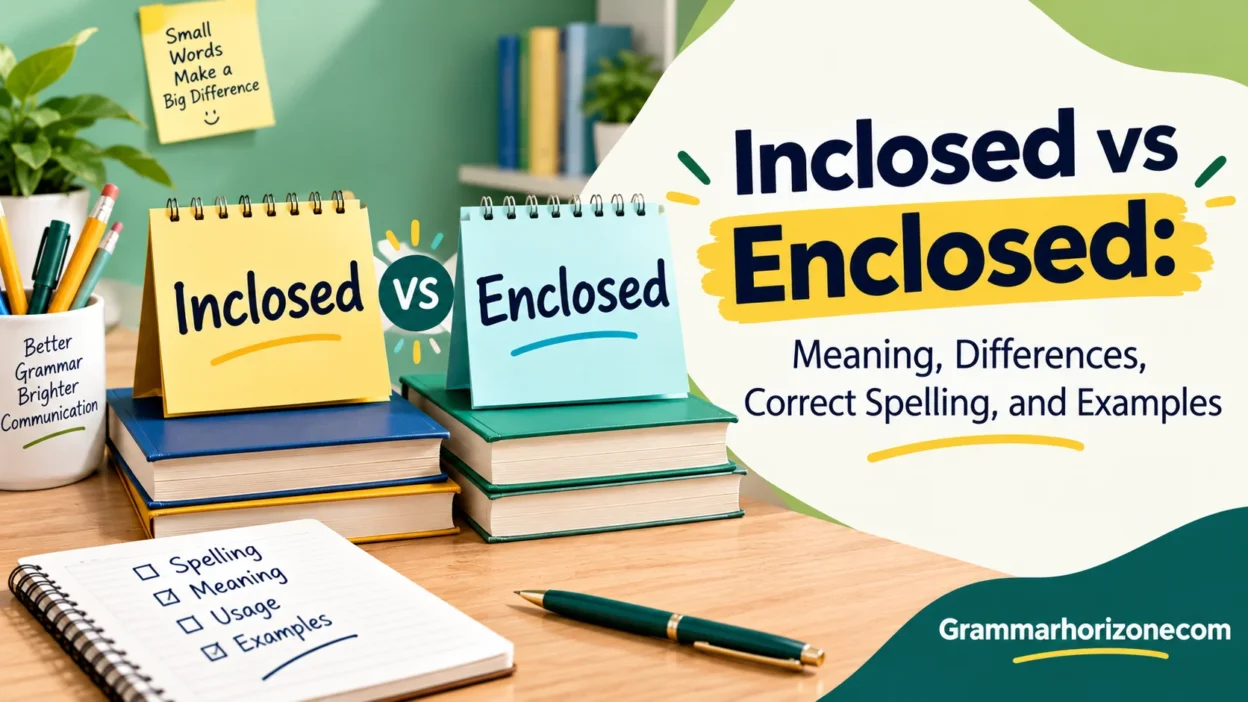
Inclosed vs Enclosed explains the difference between these two spellings and shows why enclosed is the correct choice in modern English. Although both words have appeared in English, inclosed is an older spelling found in historical books and documents. Modern writers prefer enclosed because it supports clear and correct writing.
The word enclosed means surrounded by something or placed inside a space. It can also describe a letter, document, or package sent with another item. You may see this word in business letters, formal writing, and everyday communication. In contrast, inclosed belongs mainly to older texts and traditional spelling. Both forms share a similar meaning, but their usage differs in contemporary English.
Choosing the correct spelling improves grammar, clarity, and writing accuracy. Modern dictionaries recognize enclosed as the standard form for professional communication and school assignments. When reading historical documents or older literature, you may still encounter inclosed. Remember to use enclosed in modern writing to avoid spelling mistakes and communicate clearly.
Quick Answer: Inclosed or Enclosed?
Enclosed is the correct and preferred spelling for modern English writing. It can describe something surrounded by a boundary, placed inside a container, or sent with a letter.
Inclosed is a historical spelling variant of enclosed. Although it appeared in older English writing, it’s rarely used in contemporary communication.
Examples:
- Correct: Please review the enclosed document.
- Correct: A wooden fence enclosed the garden.
- Modern alternative: I’ve enclosed a copy of the signed agreement.
- Historical spelling: The papers were inclosed with the letter.
For everyday writing, choose enclosed. You can retain inclosed when quoting an original historical document or preserving its original spelling.
Comparison Overview: Inclosed vs Enclosed
The primary difference between these words concerns their spelling and present-day usage. Both forms have been used to describe something surrounded, contained, or sent with another item.
| Feature | Enclosed | Inclosed |
| Spelling status | Standard modern spelling | Older spelling variant |
| Basic meaning | Surrounded, contained, or sent with something | Generally the same meaning |
| Base verb | Enclose | Inclose |
| Modern American English | Preferred | Rare and outdated |
| Modern British English | Preferred | Rare and outdated |
| Business letters | Recommended | Generally avoided |
| Historical documents | Common | May appear in original texts |
| Best choice for new writing | Yes | Usually no |
The table highlights an important point: a word can have a legitimate history without being the best choice for modern communication. Since enclosed is the familiar form today, it works best in professional documents, academic assignments, emails, and everyday messages.
Main Differences Between Inclosed and Enclosed
Although the spellings differ by only one letter, their use in modern English isn’t the same. Understanding their history, meaning, and grammatical roles will help you choose the appropriate form.
Difference in Spelling
The most noticeable difference is the first vowel. Enclosed begins with en-, while inclosed begins with in-.
Both forms have appeared in English, but enclosed has become the conventional modern spelling. Its related words follow the same pattern.
- Enclose: The base verb.
- Encloses: The present-tense form used with a singular third-person subject.
- Enclosing: The present participle or gerund.
- Enclosed: The simple past tense and past participle.
- Enclosure: A noun describing a bounded space or something enclosed.
For example, you might write, “The company enclosed the signed agreement with the application.” You could also say, “The company is enclosing a copy of the agreement.”
These forms follow standard modern spelling conventions. When writing for a contemporary audience, use enclose and its related forms rather than adopting the older inclose spelling.
Difference in Modern Usage
Modern English favors enclosed in everyday, academic, and professional communication. You’ll commonly see it in business letters, property descriptions, instructions, and official documents.
Consider these examples:
- “The enclosed form requires your signature.”
- “The building has an enclosed courtyard.”
- “Please read the enclosed safety instructions.”
- “The fence enclosed the entire garden.”
Each sentence uses the familiar modern spelling naturally.
By comparison, inclosed may look unfamiliar or outdated. Readers might understand it from context, but the spelling can distract from your message. Unless you’re working with an older source, there’s little reason to choose it over enclosed.
Difference in Meaning
Do inclosed and enclosed have different meanings? Generally, no. The two spellings have historically expressed similar ideas, so the spelling difference doesn’t normally signal a change in meaning.
The verb enclose commonly describes three situations:
- Surrounding something: A fence encloses a garden.
- Containing something: A box encloses a delicate object.
- Sending something with correspondence: A person encloses a receipt with a letter.
The historical form inclose was used for similar purposes. For example, an older writer might have described a fenced garden as an inclosed garden. A modern writer would normally use enclosed garden.
The practical lesson is simple: use the context to understand the meaning, but choose the standard spelling when writing for modern readers.
Difference in Formal and Professional Writing
Spelling choices can influence how readers perceive a document. An outdated form may make an otherwise polished letter look inconsistent or poorly proofread.
Imagine you’re applying for a job and write:
“Please review the inclosed résumé and references.”
The intended meaning is clear, but the unusual spelling may look like a mistake.
A more appropriate version is:
“Please review the enclosed résumé and references.”
The second sentence follows standard modern usage and sounds natural in a professional setting.
Use enclosed in:
- Business letters and printed correspondence.
- Job applications and supporting documents.
- Reports and academic assignments.
- Property descriptions and technical instructions.
- Website content and everyday writing.
However, historical accuracy sometimes requires a different approach. When reproducing an old document word for word, preserving inclosed may be necessary.
What Does Enclosed Mean?
Enclosed is the simple past tense and past participle of enclose. It can also function as an adjective. The word describes something surrounded by boundaries, contained within something else, or sent along with a letter or package.
Its precise meaning depends on the sentence. A document can be enclosed in an envelope, while a garden can be enclosed by a fence. In both situations, the word expresses the idea of containment.
Enclosed as a Verb
As a verb form, enclosed describes an action that happened in the past or a completed action.
Examples include:
- “They enclosed the garden with a wooden fence.”
- “She enclosed the photographs in an envelope.”
- “The builders enclosed the patio with glass panels.”
- “I enclosed a copy of the receipt with the letter.”
In the first sentence, the fence creates a boundary around the garden. In the second, the envelope holds the photographs. The final example describes sending a document along with a letter.
The word’s central meaning remains similar, even though the situation changes.
Grammar tip: Use enclose after modal verbs such as will, can, and should.
- Correct: “I will enclose the receipt.”
- Correct: “You should enclose the completed form.”
- Incorrect: “I will enclosed the receipt.”
The last sentence is incorrect because a modal verb takes the base form of the following verb. Since will already indicates the future, you should write will enclose, not will enclosed.
Enclosed as an Adjective
An adjective describes a person, place, thing, or condition. When enclosed acts as an adjective, it tells you that something is surrounded or contained.
For example:
- “The house has an enclosed porch.”
- “The children played in an enclosed playground.”
- “We held the meeting in an enclosed courtyard.”
- “The laboratory contains an enclosed testing chamber.”
In each example, enclosed describes a physical space or structure.
The word can also describe settings that limit access to the outside world. For instance, an enclosed garden has a boundary that separates it from the surrounding area. That boundary might consist of a fence, wall, hedge, or another structure.
Remember that enclosed doesn’t automatically mean airtight or completely sealed. A fenced garden is enclosed even though air, sunlight, and rain can enter freely.
Enclosed in Letters and Emails
One familiar use of enclosed appears in formal correspondence. Traditionally, writers use it to tell recipients that a document or item accompanies a physical letter.
Examples include:
- “Please find the enclosed invoice.”
- “I’ve enclosed a copy of the signed agreement.”
- “The enclosed certificate confirms your registration.”
- “Please complete the enclosed application form.”
Each sentence directs the reader to material provided with the correspondence.
However, modern communication requires a little care. When you send a digital file through email, attached is usually more natural than enclosed.
Compare these sentences:
- Physical letter: “I’ve enclosed the signed agreement.”
- Email: “I’ve attached the signed agreement.”
Both sentences communicate the intended message. The difference is that enclosed traditionally suits physical correspondence, while attached is the usual choice for digital files.
Enclosed in Physical Spaces and Structures
The word also describes buildings, outdoor areas, and objects surrounded by boundaries.
Consider these examples:
- “A stone wall enclosed the property.”
- “The apartment has an enclosed balcony.”
- “The animals stayed in an enclosed area.”
- “The museum created an enclosed exhibition space.”
An enclosed area doesn’t necessarily have to be completely sealed. A fenced yard is enclosed because a boundary surrounds it, even though the space remains open to the sky.
In technical settings, the exact degree of enclosure can matter. An enclosed room may restrict airflow, while an enclosed machine guard may limit access to moving parts. The word alone doesn’t tell you whether a space is airtight, safe, or suitable for a particular activity. Those details depend on its design.
What Does Inclosed Mean?
Inclosed is an older spelling variant associated with the verb inclose. It generally carries the same basic meaning as enclosed: surrounded, contained, confined, or sent along with something.
Older dictionaries recorded this form, and historical books and documents preserve examples of its use. For instance, Noah Webster’s 1828 dictionary included an entry for inclosed describing something surrounded or confined.
Today, however, inclosed is uncommon in ordinary writing. Most readers expect enclosed, so using the older form in a new email or report can make the spelling look incorrect.
Historical Meaning of Inclosed
The word inclosed wasn’t simply invented by people who misspelled enclosed. It reflects the history of spelling variation in English.
Before modern spelling conventions became widely established, writers and printers sometimes used different forms of the same word. Over time, some spellings remained common while others gradually fell out of everyday use.
That history explains why an old document might contain a sentence such as:
“The papers were inclosed with the letter.”
A modern writer would usually express the same idea this way:
“The papers were enclosed with the letter.”
The meaning remains essentially unchanged. Only the spelling differs.
Why Inclosed Appears in Older Texts
Historical texts preserve the language conventions of the people who created them. If you read an old letter, legal record, or printed book, you may find spellings that look unusual by today’s standards.
For example, older documents may use inclosure where modern writing would use enclosure. Such differences reflect historical spelling practices rather than necessarily indicating a mistake.
This matters when you’re researching history or quoting original sources. Changing every unfamiliar spelling can make a document easier to read, but it can also alter the source’s original form.
Consider these situations:
- Historical quotation: Preserve inclosed if that’s how the original source spells it.
- Modern explanation: Use enclosed when explaining the document in contemporary English.
- New professional document: Choose enclosed.
- Modern educational article: Use enclosed while explaining inclosed as a historical variant when relevant.
Is Inclosed Still Correct?
The answer depends on what you mean by correct.
As a historical spelling variant, inclosed has a documented basis. It isn’t simply a made-up word. However, that doesn’t make it the preferred spelling for modern writing.
If you’re writing an assignment, preparing a résumé, sending a business letter, or publishing a blog post, use enclosed. If you’re transcribing an old document, preserve inclosed when historical accuracy requires it.
This distinction avoids two common errors: treating the historical form as entirely invented and assuming both spellings are equally suitable for present-day communication.
Inclosed vs Enclosed in Example Sentences
Examples make the spelling difference easier to remember. Since enclosed is the standard modern form, it’s the one you’ll want to use in most situations.
Examples of Enclosed in Everyday Writing
Here are natural examples showing how the word works in different contexts.
- “Please read the enclosed instructions before assembling the desk.”
- “The package contains an enclosed warranty card.”
- “A tall wooden fence enclosed the backyard.”
- “The house features an enclosed sunroom.”
- “I’ve enclosed the receipt for your records.”
- “The children played inside the enclosed playground.”
- “The documents were enclosed in a sealed envelope.”
Each sentence is enclosed to describe containment, a boundary, or something accompanying another item.
Examples of Inclosed in Historical Contexts
The older spelling may appear in original texts or historical quotations. The following examples illustrate the kind of wording you might encounter; they aren’t quotations from specific historical documents.
- “I have inclosed the papers you requested.”
- “The garden was inclosed by a stone wall.”
- “The deed described the inclosed land.”
- “The letter contained an inclosed copy of the agreement.”
In modern writing, these sentences would generally use enclosed instead.
For example:
Historical-style wording: “The garden was inclosed by a stone wall.”
Modern wording: “The garden was enclosed by a stone wall.”
The meaning stays the same. The modern spelling simply matches contemporary expectations.
Incorrect vs. Correct Modern Usage
Use this table as a quick reference when proofreading your work.
| Older or nonstandard modern form | Preferred modern form |
| Please find the inclosed document. | Please find the enclosed document. |
| I have inclosed a copy of the receipt. | I have enclosed a copy of the receipt. |
| The yard was inclosed by a fence. | The yard was enclosed by a fence. |
| The inclosed area is for staff only. | The enclosed area is for staff only. |
| The papers are inclosed with the letter. | The papers are enclosed with the letter. |
The important point is that you don’t need to change the sentence’s meaning. In ordinary modern writing, replacing inclosed with enclosed is usually enough.
Common Phrases and Expressions Using Enclosed
The word enclosed appears in several familiar expressions. Understanding these phrases will help you use it naturally instead of forcing it into a sentence.
Please Find Enclosed
“Please find enclosed” is a traditional expression used in formal letters to indicate that something accompanies the correspondence.
For example:
- “Please find enclosed a copy of the invoice.”
- “Please find enclosed the completed application form.”
- “Please find enclosed the requested certificates.”
These sentences are grammatically acceptable. However, the phrase can sound formal or old-fashioned in everyday communication.
You can often make the message more direct:
- “I’ve enclosed a copy of the invoice.”
- “The completed application form is enclosed.”
- “I’ve included the requested certificates with this letter.”
The best option depends on your audience and the type of correspondence you’re writing.
Enclosed Please Find
The phrase “enclosed please find” also appears in formal correspondence.
For example:
“Enclosed please find the signed agreement.”
Although readers can understand it, the construction sounds stiff to many modern readers. A simpler sentence usually communicates the same information more naturally.
Try one of these alternatives:
- “Please find the signed agreement enclosed.”
- “I’ve enclosed the signed agreement.”
- “The signed agreement is enclosed.”
In most cases, the second option is the clearest because it uses direct, familiar language.
Enclosed With and Enclosed In
The prepositions with and in can change how a sentence describes the relationship between objects.
Enclosed with often refers to something accompanying another item.
Examples:
- “The receipt is enclosed with the letter.”
- “A return label is enclosed with the package.”
- “The application is enclosed with the supporting documents.”
Enclosed in usually identifies the container or surrounding space.
Examples:
- “The letter was enclosed in an envelope.”
- “The jewelry was enclosed in a small box.”
- “The equipment is enclosed in a protective case.”
A simple way to remember the distinction is to ask what the sentence emphasizes. Are you describing an accompanying item or the container holding something? That question will usually help you choose the right preposition.
Enclosed Area, Enclosed Space, and Enclosed Document
Enclosed combines naturally with nouns that describe spaces, objects, and paperwork.
| Phrase | Meaning | Example |
| Enclosed area | A space surrounded by boundaries | “Only authorized staff may enter the enclosed area.” |
| Enclosed space | A space surrounded or confined by boundaries | “Keep the equipment away from moisture in the enclosed space.” |
| Enclosed document | A document sent with a letter or package | “Please review the enclosed document.” |
| Enclosed courtyard | An outdoor area surrounded by walls or buildings | “The hotel has a quiet enclosed courtyard.” |
| Enclosed porch | A porch surrounded by walls, windows, or screens | “We use the enclosed porch during winter.” |
| Enclosed container | A container that holds or surrounds something | “Store the samples in an enclosed container.” |
These combinations show why enclosed is useful in everyday and specialized writing. The meaning remains connected to containment, even when the setting changes.
Conclusion
The difference between Inclosed vs Enclosed is mainly about modern spelling and usage. Enclosed is the correct and preferred spelling in modern English, while inclosed is an older form found in historical texts and documents. Use enclosed in professional writing, school assignments, business letters, and everyday communication to keep your writing clear and accurate.
FAQs
Q1. Is enclosed or inclosed correct?
Enclosed is the standard spelling in modern English. Inclosed is an older spelling that appears in historical writing.
Q2. What does enclosed mean?
Enclosed means surrounded by something, contained within a space, or included with a letter or package.
Q3. Is inclosed an incorrect word?
Inclosed is a historical spelling rather than a common modern choice. Today, writers generally use enclosed.
Q4. When should I use enclosed in a sentence?
Use enclosed in business letters, emails, formal document, and everyday writing. For example, “Please find the enclosed document.”
Q5. Do enclosed and inclosed have the same meaning?
Yes, the two spellings have generally shared the same meaning. However, enclosed is preferred in contemporary English, while inclosed is mostly found in older texts.