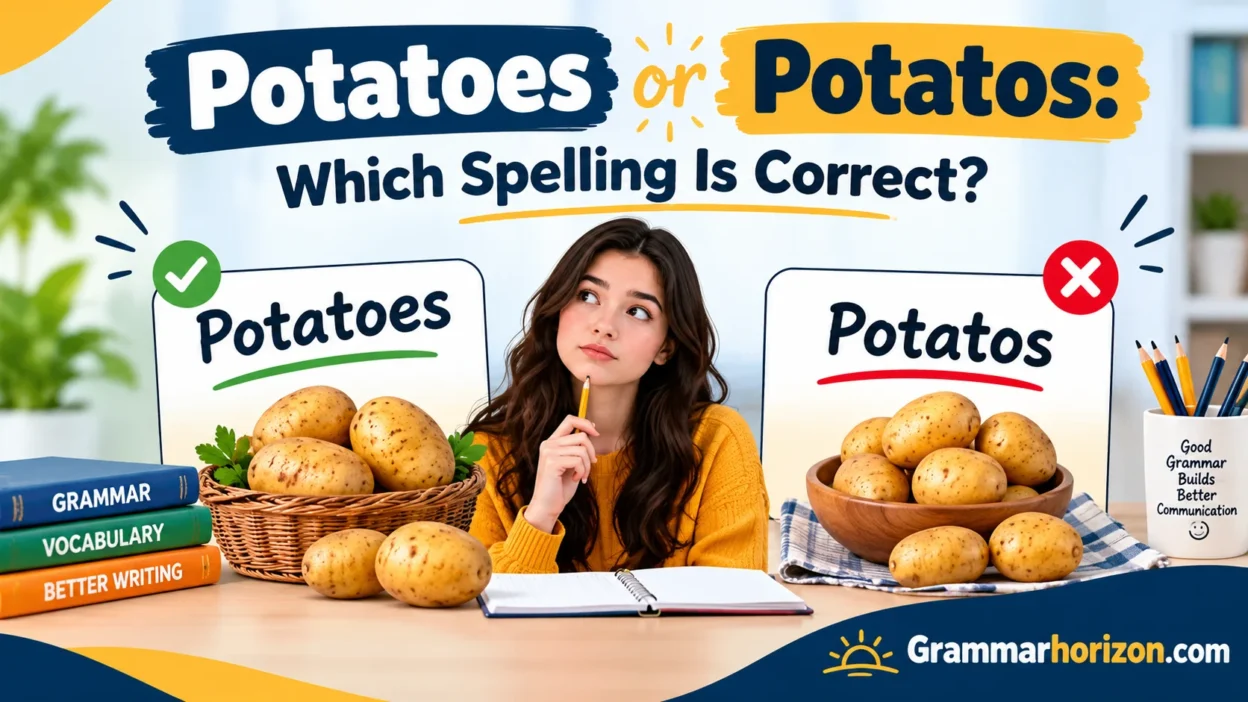
Potatoes or Potatos is a common spelling question for English learners. The correct plural is potatoes, while potatos is a misspelling. The main difference is the extra e before -s. This follows a common plural rule for some nouns ending in -o. Using the correct spelling improves clarity, accuracy, and clearer writing in standard English.
The word potatoes appears in recipes, school assignments, emails, articles, grocery lists, and everyday messages. Writers may use potatos because of confusion, spelling errors, or simple writing mistakes. Learning the correct pluralization pattern helps with grammar learning, reading practice, and vocabulary usage. It also helps students, professionals, and writers use the correct word with more confidence.
In modern written communication, correct orthography and familiar grammar patterns help create better message quality. The form potatoes follows accepted English grammar rules, while potatos is considered an error. Understanding this linguistic pattern reduces word confusion and improves natural fluency. It also supports stronger sentences, better written communication.
Quick Answer: Potatoes or Potatos?
Potatoes is the correct spelling. Potatos is incorrect in standard English.
The singular form is potato, while the plural form is potatoes.
- One potato
- Two potatoes
- Several potatoes
- A bag of potatoes
- Potatos ❌
For example:
“We bought five potatoes from the grocery store.”
The important detail is the -es ending. You don’t simply add -s to make the plural. The correct spelling changes potato to potatoes.
Potatoes or Potatos: What Is the Difference?
The difference between potatoes and potatos is spelling rather than meaning. Potatoes is the accepted plural form of potato. Potatos results from applying a simpler plural pattern that doesn’t work for this particular word.
English has many nouns that form plurals by adding -s. For example, book become books, and car become cars. That pattern can make potatos seem logical at first glance.
However, English plural formation isn’t completely predictable. Some nouns ending in -o use -es. That’s why potato become potatoes instead of potatos.
Think of the final e as part of the plural spelling:
potato → potatoes
That small letter is easy to overlook when you’re typing quickly. Still, it makes the difference between the standard spelling and a misspelling.
Why Is the Plural of Potato “Potatoes”?
The plural potatoes follows a traditional English spelling pattern for certain nouns ending in -o. These nouns often add -es rather than simply adding -s.
The pattern appears in several familiar words:
| Singular | Plural |
| potato | potatoes |
| tomato | tomatoes |
| hero | heroes |
| echo | echoes |
| torpedo | torpedoes |
This pattern isn’t universal. English also contains nouns ending in -o that take only -s.
For example:
| Singular | Plural |
| photo | photos |
| piano | pianos |
| radio | radios |
| video | videos |
| zoo | zoos |
This explains why learners sometimes struggle with words like potato. There isn’t one simple rule that applies to every English noun ending in -o.
The safest approach is to learn common plural forms individually. With frequent words such as potato and tomato, the correct pattern quickly becomes familiar.
Potatoes or Potatos: Singular and Plural Forms
Understanding the difference between singular and plural forms makes the spelling easier.
Potato refers to one potato or the food as a singular countable noun.
For example:
- “I baked one potato.”
- “She peeled a potato.”
- “This potato is ready to eat.”
When you’re talking about more than one, use potatoes.
- “I baked three potatoes.”
- “She peeled six potatoes.”
- “These potatoes are ready to cook.”
The basic pattern is straightforward:
One = potato
More than one = potatoes
Potatos = incorrect spelling
This distinction also helps you spot errors during proofreading. If the sentence refers to several potatoes, check whether the word contains the -es ending.
Potatoes or Potatos: Example Sentences
Real sentences make spelling rules easier to remember. Notice how potatoes work naturally in different situations.
Correct Examples With “Potatoes”
- We bought four potatoes for dinner.
- These potatoes need to be washed before cooking.
- She mashed the potatoes with butter and milk.
- The farmer harvested thousands of potatoes this season.
- I sliced the potatoes into thin pieces.
- The roasted potatoes smelled delicious.
- They planted potatoes in the garden.
- Please put the potatoes in the pantry.
- These potatoes are too large for the recipe.
- He cooked the potatoes until they became tender.
Each example uses potatoes as the plural of potato.
Incorrect Examples With “Potatos”
The following sentences contain the common spelling error:
- We bought four potatos for dinner. ❌
- She mashed the potatos with butter. ❌
- The farmer harvested several potatos. ❌
- These potatos need to be washed. ❌
The corrections are simple:
- We bought four potatoes for dinner. ✅
- She mashed the potatoes with butter. ✅
- The farmer harvested several potatoes. ✅
- These potatoes need to be washed. ✅
The meaning doesn’t change. Only the spelling needs correction.
Common Mistakes With Potatoes and Potatos
Several mistakes can lead writers toward potatos. Understanding them can help you avoid the error.
Adding Only “S”
The most common mistake involves treating potato like a regular noun that takes -s.
A writer may think:
potato + s = potatos
That calculation looks reasonable. English spelling doesn’t always work that way, though.
The accepted form is:
potato + es = potatoes
Assuming Every “-O” Word Uses the Same Rule
Another mistake comes from overgeneralizing. Someone may learn that photos and pianos use -s and then apply the same pattern to potato.
That doesn’t work.
Compare these forms:
- potato → potatoes
- tomato → tomatoes
- photo → photos
- piano → pianos
English has several plural patterns. Learning the individual word is often more reliable than forcing every noun into one rule.
Forgetting the Extra “E”
When you’re typing quickly, the e before the final s can disappear.
This is especially common in informal writing. A quick proofreading pass can catch it immediately.
Why “Potatos” Is Incorrect
Potatos is incorrect because it doesn’t follow the standard plural spelling of potato.
The correct form contains -es:
potato → potatoes
The incorrect form removes the e:
potato → potatos
This isn’t a difference between American and British spelling. Potatoes is the standard plural spelling in both major varieties of English.
That point matters because some spelling differences between American and British English are legitimate. For example, color and colour represent different accepted conventions. Potatos, however, aren’t simply a regional alternative to potatoes.
Potatoes or Potatos in American English
In American English, potatoes is the standard plural spelling of potato.
You’ll see the word in ordinary contexts such as cooking, gardening, farming, grocery shopping, and nutrition.
Consider these examples:
- “The recipe calls for two potatoes.”
- “We bought a bag of potatoes.”
- “The garden produced plenty of potatoes.”
- “Roasted potatoes make an easy side dish.”
Whether you’re writing casually or formally, potatoes remains the correct choice.
Other Words Similar to Potato
Learning related words can make the spelling pattern easier to remember. Several common nouns ending in -o form plurals with -es.
Words That Commonly Take “-es”
- potato → potatoes
- tomato → tomatoes
- hero → heroes
- echo → echoes
- veto → vetoes
However, other words ending in -o take -s:
- photo → photos
- piano → pianos
- radio → radios
- video → videos
- studio → studios
This contrast is important. You shouldn’t assume that every noun ending in -o follows the same plural rule.
For potato, the answer is simply potatoes.
How to Remember the Correct Spelling of Potatoes
A simple memory trick can save you from repeating the same mistake.
Pair potato with tomato:
potato → potatoes
tomato → tomatoes
Both words use -es in their standard plural forms. Since they’re common food words with similar endings, remembering them together can be useful.
Another trick is to focus on the final three letters:
oes
The plural potatoes ends with -oes, not merely -os.
When proofreading, ask yourself:
“Am I talking about one potato or more than one?”
If it’s more than one, choose potatoes.
Potatoes or Potatos in Formal and Informal Writing
Correct spelling matters even when the context feels casual. A misspelled word can distract readers or make otherwise polished writing look careless.
Use potatoes in:
- School assignments
- Recipes
- Business writing
- Articles and blog posts
- Emails
- Grocery lists
- Menus
- Social media posts
- Educational materials
Informal writing may contain spelling mistakes, abbreviations, and slang. That doesn’t make potatos an accepted spelling.
If you’re unsure, remember the simplest rule: potatoes is correct whenever you mean more than one potato.
Quick Comparison: Potatoes or Potatos
| Feature | Potatoes | Potatos |
| Standard spelling | Correct | Incorrect |
| Plural of potato | Yes | No |
| Singular form | No | No |
| Uses -es | Yes | No |
| Suitable for formal writing | Yes | No |
| Standard American English | Yes | No |
The table highlights the key point: potatoes is the standard plural form.
A Simple Spelling Test
Here’s an easy way to check yourself.
Imagine a sentence containing a number:
“I bought seven ______.”
Because seven means more than one, the plural form is required.
The correct sentence is:
“I bought seven potatoes.”
Now remove the number:
“I bought a ______.”
The singular form works:
“I bought a potato.”
This simple substitution test works well when you’re writing quickly. It also helps English learners understand why the word changes.
Conclusion
The correct plural of potato is potatoes, not potatos. The added -es follows the accepted plural spelling pattern in standard English. Remembering this simple rule can help you avoid a common misspelling and make your writing clearer and more accurate.
FAQs
Q1. Is it potatoes or potatos?
Potatoes is the correct spelling. Potatos is a common misspelling.
Q2. Why does potato become potatoes?
Potato becomes potatoes because it follows a plural pattern in which -es is added instead of only -s.
Q3. Is potatos ever correct?
No. In standard English, potatos is not the correct plural spelling of potato.
Q4. What is the plural of potato?
The plural of potato is potatoes.
Q5. Why is there an extra e in potatoes?
The e is part of the -es ending used to form the standard plural potatoes.
Q6. Is potatoes grammatically correct?
Yes. Potatoes is the grammatically and orthographically correct plural form of potato.