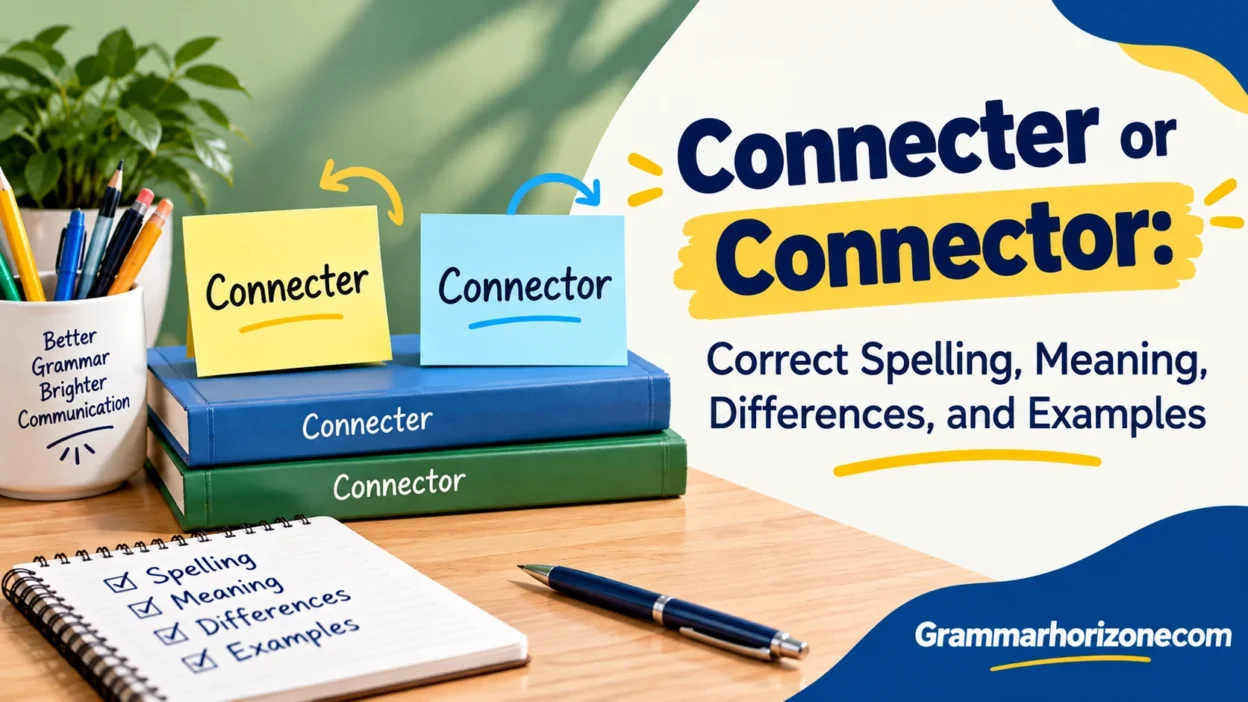
Connecter or Connector is a common spelling question in modern English because both words look similar. However, Connector is the correct spelling and the preferred choice in standard English, especially in American English. A connector is a noun that describes a person, device, or component that connects two or more things. It serves as a joining device or connection point for linking, joining, combining, attaching, or binding parts. Understanding its definition, meanings, and grammatical roles helps reduce word confusion and improves word choice in everyday communication.
In technical writing, electronics manuals, computer guides, and product descriptions, electrical connectors, cable connectors, computer connectors, and network connectors help create electronic connections between linked components. The verb connect describes the action of joining things, while connection refers to the link or relationship between them. These different word forms have distinct uses, so understanding usage rules, spelling rules, and language rules helps prevent common mistakes. For example, “The connector links the cable to the computer” and “The technician checked the connecting devices before starting the machine” demonstrate correct grammar and practical sentence examples.
Although Connecter appears as a less common variant, Connector remains the preferred spelling and standard choice in professional writing, technical communication, and everyday writing. Learning these spelling differences, similar spellings, and language conventions supports grammatical accuracy, writing accuracy, and effective communication. Whether you’re preparing an article, a grammar guide, a writing guide, or business conversations, choosing the correct word strengthens your English vocabulary, communication skills, and written communication. Following standard usage, modern usage, and English grammar also helps you communicate clearly and use technical terms correctly.
Quick Answer: Connecter or Connector?
Connector is the correct and preferred spelling for standard modern English. Use it when referring to something or someone that connects, joins, or links separate things.
Connecter is a much less common spelling variant. Although it may appear in some dictionaries or older texts, connector is the usual choice in professional, academic, technical, and everyday writing.
Here are a few examples:
- Correct: The USB connector doesn’t fit the computer port.
- Uncommon: The USB connecter doesn’t fit the computer port.
- Correct: Sarah is a natural connector who brings people together.
- Correct: The technician replaced the damaged cable connector.
Easy rule: When you mean a person or thing that connects something, use connector.
Comparison Overview: Connector or. Connecter
The two spellings look similar, but their popularity and acceptance in modern writing differ.
| Feature | Connector | Connecter |
| Spelling | Standard and preferred | Rare variant |
| Part of speech | Noun | Noun |
| Basic meaning | A person or thing that connects | Generally the same intended meaning |
| Common usage | Widely used | Uncommon |
| Technical writing | Recommended | Usually avoided |
| Professional writing | Preferred | Less familiar |
| Pronunciation | kuh-NEK-ter | Generally similar |
| Best choice for everyday writing | Yes | Usually no |
The main difference is standard spelling and common usage, not a clear difference in meaning. Both forms may communicate the same idea, but connector is the form you should normally choose.
Main Differences Between Connecter and Connector
Connector is the standard and preferred spelling, while connecter is a less common variant that most writers should avoid.
Difference in Spelling
The most noticeable difference is the final part of each word. Connector ends in -or, while connecter ends in -er.
- Connector: connect + or
- Connecter: connect + er
The spelling connecter might seem logical because English frequently uses the ending -er to describe someone who performs an action. For example, a person who teaches is a teacher, and a person who writes is a writer.
However, English doesn’t follow one universal rule for forming nouns. Some words use -or, and others use -er. The established spelling of this particular noun is connector.
Difference in Meaning
In ordinary English, connector and connecter generally refer to the same idea. Both may be intended to describe a person or object that connects separate things.
For example, a connector can join two cables, link a device to a computer, or describe someone who introduces people with shared interests.
The uncommon spelling doesn’t normally indicate a separate type of component or person. Therefore, writers shouldn’t invent a difference in meaning simply because the words have different endings.
Difference in Grammar and Part of Speech
Both spellings function as nouns when they describe a person or thing that connects.
To understand the relationship between these words, consider the following examples:
- Connect: A verb meaning to join or link things.
- Connection: A noun describing a link, relationship, or state of being connected.
- Connected: An adjective or past participle meaning joined or linked.
- Connector: A noun naming the person or thing that creates the connection.
For example, in the sentence “The connector joins two electrical wires,” the word connector identifies the component performing the action.
By contrast, in “The connection between the devices is stable,” the word connection describes the link itself.
Difference in Pronunciation
In American English, connector is pronounced kuh-NEK-ter. It has three syllables, with the strongest stress on the second syllable.
The uncommon spelling connecter is generally pronounced similarly. As a result, pronunciation won’t reliably tell you which spelling to use.
When writing, remember the standard form instead of relying on the sound of the word.
Difference in Modern Usage
The word connector appears in many areas of modern life. It’s common in electronics, computing, engineering, plumbing, manufacturing, and professional networking.
Examples include:
- USB connector
- Electrical connector
- Cable connector
- Pipe connector
- Network connector
- Software connector
You may encounter connecter in less common writing, older sources, or dictionary discussions. However, its appearance doesn’t make it equally suitable for everyday use.
When accuracy matters, follow established spelling conventions and use the terminology found in relevant technical documents.
What Does Connector Mean?
A connector is a person, object, device, or component that links two or more things. The precise meaning depends on the context, but the basic idea remains the same: it creates or supports a connection.
For instance, a connector might join electrical wires, attach a cable to a computer, link two software systems, or bring people together through shared interests.
Connector as a Physical Device
In technology and engineering, a connector is a component designed to join parts or allow compatible equipment to work together.
You can find connectors in computers, household appliances, vehicles, electrical systems, and plumbing installations.
Common examples include:
- USB connector: Connects a compatible cable to a device or port.
- Electrical connector: Joins conductors or connects equipment to an electrical circuit.
- HDMI connector: Connects compatible audio and video equipment.
- Pipe connector: Joins pipe sections or connects pipes to other components.
- Ethernet connector: Provides a connection for compatible wired network equipment.
Consider this sentence:
The technician replaced the damaged cable connector before testing the equipment.
Here, connector refers to a physical component that helps establish a connection between parts.
Connector as a Person
The word can also describe someone who brings people together. In business, networking, and social settings, a connector often introduces people who might benefit from knowing one another.
For example:
Maria is a natural connector who introduces new employees to experienced professionals.
Maria doesn’t need a physical device to make a connection. Instead, she builds relationships and helps people meet.
This meaning is useful when discussing leadership, professional networking, community building, and teamwork.
Connector in Grammar and Writing
In writing, a connector can refer to a word or expression that links ideas and shows how they relate.
Common examples include:
- However: Introduces a contrast.
- Therefore: Shows a result or conclusion.
- Furthermore: Adds supporting information.
- Meanwhile: Connects events happening during the same period.
- For example: Introduces a specific illustration.
Consider this example:
The instructions looked complicated. However, the installation was simple.
The word however connects the ideas by showing a contrast. Depending on the grammatical context, such words may also be called transition words, linking expressions, or conjunctive adverbs.
What Does Connecter Mean?
Connecter is a recognized but uncommon variant of connector. It generally carries the same basic meaning: a person or thing that connects separate items.
The spelling may look natural to someone who knows how English forms nouns such as teacher, writer, and builder. Nevertheless, the established form for ordinary modern usage is connector.
Is Connecter a Real Word?
Yes, connecter appears as a less common variant in some dictionary sources. However, recognizing a spelling variant doesn’t mean that it is the preferred choice in contemporary writing.
English contains many uncommon variants, historical forms, and regional expressions. Some remain understandable even though most writers rarely use them.
For example, if you’re preparing a school assignment, writing a product description, or explaining how a computer component works, connector is the safer and more familiar option.
Why Do People Write Connecter?
The confusion often comes from a common English word-building pattern. Writers know that adding -er to a verb can create a noun describing someone who performs an action.
Examples include:
- Teach → teacher
- Write → writer
- Build → builder
- Drive → driver
- Connect → connector
The final example may surprise some readers because the word uses -or instead of -er. However, English spelling depends on established word forms, not just what seems logical.
The best approach is to learn connector as the standard noun rather than trying to apply one suffix rule to every English word.
Why Is Connector the Preferred Spelling?
The strongest reason to choose connector is its established position in modern English. It is the familiar spelling used in general communication and technical terminology.
Established Dictionary Usage
Dictionaries help writers distinguish standard spellings from uncommon variants. When checking a word, pay attention to its main entry, definition, spelling notes, and usage labels.
For this word, the practical lesson is straightforward: use connector unless a specific source or naming convention requires a different spelling.
A dictionary may recognize an uncommon form without recommending it for everyday use. That’s why checking both the spelling and the usage information can help you make a better decision.
Established Technical Usage
Technical writing depends on consistent terminology. Engineers, technicians, manufacturers, and customers need to recognize the same component names when reading instructions or discussing equipment.
Imagine ordering a replacement part for a laptop. Searching for USB connector uses the familiar term that readers are more likely to recognize in product descriptions.
The same principle applies to electrical equipment, networking hardware, plumbing parts, and software integrations.
Consistent terminology makes technical information easier to find, understand, and use.
Examples of Connector in Sentences
Examples make it easier to understand how connector works in different situations. The following sentences show its use in everyday communication, technical writing, and professional settings.
| Context | Example sentence |
| Electronics | The USB connector is damaged and needs replacing. |
| Electrical work | The electrician checked the wire connector for a secure fit. |
| Plumbing | The pipe connector helps prevent leaks at the joint. |
| Computing | This connector links the device to the computer. |
| Networking | The technician replaced the Ethernet cable connector. |
| Professional relationships | James is a connector who introduces people with similar goals. |
| Writing | A transition word can act as a connector between ideas. |
| Manufacturing | Workers inspected each connector before packaging the equipment. |
| Software | The software connector transfers information between two applications. |
| Transportation | The new road provides a connector between the two highways. |
Each sentence uses connector as a noun that identifies something or someone that links separate things.
Correct and Uncommon Examples
Compare these sentences to see why the standard spelling matters.
Preferred: The connector is loose.
Uncommon: The connecter is loose.
Preferred: Please order a replacement cable connector.
Uncommon: Please order a replacement cable connecter.
Preferred: She is an excellent connector in her professional network.
Uncommon: She is an excellent connecter in her professional network.
The uncommon forms may still be understandable, but they can look like spelling errors to modern readers. Choosing connector helps your writing look clear and polished.
Common Types of Connectors
The word appears in several fields. Understanding these uses shows why connector is a practical and widely used noun.
Electrical Connectors
Electrical connectors join conductors or connect equipment to electrical circuits. Their designs vary according to the application, current, voltage, environment, and safety requirements.
Examples include wire connectors, terminal connectors, and power connectors.
Example: The electrician selected a connector suitable for the electrical installation.
Computer and Data Connectors
Computer connectors allow compatible devices, cables, and networks to communicate or exchange data.
Common examples include USB, HDMI, and Ethernet connectors. Although they serve different purposes, the spelling remains the same.
Example: Check the connector type before buying a replacement cable.
Audio and Video Connectors
Audio and video equipment uses connectors to carry sound or picture signals between compatible devices.
Examples include headphone connectors, audio connectors, and video connectors.
Example: The audio connector fits the microphone input on the recording device.
Mechanical and Plumbing Connectors
Mechanical connectors join parts, while plumbing connectors link pipes, hoses, and fittings. Their materials and designs depend on the systems in which they’re used.
Example: The plumber tightened the pipe connector to prevent leakage.
These examples share one feature: each connector helps establish a link between separate components.
Common Mistakes to Avoid
Even a small spelling question can cause confusion when writers assume that similar-looking words are interchangeable in every situation.
Here are the most common mistakes to avoid:
- Using connecter as the default spelling: Choose connector for ordinary modern writing.
- Claiming connecter has never existed: Some dictionaries recognize it as a less common variant.
- Assuming the two forms have different meanings: Their basic meanings generally overlap.
- Confusing connector with connection: A connector is the person or thing that links items, while a connection is the link or relationship itself.
- Confusing connector with connective: A connective can describe something that joins elements, especially in language, but it isn’t always interchangeable with connector.
- Applying suffix rules mechanically: English noun endings don’t follow one universal pattern.
For example, compare these sentences:
The connector joins the two cables.
The connection between the devices is stable.
The first sentence identifies a component. The second describes the link between devices. Both words are correct, but they serve different purposes.
Conclusion
Connector is the correct and preferred spelling in standard English, especially in American English. It refers to a person, device, or component that connects two or more things. Although Connecter appears as a less common variant, Connector is the better choice for professional writing, technical communication, and everyday usage. Using the correct spelling improves grammatical accuracy, prevents common mistakes, and helps you communicate clearly.
FAQs
Q1. Is Connecter or Connector the correct spelling?
Connector is the preferred spelling in standard English. It is widely used in everyday writing and technical documents.
Q2. What does the word Connector mean?
A connector is a person, device, or component that joins two or more things together.
Q3. Is Connecter a real word?
Connecter appears as a less common variant, but Connector is the standard and more widely accepted spelling.
Q4. How is Connector used in a sentence?
Example: “The technician replaced the damaged connector to restore the electrical connection.”
Q5. What is the difference between Connecter and Connector?
The main difference is their spelling and usage. Connector is the preferred standard form, while Connecter is much less common.