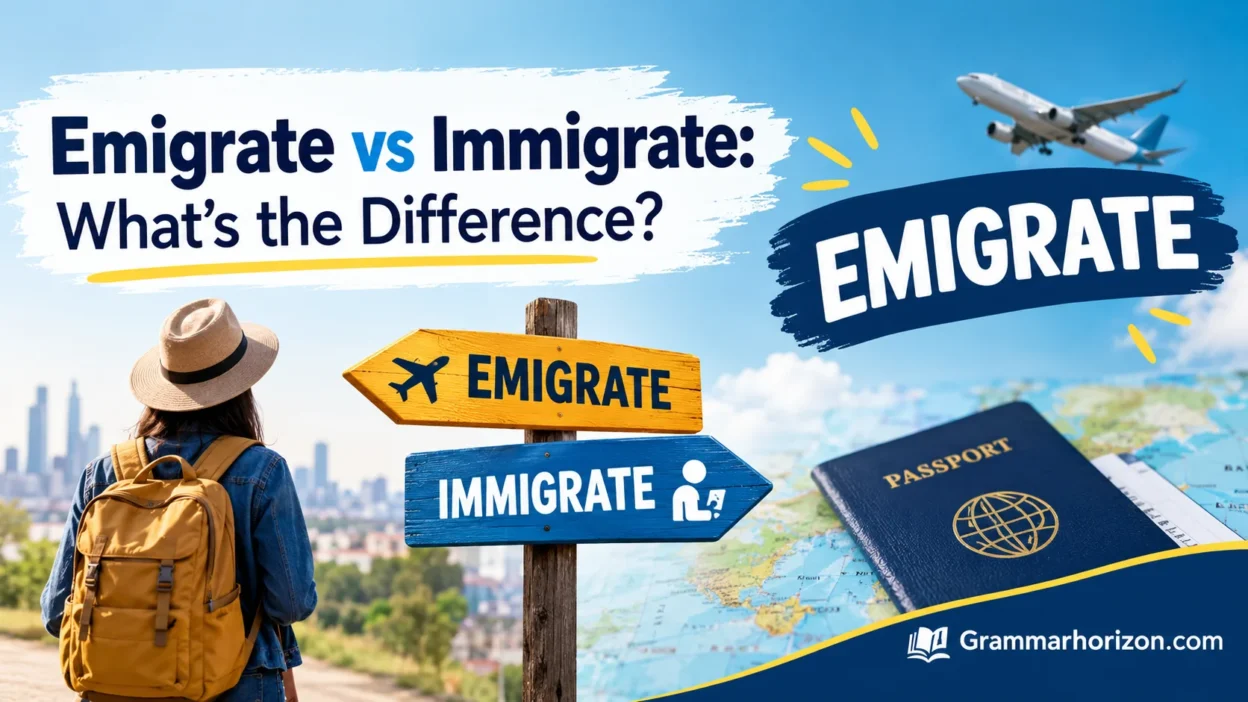
Emigrate vs Immigrate can confuse English learners because both describe moving from one country to another. The key difference is the direction. You emigrate when you leave a country and immigrate when you enter another country to live there. For example, someone moving from Pakistan to Canada can be described from different perspectives.
An emigrant leaves a country, while an immigrant enters another country. The forms emigrated, immigrated, emigrates, and immigrates follow the same pattern. Emigration means leaving a country, while immigration means entering another country. These words commonly appear in essays, applications, news reports, and everyday conversations.
The terms are often mixed up because they describe the same movement from a different viewpoint. If someone is moving permanently to another country, ask whether you mean leaving or entering. Understanding this distinction makes it easier to describe, relate, and focus on the correct word. It can also improve your writing, accuracy, and communication.
Quick Answer: Emigrate vs Immigrate
The simplest rule for emigrate vs immigrate is:
- Emigrate means to leave your country and move to another country.
- Immigrate means to enter another country and settle there.
- You emigrate from a country.
- You immigrate to a country.
- A person can emigrate from Pakistan and immigrate to Canada during the same move.
For example:
Maria emigrated from Mexico and immigrated to the United States.
Both verbs are correct because each one describes a different side of her move.
A useful memory trick is E = Exit and I = Into. If you remember those two words, the distinction becomes much easier.
What Does Emigrate Mean?
Emigrate means to leave your own country and move to another country to live there permanently or for an extended period.
Emigrate Definition
The important idea is departure. When you use emigrate, your sentence focuses on the country or place the person is leaving.
For example:
- She emigrated from India in 2019.
- His grandparents emigrated from Ireland.
- Thousands of people emigrated from the region during the conflict.
- My uncle emigrated from Pakistan to Australia.
Notice the common pattern: emigrate from.
If your sentence emphasizes where someone left, emigrate is usually the appropriate word.
How to Use Emigrate in a Sentence
The verb emigrate often appears with from because the action involves moving away from a place.
Consider these examples:
- “They emigrated from Spain after several years of planning.”
- “Her family emigrated from China when she was young.”
- “He plans to emigrate from his home country.”
- “Many residents emigrated from the area during that period.”
You can also mention the destination:
“James emigrated from England to New Zealand.”
Here, England establishes the departure point. The phrase to New Zealand identifies the destination.
Emigrate Meaning and Word Origin
The word emigrate comes from Latin emigrare, meaning to move away or depart from a place. The Latin element associated with moving out helps explain why the modern English word relates to departure.
That origin provides a useful memory aid, although you don’t need to know Latin to use the word correctly.
When you emigrate, think about someone walking out of one country’s door and beginning life somewhere else.
What Does Immigrate Mean?
Immigrate means to move into another country to live there permanently or for an extended period.
Immigrate Definition
Immigrate means to come into another country to live there, typically for an extended period or permanently.
The key idea is arrival. Unlike emigrate, which focuses on leaving, immigrate focuses on entering a new country.
For example:
- She immigrated to Canada in 2020.
- His parents immigrated to the United States.
- They immigrated to Australia for work.
- My friend immigrated to Germany after getting a job there.
The common grammatical pattern is immigrate to.
How to Use Immigrate in a Sentence
Use immigration when the destination matters most.
For example:
“David immigrated to Canada with his family.”
The sentence doesn’t emphasize David’s departure from his original country. Instead, it highlights his arrival and settlement in Canada.
Other examples include:
- “Her parents immigrated to the United States.”
- “Many families immigrated to the country during the twentieth century.”
- “He immigrated to France as a young adult.”
- “They hope to immigrate to another country someday.”
Immigrate Meaning and Word Origin
Immigrate also come from Latin. Its history relates to moving into a place.
That idea connects neatly with the modern meaning. If emigrate points outward from a country, immigrate points inward toward a new one.
The words look remarkably similar. Their prefixes provide a useful clue, but the prepositions from and to make the practical difference much clearer.
Emigrate vs Immigrate: The Key Difference
The central difference in emigrate vs immigrate is perspective.
Emigrate looks at the journey from the country being left. Immigrate look at the journey from the country being entered.
| Word | Main Meaning | Focus | Common Preposition | Example |
| Emigrate | Leave a country to live elsewhere | Departure | from | She emigrated from India. |
| Immigrate | Move into another country to live | Arrival | to | She immigrated to Canada. |
Here’s another way to picture it:
Country A → Person moves → Country B
From Country A, the person emigrates.
From Country B, the person immigrates.
The person’s physical movement hasn’t changed. Only the perspective has changed.
Emigrate vs Immigrate: One Move Can Use Both Words
This is where many learners get tripped up. A single international move can involve both emigration vs immigration.
Suppose Daniel leaves Brazil and settles in Portugal.
From Brazil’s perspective:
Daniel emigrated from Brazil.
From Portugal’s perspective:
Daniel immigrated to Portugal.
Both statements can describe the same person and the same move.
This distinction resembles looking at a road trip from opposite ends. One person sees the traveler leaving. The other sees the traveler arriving.
A Practical Example
Imagine a family moving from Pakistan to the United Kingdom.
You could write:
- “The family emigrated from Pakistan.”
- “The family immigrated to the United Kingdom.”
- “The family emigrated from Pakistan and immigrated to the United Kingdom.”
Each sentence is grammatically meaningful. The third sentence simply gives both perspectives at once.
Emigrate From vs Immigrate To
Emigrate describes leaving a country, while immigrate describes moving into another country to live there.
Emigrate From
Use emigrate from when identifying the country someone leaves.
Examples:
- She emigrated from France.
- They emigrated from India.
- His family emigrated from Italy.
- Thousands emigrated from the region.
The word from fits naturally because the movement begins at that location.
Immigrate To
Use immigrate to when identifying the country someone enters and settles in.
Examples:
- She immigrated to Canada.
- They immigrated to Australia.
- His family immigrated to the United States.
- Many workers immigrated to the country.
The word to identify the destination.
Emigration vs Immigration
The verbs emigrate vs immigrate have corresponding nouns: emigration vs immigration.
What Does Emigration Mean?
Emigration refers to the act or process of leaving one country to live elsewhere.
For example:
“The country experienced significant emigration during the decade.”
The focus remains on people leaving.
What Does Immigration Mean?
Immigration refers to the act or process of entering another country to live there.
For example:
“Immigration changed the country’s population during the period.”
The focus shifts toward people arriving.
| Term | Meaning | Perspective |
| Emigration | Leaving a country | Departure |
| Immigration | Entering another country | Arrival |
So, if 10,000 people leave Country A for Country B, Country A experiences emigration from those people. Country B experiences their immigration.
Emigrant vs Immigrant
The difference also appears in the nouns used for people.
Emigrant Definition
An emigrant is someone who leaves their country to live elsewhere.
Example:
“The emigrant left Italy and settled abroad.”
The word emphasizes the person’s departure from their original country.
Immigrant Definition
An immigrant is someone who moves to another country to live there.
Example:
“The immigrant settled in Canada with her family.”
Here, the focus is the person’s arrival in the new country.
Emigrant vs Immigrant
Consider someone named Ahmed who moves from Pakistan to Australia.
| Perspective | Correct Term |
| Leaving Pakistan | Emigrant |
| Arriving in Australia | Immigrant |
Ahmed hasn’t become two different people. The terminology changes because the viewpoint changes.
Emigrate vs Immigrate vs Relocate
Relocate is another related word, but it has a broader everyday meaning.
A person can relocate without crossing an international border.
For example:
“Sarah relocated from Chicago to Denver.”
That is relocation, but it isn’t necessarily immigration or emigration because both cities are in the same country.
By contrast:
“Sarah emigrated from the United States and immigrated to Germany.”
That movement crosses an international border and involves the specific departure-and-arrival terminology.
Common Mistakes With Emigrate and Immigrate
Common mistakes with emigrate and immigrate usually happen when writers confuse the country someone leaves with the country they enter.
Using Emigrate for the Destination
A common mistake is choosing to emigrate when the sentence focuses on arrival.
For example, if you want to emphasize Canada as the destination, immigrated to Canada clearly expresses that idea.
The easiest fix is to ask:
Am I talking about where the person left or where they arrived?
Using Immigrate for the Country Someone Leaves
Another common error occurs when writers use immigrate with the country of departure.
If the sentence emphasizes leaving Brazil, use:
“He emigrated from Brazil.”
If it emphasizes arrival in Portugal, use:
“He immigrated to Portugal.”
The preposition often gives you the answer.
Treating the Words as Exact Synonyms
Although both words involve international movement, they aren’t interchangeable in every sentence.
Calling someone an immigrant emphasizes their connection to the destination country. Calling someone an emigrant emphasizes their departure from their original country.
That perspective is the heart of the distinction.
How to Remember Emigrate vs Immigrate
To remember emigrate vs immigrate, think E = Exit for leaving a country and I = Into for entering a new country.
The E in Emigrate Means Exit
Think:
E = Exit
Someone who emigrates exits their country.
The I in Immigrate Means Into
Think:
I = Into
Someone who immigrates moves into another country.
This isn’t a formal grammatical rule. It’s simply a memory device that can help you choose the right word quickly.
The One-Sentence Memory Trick
Keep this sentence in mind:
You emigrate from a country and immigrate to a country.
For example:
“She emigrated from Pakistan and immigrated to Canada.”
If you remember from = emigrate and to = immigrate, many common mistakes disappear.
Emigrate vs Immigrate Examples
Here are several examples showing how the words work in real sentences:
| Sentence | Why It Works |
| She emigrated from India. | Focuses on leaving India. |
| She immigrated to Canada. | Focuses on entering Canada. |
| They emigrated from Spain to France. | Focuses on departure while naming the destination. |
| They immigrated to France from Spain. | Focuses on arrival while naming the origin. |
| His grandparents emigrated from Ireland. | Highlights their departure. |
| His grandparents immigrated to Australia. | Highlights their arrival. |
Notice how the same basic journey can support different wording.
Emigrate or Immigrate in Formal English
Both words commonly appear in formal contexts such as history, journalism, demographic research, government documents, academic writing, and immigration discussions.
In casual conversation, people often use simpler expressions such as move abroad, move to another country, or move overseas.
For example:
“My brother moved to Canada.”
This sounds perfectly natural in everyday speech.
In a more formal historical context, you might write:
“His family emigrated from India and immigrated to Canada.”
The more specific vocabulary makes the direction of movement explicit.
Read More: https://grammarhorizon.com/time-has-flew-by-or-time-has-flown-by/
Conclusion
Understanding Emigrate vs Immigrate becomes simple when you remember the direction. Emigrate means leaving a country, while immigrate means entering another country. Once you understand this difference, you can use both words correctly in everyday English, writing, and communication.
FAQs
Q1. What is the difference between emigrate and immigrate?
Emigrate means leaving one country to live elsewhere. Immigrate means entering another country to live there.
Q2. Is it correct to say emigrate to another country?
Yes. You can say someone emigrated from Pakistan or emigrated to Canada, depending on the sentence structure.
Q3. Is immigrate used for entering a country?
Yes. Immigrate describes moving into another country, usually to live there permanently.
Q4. What is an emigrant?
An emigrant is a person who leaves their country to live somewhere else.
Q5. What is an immigrant?
An immigrant is a person who moves into another country to live there.
Q6. How can I remember emigrate and immigrate?
Think of emigrate as leaving and immigrate as entering. This simple direction-based rule makes the difference easier to remember.