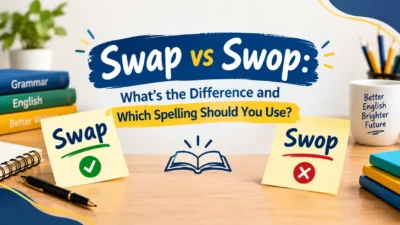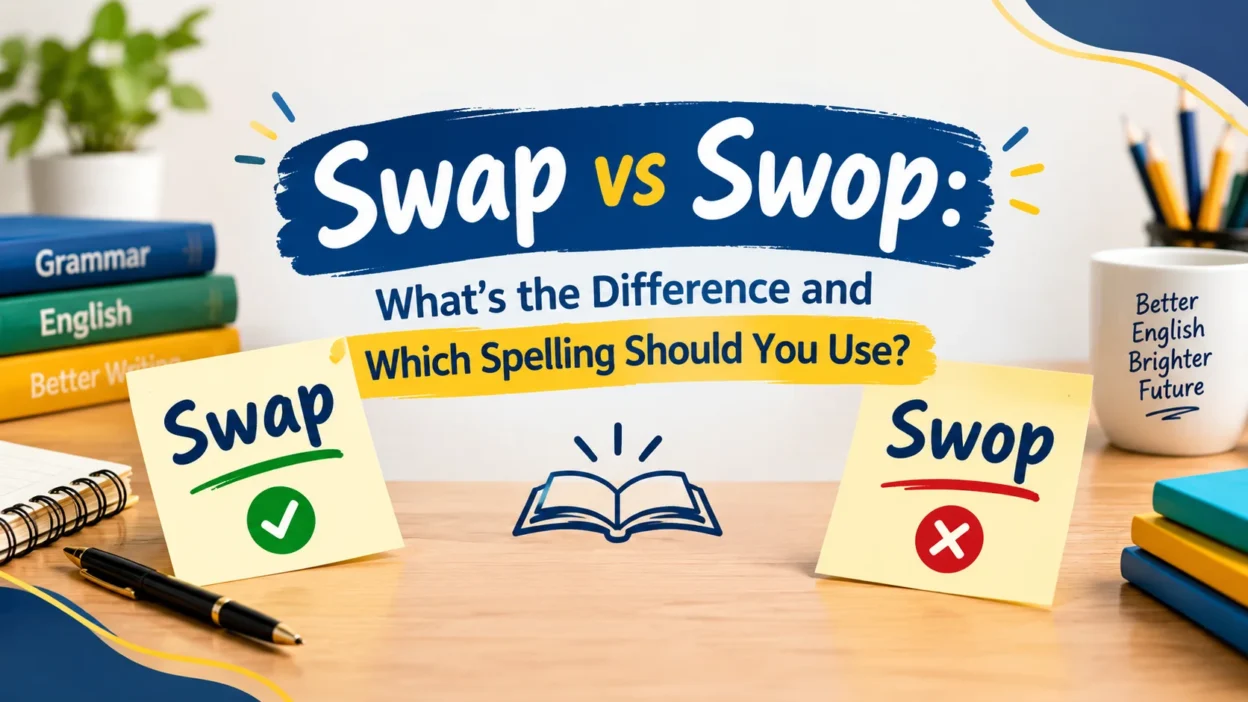
When comparing Swap vs Swop, the definition, usage, and frequency of each form show why swap is the more common choice. Both words describe exchanging one thing for another, and both can work as nouns and verbs. The main difference is in spelling, usage, and regional preference rather than the basic idea. Swap is widely accepted in modern English, especially American English, while swop remains a recognised variant with a stronger British and UK association. For clarity, swap usually feels more familiar and natural to a broad audience. For example, you might swap a sandwich for an apple at lunch, or swop cards with a friend.
Both forms are correct in their appropriate English varieties, so swop isn’t automatically a spelling mistake. It has an old, traditional place in British writing, while swap has become the default choice in much modern usage. In texts, emails, an article, an academic paper, a website, or another text, swap can communicate the meaning immediately to many readers. From my experience with English writing, choosing the more familiar form often improves clarity, especially when your content reaches a global audience. The practical question is simple: use swap when you want the most familiar choice, while swop can still fit comfortably when your writing follows a British style or traditional preference.
The two words share the same basic meaning and refer to an exchange, but their forms have different levels of familiarity. Swop carries a stronger regional association, while swap works naturally across several English varieties. The important point is to match your choice with your audience and context. If your writing needs to reach a broad audience, swap is generally the safer default. If your style reflects UK usage, swop can be a deliberate choice rather than a spelling mistake.
Quick Answer: Swap vs Swop
Swap and swop generally have the same meaning: to exchange one thing for another. Both can work as a verb and a noun.
However, swap is much more common and is usually the best choice for general writing. Swop is a legitimate variant, especially in British English, but it occurs far less often.
| Word | Meaning | Usage | Best General Choice |
| swap | Exchange one thing for another | Very common | Yes |
| swop | Exchange one thing for another | Less common, especially British | Sometimes |
A simple rule makes the choice easy:
Use “swap” by default. Use “swop” when a British regional style or an existing source specifically calls for it.
What Does Swap Mean?
Swap means to exchange one person, thing, position, responsibility, or item for another. The exchange can happen temporarily or permanently, depending on the context.
You might swap seats with someone on a train. You could swap clothes with a friend. At work, two employees might swap shifts.
The word works naturally in everyday conversation because it describes a familiar action: one thing goes out and another takes its place.
For example:
- Can we swap seats?
- I want to swap my old phone for a newer model.
- We decided to swap shifts on Friday.
- The children swapped toys during the break.
- Let’s swap ideas before we make a decision.
Swap as a Verb
As a verb, swap describes the act of exchanging something.
One common structure is swap A for B. Here, A is the thing you give up while B is what you receive.
For example:
I swapped my old laptop for a newer one.
Another useful structure is swap A with B.
I swapped seats with my brother.
The word can also describe exchanging roles, duties, or positions:
- The players swapped positions.
- We swapped responsibilities for the afternoon.
- They swapped shifts at work.
The context determines exactly what gets exchanged.
Swap as a Noun
Swap also works as a noun. In this form, it refers to an exchange itself rather than the action of exchanging.
For example:
- We made a swap after lunch.
- The book club organized a book swap.
- She got the jacket in a clothing swap.
- The two teams agreed to a player swap.
You’ll also see swap in more specialized fields. In finance, a swap can describe a contractual arrangement in which two parties exchange financial obligations or cash flows. That technical meaning is more specific than the everyday idea of trading one thing for another.
What Does Swop Mean?
Swop means essentially the same thing as swap. It can describe an exchange involving objects, positions, duties, or other things.
For example:
- They decided to swop seats.
- We could swop books after class.
- The players agreed to swop positions.
The important point is that swop isn’t a separate concept from swap. In ordinary usage, the two forms communicate the same basic idea.
Swop as a Verb
As a verb, swop means to exchange something.
It can appear in the same grammatical patterns as swap:
- swop something for something
- swop something with someone
- swop places
- swop roles
- swop seats
For example:
She decided to swop her seat with her friend.
The sentence has the same basic meaning if swop is replaced with swap.
Swop as a Noun
Swop can also function as a noun meaning an exchange.
For example:
The two collectors agreed to a swop.
You may encounter this form in British English contexts, although swap is considerably more common.
That difference in frequency is important. A word doesn’t have to be wrong simply because another spelling appears much more often.
Main Differences Between Swap vs Swop
The biggest difference between swap vs swop isn’t meaning. It’s usage and popularity.
Both words can describe an exchange. However, swap has become the overwhelmingly familiar form in modern general English.
| Difference | Swap | Swop |
| Core meaning | Exchange | Exchange |
| Verb | Yes | Yes |
| Noun | Yes | Yes |
| American English | Common | Uncommon |
| British English | Very common | Recognized variant |
| International English | Widely understood | Less familiar |
| General writing | Preferred | Usually unnecessary |
| Meaning difference | None in ordinary use | None in ordinary use |
This makes swap the practical choice for most writers.
If your audience includes readers from different English-speaking countries, swap offers broader recognition. If you’re writing specifically in a British variety and the context supports swop, the variant remains valid.
Swap vs Swop in American and British English
Regional English helps explain why both spellings exist.
Swap in American English
In American English, swap is overwhelmingly the normal spelling.
You’ll see it in everyday speech, business communication, technology, education, sports, and general writing.
For example:
- Swap your current password for a stronger one.
- The players swapped jerseys after the game.
- Can we swap shifts next week?
- The app lets users swap files between devices.
For American readers, swop may look unusual because swap is the established form they encounter most often.
Swop in British English
British English recognizes swop as a variant of swap. However, British writers aren’t required to use it.
In fact, swap remains extremely familiar in British English as well.
This creates an important distinction:
British English allows “swop,” but that doesn’t mean British English prefers it in every situation.
A British writer can naturally write:
Would you like to swap seats?
There’s no need to change swap to swop simply because the audience is British.
Which Spelling Is More Common?
Swap is much more common than swop.
That frequency difference explains why most learners should choose swap when they’re unsure.
Think of it like choosing the main road when several roads lead to the same destination. Swop can get you there too, but swap is the route more readers expect.
When to Use Swap
In most situations, swap is the strongest choice.
Use swap when you’re writing for:
- A general audience
- American readers
- International readers
- Students and English learners
- Business readers
- Website visitors
- Academic or educational audiences
- Professional communication
- Digital content
For example, a website might say:
Swap your old device for a new one.
That wording feels immediately familiar to a broad audience.
Likewise, a workplace email might say:
Could we swap shifts on Thursday?
There is nothing informal or incorrect about this use.
Swap in Everyday Expressions
Some common expressions strongly favor swap because it is the established form:
- swap places
- swap seats
- swap roles
- swap shifts
- swap ideas
- swap stories
- swap clothes
- swap gifts
- swap numbers
- swap recipes
These phrases are especially useful for English learners because they show how naturally swap fits into everyday communication.
When to Use Swop
Swop makes sense when you deliberately want to use the recognized British variant.
It can also appear when you’re preserving the spelling used in an original British source. For example, if you’re quoting or reproducing someone else’s wording, changing swop to swap could alter the original style.
However, don’t choose swop simply because you think it sounds more sophisticated or more British.
It doesn’t have a different meaning. It simply represents a less common variant.
For most readers, swap remains the cleaner default.
Common Mistakes With Swap vs Swop
The most common mistakes with swap vs swop involve assuming swop is incorrect, treating them as different in meaning, or choosing swop when swap is more appropriate for a broad audience.
Assuming Swop Is Incorrect
One of the most common misunderstandings is treating swop as an outright spelling error.
That’s not accurate.
Swop is a recognized variant of swap. Its lower frequency doesn’t make it inherently wrong.
The important distinction is between uncommon and incorrect. Those aren’t the same thing.
Treating Swap vs Swop as Different Meanings
Another mistake involves assuming that the spelling changes the meaning.
In ordinary English, it doesn’t.
Compare:
They swapped seats.
They swopped seats.
Both sentences describe an exchange of seats.
The difference is mainly one of usage and regional preference, not definition.
Mixing Regional Styles
Consistency matters in polished writing.
If you’ve chosen American English for an article, swap is the natural choice. If you’re following a particular British publication’s house style, its preference may differ.
Regional consistency doesn’t mean every word must follow a rigid formula. It simply means you should avoid making arbitrary spelling choices that distract readers.
Choosing Swop for a Global Audience
If your content targets readers worldwide, swap is usually the safer option.
A global audience may recognize swop, but swap has much wider familiarity.
This matters particularly in:
- SEO content
- Product descriptions
- User interfaces
- Help articles
- Business websites
- Educational materials
Clear communication usually beats unnecessary variation.
Swap vs Swop Examples in Sentences
Seeing both forms side by side makes the distinction easier.
| With swap | With swop |
| Can we swap seats? | Can we swop seats? |
| They swapped clothes. | They swopped clothes. |
| We decided to swap shifts. | We decided to swop shifts. |
| She swapped books with him. | She swopped books with him. |
| Let’s swap ideas. | Let’s swop ideas. |
The meaning remains essentially unchanged.
However, the swap examples generally sound more familiar to a wider modern English audience.
Swap vs Swop in Formal Writing
For formal writing, swap is generally the better default.
That doesn’t mean swop becomes grammatically wrong in a formal British context. Instead, swap simply offers greater familiarity and fewer chances of distracting the reader.
Consider a professional report:
The two departments agreed to swap responsibilities.
That sentence is straightforward and widely understood.
Using swop isn’t necessarily incorrect, but it may attract unnecessary attention because readers encounter it less often.
When your goal is clarity, the familiar form usually wins.
Is Swap More Versatile Than Swop?
Yes. Swap has broader practical use because readers across different English varieties recognize it immediately.
It also appears in numerous modern compounds and technical expressions.
Examples include:
- swap meet
- swap file
- swap space
- swap memory
- interest-rate swap
- currency swap
- clothing swap
- book swap
These expressions show how deeply swap has entered modern vocabulary.
The word isn’t limited to casual exchanges. It has developed established meanings in technology, finance, commerce, and social activities.
A Useful Case Study: Choosing a Word for a Website
Imagine you’re creating a website where users exchange used books.
Two possible calls to action are:
Swop Books
and
Swap Books
Both can communicate the intended action. Yet Swap Books is the stronger choice for a broad online audience.
Why?
- Swap is more familiar.
- It works naturally in American English.
- British readers also understand it immediately.
- International English users commonly recognize it.
- It requires no explanation.
The second option therefore reduces friction. A reader sees the button and understands the action instantly.
That’s a small wording decision, but good writing often depends on small decisions.
How to Remember Swap vs Swop
Use this simple rule:
When you’re unsure, choose swap.
Remember three points:
- Swap is the common spelling.
- Swop is a recognized variant.
- Both generally mean exchange.
You don’t need a complicated mnemonic.
Think of swap as your default setting. Think of swop as an alternative spelling that fits certain British English contexts.
Related Words and Expressions
The word swap appears in many useful expressions.
Swap Out
Swap out means to remove one thing and replace it with another.
We need to swap out the damaged battery.
This expression is especially common in technology, maintenance, and everyday American English.
Swap Places
Swap places means to exchange positions.
Let’s swap places so you can sit near the window.
Swap Roles
Swap roles means to exchange responsibilities or positions.
The students swapped roles during the activity.
Swap Something for Something
This structure clearly identifies what you give up and what you receive.
She swapped her old phone for a newer model.
Swap Ideas
This means to exchange thoughts, suggestions, or opinions.
The designers met to swap ideas for the new campaign.
These expressions reinforce why swap is such a useful and flexible word.
Read Also:https://grammarhorizon.com/council-vs-counsel/
Conclusion
Swap vs swop both describe the act of exchanging one thing for another. However, swap is the more common and widely recognise form in modern English, especially for international and American audiences. Swop is also correct, but it has a stronger association with British English and traditional usage.If you want the safest choice for general writing, choose swap. It feels familiar and natural to most readers. Use swop when you’re following British usage or intentionally keeping a traditional style. Ultimately, both forms are valid, but swap is usually the better default for a broad audience.
FAQs
Q1. Is swap vs swop correct?
Both swap vs swop are correct words. Swap is more common in modern English, while swop is recognized as a British variant.
Q2. Is swop a spelling mistake?
No. Swop isn’t simply a spelling mistake. It is a recognized variant of swap, although it appears less frequently in modern English.
Q3. Which is more common, swap or swop?
Swap is more common. It is widely used in American English and other varieties of modern English, while swop has stronger British associations.
Q4. Does swap mean the same as swop?
Yes. Swap vs swop generally have the same meaning. Both can describe exchanging one thing, item, or service for another.
Q5. Should I use swap in formal writing?
Yes. Swap is perfectly acceptable in formal writing when the context calls for the idea of an exchange. It’s also the more familiar choice for a broad audience.