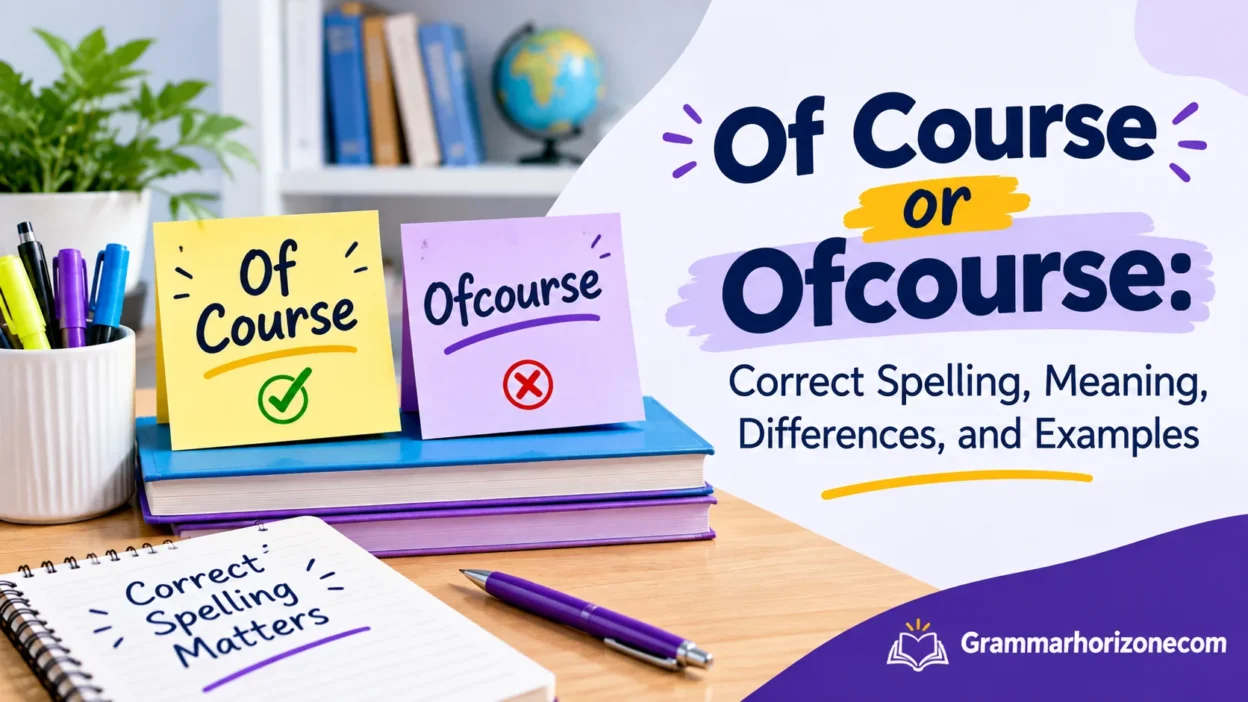
Of Course or Ofcourse is a common spelling question among English learners, students, bloggers, and native speakers. The correct spelling is of course, written as two separate words, while ofcourse is incorrect in standard English. Although the phrase sounds like a single word when spoken quickly, its spelling remains the same in emails, social media posts, blogs, and casual conversations. Learning this simple rule helps you common mistakes and improve your every day writing
Understanding correct usage becomes easier when you know that of course means certainly, naturally, or yes. You can use this polite expression in text messages, social media comments, informal writing, formal writing, academic writing, and professional emails. Its meaning and tone depend on the sentence and context. For example, “Of course, I can help you” expresses agreement naturally. Remembering the difference between the accepted spelling and the nonstandard spelling also improves your word choice, written communication, and overall English spelling accuracy.
Regular practice can strengthen your English grammar, English vocabulary, and writing skills. Pay attention to sentence structure, punctuation, and spelling rules when completing school assignments or preparing professional writing. Understanding this two-word expression and its contextual meaning helps you communicate with clarity and accuracy, maintain grammatical correctness, and make your message easier for readers to understand.
Quick Answer: Of Course or Ofcourse?
Of course is the correct spelling in standard American English. Ofcourse is incorrect and should be written as two separate words.
- Correct: Of course, I can help you with your project.
- Incorrect: Ofcourse, I can help you with your project.
- Correct: She will, of course, attend the meeting.
- Incorrect: She will, ofcourse, attend the meeting.
The phrase of course commonly expresses agreement, willingness, certainty, or something expected or already understood. Write it as two words in everyday conversations, text messages, academic assignments, business emails, and published articles.
Comparison Overview
The difference between of course and ofcourse is straightforward. One follows standard English spelling rules, while the other incorrectly combines two words.
| Feature | Of Course | Ofcourse |
| Correct spelling | Yes | No |
| Number of words | Two | One |
| Accepted in standard English | Yes | No |
| Meaning | Certainly, naturally, or yes | No separate standard meaning |
| Professional writing | Appropriate when the context fits | Avoid |
| Academic writing | Correct | Incorrect |
| Text messages | Correct | Still a misspelling |
| Hyphen required | No | No |
The main point is simple: the expression remains two words regardless of where or how you use it. You don’t need a different spelling for formal writing, casual conversations, or online communication.
Main Differences Between Of Course and Ofcourse
Although these spellings look similar, they don’t have the same status in standard English. Understanding the difference helps you avoid a mistake that can easily slip into everyday writing.
Of Course Is the Correct Spelling
Of course is a standard English expression made up of two separate words. It can mean “certainly,” “naturally,” or “yes,” depending on the situation.
For example:
- Of course, I’ll help you with your homework.
- You can, of course, contact me tomorrow.
- Of course, we should check the information before publishing it.
The expression works in both formal and informal settings. You can use it in a business email, a classroom discussion, a personal message, or an article.
Ofcourse Is a Common Spelling Mistake
Ofcourse combines the two words without a space. Although readers can usually understand what the writer means, the spelling doesn’t follow standard English usage.
For example:
- Incorrect: Ofcourse, I’ll call you later.
- Correct: Of course, I’ll call you later.
Writers often make this mistake because they type quickly or assume the expression functions as a single word. However, familiarity doesn’t make a misspelling correct.
Meaning and Usage Differences
The two forms don’t express different meanings. Instead, of course is the correct expression, while ofcourse is a misspelled version of it.
For example, if someone asks, “Can you help me?” the appropriate response is “Of course!” The response expresses willingness and agreement.
Writing “Ofcourse!” communicates the same intended message, but it contains a spelling error. In professional or academic writing, you should always use the standard form.
What Does Of Course Mean?
The expression of course has several related meanings. Depending on the situation, it can communicate agreement, permission, confidence, or the idea that something is obvious or expected.
Of Course as a Way to Agree
When someone asks a question or makes a request, of course can express a clear and positive response. It often sounds warmer and more enthusiastic than a simple yes.
Examples:
- “Would you like to join us for dinner?” “Of course!”
- “Do you agree with the new plan?” “Of course, it makes sense.”
- “Can you review my essay?” “Of course. Send it to me.”
- “Will you attend the meeting tomorrow?” “Of course, I’ll be there.”
In each example, the expression signals agreement or a willingness to respond positively.
Of Course to Show Willingness
You can use of course when someone asks for help or permission. It reassures the other person that their request is welcome.
Examples:
- “May I borrow your notebook?” “Of course.”
- “Could you explain this question again?” “Of course, let’s go through it.”
- “Can I sit here?” “Of course. Have a seat.”
- “Would you mind helping me carry these boxes?” “Of course not. I’ll help.”
Notice that of course not can be a positive response to a negatively worded request. It means the speaker doesn’t mind doing what the other person asks.
Of Course to Express Certainty
Sometimes, of course emphasizes that the speaker feels certain about something. It can reinforce a statement or make the speaker’s confidence more noticeable.
Examples:
- Of course, I remember where we parked the car.
- She will, of course, receive a copy of the report.
- Of course, regular practice can improve your writing skills.
- We can, of course, discuss the proposal again.
In these sentences, the expression adds emphasis rather than simply answering a question.
Of Course to Refer to Something Obvious or Expected
Writers also use of course when introducing a fact that seems natural, predictable, or already understood.
Examples:
- Of course, plants need water to grow.
- The store was closed because it was a public holiday, of course.
- Of course, the final decision depends on the available budget.
- He practiced every day, so of course he improved.
However, be careful with tone. Saying of course can sometimes make another person feel that their question was unnecessary.
Consider this exchange:
“Did you submit the assignment?”
“Of course I did!”
Depending on the speaker’s tone, the answer may sound confident or irritated. If you want to sound neutral, a simple “Yes, I did” may work better.
How to Use Of Course Correctly in a Sentence
Knowing the spelling is only half the job. You should also understand where the expression fits naturally within a sentence and how punctuation affects readability.
Of Course at the Beginning of a Sentence
You can place of course at the beginning when responding to a request, introducing an obvious fact, or expressing agreement.
Examples:
- Of course, I’ll send you the document today.
- Of course, students need enough time to prepare for an exam.
- Of course, you can ask me another question.
- Of course, we should check the figures before publishing the report.
When of course introducing a sentence as a comment on the whole statement, a comma commonly follows it.
Of Course in the Middle of a Sentence
The expression can appear in the middle of a sentence when it adds emphasis or provides a side comment.
Examples:
- We can, of course, arrange another meeting.
- The manager will, of course, review the proposal.
- This approach is, of course, only one possible solution.
- You should, of course, check your work before submitting it.
When of course interrupts the sentence as a parenthetical comment, commas help set it apart. However, punctuation depends on how the phrase functions in the sentence.
Compare these examples:
- I know, of course, that you tried your best.
- We can, of course, consider another option.
In both sentences, commas mark of course as an aside.
Of Course at the End of a Sentence
You can also place the expression at the end to reinforce a statement or add a conversational touch.
Examples:
- I’ll help you with the assignment, of course.
- You can join us whenever you like, of course.
- The final choice is yours, of course.
- We need to consider the cost, of course.
A comma before the phrase often helps when it functions as an afterthought. Read the sentence naturally to determine whether the phrase needs to be separated.
Of Course in Questions and Answers
In everyday conversation, of course works especially well as a short response.
| Question | Natural response |
| Can I ask you something? | Of course. |
| May I use your computer? | Of course. |
| Will you be there tomorrow? | Of course, I’ll be there. |
| Can you help me understand this rule? | Of course. Let’s look at an example. |
| Do you mind if I open the window? | Of course not. |
One important point: of course doesn’t always sound neutral. When someone asks for information they couldn’t reasonably know, answering with of course might sound impatient or dismissive. Choose your response with the listener in mind.
Of Course or Ofcourse Examples
Examples make the spelling rule easier to remember. In every standard-English example below, the correct expression contains a space between of and course.
Correct Examples Using Of Course
Here are examples from several everyday situations.
In casual conversation
- Of course, you can come to my birthday party.
- Of course, I’ll help you clean the kitchen.
- Yes, of course I remember that movie.
In professional communication
- Of course, I’ll send the updated report by Friday.
- We can, of course, schedule another discussion.
- Of course, please contact me if you need additional information.
In academic writing
- Of course, the results should be interpreted within the study’s limitations.
- Researchers must, of course, consider the quality of their evidence.
- Of course, further investigation may help answer the remaining questions.
In text messages
- Of course! See you at six.
- Of course, you can borrow my book.
- Sure, of course I’ll call you later.
These examples show that the expression works across different contexts. The spelling doesn’t change just because the tone becomes more formal or casual.
Incorrect Examples Using Ofcourse
The following sentences contain the same spelling mistake. Each one needs a space between the two words.
| Incorrect sentence | Correct sentence |
| Ofcourse, I’ll help you. | Of course, I’ll help you. |
| You can ofcourse join us. | You can of course join us. |
| She will ofcourse attend the event. | She will, of course, attend the event. |
| Ofcourse we understand the problem. | Of course, we understand the problem. |
| “Can I come?” “Ofcourse!” | “Can I come?” “Of course!” |
Remember: Correcting ofcourse doesn’t change the intended meaning. It simply fixes the spelling.
Before-and-After Sentence Corrections
Imagine a student writing an email to a teacher.
Before: Ofcourse, I will submit my assignment before the deadline.
After: Of course, I will submit my assignment before the deadline.
Now consider a workplace message.
Before: We can ofcourse review the figures during tomorrow’s meeting.
After: We can, of course, review the figures during tomorrow’s meeting.
Finally, consider a casual reply.
Before: Ofcourse you can use my laptop!
After: Of course you can use my laptop!
These are straightforward corrections. In the workplace example, commas also help show that the expression adds a comment to the sentence.
Is Of Course One Word or Two Words?
Of course is written as two words when you use it to mean “certainly,” “naturally,” or “yes.” It isn’t a single compound word, and you don’t need a hyphen.
The expression contains two separate words:
- Of: A preposition that helps form the expression.
- Course: A noun with several meanings, including a class, a direction, or a sequence of events.
Together, these words form an established expression with a meaning that goes beyond the individual words.
For example, you might write, “Of course, I’ll attend the class.” The phrase of course expresses agreement, while the class refers to a lesson or course of study.
Compare the correct and incorrect forms:
- Correct: Of course, that sounds interesting.
- Incorrect: Ofcourse, that sounds interesting.
- Incorrect: Of-course, that sounds interesting.
The space matters. The hyphen isn’t necessary, either.
Is Of Course Formal or Informal?
One advantage of of course is its flexibility. You can use it in casual conversations and professional settings, provided it suits the tone and purpose of your message.
However, a phrase that sounds friendly in one situation might seem overly casual or dismissive in another.
Using Of Course in Professional Writing
In business emails, workplace messages, and customer communication, of course can express willingness and cooperation.
Examples:
- Of course, I’ll send you the revised document this afternoon.
- We can, of course, discuss the proposal at our next meeting.
- Of course, our team will review your request.
These sentences sound natural and professional. Still, if you’re answering a sensitive question or responding to a complaint, consider whether the phrase could sound impatient.
For example, “Of course we checked your account” might sound defensive to an unhappy customer. A more helpful response would be, “We’ve reviewed your account and can explain what we found.”
Using Of Course in Academic Writing
You can use of course in academic writing when it serves a clear purpose. However, research papers and formal essays often benefit from precise, evidence-based statements rather than conversational emphasis.
Consider these examples:
- Conversational: Of course, the results show that the treatment worked.
- More precise: The results indicate that the treatment was effective under the conditions tested.
The second sentence is better if the evidence supports that specific conclusion. It avoids implying that the result was obvious before the research took place.
In academic writing, use of course when it genuinely clarifies your point. Don’t add it simply to make a statement sound stronger.
Using Of Course in Text Messages and Everyday Speech
In casual communication, of course is a common and natural expression.
For example:
- “Are we still meeting today?” “Of course!”
- “Can you bring my notebook?” “Of course.”
- “Do you want some pizza?” “Of course I do!”
Even in a quick text, write the expression as two words. Informal communication doesn’t require perfect formality, but the correct spelling remains the same.
Common Mistakes to Avoid When Using Of Course
Most errors involving this expression are easy to fix. A few other mistakes, however, involve punctuation, word choice, or tone.
Joining Of Course Into One Word
The most common mistake is writing ofcourse.
Incorrect: Ofcourse, I’ll call you later.
Correct: Of course, I’ll call you later.
Always check for the space between the two words.
Adding an Unnecessary Hyphen
Some writers use of-course because they assume the phrase needs a hyphen to connect its parts.
That isn’t correct in standard usage.
Incorrect: You can, of-course, contact us tomorrow.
Correct: You can, of course, contact us tomorrow.
Confusing Of Course With Of Coarse
The words course and coarse sound alike in many varieties of American English, but they have different meanings.
- Course: A class, route, sequence, or part of a meal.
- Coarse: Rough in texture or lacking refinement.
For example:
- Correct: Of course, you can take another course.
- Incorrect: Of coarse, you can take another course.
- Correct: The fabric feels coarse.
When you mean “certainly,” use of course, never of coarse.
Confusing Of Course With Off Course
This distinction is especially important because off course is a correct expression with a different meaning.
Of course means certainly, naturally, or yes.
Off course means away from the intended route, direction, or plan.
Compare these examples:
- Of course, I’ll help you find the station.
- The boat drifted off course during the storm.
- The discussion went off course and moved away from the main topic.
The first expression communicates agreement. The second and third describe a departure from an intended direction.
Forgetting Appropriate Punctuation
When of course introduces a sentence as a comment, a comma usually improves readability.
For example:
- Of course, we can make those changes.
- The report will, of course, include the latest figures.
However, don’t assume every use requires commas on both sides. The punctuation depends on the phrase’s position and function.
Using Of Course in a Dismissive Way
Spelling isn’t the only consideration. Tone matters, too.
Suppose a coworker asks whether you received an important email. Responding with “Of course I did!” might suggest that the question was unnecessary.
A neutral alternative would be:
“Yes, I received it this morning.”
Use of course when it communicates the right attitude, not simply because it fits the sentence grammatically.
Of Course vs. Similar Expressions
Several English expressions can replace of course. However, they don’t always carry exactly the same meaning or tone.
| Expression | Main meaning | Example |
| Of course | Agreement, certainty, or something expected | Of course, I’ll help. |
| Certainly | Polite or confident agreement | Certainly, I’ll review it. |
| Sure | Casual agreement or willingness | Sure, send it over. |
| Absolutely | Strong agreement or enthusiasm | Absolutely! That’s a great idea. |
| Naturally | Something expected or unsurprising | Naturally, we checked the details. |
Of Course vs. Certainly
Both expressions can communicate agreement, but certainly often sounds more formal or measured.
- Of course, I’ll send the report.
- Certainly, I’ll send the report.
The first sounds friendly and conversational. The second can sound more formal, especially in customer service or business communication.
Of Course vs. Sure
Sure is a short, informal way to agree to a request. Of course can sound more reassuring or enthusiastic.
- “Can you help me move this table?” “Sure.”
- “Can you help me move this table?” “Of course!”
Both responses are correct. Choose the one that fits the relationship and situation.
Of Course vs. Absolutely
Absolutely often expresses strong agreement or enthusiasm. It can be more emphatic than of course.
For example:
- “Should we launch the new project?” “Absolutely!”
- “Can I ask you a question?” “Of course.”
You could use either expression in some situations, but absolutely places more emphasis on the strength of the agreement.
Of Course vs. Naturally
Naturally suggests that something follows logically or should be expected.
For example:
- Of course, the team needs more time to prepare.
- Naturally, the team needs more time to prepare.
The first sounds conversational. The second can sound more formal or analytical, depending on the context.
Of Course vs. Of Course Not
Adding not changes an affirmative response into a negative one.
Examples:
- “Can I borrow your pen?” “Of course.”
- “Do you mind if I sit here?” “Of course not.”
- “Would you ever share my private information?” “Of course not.”
Use of course not to express a clear negative response, often with reassurance. As always, the speaker’s tone can affect how the answer sounds.
Why Do People Write Ofcourse Instead Of Of Course?
The spelling mistake is understandable, even though the correction is simple. Several habits can cause people to merge the two words.
- Fast typing: When writing quickly on a phone, people sometimes skip spaces or overlook small errors.
- Connected speech: In natural conversation, of course flows together. Listeners don’t hear a written space.
- Familiar compound words: English contains many single-word expressions, so writers may assume this phrase works the same way.
- Repeated online exposure: Seeing a misspelling in comments or messages can make it look familiar.
- Insufficient proofreading: A writer may focus on the message’s meaning and overlook a small spelling error.
None of these reasons makes ofcourse correct in standard English.
For published articles, academic assignments, resumes, and professional emails, review the spelling before sending or submitting your work. A spelling checker can help, although you should still read the finished text yourself.
How to Remember the Correct Spelling of Of Course
You don’t need a complicated grammar rule to remember this expression. A simple memory trick works well.
Remember Of Plus Course
Think of the expression as two separate parts:
Of + course = of course
The same word course appears in familiar expressions such as a course of study, a golf course, and a course of action. Those examples can help you recognize the correct spelling.
Try this memory sentence:
“Of course, I completed the course.”
The first course appears in the expression of course. The second refers to a class or program of study. Seeing the two uses together makes the spelling easier to remember.
Use a Quick Proofreading Test
Whenever you type of course, pause and ask whether you mean “certainly,” “naturally,” or “yes.”
If you do, separate the words.
- Ofcourse, I understand. → Of course, I understand.
- We can of course reschedule. → We can, of course, reschedule.
- Of course you can join us. → Of course you can join us.
This quick check can prevent the same error from appearing throughout an article or email.
Conclusion
In conclusion, of course is the correct spelling, while ofcourse is an incorrect form in standard English. Always write of course as two separate words when you mean certainly, naturally, or yes. By remembering this simple spelling rule, you can improve your English grammar, avoid common mistakes, and make your everyday writing, emails, and professional communication clearer and more accurate.
FAQs
Q1. Is it of course or ofcourse?
Of course is the correct spelling in standard English. Ofcourse is incorrect because the expression consists of two separate words.
Q2. What does of course mean?
Of course means certainly, naturally, or yes. People use it to express agreement, confirm something, or show that something is expected.
Q3. Why do people write ofcourse as one word?
People often write ofcourse because they pronounce the expression quickly, making it sound like one word. However, the correct spelling remains of course.
Q4. Can I use of course in formal writing?
Yes, of course is acceptable in formal writing, academic assignments, business emails, and professional communication. However, choose your tone carefully because it can sometimes sound overly direct or informal, depending on the context.
Q5. How can I remember the correct spelling of of course?
Remember that of course always contains two words. Practice using it in sentences, such as “Of course, I can help you,” to reinforce the correct spelling.