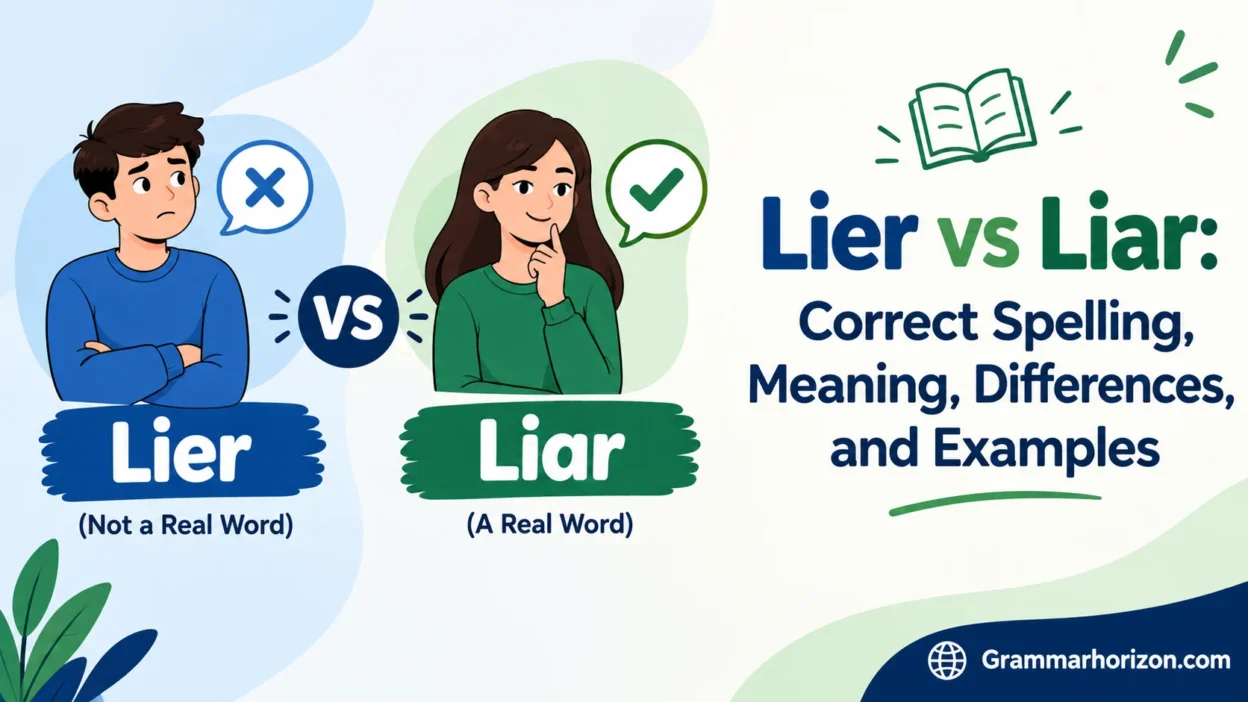
Lier vs Liar can confuse English learners because both words look similar and sound alike, but their meanings and uses differ. In standard American English, liar is the correct word for describing someone who doesn’t tell the truth or makes a false statement. A liar is a dishonest person who knowingly says something untrue. In contrast, lier is a rare word associated with someone or something that lies in a particular position or place to rest. Understanding the English verb lie helps explain this common confusion because it can mean either telling an untruth or reclining in a resting position.
In English grammar, choosing the correct spelling depends on the context and intended meaning. For example, “He is a liar because he told an untruth” uses liar correctly. Using lier to describe someone who tells lies is generally a spelling mistake. Recognizing this distinction improves grammatical correctness, sentence clarity, and writing accuracy. When checking word choices, looking at the meaning first makes correct usage easier to understand. This method helps language learners avoid spelling errors, improve their English vocabulary, and develop stronger writing skills. Learning the verb meaning, noun meaning, and different word forms also helps you choose the correct word and create a clear sentence.
Whether you’re writing conversations, school assignments, emails, or professional documents, correct spelling supports effective written communication. The words lie, lying, truthfulness, and untruthful statements relate to honesty, but each has a different role. Careful word choice, word selection, and sentence structure help prevent confusion and express ideas clearly. These usage differences matter in academic writing, professional communication, and everyday English. With better language understanding, you can choose the correct expression, avoid unnecessary spelling mistakes, and communicate your intended meaning confidently.
Quick Answer: Lier vs Liar?
Liar is the correct, standard word when you mean a person who tells lies or deliberately makes false statements. Lier is a rare English noun associated with someone or something that lies in a position or lies in wait.
Here are the basic differences:
- Liar: A person who tells lies. Example: Everyone discovered that he was a liar.
- Lier: A rare word connected to lying in a particular position or waiting in concealment. In everyday writing, a phrase such as someone lying down is usually clearer.
Remember this simple rule: If you’re talking about dishonesty, use liar. In ordinary American English, that’s almost always the word you need.
Comparison Overview: Lier vs Liar
Although lier and liar differ by only one vowel, their meanings aren’t interchangeable. The following table highlights the important distinctions.
| Feature | Liar | Lier |
| Part of speech | Noun | Noun |
| Meaning | A person who tells lies | A rare term associated with lying in a position or lying in wait |
| Standard spelling for dishonesty | Yes | No |
| Frequency in everyday English | Common | Rare |
| Related verb | Lie, meaning to tell an untruth | Lie, meaning to rest or remain in a position |
| Typical context | Conversations, stories, arguments, and descriptions of dishonesty | Rare or specialized descriptive contexts |
| Example | The witness admitted that he was a liar. | The term may describe someone lying in wait. |
The most important difference concerns meaning. Liar describes a person who tells untruths, while lier relates to a different sense of the verb lie. Because the second noun is uncommon, most writers rarely need it.
What Does Liar Mean?
A liar is a person who deliberately tells falsehoods or misleads others instead of telling the truth.
Definition of Liar
A liar is a person who tells lies or deliberately presents something false as the truth. The word is a noun and usually carries a negative meaning because it suggests dishonesty or an attempt to mislead someone.
For example, imagine that a student breaks a classroom window and tells the teacher that someone else did it. If the student knowingly makes that false claim, the teacher might describe the student as a liar.
The word can also describe someone who repeatedly hides the truth, invents stories, or gives false information to avoid responsibility.
Consider these examples:
- He is a liar who makes up stories to impress his friends.
- The witness was called a liar after investigators challenged his account.
- She apologized because she didn’t want her family to think she was a liar.
- Nobody trusted the salesman after he lied about the product.
In each sentence, liar refers to a person associated with telling lies.
One important distinction matters here: making a false statement doesn’t automatically make someone a liar. People can give incorrect information because they’re mistaken, confused, or unaware of the facts. The word generally suggests intentional dishonesty, although people sometimes use it loosely during arguments.
Examples of Liar in Everyday Sentences
The best way to understand liar is to see how it works in different situations. It commonly appears after linking verbs such as is, was, and seems, or after verbs such as called and considered.
In everyday conversation
“You’re a liar because you said you finished the work when you hadn’t started it.”
The speaker accuses someone of knowingly making a false claim.
At school
“The teacher didn’t call him a liar; she asked him to explain his conflicting answers.”
The example shows how a writer can discuss honesty without immediately labeling someone.
At work
“Employees lost confidence in the manager after discovering that he had repeatedly lied about deadlines.”
The sentence connects dishonesty with a loss of trust.
In a story
“The old liar finally confessed that the entire adventure had been invented.”
Here, liar describes a character who regularly tells false stories.
These examples also show that liar can describe a person’s general reputation or refer to a specific accusation. Context helps readers understand the intended meaning.
Synonyms and Related Words for Liar
English offers several alternatives to liar, but each word has its own tone and meaning. Choosing the right one helps you describe dishonesty more accurately.
| Word or phrase | Meaning and usage |
| Deceiver | Someone who misleads another person through lies or other methods |
| Fibber | Someone who tells small or relatively harmless lies; often informal |
| Dishonest person | A broad description of someone who acts without honesty |
| Untruthful person | Someone who doesn’t consistently tell the truth |
| Fraudster | Someone who uses deception, often for financial or personal gain |
| Fabricator | Someone who invents information or stories and presents them as real |
For example, fibber may sound playful when a child tells a small lie. By contrast, fraudster suggests more serious deception, often involving money, identity, or unlawful gain.
These words aren’t perfect substitutes for one another. If you want to describe someone who knowingly tells falsehoods, liar is usually the clearest choice.
What Does Lier Mean?
A lier is a rare English noun associated with someone or something that lies in a particular position or lies in wait, but everyday English usually uses clearer phrases such as “someone lying down.”
Definition of Lier
Lier is a real but rare English noun. It is associated with the verb lie in senses other than telling an untruth, particularly remaining in a position or lying in wait.
For example, someone hiding near a doorway and waiting for another person could be described through the phrase lying in wait. Although lier may appear in a specialized or dictionary context, most modern writers would choose the longer, clearer expression.
The word’s existence doesn’t mean you should use it freely in everyday writing. A word can be valid yet uncommon enough to confuse readers who don’t know its meaning.
Consider these examples:
- Unusual: The lier remained hidden near the entrance.
- More natural: The person remained hidden near the entrance, waiting for someone to arrive.
The second sentence communicates the intended action more clearly. That’s why lier rarely offers an advantage over familiar phrases in ordinary American English.
Examples of Lier in Context
Because lier is uncommon, it’s important not to invent examples that make it sound like the normal word for someone who lies down.
Consider these examples of the underlying physical or positional meaning:
- The dog is lying beside the fireplace.
- The patient was lying quietly in bed.
- The object lies flat against the surface.
- A guard was lying in wait near the gate.
Notice that these sentences use lying or lies, not lier. They demonstrate the meaning from which the rare noun is associated without forcing an unnatural word into the sentence.
If you encounter lier in a dictionary or older text, examine the surrounding sentence carefully. The writer may be referring to position or concealment rather than dishonesty.
Why Lier Is Rare in Modern English
The main reason is simple: English already has natural ways to describe someone or something resting in a position.
Instead of saying a lier on the couch, a modern writer would normally say a person lying on the couch. Instead of calling an animal a lier, the writer would usually describe where it rests.
This preference makes the noun unnecessary in most everyday situations.
There is also a practical issue. Readers commonly recognize liar as a word about dishonesty. When they see lier, many will assume the writer misspelled liar, especially if the sentence discusses trust, false statements, or accusations.
Therefore, even when lier is technically appropriate in a rare context, clearer wording is usually the better choice.
Main Differences Between Lier and Liar
The difference between lier and liar becomes clear when you examine their meanings, frequency, and use in sentences. Both forms relate to the verb lie, but they connect to different meanings of that verb.
Difference in Meaning: Lier vs Liar
The word liar refers to someone who tells an untruth. It can describe a person who makes a false statement once or someone who lies repeatedly.
By contrast, lier is a rare noun associated with lying in a position or lying in wait. It doesn’t serve as an alternative spelling of liar.
Compare these examples:
- Liar: Mark is a liar because he knowingly gave the police false information.
- Lier: The rare noun may refer to someone lying in wait, but a person hiding and waiting is clearer in everyday writing.
The meaning of the sentence determines the correct word. If you’re describing dishonesty, choose liar.
Difference in Usage and Frequency
Another important distinction is how often people use each word. Liar appears in ordinary conversations, books, news reports, and discussions about honesty. Lier, on the other hand, is rarely needed in modern American English.
Here are some situations where liar is the natural choice:
- Writing about a character who deceives others.
- Describing a false statement made intentionally.
- Discussing trust in personal or professional relationships.
- Reporting an accusation that someone has lied.
- Explaining the difference between truthfulness and dishonesty.
You probably won’t need lier in these situations. If you’re describing a person resting on a bed, for instance, simply write the person lying on the bed.
Difference in Examples and Context
Sometimes the easiest way to choose between two words is to look at the surrounding sentence. The following examples show how meaning determines the correct wording.
| Sentence | Correct wording | Reason |
| He is a ___ who never tells the truth. | Liar | The sentence describes dishonesty. |
| She called him a ___ after discovering the false story. | Liar | The noun identifies someone accused of lying. |
| The dog is ___ beside the fireplace. | Lying | The sentence describes a physical position. |
| The patient was ___ in bed. | Lying | The sentence uses the verb meaning to rest. |
| The guard was ___ in wait near the entrance. | Lying | The phrase describes concealment and waiting. |
Notice that the last three sentences use lying, not lier. That’s because the verb is usually more natural than the rare noun when describing a physical position.
Lier vs Liar: Common Grammar and Spelling Mistakes
Even experienced writers can confuse similar-looking words, especially when both sound alike. Recognizing the most common mistakes will help you avoid them.
Is Lier a Misspelling of Liar?
Not always. Lier is a real word, but it is incorrect when you intend to describe someone who tells lies. The two spellings have different meanings, so context matters.
Consider these examples.
Incorrect for the intended meaning:
- My brother is a lier.
- Everyone knows that she is a lier.
- The witness was a lier who invented the story.
Correct:
- My brother is a liar.
- Everyone knows that she is a liar.
- The witness was a liar who invented the story.
The mistake comes from choosing a spelling that looks as though it follows a familiar pattern. However, English doesn’t always form words in the way learners expect.
If your sentence concerns dishonesty, use liar.
Why Do People Spell Liar as Lier?
Several factors contribute to this spelling mistake.
- Similar pronunciation: In standard American English, lier and liar are generally pronounced alike.
- Visual similarity: The words differ by just one vowel, making the mistake easy to overlook.
- Confusion about word formation: Writers may assume that adding -er to lie should automatically produce lier.
- Fast typing: People sometimes choose the wrong spelling when writing quickly.
- Limited familiarity: Readers who haven’t encountered lier may not understand why it differs from liar.
Spell-checkers can help, but they don’t always identify a correctly spelled word used in the wrong context. The best solution is to check the meaning before choosing the spelling.
How to Use Liar Correctly in a Sentence
The word liar functions as a noun. You can use it after a linking verb, following an article, or as part of a longer description.
Here are some correct examples:
- He is a liar.
- She called the politician a liar.
- Nobody wants to be known as a liar.
- The story exposed him as a liar.
- A habitual liar often damages relationships through repeated dishonesty.
You can also use liar in direct speech:
“You’re a liar,” Jake said after discovering that the story wasn’t true.
The word carries a strong accusation, so consider your tone when using it. If you aren’t certain that someone deliberately lied, a more neutral sentence may communicate your point more fairly.
For example, instead of writing You’re a liar, you could say, What you said doesn’t match the evidence.
Liar vs Lied vs Lying
The words liar, lied, and lying look similar because they relate to the verb lie. However, they serve different grammatical purposes.
| Word | Part of speech | Meaning | Example |
| Liar | Noun | A person who tells lies | He is a liar. |
| Lie | Verb | To tell an untruth | Don’t lie about what happened. |
| Lied | Past-tense verb | Told an untruth in the past | She lied to her parents. |
| Lying | Verb form | Telling an untruth | He is lying about his age. |
The key distinction is that liar names a person, while lie, lied, and lying describe an action.
For example, consider these sentences:
- Present: He lies whenever someone asks about the incident.
- Past: He lied about where he had been.
- Ongoing action: He is lying to his friends.
- Noun: His friends now consider him a liar.
There’s another source of confusion: lie can also mean to rest or recline. When used in that sense, its forms differ.
| Physical meaning | Example |
| Lie | I need to lie down. |
| Lay | I lay down for an hour yesterday. |
| Lain | I have lain here long enough. |
| Lying | She is lying on the sofa. |
In standard English, lay is the past tense of lie when it means to recline. By contrast, laid is the past tense of lay when it means to put something somewhere: She laid the book on the table.
Keeping these verb forms separate makes the difference between lier and liar easier to understand.
How to Remember the Correct Spelling of Lier vs Liar
A simple memory trick can save you from repeating the same spelling mistake.
Remember this sentence: A liar tells lies.
The word liar contains the same vowel sequence you’ll see in lies. Both words relate to dishonesty in this memory aid.
Use the following steps when you’re unsure:
- Ask yourself whether the sentence describes someone who tells an untruth.
- If the answer is yes, write liar.
- If the sentence describes someone resting or waiting in concealment, use a natural phrase such as lying down or lying in wait.
- Read the sentence again to make sure the word fits its meaning.
For example, suppose you’re writing, My friend is a ___ because he invented the entire story. The sentence clearly describes dishonesty, so liar is the correct choice.
Think of lier as a rare word you may recognize in a dictionary, rather than the everyday spelling you need for a dishonest person.
Lier vs Liar: Which Word Should You Use?
For nearly all everyday writing about dishonesty, choose liar. It’s the standard noun for someone who tells lies, and readers will immediately understand what you mean.
Use lier only when its rare meaning genuinely fits your context. Even then, a more familiar expression will often make your writing easier to understand.
Here’s a practical guide:
- For school assignments: Write liar when discussing dishonesty.
- For emails and messages: Use liar when referring to someone who tells lies.
- For stories and essays: Use liar to describe a dishonest character.
- For descriptions of physical positions: Choose lying down, resting, or reclining.
- For descriptions of someone waiting in concealment: Use lying in wait when it fits the intended meaning.
The goal isn’t simply to choose a word that exists. It’s to choose the word that communicates your meaning clearly and naturally.
Conclusion
Understanding Lier vs Liar helps you improve your English grammar, spelling, and writing accuracy. Liar is the correct and commonly used word for a person who doesn’t tell the truth or makes a false statement. In contrast, lier is a rare word associated with someone or something that lies in a particular position. By learning their meanings, uses, and context, you can avoid spelling mistakes and communicate clearly in everyday English, academic writing, and professional communication. Always choose liar when describing a dishonest person.
FAQs
Q1. Is it lier or liar?
Liar is correct when referring to someone who tells lies. Lier is a rare word with a different meaning related to lying in a position.
Q2. What does liar mean?
A liar is a person who knowingly tells an untruth or makes a false statement.
Q3. Is lier a real word?
Yes, lier is a real but uncommon word. It can refer to someone or something that lies or rests in a particular position.
Q4. Why do people confuse lier and liar?
People confuse these words because their spellings look similar and their pronunciation can sound alike. However, their meanings and usage differ.
Q5. How can I remember the correct spelling of liar?
Remember that liar refers to a person who tells lies. For example, “He is a liar because he repeatedly tells untruths.” Use liar when talking about dishonesty.