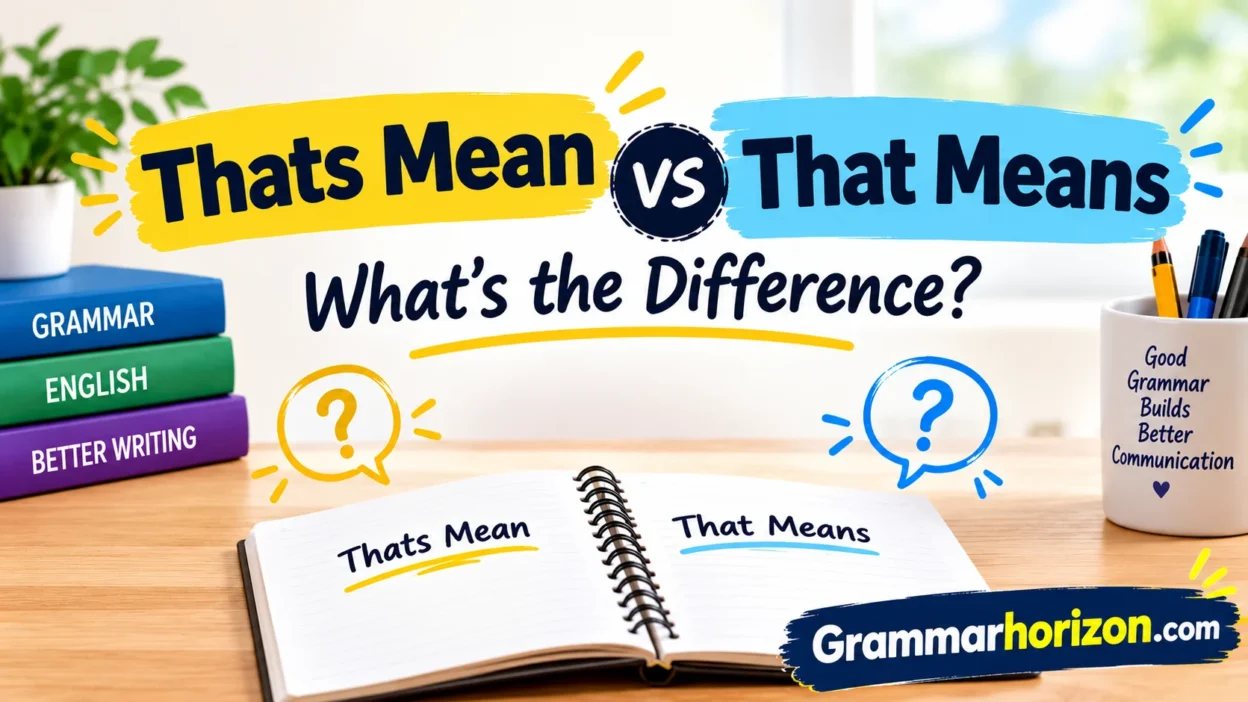
When comparing Thats Mean vs That Means, the main difference depends on grammar, meaning, and context. That’s mean uses that’s as a contraction of “that is,” while mean works as an adjective describing something rude, unkind, or hurtful. On the other hand, that means contains means as a verb and is used to explain, clarify, or show what something indicates or represents. Although these phrases sound similar, they communicate completely different ideas. Understanding this grammar rule helps you choose the correct phrase in everyday English.
For advanced learners, these tricky expressions can sometimes cause confusion because the difference between mean and means is only one letter. However, their grammatical functions are different. “That means you are correct” provides an explanation or shows a logical result, whereas “That’s mean” expresses an emotional judgment about someone’s action, comment, or behavior. The first expression focuses on meaning, implication, or result. The second describes something as cruel, unkind, insulting, or unpleasant. Looking at the surrounding context makes the intended meaning much easier to identify.
A useful guide is to ask what you are trying to communicate. If you want to explain what a statement, situation, or result indicates, use that means. For example, “The lights are off. That means nobody is home” explains the logical implication of the situation. If someone makes an insulting joke, you can respond, “That’s mean,” because you are giving an emotional reaction or judgment about the behavior. Remember that the apostrophe in that represents “that is,” while means is a verb. Once you focus on the complete expression rather than the single letter difference, the correct usage becomes much easier to recognize.
Quick Answer
That means is used when you want to explain what something indicates, signifies, or causes.
“The road is closed. That means we need another route.”
That’s mean is used when you want to describe an action, comment, or behavior as unkind or hurtful.
“You laughed at his mistake. That’s mean.”
The simplest way to remember the difference is:
- That means = that indicates or signifies something.
- That’s mean = that is unkind or hurtful.
So, if you can replace the phrase with “that indicates,” use that means. If you can replace it with “that is unkind,” use that’s mean.
Thats Mean vs That Means: Key Difference
The main difference between thats mean vs that means comes from the grammatical role of mean.
In that means, the word means is a verb. The subject is that, which is singular. Therefore, the present-tense verb takes the third-person singular form means.
In that’s mean, the word mean is an adjective. The expression is a shortened form of that is mean. Here, mean describes something rather than explaining what something signifies.
| Phrase | Grammar | Meaning | Example |
| That means | Verb phrase | That indicates or signifies | “The shop is closed. That means we should leave.” |
| That’s mean | “That is” + adjective | That is unkind or hurtful | “Making fun of him is mean.” |
The difference looks tiny on the page. The meaning, however, is completely different.
What Does “That Means” Mean?
That tells you the meaning, result, implication, or significance of something.
The word means comes from the verb mean. In this construction, that acts as the subject.
For example:
“The battery is dead. That means the car won’t start.”
The first statement gives you a fact. The second statement explains its consequences.
You can often replace that means with phrases such as:
- That indicates
- That signifies
- That tells us
- That implies
- That results in
For example:
“She hasn’t replied. That means she may be busy.”
The phrase doesn’t describe the person as unkind. Instead, it draws a conclusion from the information available.
Examples of “That Means”
Here are several everyday examples:
- “The alarm is ringing. That means there is a problem.”
- “He missed the train. That means he’ll arrive later.”
- “The sign says closed. That means we can’t enter.”
- “You finished all your work. That means you can go home.”
- “The price increased. That means we’ll need a larger budget.”
Notice the pattern. In every example, that means introducing an explanation, conclusion, or consequence.
What Does “That’s Mean” Mean?
That’s mean is normally a contraction of that is mean.
Here, mean is an adjective. It describes something as unkind, nasty, hurtful, or unfair.
For example:
“You shouldn’t laugh when someone gets hurt. That’s mean.”
The speaker isn’t saying that the action has a particular meaning. Instead, the speaker is criticizing the behavior as unkind.
This expression commonly appears in casual conversations, especially when people react to someone’s words or actions.
Examples of “That’s Mean”
- “You made fun of her accent. That’s mean.”
- “He refused to help his friend. That’s mean.”
- “You shouldn’t call people names. That’s mean.”
- “She laughed at my mistake. That’s mean.”
- “Taking his lunch without asking was mean.”
In each example, mean describes behavior rather than explaining a meaning.
Is “That’s Mean” Grammatically Correct?
Yes, that means it can be grammatically correct.
The important point is that that means that it is in this construction.
Consider this sentence:
“That’s mean.”
Expand the contraction:
“That is mean.”
Now the grammar becomes easier to see. That is the subject, is is the linking verb, and mean is an adjective describing the subject.
The expression can describe a comment, action, joke, decision, or behavior.
For example:
“You told everyone about her private mistake. That’s mean.”
Here, mean describes the action as unkind.
However, that means shouldn’t normally replace that means. Doing so changes the grammatical structure and creates a different meaning.
Is “That Means” Grammatically Correct?
Yes. That means is standard English when mean expresses significance or implication.
The structure is:
That + means + information
For example:
“The store is closing early. That means we need to hurry.”
The subject that is singular. Therefore, the verb mean changes to means in the present tense.
Compare these forms:
- I mean
- You mean
- We mean
- They mean
- He means
- She means
- It means
- That means
This is why that mean usually isn’t correct when that refers to one thing.
Thats Mean vs That Means in Different Contexts
Context provides a useful clue when you’re unsure which expression to choose.
When You Mean “That Indicates”
Use that means when you’re explaining information.
“The door is locked. That means we have to wait.”
The second part interprets the first part.
Another example is:
“He hasn’t called all day. That means he probably isn’t available.”
Again, the phrase introduces an interpretation.
When You Mean “That Is Unkind”
Use that’s mean when you’re commenting on someone’s behavior.
“You embarrassed him in front of everyone. That’s mean.”
Here, the speaker isn’t explaining what the behavior means. The speaker is describing it as unkind.
When You Are Explaining a Consequence
That means it works naturally when one fact leads to another.
“The deadline moved to Friday. That means we have two extra days.”
The phrase connects information with its consequences.
When You Are Reacting to Behavior
That’s mean works naturally as a quick reaction.
“You deleted her work as a joke? That’s mean.”
The expression carries an emotional judgment about the action.
Thats Mean vs That Means: Example Sentences
The following examples show how the two phrases behave in ordinary conversations.
That means:
- “The weather is getting worse. That means we should leave now.”
- “He forgot his wallet. That means he can’t pay.”
- “The meeting starts at eight. That means we need to arrive early.”
- “She passed the test. That means she can move to the next level.”
- “The computer isn’t charging. That means the battery may have a problem.”
That’s mean:
- “You ignored her after she apologized. That’s mean.”
- “Calling him stupid was mean.”
- “You laughed at his broken phone. That’s mean.”
- “She spread a private story about him. That’s mean.”
- “Don’t make jokes about someone’s appearance. That’s mean.”
A useful pattern emerges. That means connecting information to meaning or consequence. That’s mean evaluating something as unkind.
Common Mistakes With Thats Mean and That Means
The most common mistake occurs when writers use that’s mean when they actually mean that means.
For example:
“The store is closed. That means we have to wait.”
This is incorrect if the intended meaning is “that indicates we have to wait.”
The correct sentence is:
“The store is closed. That means we have to wait.”
Another common mistake is using that means when reacting to cruel behavior.
“You made fun of her. That means.”
This doesn’t communicate the intended idea. If you want to say the behavior is unkind, say:
“You made fun of her. That’s mean.”
Quick Mistake Check
When choosing between the two phrases, ask yourself:
- Am I explaining what something indicates?
- Am I describing something as unkind?
- Can I replace the phrase with that indicates?
- Can I replace it with that is unkind?
If the answer to question three is yes, choose that means.
If the answer to question four is yes, choose that’s mean.
How to Remember the Difference
A simple substitution trick can help you remember thats mean vs that means.
Test One: “That Indicates”
Replace the phrase with that indicates.
“The lights are off. That means nobody is home.”
You could say:
“The lights are off. That indicates nobody is home.”
The meaning still works. Therefore, that means it is correct.
Test Two: “That Is Unkind”
Now try the second phrase.
“You laughed at his mistake. That’s mean.”
Replace it:
“You laughed at his mistake. That is unkind.”
The basic meaning remains intact. Therefore, that’s mean fits.
This two-second test can prevent many grammar mistakes.
Thats Mean vs That Means in Formal and Informal English
Both expressions can appear in everyday English. Their uses differ more because of meaning than formality.
That means working comfortably in casual, academic, professional, and formal writing.
For example:
“The contract expires next month. That means the company must renew it before the deadline.”
In more formal writing, you might also use this indicates, this suggests, or this implies, depending on the context.
That’s mean, by contrast, it sounds more conversational. People commonly use it when reacting to someone’s behavior.
For example:
“You told everyone his secret? That’s mean.”
In formal writing, a more precise alternative might be unkind, insensitive, hurtful, or inconsiderate, depending on the situation.
Thats Mean vs That Means: A Simple Comparison
| Feature | That means | That’s mean |
| Expanded form | That means | That is mean |
| Role of “mean” | Verb | Adjective |
| Main meaning | Indicates or signifies | Unkind or hurtful |
| Common use | Explaining information | Reacting to behavior |
| Tone | Neutral and flexible | Usually conversational |
| Example | “That means we’re late.” | “That’s mean.” |
| Easy replacement | That indicates | That is unkind |
The distinction becomes clear once you focus on the word mean. In one phrase, it describes significance. In the other, it describes behavior.
A Practical Case Study
Imagine that a friend tells you, “The restaurant closes at 9 p.m.”
You check the time and see that it’s already 9:15.
You might say:
“It’s already 9:15. That means the restaurant is closed.”
Here, that means introducing a conclusion based on information.
Now imagine that another friend laughs because someone accidentally dropped their food.
You might respond:
“You laughed when they dropped their food. That’s mean.”
This time, you’re describing the behavior as unkind.
The situations are different. The grammar follows the meaning.
Conclusion
The difference between that’s mean and that means comes down to grammar, meaning, and context. That’s mean means “that is mean” and describes something rude, unkind, cruel, or hurtful. That means, however, uses means as a verb to explain what something indicates, represents, or implies. Once you understand the grammatical role of mean and means, these similar-looking expressions become much easier to use correctly. Always consider the context and what you want to communicate before choosing the phrase.
FAQs
Q1. Is “that’s mean” grammatically correct?
Yes. That’s mean is grammatically correct when mean is an adjective describing something as unkind, rude, or hurtful.
Q2. Is “that means” grammatically correct?
Yes. That means is grammatically correct when means is a verb used to explain the meaning, result, or implication of something.
Q3. What is the difference between “that’s mean”vs“that means”?
That’s mean expresses an emotional judgment, while that means provides an explanation or describes what something indicates.
Q4. What does “that’s mean” mean?
That’s mean means that someone’s words, actions, or behavior are unkind, rude, cruel, or hurtful.
Q5. What does “that means” mean?
That means is used to explain what something means, indicates, implies, or results in. For example, “The store is closed. That means we have to come back tomorrow.”