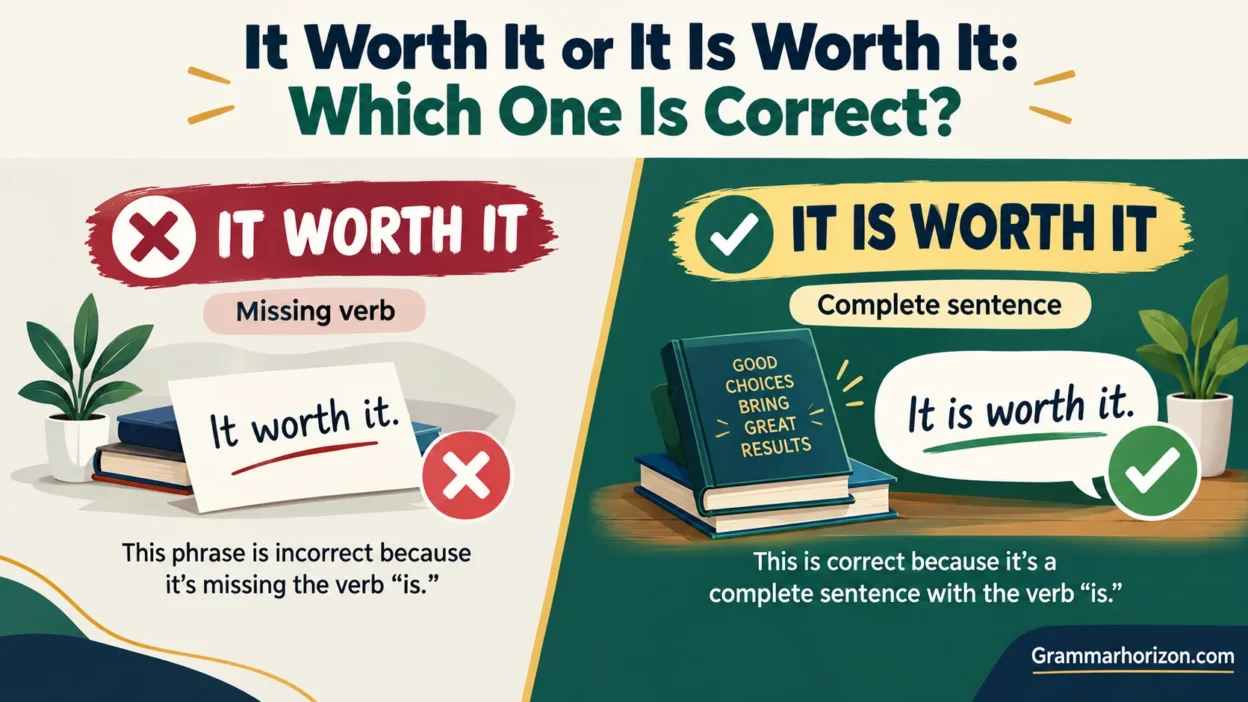
p It worth it is grammatically incorrect because it has a small missing word. In standard English grammar rules, it is worth it is the acceptable form because is works as a linking verb that connects it with worth. Without this helping verb, the sentence becomes grammatically incomplete and loses clarity and correctness. It’s worth it is also correct because it’s is a contraction of it is, making it common in everyday English and everyday communication.
The difference is easy to notice when people write or say these expressions in conversations, emails, social media posts, messages, and reviews. When composing an email, writing an essay, or creating online content, it is worth it can sound more professional and polished, while it’s worth it sounds more natural when chatting with friends. Both forms are correct in standard English, but it worth it is an incorrect structure because it misses the necessary verb. This grammar rule helps learners understand how similar expressions need a complete standard English sentence with the correct grammatical structure.
The word worth describes value, effort, or whether something provides enough value for its expense. A purchase or experience may be worth the cost when its benefits justify the effort involved. This usage gives learners a simple guide for correct usage: use it is worth it or it’s worth it, but not it worth it. As a quick takeaway, always include the linking verb when you use this adjective expression. When you try to learn English through examples and practical examples, you can recognize the structure, avoid a common mistake and other common mistakes, and make your writing clearer. Expert tips can also help you communicate an idea, judge value, and decide whether something is worthwhile while improving effective communication.
Quick Answer: It Worth It or It Is Worth It?
“It is worth it” is the grammatically correct form when you need a complete sentence.
“It worth it” is incorrect because it leaves out the verb is.
For example:
- Correct: It is worth it.
- Correct: It’s worth it.
- ncorrect: It’s worth it.
- Correct: Is it worth it?
- Incorrect: Is it worth it?
It Worth It or It Is Worth It: Main Difference
The main difference between “it worth it” and “it is worth it” is grammatical completeness.
The word worth doesn’t normally function as the main verb in this construction. You need a linking verb to connect the subject with the description worth it.
| Expression | Correct? | Explanation |
| It was worth it. | ❌ No | Missing the verb is |
| It is worth it. | ✅ Yes | Complete grammatical sentence |
| It’s worth it. | ✅ Yes | Contraction of it is |
| Is it worth it? | ✅ Yes | Correct question form |
| It was worth it. | ✅ Yes | Correct past-tense form |
| It will be worth it. | ✅ Yes | Correct future form |
This distinction remains the same whether you’re talking about money, time, effort, travel, education, or personal experiences.
Why “It Worth It” Is Incorrect
English sentences usually require a verb. In “It worth it,” the subject is it, but there is no appropriate verb connecting the subject to worth it.
Compare these sentences:
- The trip is expensive.
- The course is useful.
- The experience is valuable.
- The trip is worth it.
In each sentence, is connects the subject with information describing it.
Without is, the sentence becomes incomplete:
- The trip was expensive. ❌
- The course was useful. ❌
- The experience was valuable. ❌
- The trip was worth it. ❌
That’s why “it is worth it” is the standard grammatical construction.
What Does “It Is Worth It” Mean?
“It is worth it” means that something provides enough benefit, value, enjoyment, or satisfaction to justify its cost or effort.
The word worth can refer to different types of value. That value doesn’t always involve money.
For example, you might say:
The long drive was worth it because we saw the mountains.
Here, the drive required time and effort. However, the experience made that effort worthwhile.
You could also say:
- The expensive laptop is worth it.
- Studying every night is worth it.
- The extra money is worth it.
- Waiting for two hours was worth it.
- The trip was worth it.
- Learning another language is worth it.
In every example, the speaker believes the result justifies the cost, effort, inconvenience, or sacrifice.
“It’s Worth It” or. “It Is Worth It”
“It’s worth it” and “it is worth it” have the same grammatical meaning.
The difference mainly involves tone and context.
It is worth it to sound slightly more deliberate or formal.
It’s worth it to sound more natural in casual conversation.
For example:
- Formal: The additional investment is worth it.
- Conversational: Trust me, it’s worth it.
In everyday speech, native speakers commonly use it’s. In formal writing, you may choose it is when you want extra emphasis or a more polished tone.
However, neither version changes the meaning.
When to Use “It’s Worth It”
Use “it’s worth it” in conversations, informal writing, text messages, reviews, and casual discussions.
Examples:
- It’s worth it if you use the software every day.
- The extra cost is worth it.
- The wait is long, but it’s worth it.
- Learning the skill takes time, but it’s worth it.
The contraction makes the sentence shorter and more conversational.
When to Use “It Is Worth It”
Use “it is worth it” when you want a slightly more formal or emphatic tone.
Examples:
- It is worth it to invest in reliable equipment.
- The additional training is worth it for experienced employees.
- Although the process takes longer, it is worth it.
You can also emphasize is when correcting someone:
“You don’t think the course is useful?”
“Actually, it is worth it.”
Here, is receives emphasis because the speaker wants to make the point strongly.
Is “It Worth It” Ever Correct?
In standard modern English, “it worth it” isn’t correct as a complete sentence.
However, you may occasionally see the phrase in informal online writing, headlines, searches, captions, or non-native English. People sometimes leave out words when typing quickly.
For example, someone might write:
“Is it worth it?”
Another person may accidentally type:
“It worth it?”
The second version may still be understandable from context, but understanding a sentence doesn’t make it grammatically correct.
If you’re writing professionally, academically, or for publication, use “it is worth it” or “it’s worth it.”
Common Sentence Patterns With “Worth It”
Learning a few common patterns makes this expression much easier to use.
It Is Worth It
Use this pattern when you’re making a general statement.
Example:
The extra expense is worth it.
Is It Worth It?
Use this form when asking whether something provides enough value.
Example:
Is the upgrade worth it?
It Was Worth It
Use was when talking about something in the past.
Example:
The difficult journey was worth it.
It Will Be Worth It
Use will be when discussing a future result.
Example:
Keep practicing. It will be worth it.
It Might Be Worth It
Use might be when the value is uncertain.
Example:
It might be worth it if you plan to use the device frequently.
These patterns demonstrate why the verb matters. The sentence changes naturally with tense and modal verbs.
It Is Worth It or. Worthwhile
Worth it and worthwhile often communicate a similar idea, but they aren’t always interchangeable.
Worth it commonly compares a benefit with a cost, effort, risk, or inconvenience.
Example:
The expensive repair was worth it.
Worthwhile describes something as valuable, useful, or beneficial enough to justify the time or effort.
Example:
The repair was worthwhile.
Both sentences communicate positive values. However, worth it often sounds more conversational and directly connects the result with a sacrifice.
| Phrase | Typical meaning | Example |
| Worth it | Justifies a cost or effort | The trip was worth it. |
| Worthwhile | Valuable or beneficial | The training was worthwhile. |
| Valuable | Has significant usefulness or importance | The advice was valuable. |
| Beneficial | Produces a helpful result | Exercise is beneficial. |
Common Mistakes With “It Is Worth It”
Common mistakes with “it is worth it” include leaving out “is,” using “worths,” or confusing “worth it” with “worth.”
Leaving Out “Is”
Incorrect: It’s worth it.
Correct: It is worth it.
This is the most common mistake in this comparison.
Using “It Is Worths It”
Incorrect: It is worth it.
Correct: It is worth it.
The word worth doesn’t take an -s in this construction.
Confusing “Worth It” With “Worth”
You can say:
The book is worth $20.
You can also say:
The book is worth it.
But these structures have slightly different meanings. The first specifies a monetary value. The second says the result justifies the cost, effort, or expectation.
How to Remember “It Worth It or It Is Worth It”
A simple trick can help you remember the correct expression.
Ask yourself whether it needs a verb.
If you’re making a complete statement, the answer is usually yes:
It + is + worth it.
Think of is as the bridge between it and worth it.
You can also replace worth it with another description:
- It is useful.
- It is expensive.
- It is difficult.
- It is valuable.
- It is worth it.
Once you recognize this pattern, the missingness becomes much easier to notice.
Conclusion
It is worth it and it’s worth it are both correct expressions in standard English, while it worth it is grammatically incorrect because it is missing the linking verb “is.” Use it is worth it in more formal writing and it’s worth it in everyday conversations and informal communication. Understanding this simple grammar structure can help you avoid a common mistake and make your English writing and speaking more clear, natural, and accurate.
FAQs
Q1. Is “it worth it” grammatically correct?
No. It worth it is grammatically incorrect because the sentence needs the linking verb “is.” The correct forms are it is worth it and it’s worth it.
Q2. Is “it is worth it” correct English?
Yes. It is worth it is grammatically correct and can be used in both formal and general English.
Q3. Is “it’s worth it” correct?
Yes. It’s worth it is the contraction of it is worth it. It is especially common in everyday conversations, messages, and informal writing.
Q4. What is the difference between “it is worth it” and “it’s worth it”?
There is no difference in basic meaning. It is worth it is the full form, while it’s worth it is the contracted form. The choice mainly depends on the level of formality.
Q5. Why is “it worth it” wrong?
It worth it is wrong because worth cannot function as the main verb in this structure. The linking verb “is” is needed between it and worth.
Q6. Can I use “it’s worth it” in formal writing?
Yes, but the full form it is worth it may sound more formal or polished in academic, professional, or highly formal writing. It’s worth it is perfectly natural in most everyday contexts.