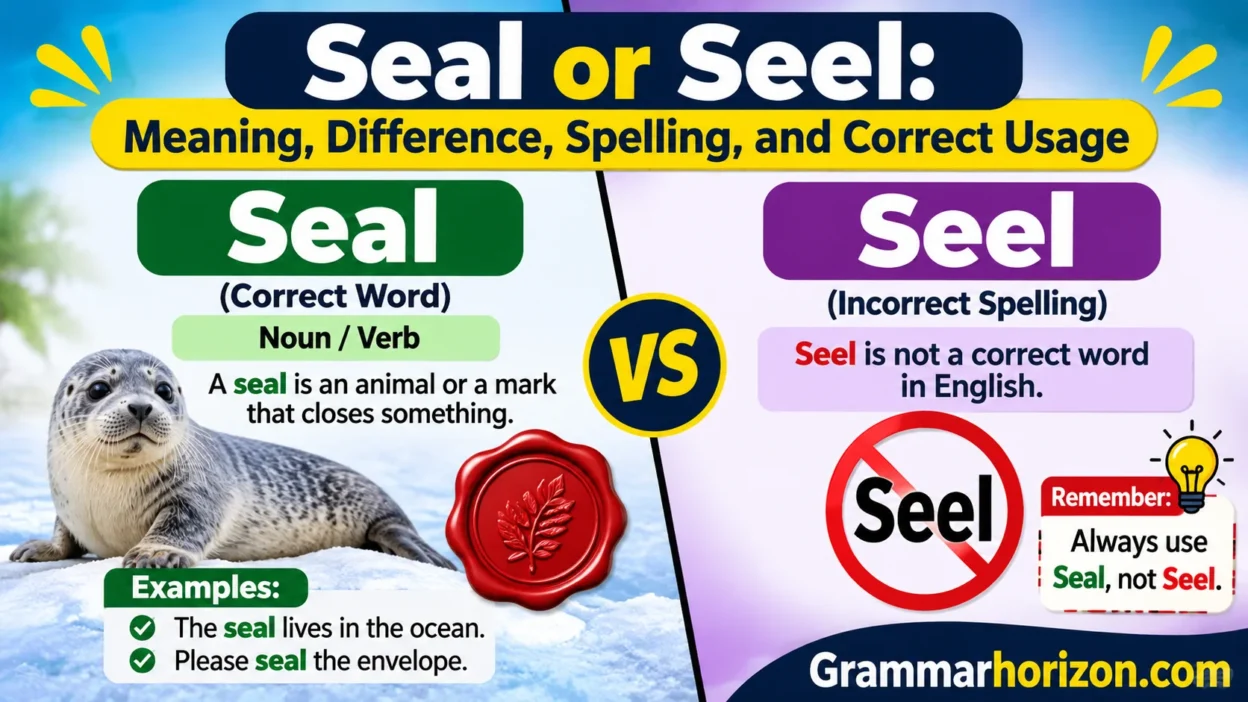
Seal or Seel can confuse English writers because both spellings exist, but they have different meanings and uses in everyday communication. These similar-sounding words often cause spelling confusion in English writing, written communication, and everyday conversations. However, they are not interchangeable words. Understanding their word meanings, spelling differences, and grammatical usage helps you choose the correct word according to the context. Both words belong to English vocabulary, but their pronunciation and historical background make them an interesting word pair.
The word seal works as both a noun and a verb. As a noun, it refers to an aquatic animal or aquatic mammal, or an official mark placed on a document to show authenticity, approval, or authority. An official seal can represent an organization’s approval or confirm an agreement. As a verb, it describes the action of closing securely or creating a secure closure. For example, you can use it when sealing an envelope, repairing a leaking pipe, or completing a business agreement. It can also describe finalizing an agreement between two parties. These different examples show why context matters when making the right word choice.
On the other hand, seel is a rare word and a historical English word connected with falconry, a traditional practice involving birds of prey. In historical falconry, it describes the unusual technique of sewing together eyelids to close the eyes of a hawk or falcon during training. This practice appears in historical literature and discussions of hawk training and falcon training, but it is rarely found in modern English or ordinary English communication. While seal has several common meanings and uses, seel mainly appears in historical contexts. Knowing their historical usage and modern usage helps prevent spelling mistakes and keeps your writing accurate.
Quick Answer: Seal or Seel?
Seal is the correct and commonly used spelling when referring to an aquatic animal, an official mark, or the action of closing something tightly. Seel is also a real English word, but it is a rare historical verb associated with falconry.
Here is the basic difference:
- Seal: A noun or verb referring to an aquatic animal, an official mark, or something that closes an opening securely.
- Seel: A rare verb meaning to sew together the eyelids of a hawk or falcon in traditional falconry.
Examples:
- Please seal the envelope before mailing it.
- We saw a seal swimming near the beach.
- The certificate carries an official seal.
- Historical falconers sometimes used the practice of seeling a bird’s eyelids.
Remember that seal is the appropriate choice in almost all everyday writing situations.
What Does Seal Mean?
Seal is a common English word that functions as both a noun and a verb. Its meaning depends on how it is used in a sentence.
As a noun, seal can refer to a marine mammal, an official stamp, or a device that prevents air and water from passing through an opening. As a verb, it describes closing, securing, or officially confirming something.
The word appears in everyday conversations, business communication, legal documents, construction, and technical writing.
Seal as a Noun
When used as a noun, seal has several meanings.
An aquatic animal
A seal is a marine mammal that belongs to the group of animals known as pinnipeds. Seals have streamlined bodies, flippers, and thick layers of fat that help them survive in cold water. They spend much of their lives in the ocean but also come onto land or ice to rest and reproduce.
Example: A large seal rested on a rock near the coastline.
An official mark or stamp
A seal can refer to an official symbol or mark used to authenticate a document. Governments, courts, educational institutions, and organizations use official seals to identify documents and demonstrate authority.
Example: The university certificate carried the institution’s official seal.
A device that prevents leakage
In engineering and household applications, a seal is a material or component that prevents air, water, oil, or other substances from passing through a gap.
Rubber seals are commonly used in doors, windows, pipes, engines, and water containers.
Example: The plumber replaced the damaged rubber seal to stop the water leak.
A secure closure
A seal can also describe something that closes a package, bottle, or container securely.
Example: The bottle has a protective seal around its cap.
Seal as a Verb
The word seal also functions as a verb. It describes the action of closing, securing, protecting, or officially confirming something.
Its common meanings include:
- To close tightly: Preventing air, water, dust, or other substances from entering or escaping.
- To authenticate: Placing an official mark or stamp on a document.
- To finalize: Completing an agreement or arrangement.
- To secure: Making something protected or difficult to open.
Examples:
- Please seal the package before sending it.
- The authorities sealed the official document.
- They finally sealed the business agreement.
- Workers used a special material to seal the cracks in the wall.
- The company sealed the container to protect its contents.
The different grammatical forms of seal include:
| Verb Form | Word |
| Base form | Seal |
| Third-person singular | Seals |
| Past tense | Sealed |
| Past participle | Sealed |
| Present participle | Sealing |
These forms help you describe different actions involving closing, protecting, or finalizing something.
What Does Seel Mean?
Seel is a genuine but uncommon English word. Unlike seal, which has several everyday meanings, seel has a specialized historical meaning connected to falconry.
Traditionally, falconers used this word to describe sewing together the eyelids of a hawk or falcon during training. This practice was intended to keep the bird calm and reduce visual stimulation while it became accustomed to human handling.
The word also appeared in older English literature with meanings related to closing the eyes or causing blindness.
Today, seel is rarely used in everyday conversations. You are more likely to encounter it in historical dictionaries, older literary works, and discussions of traditional falconry.
Seel as a Verb
Seel is primarily used as a transitive verb. A transitive verb requires an object to complete its meaning.
In its historical falconry sense, the object is usually a hawk or falcon whose eyelids are being closed through the traditional practice.
Examples:
- Historical falconry texts describe how to seel a hawk’s eyelids.
- The old manuscript explained the process of selling a falcon.
- The falconer followed a traditional method of selling the bird.
These examples demonstrate the word’s specialized historical meaning rather than an ordinary modern action.
Historical Meaning of Seel
The history of seel goes back several centuries. Its origin is connected to Old French and Medieval Latin words associated with the eyelid and eyelashes.
The word appeared in English during the late fifteenth century. Historical dictionaries also record its use in older writing about closing the eyes and blindness.
For example, William Shakespeare used the expression “Come, selling night” in Macbeth. In this context, the word suggests covering or closing the eyes.
This literary example shows that seel has a place in English history, even though it is not commonly used today.
Main Differences Between Seal or Seel
Although seal and seel look and sound similar, their meanings and practical uses are different.
The most important distinction is that seal is a standard everyday word, while seel is a rare historical term.
| Feature | Seal | Seel |
| Spelling | Seal | Seel |
| Meaning | Animal, official mark, or secure closure | To close a hawk’s or falcon’s eyelids |
| Part of speech | Noun and verb | Primarily a verb |
| Usage | Common in modern English | Rare and historical |
| Context | Everyday, business, legal, and technical writing | Historical falconry and literature |
| Pronunciation | /siːl/ | /siːl/ in many British pronunciations |
| Example | Seal the package | Seel a hawk’s eyelids |
Difference in Meaning
The biggest difference between these words is their meaning.
Seal has several meanings. It can refer to a marine animal, an official symbol, a protective closure, or the action of closing something tightly.
Seel, however, has a much narrower meaning. It traditionally refers to sewing together the eyelids of a hawk or falcon during falconry training.
Examples:
- The seal swam through the cold water.
- The falconer used the historical practice of seeling the hawk.
The first sentence describes an aquatic animal, while the second describes a specialized historical practice.
Difference in Spelling
Both words contain four letters, but their middle vowel combinations are different.
- Seal uses the letters “ea.”
- Seel uses the letters “ee.”
This small spelling difference changes the meaning and use of each word.
Writers should pay attention to this distinction because spell-checking software may not identify an incorrect word if it is a valid English spelling.
For example, writing “seel the envelope” may not trigger a spelling warning, even though seal is the correct word.
Difference in Pronunciation
In many English accents, seal and seel are pronounced alike, using the long “ee” sound.
However, pronunciation references may differ for the rare word seel, particularly in American English. Therefore, pronunciation can depend on the regional accent and dictionary.
Since the words can sound alike, spelling and context are more reliable ways to identify the intended meaning.
Why Do People Confuse Seal and Seel?
People sometimes confuse seal and seel because their spelling and pronunciation are similar. However, several other factors can contribute to this mistake.
Similar Pronunciation
In many English accents, both words have the same pronunciation. When people hear them in conversation, they may not immediately recognize which spelling is appropriate.
For example, someone discussing a marine animal might understand the meaning but still hesitate between the two spellings.
Different Vowel Combinations
The difference between “ea” and “ee” is small in appearance. Writers who are unfamiliar with the historical word may assume that both spellings are acceptable alternatives.
However, each spelling has its own meaning and usage.
Limited Knowledge of Seel
Most English speakers regularly encounter seal in books, advertisements, conversations, and professional writing.
The word seel is much less familiar. People may encounter it only when reading historical literature or studying traditional falconry.
Because of this difference in familiarity, writers may mistakenly treat seel as an ordinary spelling variation of seal.
Typing and Spelling Mistakes
Typing mistakes can also cause confusion. A person may accidentally replace “ea” with “ee” while writing quickly.
For example:
Incorrect: Please seel the package.
Correct: Please seal the package.
The sentence requires the verb seal because it describes closing a package securely.
How to Remember the Correct Spelling of Seal or Seel
Remembering the difference becomes easier when you connect each spelling with its meaning.
Here are some practical techniques:
- Associate seal with the sea: A seal is a marine animal, so remembering the word sea can help you recall its spelling.
- Connect seal with closing: You seal an envelope, bottle, package, or container.
- Remember the historical meaning of seel: This unusual spelling belongs to a specialized falconry term.
- Check the sentence context: If you are discussing a package, document, animal, or closure, the intended word is usually seal.
- Use a dictionary when necessary: If you encounter seel in an old book, check its historical meaning instead of assuming it is a spelling mistake.
A simple memory trick is:
Seal = Sea animal or something securely closed.
Seel = Historical falconry term.
This distinction will help you choose the correct spelling in most writing situations.
Common Expressions and Uses of Seal
The word seal appears in many common English expressions. Understanding these expressions helps you use the word naturally in conversations and writing.
Seal the Deal
“Seal the deal” means to finalize an agreement or complete a successful arrangement.
Example: The two companies negotiated for several weeks before they finally sealed the deal.
Seal an Envelope
This expression means to close an envelope securely, usually by fastening its adhesive flap.
Example: Remember to seal the envelope before mailing the letter.
Official Seal
An official seal is a recognized mark or symbol used to identify or authenticate a document, organization, or institution.
Example: The government certificate carried the official seal of the department.
Watertight Seal
A watertight seal prevents water from passing through a gap or opening.
It is commonly used in plumbing, construction, manufacturing, and waterproof equipment.
Example: The technician checked the pipe to make sure it had a watertight seal.
Seal of Approval
A seal of approval is a sign of acceptance, support, or recognition. It can be official or informal, depending on the situation.
Example: The new product received the manager’s seal of approval.
Seal a Promise
To seal a promise means to confirm or strengthen a commitment.
Example: They shook hands to seal their promise to work together.
Common Mistakes to Avoid When Using Seal or Seel
Although both words are real English words, using one in place of the other can change the meaning of a sentence.
Here are some common mistakes and their corrections.
| Incorrect Usage | Correct Usage | Explanation |
| Please seel the envelope. | Please seal the envelope. | Seal means to close securely. |
| We saw a seel at the beach. | We saw a seal at the beach. | Seal refers to the marine animal. |
| The document needs an official seel. | The document needs an official seal. | Seal refers to an official mark. |
| The bottle has a protective seel. | The bottle has a protective seal. | Seal refers to a closure. |
| They seel the business agreement. | They seal the business agreement. | Seal means to finalize an agreement. |
Using Seel as a General Alternative to Seal
One common mistake is assuming that seel is simply another spelling of seal.
It is not. Although seel has a historical meaning related to closing the eyes, it is not the standard spelling for closing packages, containers, or documents.
Always use seal when discussing these ordinary activities.
Ignoring the Context
Another mistake is choosing a word based only on its appearance or sound.
For example, a sentence about a falcon’s historical training may require seel, while a sentence about a marine animal requires seal.
Understanding the context is more important than relying on pronunciation alone.
Seal or Seel in Everyday Writing
In modern English, seal is the appropriate choice for almost all ordinary writing situations involving this spelling pair.
You will encounter it in emails, school assignments, business communication, legal documents, technical instructions, and everyday conversations.
For example, a workplace instruction might say:
“Please seal the storage containers before moving them to the warehouse.”
Similarly, a business document might contain the sentence:
“The agreement becomes official once both parties sign and seal the document.”
In both cases, seal is the correct spelling because it describes closing or officially authenticating something.
On the other hand, seel belongs mainly in specialized historical discussions. A writer explaining traditional falconry might use the word to describe how falconers historically closed a bird’s eyelids during training.
A Practical Writing Example
Consider these three situations:
Situation One: Sending a Letter
You want to close an envelope before mailing it.
Correct: “Please seal the envelope before sending it.”
Situation Two: Visiting the Beach
You see an aquatic animal swimming near the shore.
Correct: “A seal was swimming close to the beach.”
Situation Three: Studying Historical Falconry
You are writing about an old falconry practice involving a hawk’s eyelids.
Correct: “The historical text describes how to seel a hawk’s eyelids.”
These examples show why the correct spelling depends on the meaning of the sentence.
Conclusion
Understanding the difference between seal and seel helps you avoid spelling mistakes and use both words correctly. Seal is the common English word used as a noun and verb for an aquatic animal, an official mark, or the action of closing something securely. In contrast, seel is a rare historical word associated with falconry and the practice of closing a hawk’s or falcon’s eyelids during training. Although both words have similar spellings and pronunciation, their meanings and contexts are different. Remembering these distinctions will make your English writing clearer and more accurate.
Frequently Asked Questions (FAQs)
1. Is seal or seel the correct spelling?
Both spellings are correct English words, but they have different meanings. Seal is commonly used in modern English, while seel is a rare historical word associated with falconry.
2. What does the word seal mean?
Seal can refer to an aquatic mammal, an official mark, or the action of closing something securely. It works as both a noun and a verb.
3. What does seel mean in English?
Seel is a historical falconry term that describes the traditional practice of sewing together a hawk’s or falcon’s eyelids during training.
4. Are seal and seel pronounced the same?
Yes. In standard English, seal and seel are pronounced the same way, even though their spellings and meanings are different.
5. When should I use seal instead of seel?
Use seal when discussing an aquatic animal, an official mark, or closing something securely. Use seel only when referring to its historical meaning in falconry.