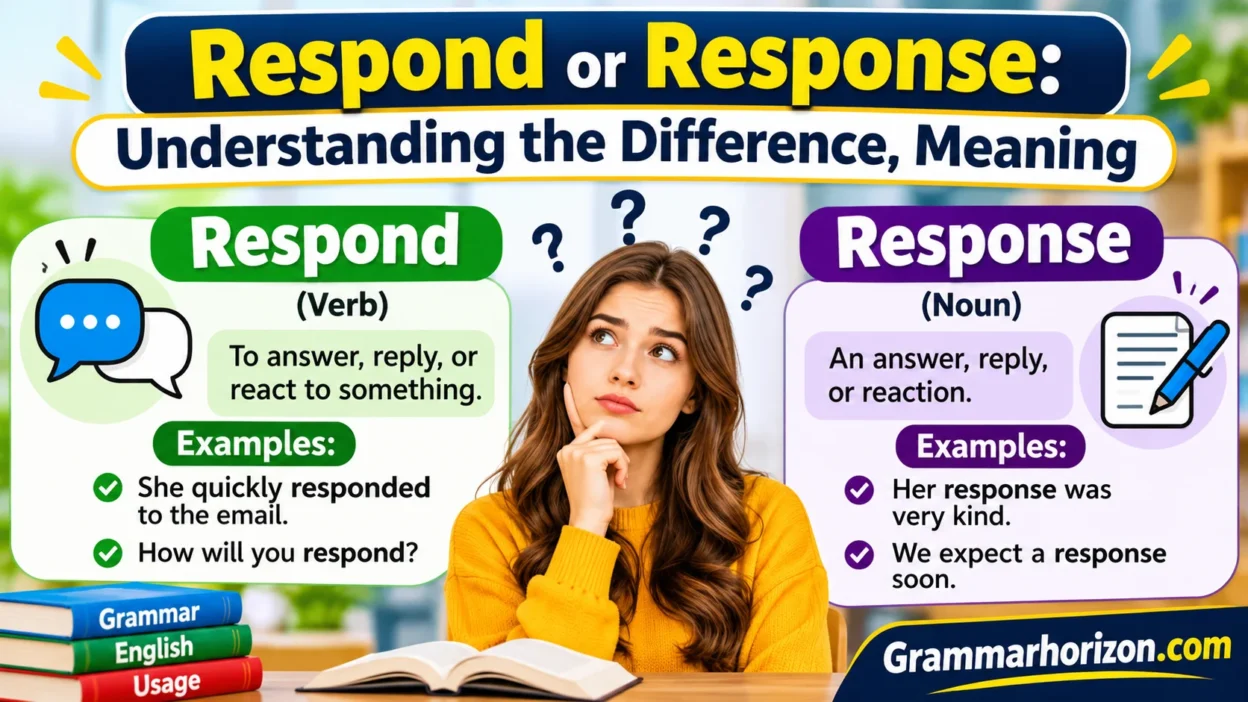
Respond or Response have related meanings, but they perform different grammatical functions in English. Respond is a verb that describes the action of answering, replying, or reacting to something, while response is a noun that refers to the answer or reaction itself. For example, you respond to an email, but the message you send is your response. Understanding their parts of speech, sentence structure, and correct usage helps you choose the right word in everyday communication.
In everyday situations, respond describes what someone does when answering a question, request, message, or comment. Response identifies the information or explanation someone provides in return. These words commonly appear in emails, workplace communication, academic writing, and everyday conversations. For example, a manager may ask an employee to respond to a request, while the employee’s response may contain an answer or explanation. Recognizing this difference makes editing easier and improves your word choice.
The grammatical roles of these words become clearer when you examine their position in a sentence and the surrounding context. Respond functions as a verb and usually follows a subject, such as a person replying to something. Response functions as a noun and can act as a subject or object. Both words relate to written communication and spoken communication, but their usage depends on sentence structure. Remember that you respond to something, while you give or receive a response. This simple distinction helps you avoid grammatical mistakes and communicate your intended meaning correctly.
Quick Answer: Respond or Response
Respond is a verb that means to answer, reply, or react to a question, message, request, or situation. Response is a noun that means an answer, reply, or reaction given after receiving information or experiencing something.
Both words are correct in standard English, but they cannot always replace each other.
- Respond (Verb): Please respond to my email before Friday.
- Response (Noun): I received your response this morning.
The easiest way to remember the difference is:
- You respond when you perform the action of answering.
- Your response is the answer or reaction you provide.
What Does Respond Mean?
Respond means to answer, reply, or react to something that someone says, asks, requests, or does. It describes an action performed by a person, organization, animal, or system. In English grammar, respond functions as a verb because it tells the reader what someone or something does.
People commonly respond when discussing conversations, emails, customer questions, workplace requests, and unexpected situations. It can describe both spoken and written communication. It can also refer to actions that show a reaction without using words.
For example, when someone asks you a question, you can respond by giving an answer. When a customer contacts a company about a problem, the company can respond by explaining the issue or offering a solution.
Grammatical Forms of Respond
The word respond has several grammatical forms that help express different tenses and sentence structures.
| Word Form | Grammatical Use | Example |
| Respond | Base form | Please respond today. |
| Responds | Present tense, third-person singular | She responds quickly. |
| Responded | Simple past tense | He responded yesterday. |
| Responding | Present participle or gerund | They are responding now. |
These forms allow writers to describe actions that happen regularly, happened in the past, or are currently taking place.
Common Ways to Use Respond
Respond to: This is the most common structure. It identifies the question, message, person, or situation receiving an answer or reaction.
- Please respond to my request.
- She responded to the customer’s complaint.
- He did not respond to the question.
Respond with: This structure explains what someone uses to answer or react.
- The manager responded with a detailed explanation.
- She responded with a smile.
- The company responded with an official statement.
Respond by: This structure explains the method or action used to answer.
- He responded by sending an email.
- The employee responded by apologizing.
- The organization responded by changing its policy.
Examples of Respond in Sentences
- Please respond to the invitation before the deadline.
- The teacher asked everyone to respond to the question.
- My manager usually responds to important emails quickly.
- She responded politely when the customer complained.
- The company is responding to feedback from its users.
- Some plants respond to changes in sunlight.
- The emergency team responded immediately to the incident.
In each example, respond describes an action. It tells the reader what a person, organization, or living thing does after receiving information or experiencing something.
What Does Response Mean?
Response means an answer, reply, reaction, or action given after someone receives a question, message, request, or stimulus. Unlike respond, response is a noun. It names the result of answering or reacting rather than describing the action itself.
People use response when talking about feedback, communication, opinions, reactions, and outcomes. For example, when a company receives customer feedback, it may prepare an official response. Similarly, when someone asks a question, the answer they receive is called a response.
Response can also describe physical, emotional, or automatic reactions. A person’s response to unexpected news might be a surprise, while a computer’s response to a command might be a displayed message.
Common Expressions Using Response
The noun response appears in several common English expressions.
- Give a response: To provide an answer or reaction.
- Receive a response: To get an answer from someone.
- Positive response: A favorable answer or reaction.
- Negative response: An unfavorable answer or reaction.
- Immediate response: An answer or reaction given without delay.
- Delayed response: An answer or reaction that comes later.
- In response to: Used to explain why someone takes an action or gives an answer.
These expressions are useful in formal writing, business communication, education, and everyday conversations.
Examples of Response in Sentences
- I am waiting for your response to my application.
- The manager gave a positive response to the proposal.
- Her response to the question was clear and informative.
- We received an immediate response from customer support.
- The company issued an official response to the complaint.
- His emotional response surprised everyone.
- The computer showed an error response after receiving the command.
In these examples, response identifies an answer, reply, or reaction. It does not describe the action of answering.
Respond or Response: What Is the Difference?
The main difference between respond and response is their part of speech. Although both words relate to answering or reacting, they perform different jobs in a sentence. Respond describes an action, whereas response identifies the answer or reaction produced by that action.
Understanding this difference helps you build grammatically correct sentences. It also makes your writing clearer, especially when communicating with coworkers, teachers, customers, and friends.
Grammatical Difference Between Respond or Response
Respond is an action verb. It tells the reader what someone does after receiving a question, message, instruction, or request. It can appear in different tenses depending on when the action happens.
Response is a noun. It refers to the answer or reaction itself. You can use it as a subject or object and place an adjective before it to describe the type of answer.
Consider these examples:
- Respond: The student will respond to the teacher’s question.
- Response: The student’s response was correct.
In the first sentence, respond describes what the student will do. In the second sentence, the response identifies the answer the student provides.
Meaning Difference Between Respond or Response
The two words share a related meaning, but their focus is different.
- Respond: Focuses on the process of answering or reacting.
- Response: Focuses on the answer or reaction that someone gives.
For example, a customer sends a complaint to a company. The customer service representative must respond to that complaint. The explanation or solution provided by the representative becomes the company’s response.
This distinction also applies to personal conversations. When someone asks about your plans, you respond by speaking. The words you say are your response.
Respond or Response Comparison Table
| Feature | Respond | Response |
| Part of speech | Verb | Noun |
| Meaning | To answer or react | An answer or reaction |
| Main function | Describes an action | Names an answer or reaction |
| Common forms | Respond, responds, responded, responding | Response, responses |
| Common expressions | Respond to, respond with, respond by | Give a response, positive response, in response to |
| Example | Please respond to my message. | I received your response. |
The table shows why these words cannot replace each other in every sentence. Their meanings are connected, but their grammatical functions are different.
When to Use Respond
Use respond when you want to describe someone answering a question, replying to a message, or reacting to a particular situation. It is especially useful when the sentence focuses on an action rather than the answer itself.
Respond works in casual and formal communication. You can use it when talking about personal conversations, business emails, customer complaints, instructions, and unexpected events.
Using Respond in Everyday Conversations
In everyday conversations, respond describes how someone answers another person’s words or reacts to an event.
Examples:
- Please respond when I call your name.
- My brother did not respond to my question.
- She always responds politely to her friends.
- He responded with a laugh when I told him the story.
These examples show that responding does not always require a detailed verbal answer. A person can also respond through facial expressions, gestures, or other actions.
Using Respond in Emails and Text Messages
Respond is common in digital communication because people regularly answer emails, messages, and online requests.
Examples:
- Please respond to this email by tomorrow.
- I will respond to your message after the meeting.
- The manager has not responded to my request yet.
- We usually respond to customer inquiries within two business days.
In professional emails, responses can sound direct and appropriate. However, the tone of the sentence depends on how you frame the request.
For example, “Please respond immediately” sounds more demanding than “Please respond when you have a moment.”
Using Respond in Professional Communication
In workplaces, respond describes how employees, managers, and organizations handle questions, feedback, complaints, and requests.
Examples:
- The HR department will respond to your application.
- Employees should respond to important instructions promptly.
- Our support team responds to technical questions.
- The director responded to the concerns raised during the meeting.
Using respond makes it clear that someone needs to take action. It is particularly useful when discussing responsibilities and communication deadlines.
When to Use Response
Use response when you want to identify an answer, reply, or reaction. Since it is a noun, it usually appears as the subject or object of a sentence or after a preposition.
You can also describe a response using adjectives. For example, a response can be positive, negative, helpful, immediate, delayed, polite, or unexpected.
Using Response for Answers and Replies
When someone provides an answer to a question, you can call that answer a response.
Examples:
- Her response answered all my questions.
- I am waiting for a response from the teacher.
- His response was short but helpful.
- We received several responses to the announcement.
Notice that the response can be singular or plural. Use response when referring to one answer and responses when discussing multiple answers or reactions.
Using Response for Feedback and Reactions
Response is also useful when describing how people react to news, decisions, products, or events.
Examples:
- The new product received a positive response from customers.
- His response to the criticism was unexpected.
- The announcement created an emotional response among employees.
- The public’s response to the campaign was encouraging.
In these examples, response does not necessarily mean a spoken or written answer. It can also describe a feeling, behavior, or general reaction.
Using Response in Formal Writing
In academic and professional writing, response often appears when discussing research, feedback, applications, and official communication.
Examples:
- The research team recorded the participants’ responses.
- The organization published its official response to the report.
- We are awaiting a formal response from the department.
- The survey received a strong response from local residents.
Response is useful in formal writing because it provides a clear noun for an answer or reaction.
Respond or Response in Sentences
Looking at both words in similar situations is one of the easiest ways to understand their difference. The following examples show how their grammatical roles change even when the subject and situation remain the same.
| Respond (Verb) | Response (Noun) |
| Please respond to the question. | Please provide a response to the question. |
| She responded to my email. | Her response to my email was helpful. |
| The company responded to the complaint. | The company’s response to the complaint was professional. |
| He responded quickly. | He gave a quick response. |
| The student responded correctly. | The student’s response was correct. |
| They responded positively. | They gave a positive response. |
Both versions can communicate nearly the same information. However, the sentence structure changes because one uses a verb and the other uses a noun.
Examples in Everyday Conversations
- I asked him about the trip, but he did not respond.
- Her response made everyone laugh.
- Please respond if you understand the instructions.
- His response showed that he was interested.
- She responded calmly to the unexpected question.
Examples in Workplace Communication
- The manager will respond to your request tomorrow.
- We are waiting for an official response from management.
- Employees should respond to important messages.
- The team’s response to the new policy was positive.
- The company responded by offering additional support.
Examples in Academic Writing
- Students must respond to each question in complete sentences.
- The student’s response demonstrated a clear understanding of the topic.
- Researchers asked participants to respond to a series of questions.
- The researchers analyzed the participants’ responses.
- Each participant responded independently.
These examples demonstrate that both words are useful in many types of writing. The correct choice depends on whether you need to describe an action or identify an answer.
Common Mistakes with Respond or Response
Writers sometimes confuse response and response because both words come from the same root. Their similar meanings can make it easy to overlook their grammatical differences.
Here are some common mistakes and their corrections.
Using Respond as a Noun
One common mistake is using respond where the sentence requires a noun.
- Incorrect: I am waiting for your response.
- Correct: I am waiting for your response.
The sentence needs a noun after “your.” Response is the correct choice because it identifies the answer being expected.
Using Response as a Verb
Another mistake is using response to describe an action.
- Incorrect: Please respond to my email.
- Correct: Please respond to my email.
The word following “please” should be a base-form verb in this sentence. Therefore, the response is correct.
Confusing Respond To With Response To
Both expressions are correct, but their grammatical structures are different.
- Respond to: She will respond to the invitation.
- Response to: She gave a response to the invitation.
The first expression uses a verb followed by a preposition. The second uses a noun followed by a preposition.
Forgetting the Correct Word Form
Sometimes writers understand the meaning but choose the wrong form for the sentence.
- Incorrect: He responds quickly to every request.
- Correct: He responds quickly to every request.
- Incorrect: We are waiting for her response.
- Correct: We are waiting for her response.
Remember that the subject and sentence structure determine which grammatical form you need.
Respond or Response in Different Contexts
Both words appear in different areas of communication. Their meanings remain connected, but their usage depends on the situation.
Respond or Response in Professional Communication
In professional environments, respond describes the action of answering an email, request, or workplace concern. Response refers to the actual answer or feedback.
Example:
“The supervisor will respond to your request after reviewing the documents. You should receive a formal response by Friday.”
This distinction is helpful when writing business emails, preparing reports, and discussing workplace responsibilities.
Respond or Response in Customer Service
Customer service teams regularly respond to questions, complaints, and requests for assistance. The answers they provide are their responses.
Example:
“Our support team will respond to your complaint within two business days. You will receive a detailed response explaining the next steps.”
The verb focuses on the service team’s action, while the noun identifies the information delivered to the customer.
Respond or Response in Education
Teachers and students use these words when discussing classroom questions, assignments, tests, and feedback.
Example:
“Students must respond to all questions in the examination. Each response should include a clear explanation.”
This distinction is particularly useful in academic instructions because it separates the action of answering from the answer itself.
Respond or Response in Technology
Technology provides another useful example. Computers, applications, and other systems can respond to commands, while the information they display can be described as a response.
Example:
“The application may take several seconds to respond to your command. Its response will appear on the screen.”
The same distinction applies to website performance, automated systems, and digital communication.
Respond, Response, or Responsive: Related Words
The words respond, response, and responsive belong to the same word family. They share a connection with answering and reacting, but each word has a different grammatical function.
Understanding these related forms can help you improve your vocabulary and avoid mistakes in formal and informal writing.
Respond
Respond is a verb that describes the action of answering or reacting to something.
Example: The customer service team will respond to your complaint.
Response
Response is a noun that identifies an answer, reply, or reaction.
Example: The company provided a helpful response to the complaint.
Responsive
Responsive is an adjective that describes someone or something that responds quickly, positively, or appropriately.
Examples:
- The customer support team is very responsive.
- This website has a responsive design that works on different screen sizes.
- The teacher was responsive to the students’ concerns.
Comparison of Respond, Response, and Responsive
| Word | Part of Speech | Meaning | Example |
| Respond | Verb | To answer or react | Please respond to my email. |
| Response | Noun | An answer or reaction | I received your response. |
| Responsive | Adjective | Quick or appropriate to react | The team is responsive to feedback. |
These words are related, but they are not interchangeable. Always consider whether your sentence needs an action, an answer, or a description.
Tips to Remember the Difference Between Respond or Response
If you regularly confuse these words, a few simple techniques can help you remember their meanings and grammatical roles.
- Remember the action: Use respond when someone performs the action of answering or reacting.
- Remember the answer: Use response when referring to the answer or reaction itself.
- Check the sentence structure: If you need a verb after a subject, respond may be the correct choice. If you need a noun after an article or possessive word, response may be appropriate.
- Look for common expressions: Phrases such as “respond to a message” and “give a response” can help you recognize the correct usage.
- Practice with similar sentences: Compare “She responded to my question” with “Her response was helpful.”
One useful memory trick is:
You respond, but you give a response.
For example, you respond to a teacher’s question, and your spoken answer is your response. Remembering this simple relationship makes the difference easier to understand.
Conclusion
Understanding the difference between respond and response helps you use both words correctly in everyday English. Respond is a verb that describes the action of answering, replying, or reacting to something. Response is a noun that refers to the answer, reply, or reaction itself. Although these words have closely related meanings, their grammatical roles are different. Use respond when describing an action and response when referring to the answer or reaction. Remembering this simple distinction will improve your sentence structure, workplace communication, academic writing, and overall English grammar.
Frequently Asked Questions
Q1. What is the main difference between respond and response?
Respond is a verb that describes the action of answering or reacting. Response is a noun that refers to the answer or reaction someone gives.
Q2. Is respond a verb or a noun?
Respond is a verb. It describes the action of replying to a question, message, request, or situation.
Q3. Is response a verb or a noun?
Response is a noun. It identifies an answer, reply, or reaction given by someone.
Q4. Should I say respond to an email or response to an email?
Both expressions are correct in different contexts. Say “respond to an email” when describing the action and “response to an email” when referring to the reply itself.
Q5. Can respond and response be used interchangeably?
No. Although they have related meanings, they cannot be used interchangeably because they have different grammatical functions. Respond is a verb, while response is a noun.